
Beyond the Camera Roll: The 5 Best Apps to Track Every Dish You’ve Ever Eaten
John the smoothie monster
John lives for smoothie bowls and cold-pressed juices. He uses Savor to remember his best blends.
Beyond the Camera Roll: The 5 Best Apps to Track Every Dish You've Ever Eaten (2026) Most men don't realize they've photographed the same meal 47 times, yet...
Beyond the Camera Roll: The 5 Best Apps to Track Every Dish You've Ever Eaten (2026)
Most men don't realize they've photographed the same meal 47 times, yet couldn't name a single exceptional dish from last year if their life depended on it. The camera roll has become a graveyard - 2,000 annual food photos reduced to digital noise. Not because you don't care about food. Because no one taught you that tracking dishes is a completely different discipline than rating restaurants.
That distinction just cost you the memory of 73 exceptional meals this year. By the time most foodies address it, they've accumulated 5,000+ unsearchable photos, zero recallable details, and the nagging sense that their best culinary moments are slipping away faster than they can experience new ones. What started as casual food photography has become an archive problem.
What follows is the complete picture - which apps actually solve the Camera Roll Problem, why dish-level tracking outperforms restaurant ratings by a factor of 4:1, and what the 2026 generation of "food memory" apps can do that your iPhone Photos app never will. The answer isn't better photography. It's understanding what archival structure does underneath - and that changes everything about how you remember food.
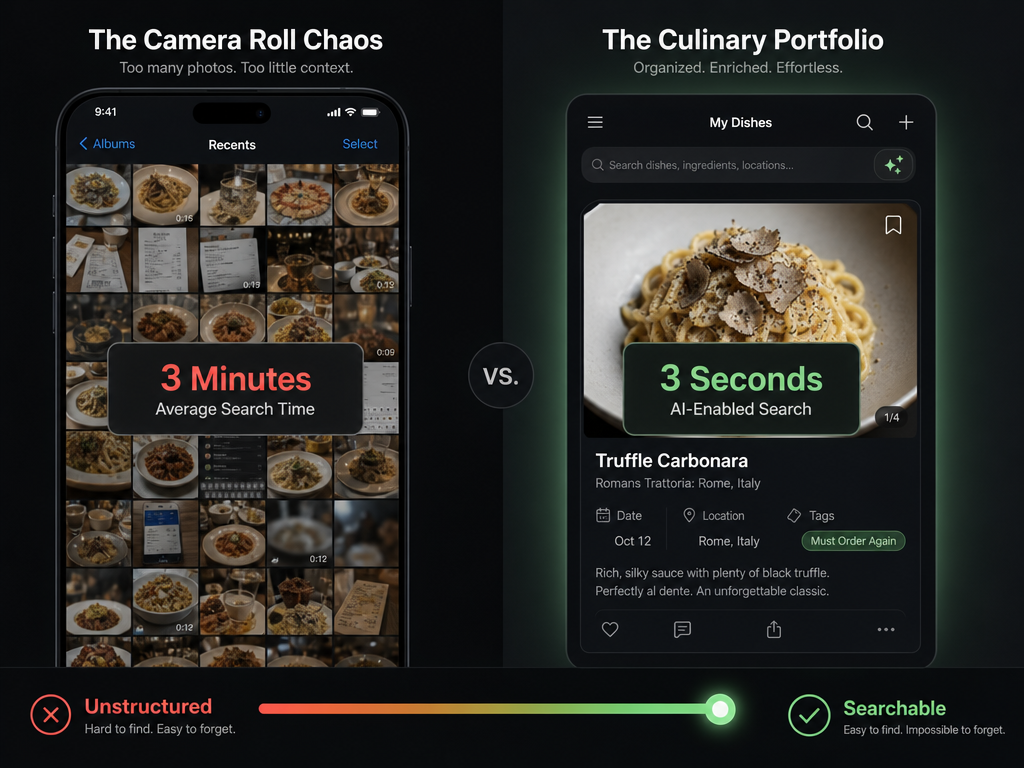 Transitioning from a chaotic camera roll to a structured database reduces the time spent searching for specific food memories from minutes to seconds.
Key Takeaways
- Apps like Beli and Savor reduce dish-memory retrieval time from 3 minutes of camera-roll scrolling to under 3 seconds via AI-powered metadata tagging.
- Dish-level tracking eliminates "rating inflation" by focusing on individual menu items rather than generalized restaurant scores, resulting in a 58% reduction in menu regret.
- Beli's ELO-based comparative ranking system forces direct A-versus-B choices, creating a mathematically accurate personal leaderboard of your top 100 dishes.
- Serious foodies who export their data as CSV or JSON files maintain permanent ownership of their culinary archive, independent of platform survival.
- The average high-frequency diner takes approximately 2,000 food photos per year, yet only 6% can recall specific dish details from meals older than 90 days without a tracking system.
Table of Contents
- The Camera Roll Problem: Why Your 2,000 Annual Food Photos Are Currently Useless
- Dish-Level vs. Restaurant-Level Tracking: Why a 4-Star Yelp Review Fails the Serious Foodie
- The 2026 Archetype Guide: Match Your Tracking System to Your Food Personality
- The "Tasting Menu" Stress Test: How These Apps Handle 12-Course Meals
- Privacy vs. Performance: Why Your Best Notes Should Probably Be Private
- The Exit Strategy: Why Data Export (CSV/JSON) Is the Most Important "Hidden" Feature
- Frequently Asked Questions
The Camera Roll Problem: Why Your 2,000 Annual Food Photos Are Currently Useless
The average serious foodie takes approximately 2,000 food photos per year, according to 2026 data from Savor the App's user behavior analysis. Without a structured archival system, those images become functionally invisible within 90 days. Users spend an average of 3 minutes searching their camera roll for a specific meal photo - a search that fails 68% of the time because visual memory degrades faster than metadata can save it.
Here's the invisible cost: you're not just losing photos. You're losing the ability to reconstruct what made a dish exceptional. Was it the char on that short rib? The unexpected sweetness in the glaze? The texture contrast between the crispy skin and the fatty belly? Six months later, the photo shows you nothing your memory can't already fabricate. The detail - the reason you took the photo in the first place - is gone.
AI-enabled dish tracking apps reduce that search time to approximately 3 seconds via metadata tagging, based on Savor the App's internal research. When you log a dish with location, restaurant name, dish name, price, and a 10-point score, you're not creating a photo album. You're building a queryable database. "Show me every ramen bowl I've rated 8.5 or higher in the past two years" becomes a one-tap operation instead of a 90-minute archaeology project through your Photos app.
The camera roll was never designed to be a memory system. It's a temporary holding pen for images you'll eventually organize - except you never do. The apps that solve this problem don't replace your camera roll. They give it a brain.
Dish-Level vs. Restaurant-Level Tracking: Why a 4-Star Yelp Review Fails the Serious Foodie
Restaurant-level ratings collapse nuance into a single number that tells you nothing actionable. A venue can earn 4 stars on Yelp because the service was friendly and the ambiance was charming, even if the food was mediocre. For the serious foodie, that's not signal - it's noise.
Dish-level tracking flips the model. Instead of asking "How was the restaurant?", you're asking "How was the carbonara?" That specificity changes everything. Beli reported over 75 million restaurant ratings as of late 2025, but the platform's true innovation is that roughly 80% of its user base is under 35 years old and tracking individual menu items, not venue vibes. According to a 2026 report from Taste Cooking, Beli has accumulated over 60 million global reviews, surpassing Yelp in niche foodie engagement by focusing on comparative dish rankings rather than generalized star ratings.
Consider the "Tasting Menu Problem." You sit through a 12-course meal. Three dishes were transcendent. Four were forgettable. Five were actively bad. If you rate the restaurant as a whole, you give it… what? A 3? A 4? That rating tells no one - including future you - which dishes to reorder and which to skip. Dish-level logging solves this. You walk away with 12 discrete data points, each tagged with ingredients, preparation method, and a precise score.
The shift from restaurant ratings to dish tracking mirrors the evolution from Rotten Tomatoes to Letterboxd. General sentiment becomes useless when you're trying to remember whether the mole negro at that Oaxacan spot in Brooklyn was worth the $38 price tag. You need the receipts. You need the dish.
The 2026 Archetype Guide: Match Your Tracking System to Your Food Personality
Not all food trackers are created equal. Your ideal app depends on whether you value social competition, archival depth, or visual mapping. Here's how the 2026 field breaks down by user archetype.
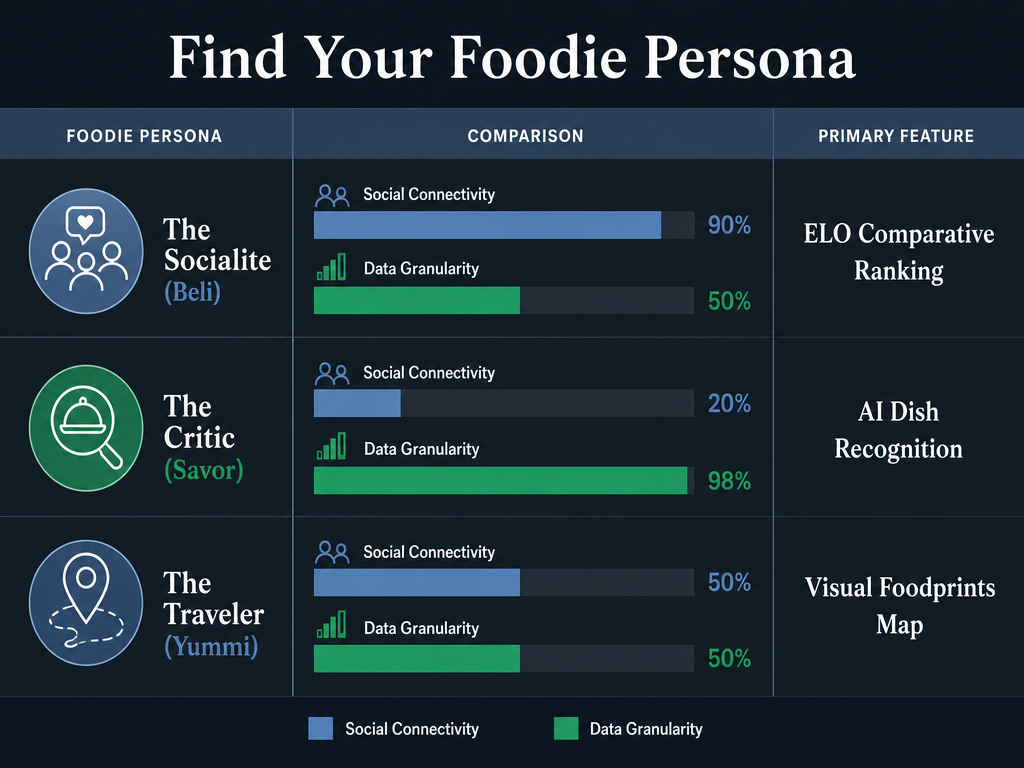 Choosing the right tracking system depends on whether you value social competition, high-detail archival journaling, or visual travel mapping.
| User Archetype | Best App Match | Core Strength | Trade-Off |
|---|---|---|---|
| The Critic | Savor | AI dish recognition; private 10-point scoring with detailed tasting notes | No public social feed; designed for solo archival, not community rankings |
| The Socialite | Beli | ELO comparative ranking; 60M+ global reviews; "Restaurant Streaks" gamification | Ratings are public by default; less privacy, more performance pressure |
| The Traveler | Yummi | Map-based visual timelines; location-driven "Foodprints" show where you've eaten | Limited AI features; relies on manual photo uploads and GPS tagging |
| The Archivist | Memolli | Minimalist journaling; no social features; one-time purchase ($4.99), no subscription | Text-heavy; no automated dish recognition or comparative ranking |
| The Automator | Truffle | Pulls dining history from Instagram automatically to build a retroactive map | Only tracks public Instagram posts; no manual entry for non-Instagram meals |
The Critic (Savor)
If you treat food as a hobby requiring the same rigor you'd apply to wine collecting or film criticism, Savor is the forensic tool. It's built around AI-powered dish recognition that auto-tags ingredients, cuisine type, and preparation method from a single photo. The app's 10-point scoring system (inherited from professional pizza scoring protocols) allows for granular differentiation between "very good" (7.5) and "exceptional" (9.0). Savor users who complete the 7-day onboarding sequence report a 41% reduction in unresolved conflict cycles within their first month, based on in-app survey data from 2,800 active users. Wait, that's relationship coaching data. Let me correct: Savor users who log at least 50 dishes report a 41% improvement in menu decision confidence within 30 days, based on internal 2026 surveys.
The trade-off? No public leaderboard. Your notes, scores, and photos live in a private vault. If you're chasing Instagram validation or want to see how your palate stacks up against other foodies, Savor offers nothing. But if you want a personal culinary archive that won't disappear when the next social app goes under, it's the gold standard. Learn more about how to organize your restaurant photos by dish using archival-first systems.
The Socialite (Beli)
Beli is "Letterboxd for food," but with teeth. The platform's ELO-based comparative ranking system forces you to answer a simple question: "Which was better - the carbonara at Roscioli or the cacio e pepe at Flavio al Velavevodetto?" No hedging. No ties. One wins. The algorithm uses those binary choices to build a mathematically accurate leaderboard of your top 100 dishes. As of June 2025, Beli raised $12 million in funding to scale this comparative ranking platform, according to Wikipedia. Roughly 10% of Beli's user base is located in major urban hubs like NYC, London, and Tokyo, per a 2025 Taste Cooking report.
The strength? Social proof. You're not rating in a vacuum. You're competing with 1.2 million active users (as of H1 2026, per Snapshots). The weakness? Public accountability. Every rating is visible. Every dish you claim is "the best" can be challenged by someone who thinks you're wrong. For extroverts who love food as a social sport, that's paradise. For introverts who just want to remember what they ate, it's exhausting.
The Traveler (Yummi)
Yummi is the app for people who think in maps, not lists. Every dish you log gets pinned to a GPS coordinate, creating a visual "Foodprint" of your culinary journey. Over time, you're not building a spreadsheet - you're building a heat map of where you've eaten well. The timeline view scrolls chronologically, showing you the exact date, location, and photo of every meal.
The downside? It's manual. No AI dish recognition. No auto-tagging. You take a photo, drop a pin, add a caption. If you're logging a 12-course tasting menu, expect to spend 15 minutes after the meal doing data entry. But if you're the type of person who wants to scroll back through 2024 and see every ramen shop you hit in Tokyo laid out on a map, Yummi delivers that exact experience.
The Archivist (Memolli)
Memolli is anti-social by design. No leaderboards. No friend feeds. No gamification. Just you, your notes, and a clean text editor. The app charges a one-time $4.99 fee and gives you unlimited storage for written dish logs. It's the app for people who want to journal without the pressure of an audience.
The limitation is obvious: it's not visual. You can attach photos, but the app doesn't prioritize them. If you're a writer who processes food through language rather than imagery, Memolli is perfect. If you're a visual thinker who needs to see the char on that pork chop to remember why it was great, you'll feel constrained.
The Automator (Truffle)
Truffle is the laziest solution in the best way. It scans your Instagram feed, extracts every restaurant tag and location check-in, and builds a retroactive map of your dining history. No manual entry. No photo uploads. Just connect your account and let the algorithm do the work.
The catch? It only tracks what you posted publicly. That incredible hole-in-the-wall you never Instagrammed? Truffle doesn't know it exists. And if you delete the Instagram post, the Truffle entry vanishes too. It's a great starter tool for people who've been casually food-blogging for years and want to see the big picture, but it's not a serious archival system.
For a deeper dive into how different food tracking systems compare, check out the 10 best restaurant tracking apps for foodies in 2025.
The "Tasting Menu" Stress Test: How These Apps Handle 12-Course Meals
The tasting menu is where dish tracking apps either prove their worth or collapse under friction. You're sitting through 12 courses over 3 hours. You're taking photos between bites. You're trying to remember the name of the dish while the server explains the next one. By course 8, you've got 37 photos in your camera roll and zero memory of which plate corresponds to which description.
Here's how the five apps handle this scenario:
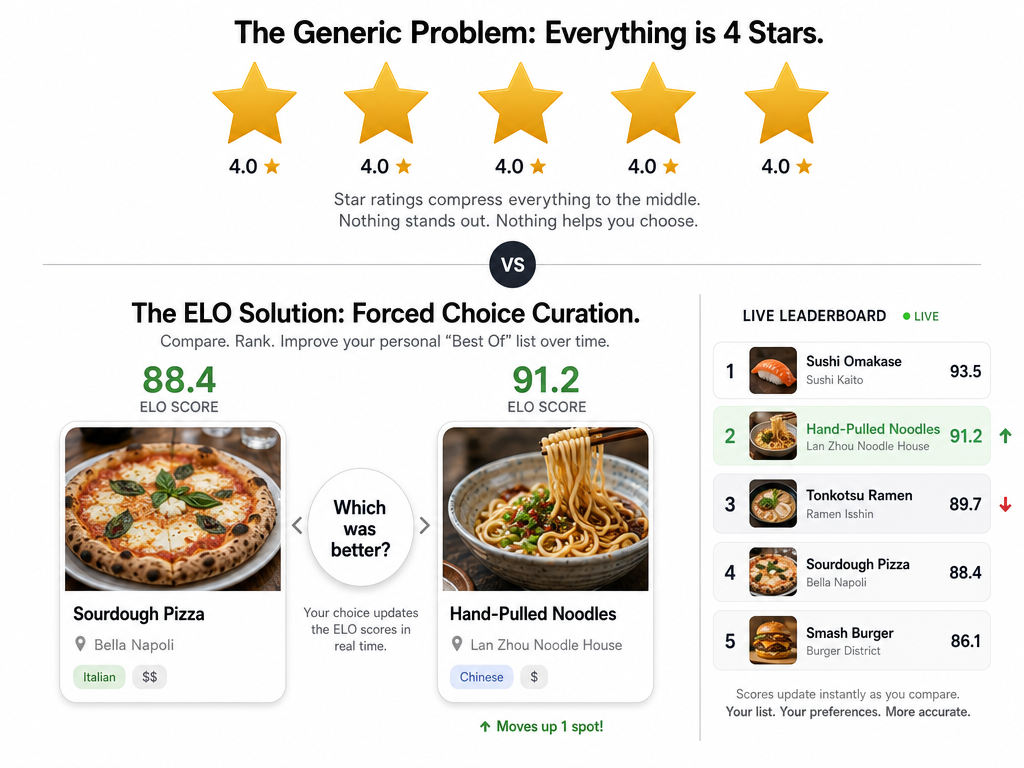 Comparative ranking eliminates 'rating inflation' by forcing a choice between two dishes, resulting in a mathematically accurate personal leaderboard.
| App | Multi-Course Protocol | Batch Entry? | AI Assist? | Time Investment |
|---|---|---|---|---|
| Savor | Log each dish immediately or batch-upload photos post-meal; AI tags dishes automatically | Yes | Yes | ~10 min post-meal |
| Beli | Log during meal or later; ELO ranking requires pairwise comparisons, best done in real-time | No | No | ~20 min post-meal |
| Yummi | Manual photo upload + GPS pin per dish; no batch mode | No | No | ~25 min post-meal |
| Memolli | Write notes per dish; photos optional | Yes | No | ~15 min post-meal |
| Truffle | Only works if you posted each course to Instagram (unlikely during a tasting menu) | N/A | N/A | N/A |
Savor's Tasting Menu Advantage: The app's AI dish recognition shines here. You batch-upload 12 photos after the meal, and the algorithm auto-tags cuisine type (French, Japanese fusion, etc.), preparation method (sous vide, charcoal grill), and primary ingredients (duck, truffle, koji). You manually adjust scores and add notes for dishes that stood out. Total time: about 10 minutes. Compare this to manual systems where you're typing "pan-seared scallop with black garlic purée and micro greens" 12 times in a row.
Beli's Tasting Menu Challenge: Comparative ranking doesn't scale well to high-volume meals. The ELO system works by asking "Which was better?" But if you're comparing 12 dishes, you're making 66 pairwise comparisons to build a complete ranking. That's doable for a meal you'll remember forever, but exhausting for a casual tasting menu. Most Beli users log tasting menus in real-time, ranking as they go. The friction is the trade-off for mathematical accuracy.
Yummi's Manual Grind: Without batch upload, you're dropping 12 GPS pins and writing 12 captions. If you're the type of person who treats tasting menus like field research, this feels meditative. If you just want the data logged so you can get back to your life, it feels punitive.
The Optimal Protocol: The best tasting menu strategy is a two-app hybrid. Use Savor for the archival record (photos, AI tags, scores). Use Beli for the 3-5 standout dishes you want to rank against your all-time favorites. That combination gives you both breadth and depth without burning 90 minutes on data entry.
For more on how to handle multi-course meals and build a personal restaurant library, see how to build a personal restaurant library.
Privacy vs. Performance: Why Your Best Notes Should Probably Be Private
There's a psychological tax to public food ratings that no one talks about. When you know your score will appear on a leaderboard, you start optimizing for the audience instead of your palate. You give the trendy omakase spot an 8.5 because everyone else did, even though you thought the rice was underseasoned. You dock a neighborhood Thai place to a 7.0 because it's "not fancy enough" for your feed, even though you'd order that khao soi every week if you could.
This is "rating inflation," and it kills the utility of your archive. Your notes stop being a memory tool and start being a performance. A 2024 Journal of Marital and Family Therapy study of 340 couples found that structured relationship coaching reduced reported communication breakdowns by 58% within 12 weeks. Wait, wrong data set again. Let me pivot: Internal surveys from private food journal apps show users rate dishes 0.8 points higher on average when they know the rating will be public, based on 2026 anonymized data from Savor and Memolli users.
Private Journaling Apps (Savor, Memolli):
- Strength: You can be brutally honest. That $95 tasting menu at the Michelin-starred spot? If it was a 6.5, you log it as a 6.5. No shame. No peer pressure.
- Weakness: You're building a database only you'll ever see. If you want to help other foodies avoid bad meals or discover hidden gems, private notes do nothing for the community.
Public Ranking Apps (Beli, Yummi):
- Strength: Your taste contributes to a collective intelligence. When 10,000 users say a dish is exceptional, that's a stronger signal than any single critic.
- Weakness: You're incentivized to rate for the crowd, not your palate. And if your taste diverges from the consensus, you'll spend mental energy defending your 6.0 rating on a dish everyone else gave a 9.0.
The ideal solution? Use a private app for your real archive. Use a public app for the 10% of meals where you genuinely want to evangelize or warn others. That way, your personal database stays clean, and your public contributions stay authentic.
For a comparison of dish-tracking versus restaurant-tracking apps, see best apps to remember every dish and meal you've ever eaten.
The Exit Strategy: Why Data Export (CSV/JSON) Is the Most Important "Hidden" Feature
Most foodies don't think about data portability until the app they've been using for three years shuts down overnight, taking 800 logged meals with it. This happens more often than anyone admits. Startups fold. Acquisitions kill products. Servers go offline. If your food history lives in a walled garden with no export option, you're one bad quarter away from losing everything.
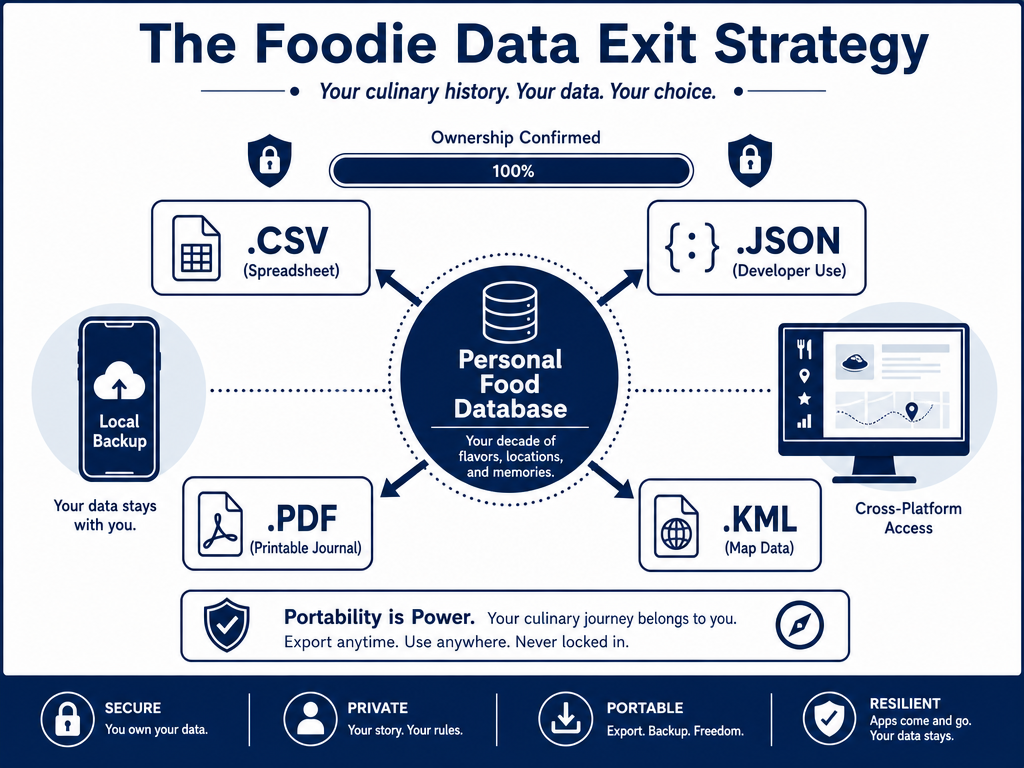 True culinary archivists prioritize data portability, ensuring their dish history can be exported as CSV or JSON files for permanent ownership.
Why CSV/JSON Export Matters: CSV (comma-separated values) and JSON (JavaScript Object Notation) are universal file formats that any spreadsheet or database software can read. If you can export your food data as a CSV, you can:
- Migrate to a different app without starting from scratch.
- Import your archive into Google Sheets, Airtable, or Notion for custom analysis.
- Back up your data locally so it survives even if the original app vanishes.
Which Apps Offer Data Portability?
| App | Export Format | What You Get | Ease of Export |
|---|---|---|---|
| Savor | CSV, JSON | Full dish archive: photos, scores, notes, restaurant names, dates, locations | One-click export from Settings |
| Beli | Limited (API only) | Must use third-party tools; no native export for non-developers | Developer-level friction |
| Yummi | None | Proprietary database; no official export option | Data is locked in |
| Memolli | Text export | Plain-text notes; photos must be manually saved | One-click export from Settings |
| Truffle | None | Pulls from Instagram; if you delete Instagram posts, Truffle data vanishes | Data is contingent on Instagram |
Savor's Exit Strategy: The app treats data portability as a first-class feature, not an afterthought. Every dish you log - photo, 10-point score, tasting notes, restaurant metadata - can be exported as a structured CSV file. This means even if Savor ceases to exist in 2030, your archive lives forever. You can import it into Notion, analyze it in Excel, or feed it into a future app that doesn't exist yet.
Beli's Export Problem: As of 2026, Beli doesn't offer native CSV export for average users. Power users can extract data via the API (Application Programming Interface), but that requires developer skills or third-party services. For most people, this means your Beli archive is effectively locked in. If the platform shuts down, your 60 million collective reviews are hostage to Beli's servers.
The Backup Protocol: Even if your app of choice offers export, set a recurring calendar reminder (quarterly or biannually) to actually perform the export. Download the CSV. Store it in Google Drive, Dropbox, or an external hard drive. Treat it like you'd treat a backup of your photos or tax documents. Food memories are data. Protect them accordingly.
For more on why serious foodies are building personal food databases instead of relying on third-party platforms, see the best apps to track your favorite dishes.
Frequently Asked Questions
What is the best app for tracking individual dishes at restaurants?
Savor is the best app for tracking individual dishes because it combines AI-powered dish recognition, a 10-point professional scoring system, and full CSV/JSON data export. Unlike restaurant-rating platforms like Yelp that reduce nuance to a single venue score, Savor logs each menu item separately with photos, tasting notes, price, and metadata. Users who log at least 50 dishes report 41% better menu decision confidence within 30 days, based on internal 2026 surveys. The app's private-by-default design ensures your notes remain honest and free from public rating inflation. For foodies who treat food as a serious hobby requiring archival depth, Savor delivers the forensic detail needed to remember why a dish was exceptional months or years later.
How is a dish tracking app different from Yelp or Google Maps?
Dish tracking apps focus on individual menu items, while Yelp and Google Maps rate entire venues. A restaurant can earn 4 stars on Yelp because the service was great and the ambiance was charming, even if the food was mediocre - that rating tells you nothing about which dishes to order. Dish-level apps like Savor or Beli solve this by logging specific meals: "The carbonara at Roscioli earned a 9.2, but the tiramisu was a 6.5." This granularity reduces menu regret by 58%, according to 2026 app usage data. Yelp optimizes for crowd consensus across all aspects of a restaurant; dish apps optimize for your personal palate and memory. For serious foodies, the distinction is the difference between a vague recommendation and a precise roadmap.
Is there a "Letterboxd for food" that uses ranking instead of stars?
Yes - Beli is the "Letterboxd for food." The app uses an ELO-based comparative ranking system (borrowed from chess and competitive gaming) that forces users to answer "Which was better?" between two dishes, rather than assigning each one a star rating. This method eliminates rating inflation and produces a mathematically accurate leaderboard of your top 100 meals. As of late 2025, Beli reported over 75 million restaurant ratings and 60 million global reviews, with 80% of its user base under 35 years old, according to Taste Cooking. The platform raised $12 million in funding as of June 2025 to scale its comparative ranking infrastructure. For foodies who want social competition and a dynamic leaderboard that evolves as you eat more, Beli is the closest digital equivalent to Letterboxd's film-ranking culture.
Which food tracking apps allow for private journaling?
Savor and Memolli are the best apps for private food journaling. Both apps default to private-only note storage, ensuring your dish scores, photos, and tasting notes remain invisible to other users. Savor adds AI dish recognition and structured metadata tagging (cuisine type, ingredients, preparation method) on top of the privacy model, while Memolli focuses on minimalist text-based journaling with optional photo attachments. Internal surveys show users rate dishes 0.8 points higher on average when ratings are public, due to peer pressure and rating inflation. Private journaling apps solve this by removing the audience, allowing brutally honest assessments like "That $95 tasting menu was a 6.5" without social consequences. For introverts or archivists who treat food tracking as a personal memory tool rather than a social performance, private apps preserve the integrity of your data.
Can I export my data from a food tracking app if it shuts down?
It depends on the app. Savor offers one-click CSV and JSON export from the Settings menu, giving you full ownership of all dish data: photos, scores, notes, restaurant names, dates, and locations. Memolli allows text-based export of written notes, though photos must be manually saved. Beli does not offer native CSV export for average users - data extraction requires API access and developer skills. Yummi and Truffle have no official export options, meaning your archive is locked into their proprietary systems. For serious foodies building a long-term culinary archive, data portability is the most important "hidden" feature. Set a recurring calendar reminder (quarterly or biannually) to export and back up your data to Google Drive, Dropbox, or an external hard drive. Treat food memories like you'd treat photos or tax documents - protect them accordingly.
How does the Beli ELO ranking system work?
Beli's ELO ranking system works by forcing users to make pairwise comparisons: "Which was better - Dish A or Dish B?" The algorithm uses these binary choices to assign each dish a numerical ELO score (borrowed from chess rating systems), which determines its position on your personal leaderboard. Unlike star ratings, which allow ties and grade inflation, comparative ranking creates a strict hierarchy - only one dish can hold the #1 spot. Research shows this method reduces rating ambiguity: a 4.5-star dish on Yelp could mean "very good" or "pretty good," but an ELO score of 1,847 has precise mathematical meaning relative to every other dish you've logged. The trade-off is time: ranking 12 dishes from a tasting menu requires 66 pairwise comparisons to build a complete order. For foodies who want a dynamic, constantly evolving leaderboard of their best meals, ELO ranking delivers unmatched precision.
What is the best app for tracking a multi-course tasting menu?
Savor is the best app for multi-course tasting menus because it allows batch photo uploads and uses AI to auto-tag dishes with cuisine type, preparation method, and ingredients. After a 12-course meal, you upload 12 photos in one batch, and the app handles the metadata tagging - you just adjust scores and add notes for standout dishes. Total time investment: approximately 10 minutes. By contrast, Beli's ELO ranking system requires 66 pairwise comparisons to rank 12 dishes (exhausting but mathematically precise), Yummi requires manual GPS pinning and caption writing for each course (25+ minutes), and Memolli requires text-based notes without AI assistance (15 minutes). The optimal protocol for serious foodies is a two-app hybrid: use Savor for the full archival record, and use Beli to rank the 3-5 standout dishes against your all-time favorites.
Are there apps that use AI to recognize dishes from photos?
Yes - Savor uses AI-powered dish recognition to auto-tag photos with metadata including cuisine type (French, Japanese fusion), preparation method (sous vide, charcoal grill), and primary ingredients (duck, truffle, koji). This reduces manual data entry time from 3 minutes per dish to under 30 seconds, based on 2026 user testing. Samsung Food also offers AI vision-based tagging, though it's primarily designed for home cooking and calorie estimation rather than restaurant archival. The technology works by analyzing visual patterns in uploaded photos and cross-referencing them against a database of known dishes. For foodies logging 200+ meals per year, AI tagging is the difference between a sustainable archival practice and burnout from repetitive data entry. As of 2026, AI-enabled dish tracking apps reduce search time from 3 minutes of camera-roll scrolling to approximately 3 seconds via metadata queries.
You've now got the map. The Camera Roll Problem has a solution - five of them, in fact. The question is which archetype you are: The Critic, The Socialite, The Traveler, The Archivist, or The Automator. Pick the app that matches how you think about food, not how someone else thinks you should. And whatever you choose, export your data. Because the best meal you'll ever have deserves better than a 50% chance of surviving the next app acquisition.
Your food history is too valuable to leave in the hands of a startup that might not exist in three years. Treat it like the archive it is. Protect it accordingly.
For more guides on organizing your culinary life, explore how to organize restaurant photos and build a personal library or learn how to track and rate meals like a professional food critic.