
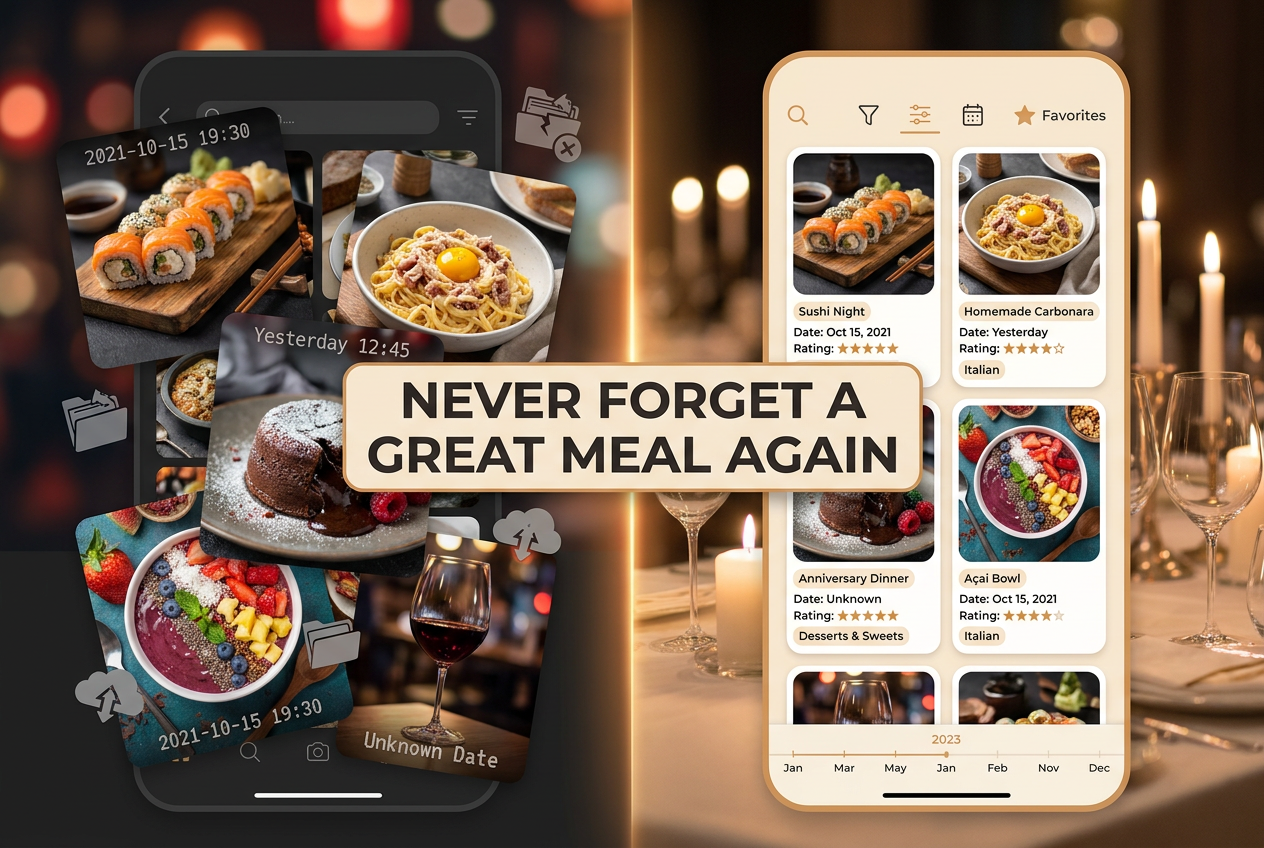
Dine and Share Reviews: The Foodie Guide to Never Forgetting a Meal
John the smoothie monster
John lives for smoothie bowls and cold-pressed juices. He uses Savor to remember his best blends.
Dine and Share Reviews: The Serious Foodie’s Guide to Never Forgetting a Meal You just had an extraordinary meal. The dish was perfect - every flavor, every...
Dine and Share Reviews: The Serious Foodie’s Guide to Never Forgetting a Meal
You just had an extraordinary meal. The dish was perfect - every flavor, every texture, every detail aligned in a way you’ll never forget. Or so you think.
Three months later, you’re scrolling through 2,400 food photos on your camera roll, desperately searching for that restaurant name. Was it the truffle pasta? The duck confit? The place with the exposed brick or the one with the marble bar? The memory is there, somewhere, buried under a thousand brunch shots and failed dessert experiments.
This is the crisis of the modern food lover. We’re taking more food photos than ever, posting to more platforms, and dining at more restaurants - but we’re remembering less. The "dine and share" culture promised to make us better-informed eaters. Instead, it gave us information overload and digital amnesia.
Let’s fix that.
Table of Contents
- The Crisis of the Camera Roll
- The Shift: Why Social Groups Aren’t Enough
- The "Serious Foodie" Tech Stack
- The 3-Minute Review Framework
- How to Share Without Being "That Person"
- Building Your Personal Culinary Archive
- Frequently Asked Questions
The Crisis of the Camera Roll
BLUF: Your smartphone camera roll has become a disorganized graveyard of food memories, making it nearly impossible to find that perfect dish you had months ago. The solution is building a searchable, organized culinary archive.
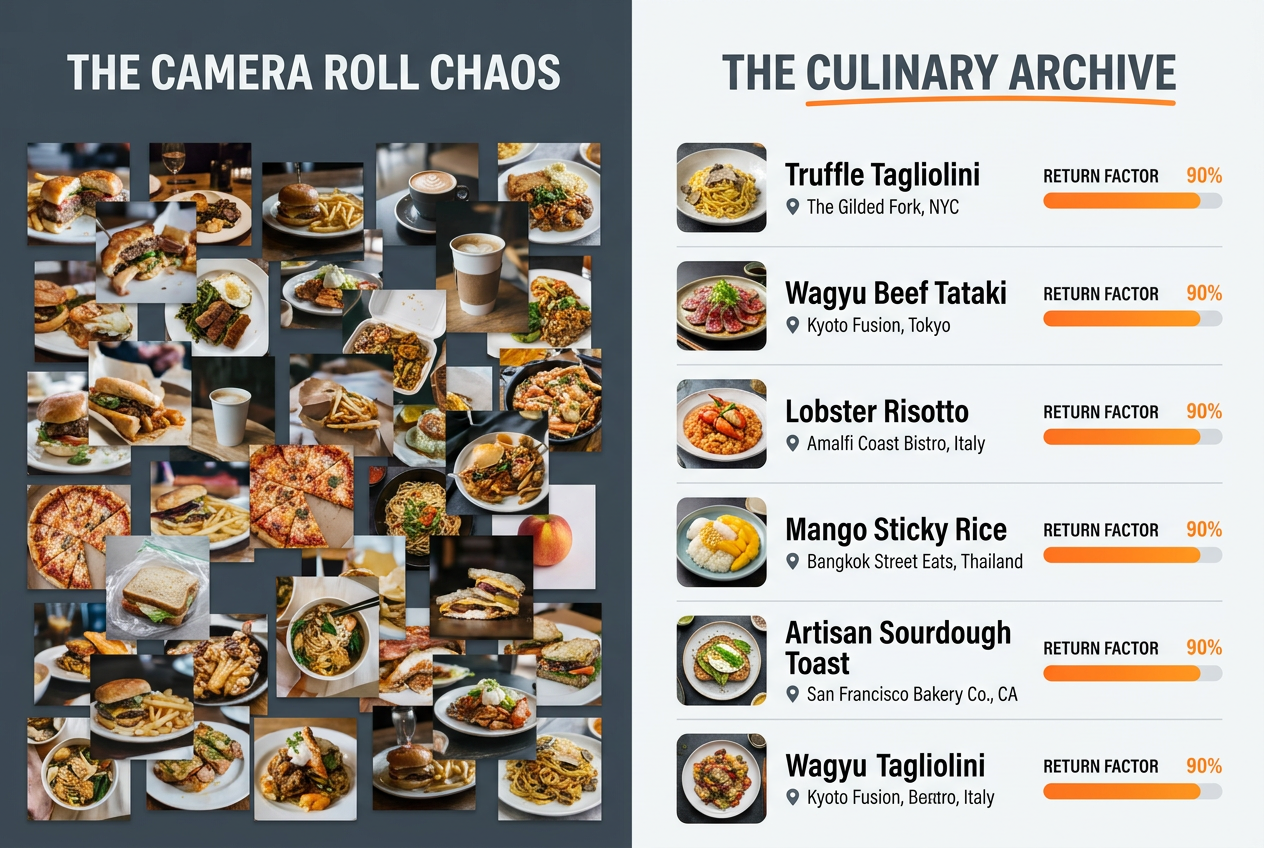 Stop losing your best dining memories in a sea of unorganized photos. Transitioning from a messy camera roll to a curated archive ensures you never forget a great meal.
Picture this: You’re standing in front of your fridge at 5 PM on a Tuesday, and you need a restaurant recommendation. You remember having an incredible sushi spot six months ago, but which one was it? You open your photos app and start scrolling. There are 47 pictures of sushi. Maybe 200 pictures of pasta. Somewhere in there is that life-changing meal, but finding it requires forensic archaeology.
This isn’t just annoying. It’s a fundamental failure of how we interact with food.
The average urban professional takes between 3-8 food photos per week. That’s 156-416 photos per year. Within two years, you’ve got nearly 800 food photos with zero organization, zero context, and zero searchability. You can’t search by restaurant name, dish type, or that specific flavor profile that made you close your eyes and smile.
The camera roll was never designed to be a culinary database. It’s a chronological dump. Photos appear in the order you took them, with no hierarchy, no tags, and no way to surface that perfect carbonara from last April when you really need it.
The technical problem is simple: your phone treats a photo of your dog with the same importance as a photo of the best meal you had all year. There’s no intelligence, no curation, no memory. Just a stream of images that grows longer and more useless every day.
This is where the serious foodie diverges from the casual diner. The casual diner takes a photo, maybe posts it to Instagram, and moves on. The serious foodie understands that great meals are rare, and capturing them properly means building a system - not just taking pictures.
The Shift: Why Social Groups Aren’t Enough
BLUF: Facebook groups and Yelp offer volume but lack curation and searchability. Serious foodies need private, organized systems that prioritize personal taste over crowd opinion.
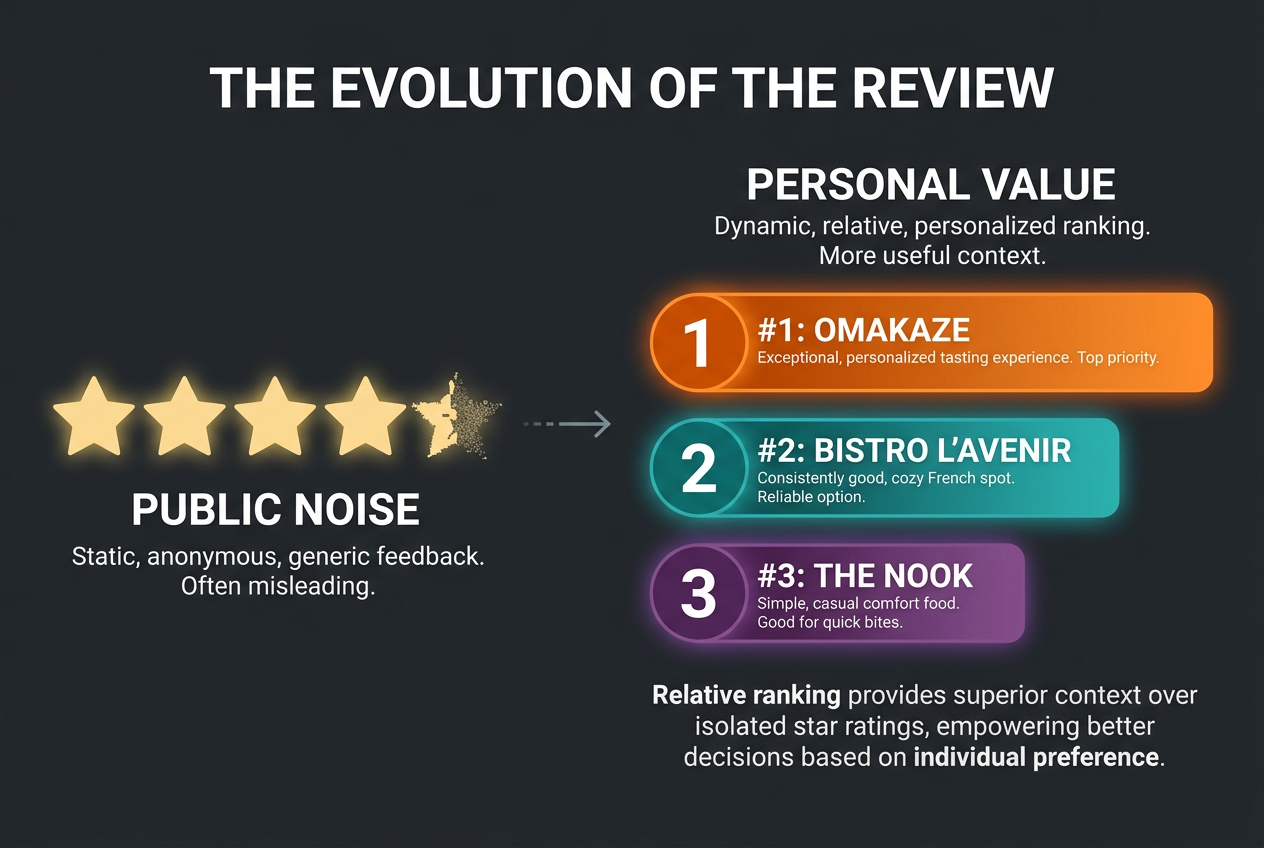 Move beyond generic five-star ratings. Stack-ranking your favorite spots creates a relative hierarchy that makes choosing your next meal significantly easier and more personal.
The "Dine and Share" Facebook groups have 267,000+ members. That’s a lot of opinions. Too many, actually.
These groups serve a purpose - real-time feedback on new openings, local delivery horror stories, quick answers about whether a place takes reservations. They’re chaotic, democratic, and occasionally useful. But they’re also fundamentally broken for anyone who wants to build lasting food knowledge.
The problem with crowd-sourced reviews is that they optimize for consensus, not excellence. A restaurant with 4.5 stars and 2,000 reviews tells you it’s acceptable to most people. It doesn’t tell you if it serves the best tonkotsu ramen you’ve ever had, or if their Tuesday lunch special is secretly the move, or if you should skip the signature dish and order the off-menu item the chef makes for regulars.
Yelp suffers from the same issue. Five stars from strangers means nothing when you realize one person’s "amazing" is another person’s "just okay." The average Yelp reviewer has different taste priorities, different budgets, and different standards. Their five-star review doesn’t help you remember which specific pasta dish at which specific restaurant made you want to return immediately.
Here’s what social groups and public reviews lack:
- Personal Context: You can’t search your own history across platforms
- Relative Ranking: A 4-star place might be better than a 5-star place for what you want right now
- Dish-Level Tracking: Most reviews focus on the restaurant, not the individual plates
- Privacy: Not every meal needs to be public performance
- Quality Signal: High volume drowns out nuanced recommendations
The shift happening now is from broadcasting to archiving. Serious foodies are realizing they don’t need to share every meal with 267,000 people. They need a personal system that helps them remember, compare, and return to the meals that matter.
Think of it this way: Would you rather have access to 10,000 opinions from strangers about restaurants in your city, or access to your own meticulously organized record of every dish you’ve loved over the past five years?
For more thoughts on how modern food tracking differs from traditional reviews, check out our guide on the best restaurant apps for foodies.
The "Serious Foodie" Tech Stack
BLUF: Different apps serve different needs. Social stack-rankers like Beli excel at competitive tracking with friends, while private journals like Savor focus on personal dish-level memories. Choose based on whether you’re building for community or for yourself.
The right tool depends on what you’re building. Are you creating a public map of recommendations for friends? Are you keeping a private journal of personal taste evolution? Are you trying to win the "who ate at the best restaurants this year" competition?
Here’s the honest breakdown:
Beli: The Social Stack-Ranker
Beli built its reputation on one insight: relative ranking matters more than absolute ratings. Instead of giving a restaurant 4 stars, you stack-rank it against every other place you’ve been. Your number-one burger spot is always number one, even if you’d only give it a 7/10 in absolute terms.
Best For: People who trust their friends’ taste more than strangers, competitive foodies who like comparing lists, anyone who wants their food tracking to feel like a social experience.
Limitations: The social aspect is both strength and weakness. If you don’t have friends using Beli, the value drops. The competitive ranking can also feel exhausting - not every meal needs to be judged against your entire dining history.
Savor: The Dish-Level Memory Vault
Savor takes a different approach entirely. Instead of ranking restaurants, you track individual dishes. That carbonara you loved? It gets its own entry, with photos, notes about flavor, and a personal 10-point score. Six months later, you can search "creamy pasta" and instantly find it.
Best For: Serious foodies who care about specific dishes more than venues, travelers who want to remember exact meals across cities, anyone building a long-term personal database of taste.
Limitations: Less social interaction, requires more detailed input, and focuses on your palate rather than crowd consensus.
Learn more about how to build your personal food database with Savor’s approach to dish tracking.
Notion/Google Maps: The DIY Approach
Some people prefer total control. They build custom Notion databases with tags, ratings, location pins, and embedded photos. Or they use Google Maps to drop pins with notes and star ratings.
Best For: People who already have a productivity system they love, those who want complete customization, anyone suspicious of apps that might shut down and take their data.
Limitations: Requires technical setup and ongoing maintenance, lacks social features entirely, and often becomes abandoned after the initial excitement.
The Feature Matrix
| Feature | Casual (FB/Yelp) | Social (Beli) | Personal (Savor) | DIY (Notion) |
|---|---|---|---|---|
| Primary Goal | Help businesses/strangers | Compete with friends | Personal memory | Total control |
| Rating System | 1-5 stars (generic) | Stack-ranking (relative) | 10-point scale (dish-specific) | Custom |
| Searchability | Low | Medium | High (by dish, flavor, date) | Depends on setup |
| Privacy | Public by default | Semi-public | Private by default | Private |
| Maintenance | None | Low | Low | High |
| Social Discovery | High | High | Low | None |
The serious foodie’s stack isn’t about picking one tool. It’s about understanding which tool serves which purpose. You might use Beli to share recommendations with your closest friends, Savor to track every dish for your personal archive, and Google Maps to mark places you want to try.
For a deeper comparison of restaurant tracking tools, see our full breakdown of the 10 best dish tracking apps.
The 3-Minute Review Framework
BLUF: A useful food review captures three elements: the dish details, your sensory experience, and the "return factor." This framework takes under three minutes but makes your notes searchable and valuable months later.
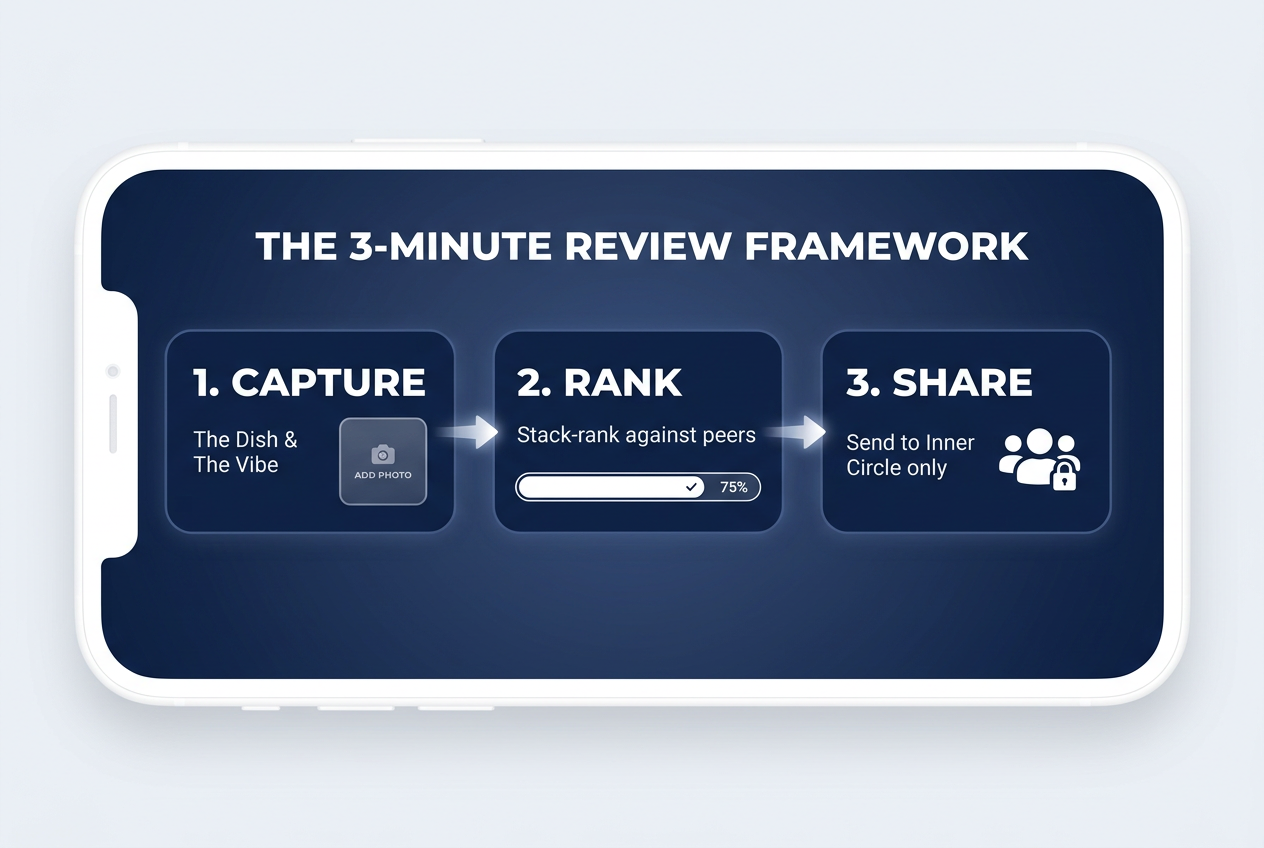 Master the art of the quick review with this three-step framework designed to help you log critical dining details in under three minutes without interrupting your meal.
The biggest mistake people make with food tracking is overthinking it. They wait until they get home, intending to write detailed tasting notes, and then never do it. The meal fades from memory. The details blur. The moment is lost.
The solution is a three-minute framework that captures everything you need while the meal is still in front of you.
Step 1: The Dish (30 seconds)
Record the basics:
- Restaurant name and location
- Dish name (exact, from the menu)
- Price
- Date and time
This seems obvious, but it’s the foundation. Three months later, you won’t remember if that duck dish was at the place on Main Street or the place downtown. You won’t remember if it cost $28 or $42. Write it down now.
Step 2: The Vibe (90 seconds)
This is where most reviews fail. They focus on adjectives ("delicious," "amazing," "perfectly cooked") without capturing specifics. Instead, ask yourself:
- What hit you first? (The visual? The smell? The first bite?)
- What was the standout element? (The sauce? The texture? The temperature?)
- What surprised you? (Good or bad)
- How did the flavor evolve? (First bite vs. last bite)
Write two or three sentences that capture the sensory experience in concrete terms. Not "the pasta was great" but "the cacio e pepe had a black pepper punch that built slowly, and the cheese pulled into glossy strings without any graininess."
For more on identifying and articulating flavor, read our guide on what is a flavor profile.
Step 3: The Return Factor (60 seconds)
This is the most important question: Would you order this dish again?
Not "would you return to the restaurant" but would you order this specific dish again. Rate it on a 10-point scale:
- 9-10: A dish you’d travel across town to eat again
- 7-8: Worth ordering if you’re already there
- 5-6: Fine, but you’d try something else next time
- 3-4: Disappointing, actively avoid
- 1-2: Genuinely bad
Then add one sentence about context: "Best when eating alone" or "Perfect for sharing" or "Order this if you’re not that hungry."
The System in Action
Here’s what a complete three-minute review looks like:
Piccolo Trattoria - Tagliatelle al Ragù Bolognese
$24 | March 15, 2025, 7:30 PM
The ragu came to the table steaming, with a deep russet color that promised hours of slow cooking. First bite delivered that promise - rich, meaty, almost sweet from the long simmer, with a hint of nutmeg you only notice in the finish. The pasta had real tooth to it, substantial enough to stand up to the sauce without turning mushy halfway through. By the last few bites, the bottom of the bowl had concentrated into almost a glaze.
Score: 9/10
Would absolutely order again. Best eaten slowly, with crusty bread to mop up the sauce at the end. Skip this if you’re craving something light.
Total time: Under three minutes. Total value six months from now: immeasurable.
This framework works whether you’re logging in a personal food journal app or just keeping notes in your phone.
How to Share Without Being "That Person"
BLUF: Share recommendations strategically by creating private "Inner Circle" lists, using direct messages instead of public posts, and focusing on specific dishes rather than vague endorsements.
Nobody likes the friend who posts every meal to Instagram. But there’s real value in sharing food knowledge - when it’s done right.
The key is understanding the difference between broadcasting and recommending. Broadcasting is noise. Recommending is signal.
The Inner Circle Strategy
Instead of posting to social media, maintain private lists for specific people or contexts:
- The Reliable List: 5-7 restaurants you’d confidently recommend to anyone
- The Adventurous List: Places for friends who want to try something unusual
- The Safe List: Spots that never disappoint, even if they’re not exciting
- The Special Occasion List: Where to go when it matters
When someone asks for a recommendation, you’ve got a curated answer ready. No hedging, no "well, it depends," just confidence.
The Specific Dish Rule
Never recommend a restaurant. Recommend a dish at a restaurant.
Wrong: "You should try Osteria Morini."
Right: "Get the tagliatelle bolognese at Osteria Morini. Sit at the bar if you can."
This is the difference between useful and useless recommendations. The restaurant is just the location. The dish is the experience.
When you share on this level, people actually follow through. They don’t get overwhelmed by the menu. They don’t order wrong and blame you. They get exactly what you loved, and if they love it too, you’ve built trust.
For more on creating shareable food memories, see our guide on the best way to organize recipes.
The Direct Message Method
Public posts create pressure to perform. Direct messages create conversations.
When you find something great, text three people you know would appreciate it. Not everyone. Not your entire contact list. Just the people who care about that specific thing.
- Your friend who’s obsessed with natural wine gets the new wine bar tip
- Your colleague who loves ramen gets the tonkotsu spot
- Your partner gets the date-night reservation
This approach respects people’s attention and increases follow-through. If someone asks, "Where should I eat?" and you respond with a thoughtful message instead of a link to your last 30 Instagram posts, you’re providing value.
The Follow-Up Protocol
When someone takes your recommendation, close the loop. Ask them what they thought. Did they order the dish you suggested? Did it land the way you expected?
This isn’t just polite. It’s how you build a reputation as someone with reliable taste. And it helps you refine your own recommendations - maybe that dish isn’t as universally appealing as you thought, or maybe there’s a better starter to suggest alongside it.
The goal isn’t to become a food influencer. It’s to become the friend people text when they want a real answer, not a scroll through 40 mediocre options.
Building Your Personal Culinary Archive
BLUF: A personal culinary archive transforms scattered food photos into a searchable, meaningful database. Use consistent tagging, regular maintenance, and a clear organizational system to make past meals easy to find and compare.
The difference between a camera roll and an archive is intentionality.
An archive isn’t just bigger or better organized. It’s built with future use in mind. When you photograph that perfect pasta, you’re not just capturing the moment - you’re creating a reference point for every pasta you’ll eat in the future.
The Tagging System
Tags are the infrastructure of your archive. Without them, you’re back to scrolling through chronological photos. With them, you can surface exactly what you need in seconds.
Start with three tag categories:
1. Type Tags (The What)
- Cuisine: Italian, Japanese, Mexican, etc.
- Category: Pasta, Ramen, Tacos, Dessert, etc.
- Preparation: Grilled, Fried, Raw, Braised, etc.
2. Context Tags (The Where/When)
- Location: City, neighborhood, specific restaurant
- Occasion: Business lunch, date night, solo meal, group dinner
- Price point: Budget, mid-range, splurge
3. Quality Tags (The Why)
- Standout element: Sauce, texture, presentation, value
- Mood: Comforting, exciting, disappointing, surprising
- Return status: Would reorder, would skip, want to try variation
You don’t need all these tags for every meal. But having the system means you can search "comforting pasta under $20" or "date night splurges" and actually get useful results.
Tools like Savor make this tagging automatic by letting you score dishes across multiple dimensions and then search based on those scores.
The Maintenance Routine
Archives decay without maintenance. Set a weekly 10-minute review session:
- Input new meals: Log anything from the past week that you haven’t captured yet
- Add missing details: Fill in restaurant names, exact dish names, notes you skipped
- Review and adjust: Did that 8/10 score still feel right after a week? Update it.
This isn’t busywork. It’s the difference between a tool you trust and a database full of outdated information.
The Comparison Protocol
The real power of an archive reveals itself when you start comparing. You can finally answer questions like:
- "Which ramen shop in my city has the best broth?"
- "Have I ever had a better carbonara than the one I’m eating right now?"
- "What’s the highest-rated dish I’ve tried under $15?"
This is where apps designed for dish tracking shine. Platforms like Savor let you stack-rank dishes within categories, creating a living hierarchy of your taste preferences.
For more on how professional critics score and compare dishes, check out our 100-point pizza scoring protocol.
The Evolution Record
Your archive isn’t static. It’s a record of how your palate evolves.
The sushi you rated 9/10 two years ago might be a 7/10 today because you’ve had better. That’s not failure - it’s growth. Your archive should capture this evolution, showing you not just what you like now but how your taste has changed over time.
This is why dating your reviews matters. And why revisiting old favorites matters. And why comparing your scores from different periods reveals patterns you wouldn’t otherwise notice.
The culinary archive isn’t about perfection. It’s about having a system reliable enough that you trust it more than your memory.
Frequently Asked Questions
What is the best app for tracking restaurant reviews?
The best app depends on your goal. Beli excels for social stack-ranking with friends, while Savor focuses on private dish-level tracking with searchable notes and scores. If you want public reviews to help others, Yelp or Google Maps remain standard. For serious foodies building a personal culinary archive, Savor offers the most detailed dish-specific organization.
How do I organize my food photos?
Start by moving from chronological chaos to categorical organization. Create albums by cuisine type, city, or restaurant. Better yet, use a dish tracking app that lets you add searchable tags, notes, and ratings to each photo. The goal is making any dish findable in under 10 seconds rather than scrolling through hundreds of images.
Should I post food reviews publicly or keep them private?
Private tracking gives you honest, useful records without social pressure. Public reviews help others but often become performative. Consider a hybrid: keep detailed notes in a private food journal app for yourself, then share only your absolute favorites with trusted friends via direct message. This preserves authenticity while still providing value to your circle.
What’s the difference between rating restaurants vs. rating dishes?
Rating restaurants gives you broad guidance but misses specifics. A 4-star restaurant might have one incredible signature dish and mediocre everything else. Rating individual dishes creates actionable memories - you remember exactly what to order next time. Dish-level tracking also lets you compare across venues, like finding the best carbonara in your city regardless of restaurant ratings.
How often should I update my food tracking system?
Weekly maintenance works best for most people. Spend 10 minutes logging recent meals while details are fresh, adding missing notes, and adjusting scores if needed. Daily tracking creates burnout, while monthly reviews mean forgotten details. The sweet spot is capturing experiences within 7 days of eating, when memory is still vivid but you’ve had time to process whether you’d actually return.
Can I export my reviews from Yelp or Google Maps?
Yes, both platforms allow data export, though the process differs. Google Takeout lets you download your Google reviews, while Yelp requires using their data request feature. However, exported data often lacks useful formatting. Consider this a catalyst to rebuild your archive in a more personal, searchable system where you control the structure and have better search capabilities.
What should I include in a quick restaurant review?
A useful review captures three things in under three minutes: the specific dish name and price, concrete sensory details about taste and texture, and a simple return factor score. Skip vague adjectives like "delicious" and focus on specifics - what hit first, what surprised you, what you’d order differently next time. This framework gives you actionable notes months later when memory fades.
How do food tracking apps handle privacy?
Privacy varies widely. Public platforms like Yelp make everything visible by default. Social apps like Beli share within your friend network. Personal journal apps like Savor keep everything private unless you explicitly share. Check each app’s privacy settings and understand who can see your data. For truly private tracking, choose apps that store data locally or let you control visibility at a granular level.