
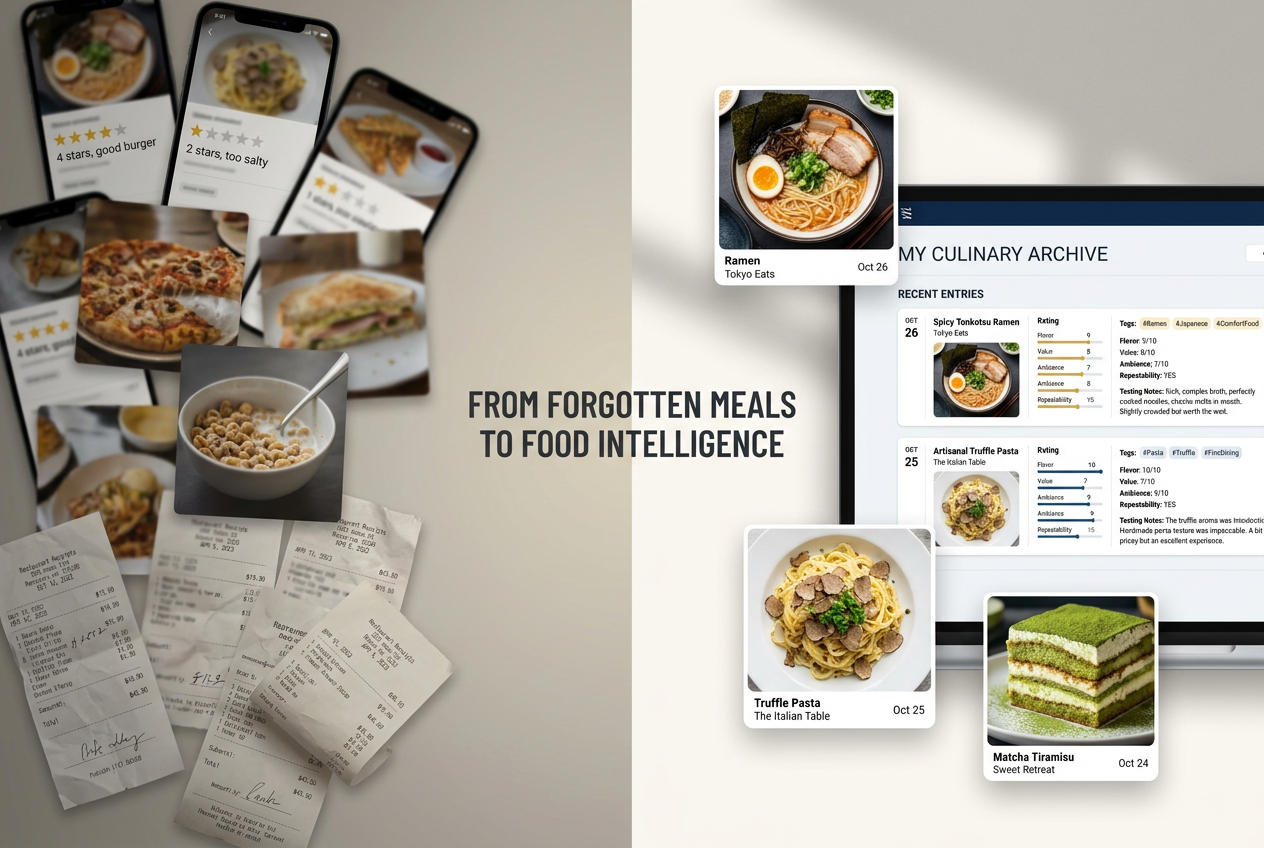
Beyond the Star Rating: How to Review and Track Meals Like a Serious Foodie
John the smoothie monster
John lives for smoothie bowls and cold-pressed juices. He uses Savor to remember his best blends.
Beyond the Star Rating: How to Review and Track Meals Like a Serious Foodie You just had an extraordinary bowl of ramen that redefined your understanding of...
Beyond the Star Rating: How to Review and Track Meals Like a Serious Foodie
You just had an extraordinary bowl of ramen that redefined your understanding of umami. Two weeks later, you can barely remember the restaurant’s name. Sound familiar? The 4.2-star Google rating you saw before walking in told you nothing about the specific magic of that particular bowl - the depth of the pork broth, the perfect chew of the noodles, the way the soft-boiled egg yolk dissolved into liquid gold.
Generic star ratings are the most useless piece of data in 2026. They’re diluted by every diner who ordered the wrong dish, showed up on an off night, or confused "not my taste" with "objectively bad." For the serious foodie, this isn’t just annoying - it’s a fundamental failure of the current review ecosystem.
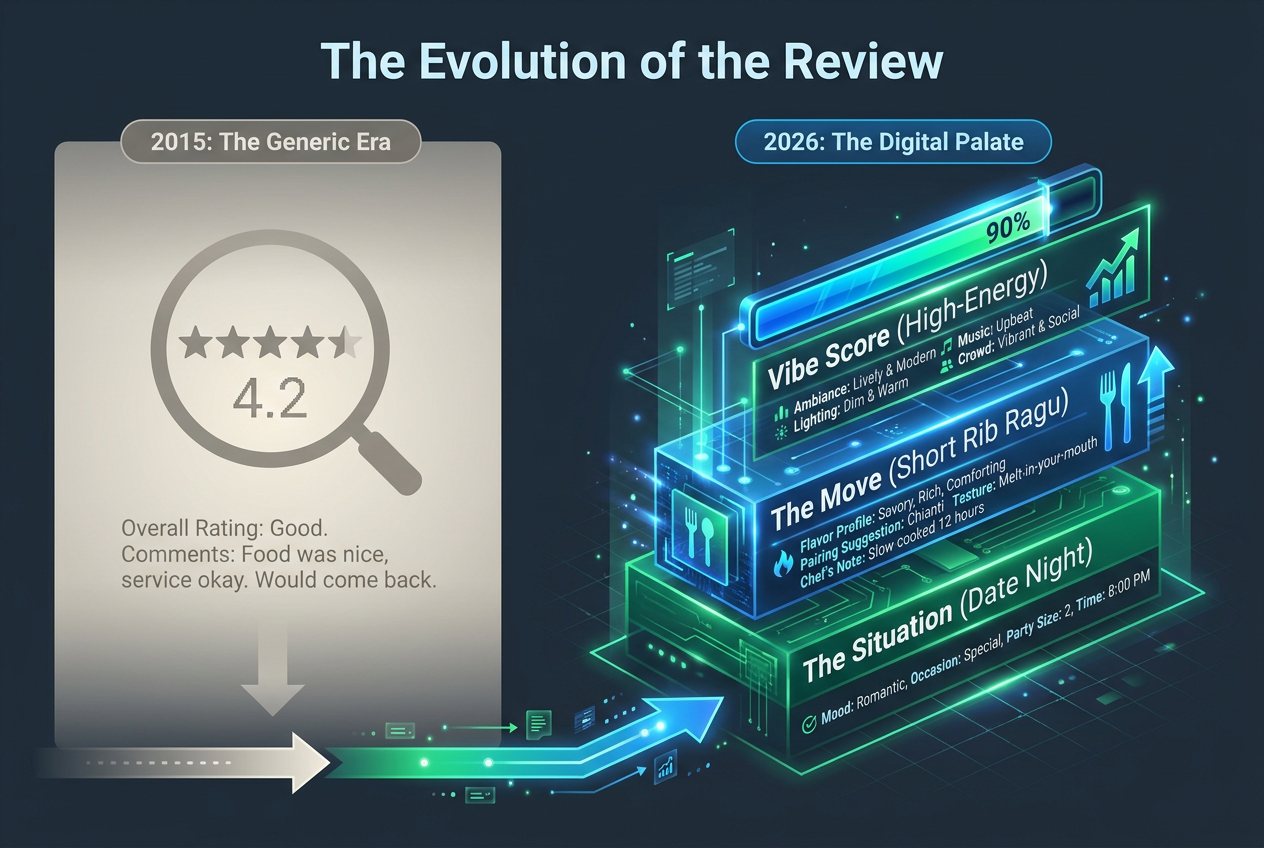 Beyond the binary star rating. The modern foodie ecosystem prioritizes situational context and specific dish-level insights over the outdated and often unreliable 5-star average.
Your camera roll is a graveyard of 2,000 food photos with zero context. You remember the feeling but not the facts. The meal was perfect, but which three dishes made it perfect? Was it a "bring your parents" spot or a "solo at the bar" experience? Would you go back for that specific pasta or was it just fine?
This is the Serious Foodie trap: you’ve accumulated extraordinary culinary experiences, but you have no system to catalog, compare, or retrieve them. You’re essentially running a museum with no labels.
Table of Contents
- The Tech Stack: From Searchable to Social
- How to Write a ’Serious’ Review (The Anatomy)
- Organizing the Digital Palate
- Building Your Personal Food Operating System
- Frequently Asked Questions
The Tech Stack: From Searchable to Social
The 2026 food ecosystem has fractured. Generic platforms like Yelp and Google Reviews are increasingly viewed as unreliable noise by discerning diners. The migration is toward specialized tools that serve specific functions in your culinary life. Think of it as building a personal food operating system rather than relying on a single app.
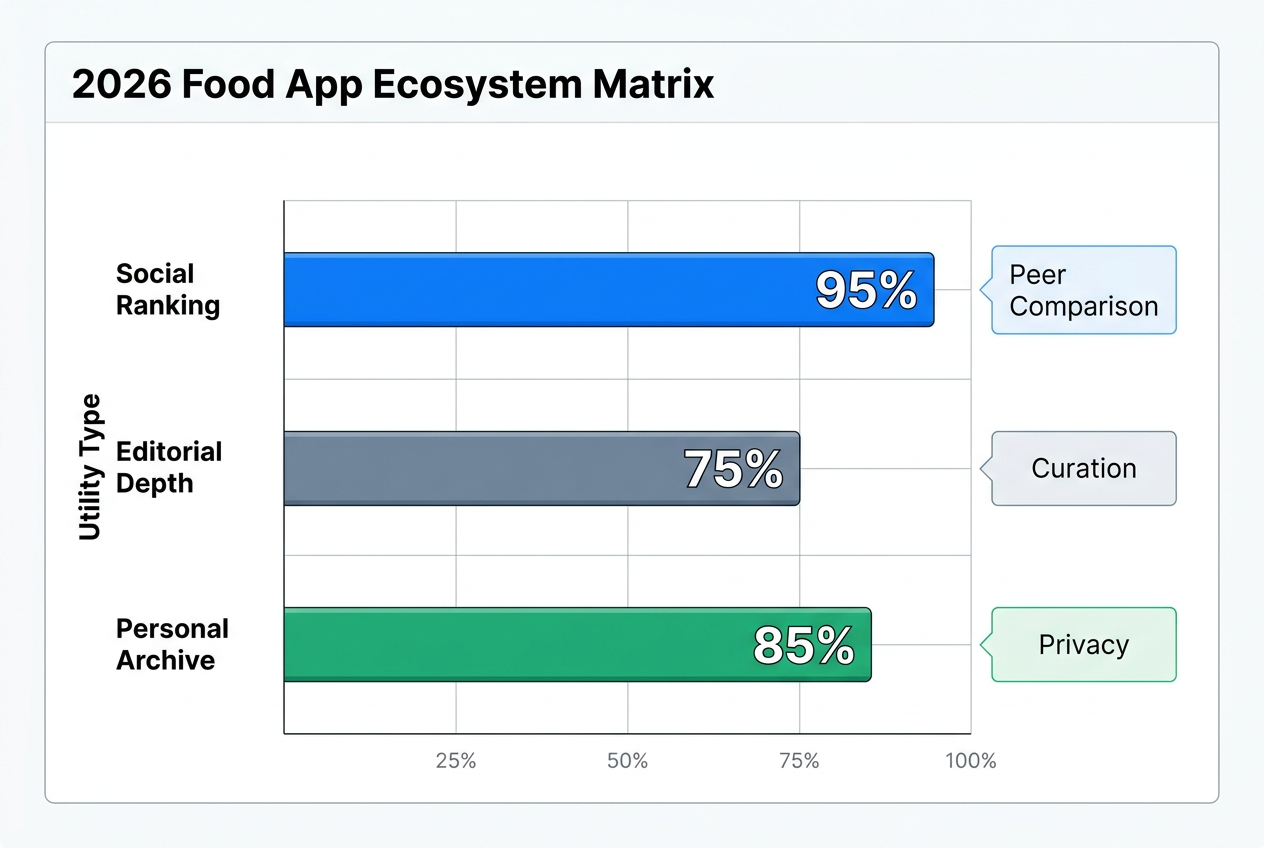 Choosing your digital food stack. Depending on your goals - whether it is social competition or private archiving - the 2026 landscape offers specialized tools for every type of diner.
The Foundation: Comparative Ranking
Beli revolutionized food tracking by introducing a simple concept: instead of rating restaurants in isolation, you rank them against each other. When you add a new spot, Beli asks, "Was this better than Restaurant X?" After enough comparisons, you have a personalized, ranked list that reflects your actual preferences - not some abstract 1-5 scale.
The genius is in the relativity. You’re not trying to decide if something deserves 4.3 or 4.4 stars. You’re answering a much simpler question: would I rather go here or there? Over time, the algorithm builds a hierarchy that genuinely reflects your taste.
The limitation? Beli is primarily app-based and doesn’t offer deep editorial context or food history. It solves the ranking problem brilliantly but doesn’t help you understand why a dish worked or capture the story behind a meal.
The Editorial Filter: Curated Discovery
The Infatuation and Eater operate as your sanity check against hype. The Infatuation pioneered "situation-based" tagging - their reviews explicitly tell you whether a place is right for a first date, a business dinner, or a solo meal at the bar. This is infinitely more useful than knowing a restaurant has 4.7 stars.
Eater excels at the "why" - the cultural context, the chef’s background, the history of a specific dish. When you’re traveling or exploring a new neighborhood, these platforms provide the editorial depth that peer reviews can’t match. They’re staffed by professional critics who eat at 300+ restaurants per year and have the vocabulary to articulate why something works.
The gap? Neither platform helps you build your personal archive. They’re discovery engines, not memory vaults. Once you’ve eaten the meal, the information disappears into your camera roll unless you have a system to capture it.
The Private Archive: Visual-First Journaling
Apps like Yummi and Memolli address the forgotten meal problem. They’re designed for private, visual-first food journaling - a place to log the specific dish, add notes while the flavors are fresh, and organize everything by cuisine, location, or occasion.
The advantage of these tools is that they’re built specifically for food memory, not general-purpose photo organization. You’re not scrolling through 2,000 random photos to find that pasta. You’re searching a structured database where every entry has context, location data, and your own tasting notes.
For serious foodies who want to organize restaurant photos into a searchable library, this category of apps solves the core problem: turning ephemeral experiences into permanent, retrievable memories.
Building Your Stack
The optimal setup isn’t choosing one app - it’s layering them strategically:
- Discovery: The Infatuation or Eater for pre-visit research and cultural context
- Social Ranking: Beli for building a comparative hierarchy of where you’ve been
- Private Archive: A dish tracking app for detailed notes, photos, and personal ratings
Think of it as a three-tier system: you discover through editorial content, compare through social tools, and archive through private journaling. Each layer serves a distinct function in your food life.
How to Write a ’Serious’ Review (The Anatomy)
A restaurant review that just says "the pasta was delicious" is useless. It tells the reader nothing about which pasta, what made it distinctive, or whether they’d actually like it based on their own preferences. Professional food critics follow a structure - not a rigid formula, but a mental checklist that captures the information someone needs to make a decision.
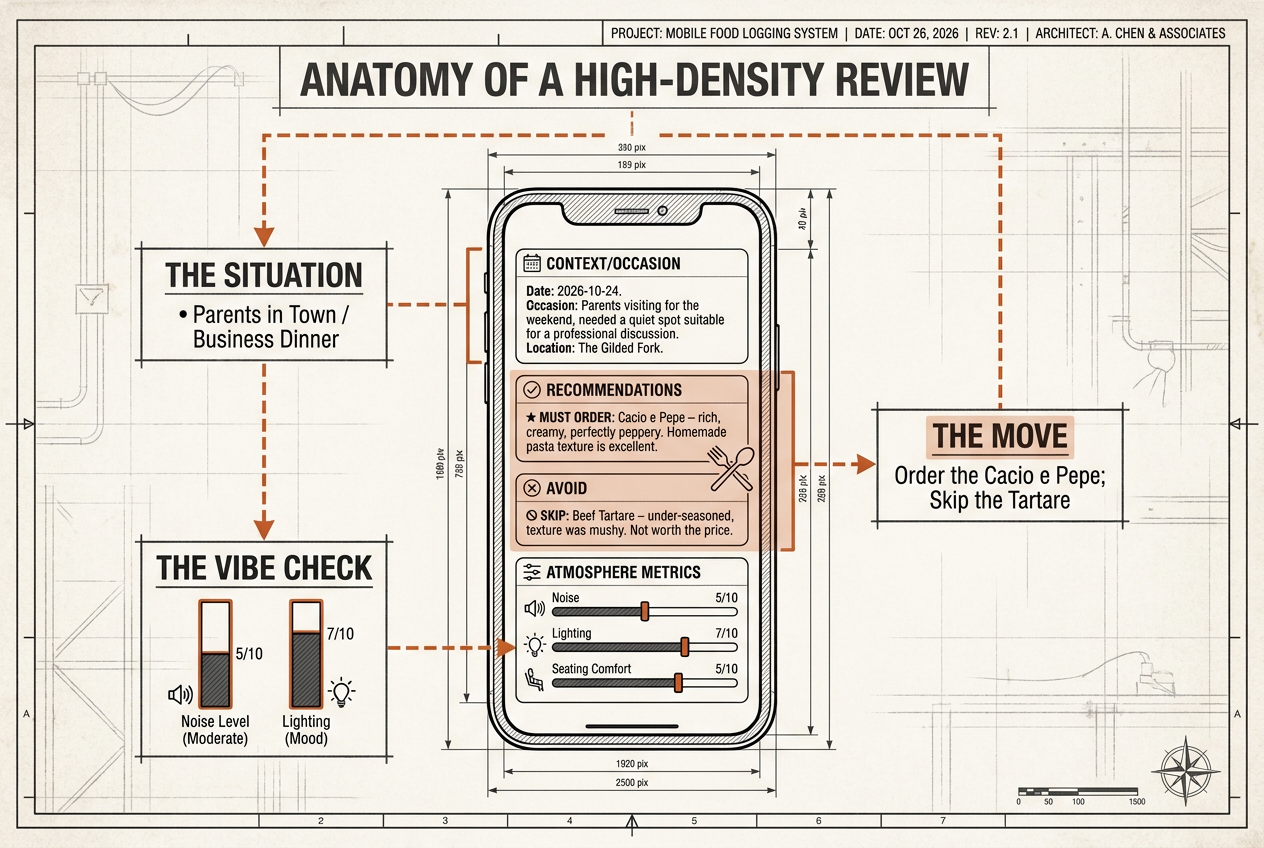 The anatomy of a modern review. To be useful in 2026, food logging must move past adjectives and focus on actionable intel like the specific ’move’ and situational vibe.
The Situation: Context Is Everything
Before you write a single word about the food, establish the context. Is this a loud, high-energy spot where you’ll struggle to hear conversation? A white-tablecloth restaurant where you’ll feel underdressed in jeans? A neighborhood gem that’s perfect for a solo weeknight dinner?
This isn’t fluff - it’s the most important information for someone deciding whether to go. A restaurant can serve incredible food and still be the wrong choice for the occasion. Your review should explicitly state:
- Noise level: Can you actually hear your dinner companion?
- Lighting: Is it romantic and dim or Instagram-bright?
- Service style: Is it hands-on and chatty or invisible and efficient?
- Reservation difficulty: Did you book three weeks ahead or walk in at 7 PM on a Saturday?
- Price reality: What did you actually spend per person, including drinks and tax?
The Infatuation pioneered this approach. Their reviews often spend as much time describing the vibe as the food because both are equally important to the dining experience.
"The Move": The Dishes That Define the Restaurant
Every memorable restaurant has "the move" - the 2-3 dishes that justify its existence. Your job as a reviewer is to identify and describe them with enough specificity that someone could order confidently based on your notes.
Generic description: "The cacio e pepe was excellent."
Specific description: "The cacio e pepe ($22) arrives in a wheel of Pecorino Romano, where the server finishes it tableside. The pasta - actual tonnarelli, not spaghetti - has the perfect al dente chew, and the sauce is an emulsion miracle: creamy without cream, coating each strand evenly with a sharp, peppery bite that lingers. This is the move. Everything else on the menu is competent, but this dish is why the restaurant exists."
Notice the difference? The second version tells you the price, the specific pasta shape, the preparation method, and most importantly, makes a value judgment: this is what you should order.
For those learning to rate dishes like a professional, this level of specificity is non-negotiable. It transforms a vague impression into actionable intelligence.
The Vibe Check: Beyond the Food
A serious review acknowledges that dining out is about more than what’s on the plate. The same meal tastes different in a cramped, fluorescent-lit room versus a thoughtfully designed space with great acoustics.
Your review should answer:
- Did the space enhance the experience? Was the design intentional and cohesive, or did it feel like an afterthought?
- Was the service knowledgeable? Could the staff answer questions about the menu, make recommendations, or adjust for dietary restrictions?
- Was the pacing right? Did you feel rushed, or did courses arrive at a comfortable interval?
- Would you return? This is the ultimate test. If you wouldn’t go back, your review should make that clear.
The most useful reviews are honest about trade-offs. "The food is outstanding, but the space is aggressively loud - come for a celebration, not a first date" is far more valuable than generic praise.
The Reviewer’s Checklist
Before you finish writing, verify you’ve addressed:
- The situation: Who is this restaurant for, and when?
- The move: Which specific dishes justify a visit?
- The vibe: What was the non-food experience like?
- The verdict: Would you return, and what would you order again?
This structure works whether you’re writing for an audience or just building your personal food database. The discipline of answering these questions forces you to capture the information that matters.
Organizing the Digital Palate
The difference between a food enthusiast and a serious foodie is the system. You’re not just eating - you’re building a reference library of your own taste. But that only works if you can actually retrieve the information when you need it.
 Mastering the digital palate. Efficiently organizing your food history requires moving away from generic cuisine tags toward specific flavor profiles and social utility categories.
Photo Strategy: Capturing Without Being That Person
The challenge: you want documentation, but you don’t want to be the person holding up service while you photograph their Caesar salad from six angles. The solution is to develop a fast, reliable photo routine that captures what you need in under 30 seconds.
Lighting is everything. Natural light is ideal, but most dinners happen after dark. If the restaurant lighting is warm and dim, your phone will struggle. The fix: slightly underexpose the shot (tap the screen and drag the brightness slider down) rather than letting your phone blow it out trying to compensate. You can recover detail from a dark photo later; you can’t fix an overexposed white blob.
Shoot from directly above when possible. The overhead angle is the most reliable for food photography because it eliminates perspective distortion and shows the composition of the dish. If the ceiling is too low or the lighting too harsh, a 45-degree angle works, but be consistent - your archive will look more professional if your photos follow a similar perspective.
Take the photo before you touch anything. The composed plate tells a story about the restaurant’s plating style and attention to detail. Once you’ve taken a bite, that information is gone. If the dish arrives with a dramatic presentation (tableside service, a specific garnish placement, smoke or steam), capture that first. You can always take a second photo mid-meal if the cross-section reveals something interesting.
One good photo beats five mediocre ones. You’re building an archive, not a portfolio. Snap two or three quick shots, pick the best one, and delete the rest immediately. This discipline prevents your camera roll from becoming another 2,000-photo graveyard.
For those looking to improve their food photography technique, the key is consistency over perfection. A reliable system beats artistic ambition every time.
Tagging Logic: Beyond Cuisine Categories
Most food apps default to organizing by cuisine type: Italian, Mexican, Japanese. This is almost useless for actual decision-making. When you’re trying to decide where to go for dinner, you’re not thinking, "I want Italian." You’re thinking, "I want something rich and comforting" or "I need a place that’s quiet enough for a conversation."
The solution is to build a tagging system based on flavor profiles and social utility rather than geographic categories.
Flavor profile tags:
- Rich/Indulgent: Dishes with cream, butter, or heavy sauces
- Bright/Acidic: Things with citrus, vinegar, or sharp flavors
- Umami-forward: Fermented, aged, or deeply savory
- Spice-driven: Heat level and complexity
- Sweet/Caramelized: Dishes built around sugar, honey, or roasted sweetness
Social utility tags:
- Solo-friendly: Comfortable to eat alone, ideally with bar seating
- Date night: Quiet enough for conversation, romantic lighting
- Business dinner: Professional atmosphere, accommodates dietary restrictions
- Group celebration: Can handle 6+ people, shareable plates
- Quick hit: In and out in under an hour
This system lets you search your archive by how you’re feeling rather than what kind of food you want. When you’re stressed and want comfort, you pull up your "Rich/Indulgent" tag. When you need somewhere impressive for a client dinner, you filter by "Business dinner" and cross-reference with your highest-rated spots.
Building Search Patterns
The ultimate goal is to make your food archive as searchable as your email. That means developing consistent habits:
Capture immediately. Don’t wait until you get home to log the meal. Add the photo and basic notes (restaurant name, dish name, date) while you’re still at the table. Memory fades fast - the texture of that pasta will be less vivid in three hours.
Use consistent language. If you describe something as "perfectly al dente" in one entry and "good texture" in another, you’ve lost the ability to search effectively. Develop a personal vocabulary for the qualities you care about and use the same terms consistently.
Link related experiences. If you find a pasta dish that reminds you of one you had six months ago, note the comparison explicitly. "Similar to the rigatoni at X, but richer" creates a web of connections that makes your archive more valuable over time.
For those committed to organizing their food photos systematically, the investment pays compound returns. Every hour you spend organizing saves you dozens of hours of frustrated scrolling later.
Building Your Personal Food Operating System
The end goal isn’t just to track meals - it’s to build a system that actively improves your eating life. Your personal food OS should answer three questions instantly: Where should I go tonight? What should I order when I get there? Have I been here before, and what did I think?
The Discovery Layer
Before you go anywhere new, you’re running reconnaissance. This is where editorial platforms shine. The Infatuation’s situational tags tell you whether a place fits your current need. Eater’s features provide context about the chef, the cuisine’s history, or why a particular dish is significant.
Smart diners don’t just read reviews - they cross-reference multiple sources and look for consensus. If three different critics all mention the same dish as exceptional, that’s the move. If a place has wildly divergent opinions, that’s a sign the experience is inconsistent or polarizing.
The Memory Layer
After the meal, your system should capture the experience while it’s fresh. This is where apps that remember every meal become essential. The specific details matter: not just "good pasta" but "tonnarelli cacio e pepe - sharp, creamy, perfect chew - the best version I’ve had in the city."
The discipline is writing notes before the dopamine wears off. That first 20 minutes after an exceptional dish is when your impressions are sharpest. Wait until the next day and you’re reconstructing from memory rather than recording from experience.
The Comparison Layer
This is where ranked systems like Beli add real value. When you’ve eaten at 50 Italian restaurants, you’re not trying to remember which ones were "good" - they were probably all decent. You’re trying to remember which three were truly exceptional and worth recommending.
Forcing yourself to rank experiences in relation to each other surfaces patterns you wouldn’t notice otherwise. You might realize you consistently prefer simpler preparations over complex ones, or that you value atmosphere more highly than you thought. These insights compound - they help you choose better next time.
The Social Layer
Food is more compelling when shared. Apps designed for food lovers to share lists solve a different problem: coordinating group dining and building collective knowledge.
When you and three friends each maintain detailed food archives, comparing notes becomes productive. You’re not arguing about vague impressions - you’re looking at specific dishes, comparing ratings, and identifying areas where your tastes align or diverge. This is how you find your next great meal: through people whose palates you’ve calibrated against your own.
The key is building relationships with other diners whose judgment you trust. Not because they like the same things you do, but because you understand why they like what they like. If you know someone loves aggressive acidity and you don’t, you can adjust their recommendations accordingly.
The Long Game
A personal food OS isn’t built in a weekend. It’s the accumulated knowledge of hundreds of meals, logged with discipline and organized with intention. But six months in, something shifts. You stop relying on generic review sites. You stop scrolling your camera roll hoping to remember where that photo was taken.
Instead, you open your archive and answer specific questions: Where’s the best tonkatsu I’ve had? Which restaurants are worth traveling for? What did I eat the night I got engaged? The system becomes an extension of your memory - and eventually, an extension of your taste.
For serious foodies committed to building a comprehensive food memory system, this is the ultimate goal: transforming every meal from an ephemeral experience into a permanent part of your culinary education.
Frequently Asked Questions
What’s the difference between a food diary and a food review?
A food diary is primarily for you - it’s a personal record focused on tracking what you ate, often for health, memory, or habit analysis. A food review is for an audience - it evaluates a restaurant or dish with the goal of helping others decide whether to visit. The best personal systems combine both: detailed logging for yourself with enough structure that your notes could help someone else make a decision.
Do I need multiple apps to track my meals effectively?
Not necessarily, but most serious foodies end up using 2-3 specialized tools rather than one generic app. Discovery platforms like The Infatuation help you find restaurants, ranking apps like Beli help you compare experiences, and private journaling apps help you capture detailed memories. The question isn’t whether you need multiple apps - it’s whether a single tool truly handles all three functions well enough for your needs.
How do I rate dishes consistently over time?
Develop a simple framework and stick to it. Professional critics typically evaluate taste, technique, presentation, and value. For personal use, you might simplify to: Did it exceed expectations? Would I order it again? Would I recommend it? The specific criteria matter less than using them consistently. Many foodies find systematic dish rating methods more useful than arbitrary star ratings.
What should I write in my food notes immediately after a meal?
Capture the specifics that fade fastest: exact dish name, standout flavors, texture details, and your immediate reaction. Note any surprises - ingredients you didn’t expect, preparations that were unusual, or moments that particularly impressed you. Write down what you’d order again and what you’d skip. If dining with others, record their reactions too - disagreements about a dish often reveal something interesting about preferences.
How can I organize food photos so I can actually find them later?
The camera roll is a dead end. You need a dedicated system with searchable metadata - restaurant name, dish name, date, location, and your own tags or notes. Many food photo organization apps handle this automatically, creating a searchable database where you can filter by cuisine, neighborhood, or even specific ingredients. The key is logging information while you’re still at the restaurant, not trying to remember it days later.
Is Yelp still useful for serious foodies in 2026?
Yelp remains useful for logistics - hours, location, menu photos - but increasingly unreliable for actual recommendations. The problem is dilution: ratings combine experiences across all dishes, all service levels, and all diner expectations. Serious foodies typically use Yelp to verify a restaurant exists and check basic facts, then rely on specialized editorial platforms and personal networks for actual decision-making about where to eat.
How do professional food critics rate restaurants?
Professional critics typically make multiple visits, order strategically across the menu, and evaluate both food quality and the complete dining experience. They assess technique, ingredient quality, menu coherence, service, atmosphere, and value. Most importantly, they contextualize - comparing a restaurant not to an abstract ideal but to peers in the same category and price point. The best critics have eaten at thousands of restaurants and can identify patterns and trends that casual diners miss.
What’s the best way to remember specific dishes from trips abroad?
Document obsessively while you’re there. Take photos, write detailed notes immediately, and record the neighborhood or area (not just the city). Note what makes the dish distinctly regional - techniques, ingredients, or preparations you can’t find at home. Many travelers create a dedicated food journal for their trips, separate from their regular dining log, to capture the full context of eating in a different culture.