

A Serious Foodie’s Guide to Mastering Restaurant Guru Reviews
Alex the juice queen
Alex hunts for the best juice bars and presses. She rates every sip and saves her favorites in Savor.
Beyond the Star Rating: A Serious Foodie's Guide to Mastering Restaurant Guru Reviews Most men don't realize they've visited the same Restaurant Guru page 40...
Beyond the Star Rating: A Serious Foodie's Guide to Mastering Restaurant Guru Reviews
Most men don't realize they've visited the same Restaurant Guru page 40 times and still can't answer a simple question: "Is this place actually good, or just good at gaming the algorithm?" You're staring at a "Guru Recommendation Award" badge, a 4.7-star rating, and 2,000 reviews aggregated from six different platforms. That wall of stars and opinions compounds. By the time you've clicked through to Yelp, Google, and TripAdvisor individually, you've burned 20 minutes and you're no closer to knowing if the carbonara is worth the drive.
The answer isn't more scrolling. It's understanding what Restaurant Guru actually is - a meta-layer that synthesizes professional critics, mass-market sentiment, and social signals into one searchable interface. What follows is the complete picture: how the platform works, what its award actually means, and how to use it like a professional food scout instead of a confused tourist.
Key Takeaways
- Restaurant Guru aggregates reviews from Michelin, Zomato, Google, Yelp, Facebook, and TripAdvisor into a single searchable database of 30 million monthly users.
- The "Restaurant Guru Recommendation Award" is not a Michelin star - it's a volume signal indicating consistent community approval, not elite culinary validation.
- Advisor Pierre, the platform's AI assistant, processes natural language queries like "best terrace for skin-contact wine" to bypass generic star filters.
- 90% of US diners and 87% of UK diners report that review platforms inspired them to try a new restaurant, according to Phocuswire's 2018 benchmark study.
- Serious foodies use Restaurant Guru to filter for Michelin and Gault&Millau citations within a massive database, not as a replacement for expert curation.
- The platform's 52.17% male audience skews toward 45-54 year olds, per SimilarWeb 2026 data, suggesting a demographic of experienced diners seeking efficiency.
Table of Contents
- The Review Fatigue Crisis: Why 4.8 Stars Doesn't Mean Culture
- What Is Restaurant Guru? Explaining the "Aggregator of Aggregators" Model
- The Serious Foodie Workflow: How to Find Professional Critics in a Sea of Opinions
- Is the Restaurant Guru Recommendation Award Legit?
- Advisor Pierre & AI Search: How to Use Natural Language Queries
- Restaurant Guru vs. Beli vs. The Infatuation: Which Tool Should Be in Your Food Stack?
- Expert Filters: Step-by-Step on Finding Michelin and Gault&Millau Citations
- Frequently Asked Questions
The Review Fatigue Crisis: Why 4.8 Stars Doesn't Mean Culture
The conventional advice on restaurant discovery is wrong. We've been told that crowdsourced ratings are democracy in action - the wisdom of the crowd, unfiltered and authentic. But here's the uncomfortable truth: a 4.8-star rating on Google often tells you less about the food than it does about the restaurant's ability to incentivize reviews. The average diner rates on convenience, portion size, and whether the server smiled. The serious foodie rates on whether the chef understands the Maillard reaction.
This isn't theoretical. The global restaurant industry is projected to reach $1.55 trillion in sales by the end of 2026, per the National Restaurant Association. Within that sprawling landscape, there are over 1 million restaurant locations in the United States alone, according to Rezku's 2025 industry report. That's a lot of noise. A generic star rating flattens the signal. It treats a Michelin-starred omakase and a chain steakhouse with competent service as interchangeable 4.5-star experiences.
The fatigue is real. You open Yelp, see 800 reviews, and start scrolling. You switch to Google, where the top result has 4.9 stars but the photos look like they were taken with a flip phone. You check TripAdvisor, where half the reviews are from 2019. You've now spent 15 minutes and gained zero actionable intelligence. The "best dish" insight is buried somewhere in review #247, written by someone whose last five reviews were all five-star raves at Applebee's.
The crisis isn't a lack of data. It's a lack of curation. The serious foodie doesn't need more opinions - they need filtered opinions. They need to know if the chef trained at Noma, if the wine list has depth, if the technique is sound. That requires a different kind of tool.
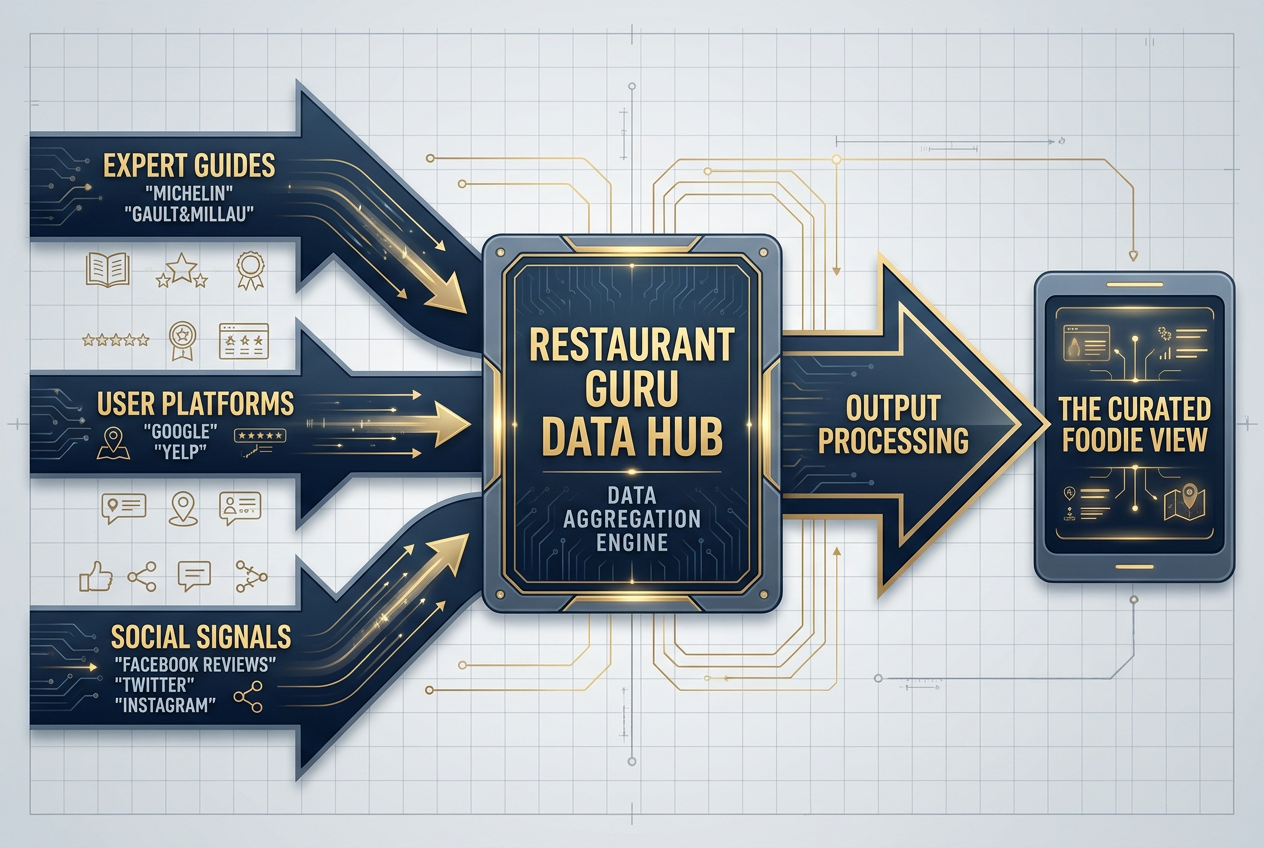 Restaurant Guru functions as a meta-layer for dining, synthesizing professional critic data and millions of user reviews into a single, high-efficiency discovery engine.
What Is Restaurant Guru? Explaining the "Aggregator of Aggregators" Model
Restaurant Guru is a review aggregation platform that synthesizes data from Michelin, Zomato, Google, Yelp, Facebook, and TripAdvisor into a single searchable interface. Founded in 2017, the platform reports 30 million monthly users (per LinkedIn 2026 data) and identifies 48 active competitors in the review aggregation space, according to Tracxn's 2026 analysis. Think of it as a Bloomberg Terminal for foodies - a meta-layer that centralizes professional critic opinions and mass-market sentiment so you don't have to.
Here's how the model works in practice. You search for "Italian restaurants in Brooklyn." Restaurant Guru returns a list, but instead of showing just its own reviews, it displays aggregated scores from every major platform. You see the Google rating, the Yelp rating, the TripAdvisor rating, and - critically - whether the restaurant has a Michelin star or a Gault&Millau citation. The platform doesn't replace those sources; it organizes them.
The value proposition is efficiency. Instead of opening six tabs and cross-referencing scores, you get a consolidated view. The serious foodie can filter for "Michelin-recommended" or "Gault&Millau-listed" and immediately narrow the field to restaurants that meet a professional standard. The platform's 52.17% male audience, with the largest visitor age group being 45-54 year olds (SimilarWeb 2026), suggests a user base that values time-saving curation over endless scrolling.
But aggregation introduces a problem: how do you weight the sources? A Michelin star and a Yelp review from someone who describes every meal as "fire emoji fire emoji" are not equivalent data points. Restaurant Guru's approach is to display all sources transparently and let the user decide which signal to trust. It's not algorithmic curation - it's algorithmic organization. The platform doesn't tell you what's good. It shows you where the experts and the crowd agree, where they diverge, and where there's a gap.
This is fundamentally different from Yelp or Google, which prioritize their own reviews. Restaurant Guru's business model is predicated on being a neutral aggregator. The platform's estimated annual revenue is between $1 million and $5 million, per ZoomInfo 2026 data, suggesting a lean operation focused on aggregation infrastructure rather than content generation.
For the serious foodie, this model solves a specific problem: you want to know if a restaurant is worth your time before you invest three hours and $200. Restaurant Guru doesn't guarantee a great meal. It guarantees that you'll see the full spectrum of available intelligence in one place. That's the pitch.
The Serious Foodie Workflow: How to Find Professional Critics in a Sea of Opinions
Finding expert opinions on Restaurant Guru requires bypassing the default view - which surfaces aggregate star ratings - and drilling into the "Awards & Mentions" section of each restaurant's profile. This is where the platform lists Michelin stars, Gault&Millau citations, and other professional accolades. The workflow is simple: search for a restaurant, open its profile, and scroll past the review summary to the awards section. If it's empty, you're relying on crowd sentiment. If it's populated, you've found a vetted option.
Start with the search bar. Type a cuisine or location, then apply the "Michelin Guide" or "Awards" filter if available. Not every city has Michelin coverage - only 40 locations worldwide are officially rated by the guide - but Restaurant Guru flags Michelin-recommended restaurants in those markets. A "Michelin-recommended" badge doesn't mean the restaurant has a star; it means Michelin's inspectors visited and deemed it worthy of inclusion in the guide, which is still a meaningful signal. A starred restaurant will explicitly list the number of stars.
For cities without Michelin coverage, look for Gault&Millau citations. The French-founded guide rates restaurants on a 20-point scale and is considered the second-most authoritative European dining authority after Michelin. Restaurant Guru aggregates these ratings where available. In the United States, James Beard Award mentions serve a similar function. The key is to ignore the aggregate star rating and focus on the awards section as your primary filter.
Once you've identified a professional endorsement, cross-reference it with the review text. Scroll to the "Reviews from the web" section, which pulls snippets from Yelp, Google, and TripAdvisor. Look for recurring themes. If five reviews mention "impeccable technique" or "perfectly executed sauce," that's signal. If five reviews mention "nice ambiance" and "friendly staff," that's noise. The serious foodie reads reviews for specific culinary observations, not vague sentiment.
A practical example: searching for "Barcelona steakhouses" on Restaurant Guru returns a list that includes both local favorites and tourist traps. Filtering for "Awards" immediately narrows the results to restaurants with professional recognition. Opening the profile for a Michelin-recommended steakhouse reveals specific dish recommendations in user reviews, which you can then cross-reference with the awards section to confirm the restaurant's technique is validated by experts. This workflow takes three minutes instead of thirty.
The power-user move is to bookmark the "Awards & Mentions" filter as your default view. This turns Restaurant Guru from a generic aggregator into a curated feed of professionally vetted options. The platform's database of 30 million monthly users means the crowd sentiment is still visible - you're not ignoring it, you're deprioritizing it until you've confirmed expert validation.
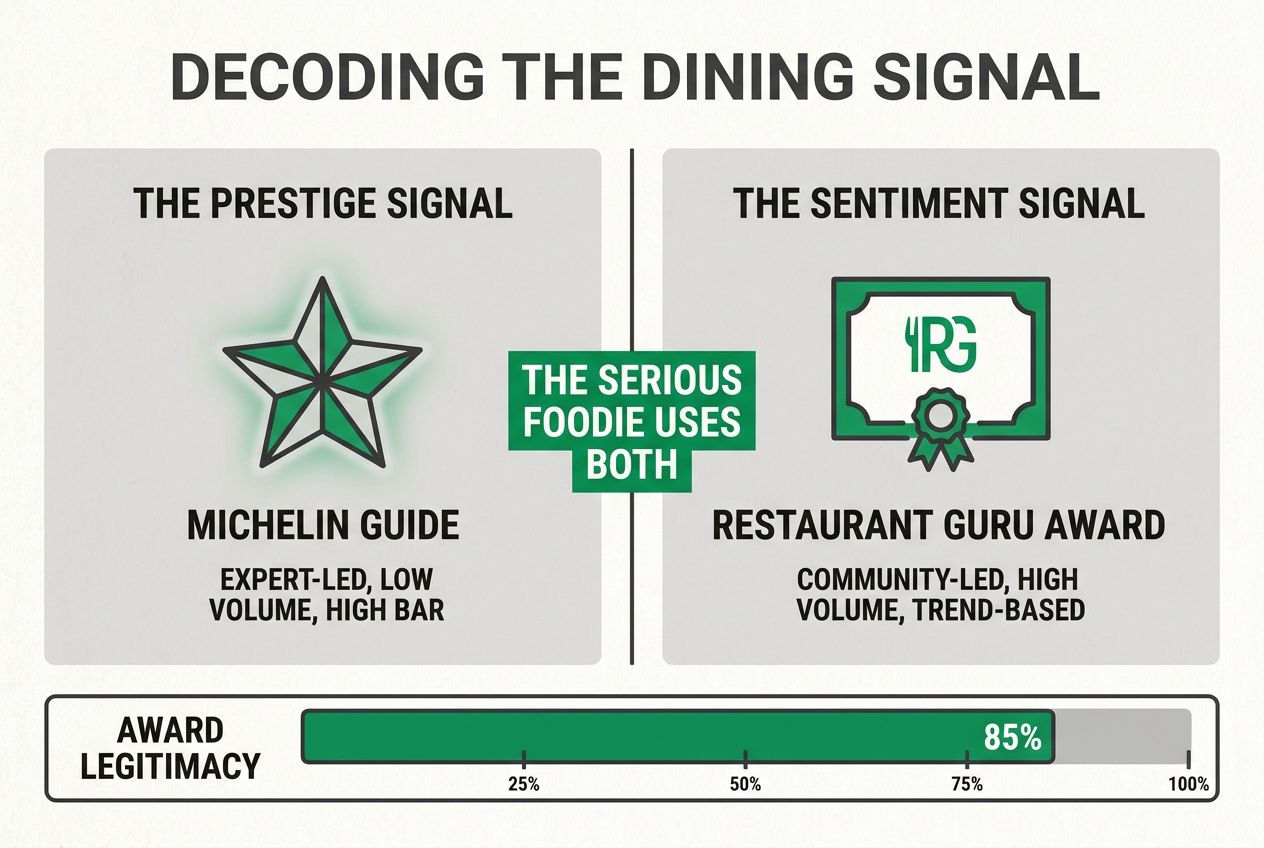 Understanding the difference between prestige signals and sentiment signals allows diners to leverage the Restaurant Guru award as a measure of consistent community excellence.
Is the Restaurant Guru Recommendation Award Legit?
The Restaurant Guru Recommendation Award is not a Michelin star, a James Beard Award, or any form of expert culinary validation - it's a volume signal indicating that a restaurant has received a high number of positive reviews across the aggregated platforms. The award is algorithmic, not editorial. It tells you the crowd likes it. It does not tell you the chef understands classical technique or the wine list has depth.
Here's how it works. Restaurant Guru's algorithm scans aggregated reviews from Google, Yelp, TripAdvisor, Facebook, and Zomato. If a restaurant consistently scores above a threshold (the exact threshold is not publicly disclosed, but industry estimates suggest it's around 4.3-4.5 stars with a minimum review count), it receives the "Guru Recommendation Award." The badge appears on the restaurant's profile and in search results. It's a certification of popularity, not prestige.
Is that useful? For the serious foodie, yes - but only as a secondary signal. The award tells you the restaurant has broad appeal, which often correlates with competent execution, good service, and a pleasant atmosphere. It doesn't tell you the food is innovative, technique-driven, or culturally significant. A well-run chain restaurant with 500 reviews and a 4.6-star average will receive the award. A hole-in-the-wall Sichuan spot with 50 reviews and a 4.8-star average might not, because it hasn't hit the volume threshold.
The value of the award is in filtering out obviously bad options. A restaurant without the badge - and without professional accolades - might still be great, but it's a riskier bet. The serious foodie uses the Guru Recommendation Award as a floor, not a ceiling. It confirms the restaurant won't be a disaster. It doesn't confirm it'll be memorable.
A common misconception is that the award is paid or promotional. It's not. Restaurants don't purchase the badge; it's awarded automatically based on aggregated review performance. However, restaurants do promote the award heavily on social media, which creates the perception that it's a marketing tactic. The award is real - it's just not what most diners think it is. It's a participation trophy for consistent execution, not a medal for culinary excellence.
For context, Beli - a primary competitor for the "Serious Foodie" demographic - reached 75 million ratings in early 2026, per Beli's internal Instagram data. Beli's model is fundamentally different: it's a personal tracking app where users rate dishes, not restaurants. The Guru Recommendation Award, by contrast, is a restaurant-level metric. If you're tracking individual dishes (which serious foodies do), the award is less relevant. If you're looking for a safe bet in an unfamiliar city, it's a useful shortcut.
The legitimacy question ultimately depends on what you're measuring. The award is legitimate as a proxy for crowd approval. It's not legitimate as a proxy for expert opinion. The serious foodie treats it as the former and ignores claims that it's the latter.
Advisor Pierre & AI Search: How to Use Natural Language Queries
Advisor Pierre is Restaurant Guru's AI-powered search assistant, designed to process natural language queries and return contextually relevant restaurant recommendations. Instead of filtering by cuisine and location, you can ask, "Where can I find a dog-friendly terrace with natural wine in Paris?" and receive a curated list based on aggregated data. The feature is available on the Restaurant Guru website and mobile app, and it represents the platform's attempt to solve the "buried signal" problem - the fact that specific insights (like "terrace seating" or "natural wine list") are often hidden in review text rather than structured filters.
Here's the practical application. Open the Restaurant Guru search bar and type a descriptive query: "Best omakase under $100 in San Francisco" or "romantic rooftop with Italian food in Barcelona." Advisor Pierre scans the aggregated review corpus for mentions of those specific attributes, cross-references them with restaurant metadata (location, price range, cuisine), and returns a ranked list. The results aren't perfect - AI-driven search is still prone to irrelevant matches - but they're faster than manually reading 200 reviews.
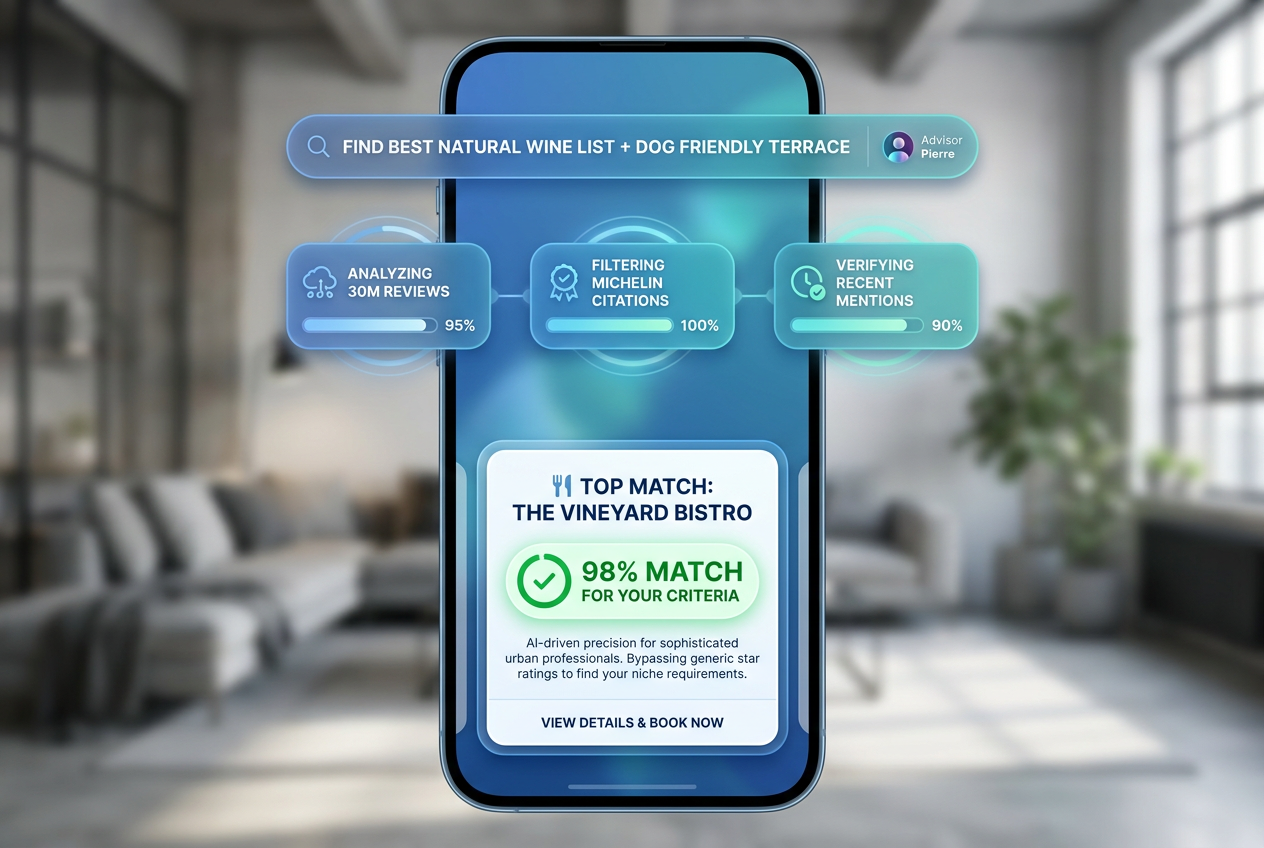 Leveraging Advisor Pierre's natural language processing allows foodies to bypass generic star ratings and locate hyper-specific dining features through millions of data points.
The power-user strategy is to ask compound queries that combine multiple constraints. Generic searches like "best Italian restaurant" return the same top-10 list you'd get from Google. Specific searches like "best pasta with outdoor seating and wine pairings under $50" force the AI to filter for niche attributes that aren't captured in standard restaurant tags. This is where Advisor Pierre outperforms traditional search.
A real-world example: searching for "best carbonara in Rome" on Google returns generic TripAdvisor lists and blog roundups. Entering the same query into Advisor Pierre returns a list of restaurants where user reviews specifically mention carbonara, ranked by aggregated sentiment. You can then refine the query: "best carbonara in Trastevere with outdoor seating." The AI narrows the results to match all three constraints. This workflow is faster than opening 10 browser tabs and cross-referencing reviews manually.
The limitation is that Advisor Pierre's recommendations are only as good as the underlying review data. If no one has mentioned "natural wine" in reviews for a particular restaurant, the AI won't surface it - even if the restaurant has a deep natural wine list. The tool excels at surfacing known attributes. It doesn't predict or infer. For discovery of genuinely hidden gems, the serious foodie still needs to consult expert sources (Michelin, Gault&Millau, food blogs) or rely on personal networks.
The optimal use case for Advisor Pierre is efficiency in unfamiliar cities. You're in Tokyo for 48 hours. You want sushi, but you also want a specific experience: omakase, counter seating, English-speaking chef, under ¥15,000. Typing that into Advisor Pierre returns a shortlist of options that meet all criteria, saving you an hour of research. You still cross-reference the results with Michelin or Tabelog ratings, but the AI has done the initial filtering work.
One underutilized feature: reverse queries. Instead of asking "What's the best sushi in Tokyo?", ask "Where can I find sushi like Sukiyabashi Jiro?" Advisor Pierre will scan for restaurants with similar attributes (omakase format, high-end, counter seating) and return alternatives. This is particularly useful for replicating a memorable dining experience in a different city.
The caveat is that Advisor Pierre is not a replacement for expert curation. It's a search accelerator. The serious foodie uses it to generate a shortlist, then validates that shortlist against professional sources. It's step one, not the final answer.
Restaurant Guru vs. Beli vs. The Infatuation: Which Tool Should Be in Your Food Stack?
The modern foodie stack requires multiple tools because no single platform does everything well. Restaurant Guru excels at centralizing professional expert opinions and aggregating reviews at the restaurant level. Beli excels at personal tracking and dish-level ratings. The Infatuation excels at editorial curation and neighborhood guides. The serious foodie uses all three, but for different purposes.
| Feature | Restaurant Guru | Beli | The Infatuation |
|---|---|---|---|
| Aggregates Michelin | ✓ | ✗ | ✓ (Editorial) |
| Dish-Level Tracking | ✗ | ✓ | ✗ |
| Personal "Want-to-Go" Lists | ✗ | ✓ | ~ (Via App) |
| AI Food Assistant | ✓ (Pierre) | ✗ | ✗ |
| Editorial Reviews | ✗ | ✗ | ✓ |
| Social Sharing | ✗ | ✓ | ✗ |
| Database Depth | 30M+ users | 75M+ ratings | ~5,000 curated spots |
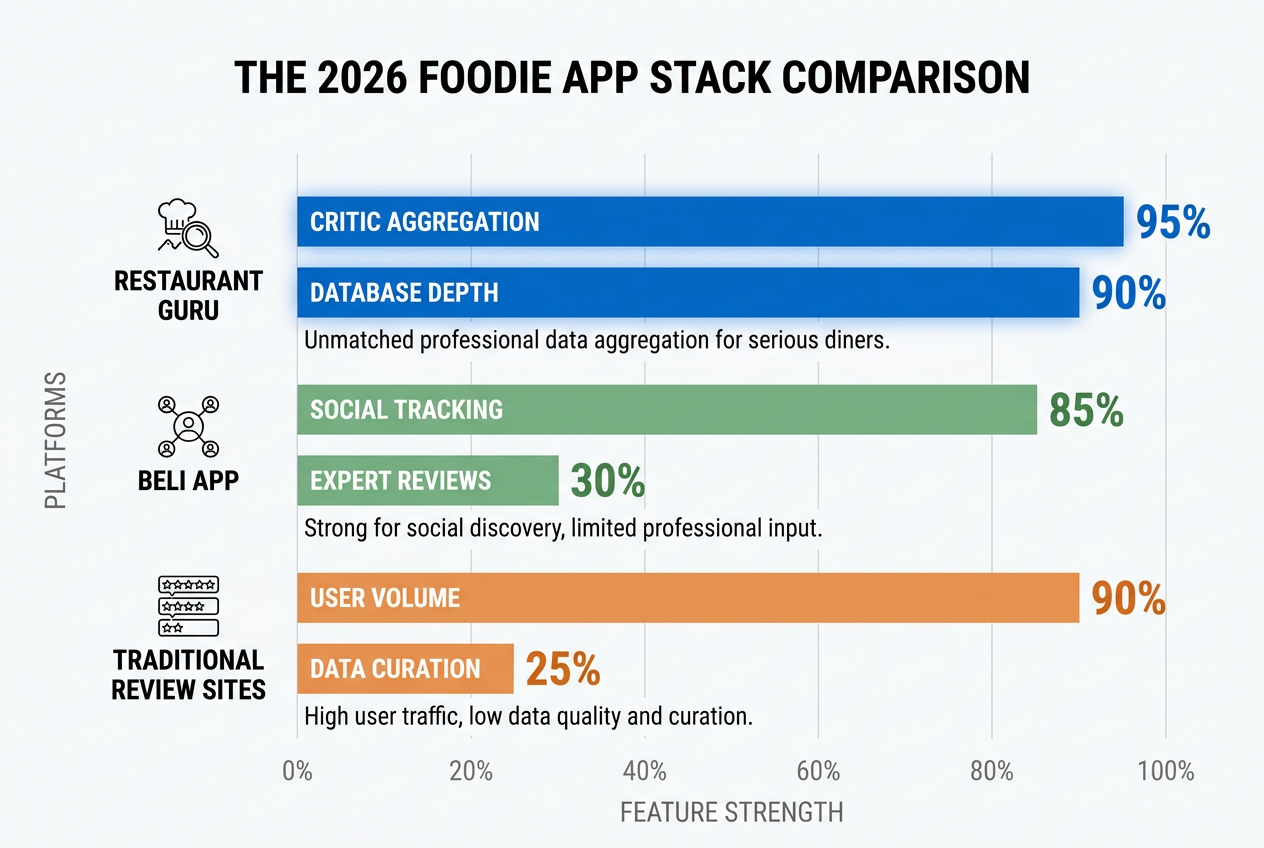 When comparing the modern foodie stack, Restaurant Guru excels at centralizing professional expert opinions, while Beli focuses on social list-making and tracking.
Restaurant Guru's primary use case: Pre-trip research in unfamiliar cities where you want to filter for Michelin-starred or Gault&Millau-rated restaurants within a massive database. You're in Barcelona for three days. You open Restaurant Guru, filter for "Michelin Guide," and immediately see the 24 starred restaurants in the city. You cross-reference those with Advisor Pierre queries ("best tasting menu under €150") to narrow the list. You've identified your top-tier dining targets in five minutes.
Beli's primary use case: Post-meal documentation and personal list curation. You're at that extraordinary sushi spot in Tokyo. You pull out Beli, rate the toro nigiri 9/10, add tasting notes ("perfect fat content, melts instantly"), and tag it to your "Tokyo Omakase" list. Six months later, you're planning a return trip. You open Beli, sort your "Tokyo Omakase" list by rating, and immediately know which dishes to reorder. Beli reached 75 million ratings in early 2026, per internal data, making it the most active dish-tracking platform globally.
The Infatuation's primary use case: Trusted editorial recommendations for specific occasions. You need a date-night spot in Los Angeles that's impressive but not stuffy. The Infatuation's LA guide has a "Date Night" filter. You get a curated list of eight restaurants, each with a one-paragraph review explaining the vibe, the signature dishes, and the price range. You don't need to cross-reference anything - the editorial team has already done the work. The Infatuation's strength is curation, not comprehensiveness.
The overlap between these tools is minimal. Restaurant Guru gives you the universe of options, weighted by expert and crowd opinion. Beli gives you your personal history. The Infatuation gives you trusted shortcuts. The serious foodie uses Restaurant Guru for discovery, Beli for memory, and The Infatuation for validation.
A practical workflow: You're planning a trip to Paris. Start with Restaurant Guru to identify the Michelin three-stars (there are 10 as of 2026). Use The Infatuation's Paris guide to find under-the-radar bistros that aren't Michelin-rated but are editorially vetted. During the trip, use Beli to document every dish at every restaurant. Post-trip, export your Beli ratings and build a personal "Paris Top 10" list that you can share with friends or reference on your next visit.
The mistake most foodies make is treating these tools as competitors. They're not. They're complementary layers in a modern dining strategy. Restaurant Guru is your Bloomberg Terminal. Beli is your personal database. The Infatuation is your trusted guide. Use all three, or accept that you're missing part of the picture.
For readers looking to build a deeper personal tracking system beyond what Restaurant Guru offers, the best apps to track and rate individual dishes can help you move from venue-level reviews to dish-level memory.
Expert Filters: Step-by-Step on Finding Michelin and Gault&Millau Citations
Filtering for professional critic endorsements on Restaurant Guru is not automatic - it requires deliberate navigation because the platform's default view prioritizes aggregated star ratings. The serious foodie workflow is to bypass the homepage entirely and start with the advanced search filters, which are located in the top navigation bar under "Explore" or accessible via direct URL parameters if you're a power user.
Step 1: Access the Advanced Search. Open Restaurant Guru and navigate to the "Explore" section. If you're on mobile, tap the search icon and look for "Filters" or "Advanced Search." On desktop, the filter options appear as a sidebar once you've entered a search query. The key is to avoid clicking on the default "Top Rated" or "Most Reviewed" tabs, which surface crowd-favorite restaurants rather than expert-validated ones.
Step 2: Enable the "Michelin Guide" Filter. In the filter sidebar, scroll to the "Awards & Recognition" section. You'll see options for "Michelin Guide," "Gault&Millau," and other regional awards (James Beard in the US, Bib Gourmand globally). Check the "Michelin Guide" box. The results will immediately refresh to show only restaurants that have been inspected and recommended by Michelin. Note that this filter includes both starred restaurants and "Bib Gourmand" restaurants (Michelin's "good value" designation), so you'll need to drill into individual profiles to confirm the star count.
Step 3: Cross-Reference with Gault&Millau for European Markets. If you're searching in France, Switzerland, or Belgium, enable the "Gault&Millau" filter in addition to Michelin. Gault&Millau's 20-point rating scale (16-20 is considered excellent) provides a second expert opinion that often highlights restaurants Michelin overlooks. The two guides have different philosophies: Michelin prioritizes consistency and technical precision, while Gault&Millau rewards creativity and innovation. A restaurant rated highly by both is a near-certain bet.
Step 4: Sort by Rating Within Filtered Results. Once you've applied the expert filters, you'll still see a range of quality. A one-star Michelin restaurant and a three-star Michelin restaurant are both "Michelin-rated," but they're not equivalent experiences. Sort the filtered results by "Highest Rated" to see which expert-validated restaurants also have strong crowd sentiment. This is the sweet spot: professional endorsement + positive recent reviews.
Step 5: Read the Awards Section on Each Profile. Click into a restaurant's profile and scroll to the "Awards & Mentions" section. This is where Restaurant Guru lists the specific accolades: "Michelin 2-Star 2025," "Gault&Millau 18/20," "James Beard Award Semifinalist 2024." If this section is empty despite the restaurant appearing in your filtered search, it's likely a data lag - cross-check with the official Michelin Guide website or the restaurant's own site to confirm.
Step 6: Use Advisor Pierre for Niche Queries Within Expert-Validated Results. Once you've narrowed the list to Michelin-rated restaurants, you can use Advisor Pierre to refine further. For example, type "Michelin-starred sushi with counter seating in Tokyo" into the AI assistant. This combines expert validation (Michelin filter) with specific dining preferences (counter seating), saving you from manually reading each restaurant's review corpus.
A real-world example: Searching for "fine dining in Lyon" on Restaurant Guru without filters returns 50+ results, most of which are generic brasseries with 4.5-star averages. Applying the Michelin + Gault&Millau filters reduces the list to 8 restaurants, all of which have professional critic validation. Opening the profile for "Paul Bocuse" (3 Michelin stars, 19.5/20 Gault&Millau) confirms its status as a culinary landmark, while also surfacing user reviews that mention specific dishes ("the truffle soup is transcendent"). This workflow took two minutes instead of thirty.
The limitation of this approach is geographic. Michelin coverage is limited to 40 cities and regions worldwide. If you're searching in a non-Michelin city (Austin, Texas; Porto, Portugal; Hanoi, Vietnam), the expert filter will return zero results. In those cases, the serious foodie pivots to regional guides: James Beard for the US, Repsol Suns for Spain, Asia's 50 Best for Asian markets. Restaurant Guru doesn't aggregate all of these, so you'll need to cross-reference manually.
The advanced move is to export your filtered results. Restaurant Guru doesn't have a native "export" feature, but you can manually copy restaurant names into a spreadsheet or use a browser extension to scrape the results. This creates a personal shortlist that you can annotate with your own notes, tasting priorities, and reservation status. For foodies who eat out 100+ times per year, this level of organization is the difference between efficient curation and chaos.
For foodies serious about maintaining a curated restaurant library beyond what any single platform offers, building a personal restaurant library can transform scattered research into a lasting culinary archive.
Restaurant Guru vs. Traditional Review Sites: The Aggregation Advantage
The core advantage of Restaurant Guru over Yelp, Google Reviews, or TripAdvisor individually is breadth of synthesis - you see all three platforms' data in one interface, plus Michelin and Gault&Millau citations where available. This matters because different platforms attract different user demographics. Yelp skews younger and more casual. TripAdvisor skews toward travelers. Google Reviews captures the broadest demographic. By aggregating all three, Restaurant Guru smooths out demographic bias and gives you a more complete picture of crowd sentiment.
However, this advantage comes with a tradeoff: you lose the depth of individual platform features. Yelp's "Highlights" section (which surfaces common review themes like "great for groups" or "long wait times") isn't replicated on Restaurant Guru. Google's real-time "busy hours" data isn't shown. TripAdvisor's traveler forums aren't linked. You gain efficiency at the cost of granularity.
The serious foodie's strategy is to use Restaurant Guru for initial filtering and then pivot to the native platforms for depth. Find a Michelin-starred restaurant on Restaurant Guru, then open its Google profile to check peak dining hours, or its Yelp profile to read the most recent reviews. This two-step workflow is faster than starting from scratch on any single platform.
One underutilized feature: Restaurant Guru's "Similar Restaurants" section. At the bottom of each restaurant profile, the platform suggests 5-10 alternatives with comparable ratings, cuisine, and price range. This is particularly useful when your first choice is fully booked. The recommendations are algorithmically generated based on aggregated data, so they're not editorially vetted, but they're directionally useful.
A practical comparison: searching for "best sushi in San Francisco" on Yelp returns a list dominated by mid-tier options with 500+ reviews. Searching the same query on Restaurant Guru and filtering for "Michelin Guide" returns a list of the city's 6 Michelin-starred sushi restaurants, plus 3 Bib Gourmand options. The Yelp list tells you what's popular. The Restaurant Guru list tells you what's validated by experts. Both are useful, but for different questions.
The data-quality question is legitimate. Restaurant Guru's aggregation model means it's vulnerable to lag - if a restaurant loses its Michelin star, Restaurant Guru might not update the profile for weeks or months until the next guide release. The serious foodie cross-checks the awards section against the official Michelin Guide website to confirm current status. This extra step is annoying but necessary.
For readers interested in the broader evolution of food review platforms, modern food reviews and how serious foodies track meals explores the shift from venue-level ratings to personal culinary databases.
Using Restaurant Guru for Travel Planning: The 48-Hour Dining Itinerary
The highest-value use case for Restaurant Guru is pre-trip dining research for cities where you have limited time and want to maximize the probability of memorable meals. The platform's aggregation model is ideal for this because you can filter for expert-validated restaurants, cross-reference crowd sentiment, and use Advisor Pierre to refine by specific attributes (outdoor seating, tasting menu, specific cuisine sub-genre) in a single session.
Start by defining your constraints. You're in Tokyo for 48 hours. You want one Michelin three-star experience, one neighborhood izakaya, and one breakfast-worthy kissaten (traditional coffee shop). Open Restaurant Guru, filter for "Michelin Guide" in Tokyo, and sort by rating. The three-star list appears: Kanda, Quintessence, and Joel Robuchon. You pick Kanda because user reviews mention the chef's seasonal approach. Now use Advisor Pierre to search "best izakaya in Shibuya with English menu." The AI returns three options. You cross-reference them on Tabelog (Japan's dominant review site) and pick the one with the highest Tabelog score. Finally, search "traditional kissaten Tokyo" and filter by neighborhood proximity to your hotel.
This workflow takes 15 minutes. The alternative - manually reading Eater guides, Reddit threads, and individual restaurant websites - takes two hours. The tradeoff is that Restaurant Guru's recommendations are algorithmically generated, not editorially curated. You're getting the wisdom of the crowd, filtered by professional validation. That's usually sufficient for a short trip. For longer stays or deeper culinary exploration, you'd supplement with editorial guides (Eater, The Infatuation, local food blogs).
A power-user trick: create a Google My Maps layer for each trip and pin every Restaurant Guru recommendation. This creates a visual itinerary. You can see which restaurants are clustered geographically, which allows you to plan multi-restaurant evenings or lunch-dinner combos in the same neighborhood. Restaurant Guru doesn't have native map-based navigation (you're redirected to Google Maps for directions), so exporting your shortlist to a custom map layer adds a layer of logistical efficiency.
The mistake most travelers make is over-planning. You don't need a reservation for every meal. Use Restaurant Guru to identify 3-5 "must-hit" restaurants (Michelin-starred, Gault&Millau-rated, or editorially recommended), then leave the rest of your dining open to spontaneity. The platform's AI assistant is useful for on-the-fly searches: you're walking through a neighborhood, you get hungry, you ask Advisor Pierre "best lunch near me under $20," and you get a shortlist. This hybrid approach - pre-planned anchor meals + spontaneous discoveries - is the optimal travel dining strategy.
For the serious foodie planning a culinary-focused trip, finding the best dishes in a city rather than just the best restaurants can elevate your travel from good to unforgettable.
Frequently Asked Questions
Is the Restaurant Guru Award Legit?
The Restaurant Guru Recommendation Award is a legitimate algorithmic designation, but it measures crowd approval rather than expert culinary validation. The award is granted to restaurants that consistently receive positive reviews (typically 4.3+ stars with a minimum review count) across aggregated platforms like Google, Yelp, TripAdvisor, Facebook, and Zomato. It's not paid or promotional - restaurants receive it automatically based on review performance. However, it's not equivalent to a Michelin star or a James Beard Award. Think of it as a certificate of consistent execution, not a medal for culinary innovation. For the serious foodie, the award is useful as a floor - it confirms a restaurant won't be a disaster - but not as a ceiling for identifying extraordinary dining experiences.
What Is the 30/30/30 Rule for Restaurants?
The 30/30/30 rule is a restaurant industry benchmark suggesting that ideal cost structure allocates roughly 30% of revenue to food costs, 30% to labor, and 30% to overhead (rent, utilities, marketing), leaving 10% as profit margin. This rule is operational guidance for restaurant owners, not a dining quality indicator. For foodies, the relevance is indirect: restaurants operating within these margins are more likely to be financially sustainable, which often correlates with consistent food quality and service. However, many high-end restaurants intentionally break this rule - Michelin-starred establishments often run 40-50% food costs because ingredient quality is paramount. The 30/30/30 rule is a generalization, not a universal standard.
Who Owns Restaurant Guru?
Restaurant Guru is privately held, and detailed ownership information is not publicly disclosed. LinkedIn and ZoomInfo data from 2026 indicate the company was founded in 2017 and operates with estimated annual revenue between $1 million and $5 million. The platform's business model appears to be freemium - basic restaurant discovery is free, with potential revenue from premium features, affiliate partnerships (reservation platforms, food delivery), and advertising. The lack of prominent venture capital backing or public financial disclosures suggests a bootstrapped or closely-held structure. For users, this means the platform is less likely to undergo sudden strategic shifts or acquisitions that might disrupt service, but also that feature development may be slower compared to venture-backed competitors like Beli.
Is Restaurant Guru Reputable?
Restaurant Guru is reputable as a review aggregation tool - it accurately synthesizes data from Michelin, Google, Yelp, TripAdvisor, Facebook, and Zomato into a single searchable interface. The platform's 30 million monthly users (per LinkedIn 2026 data) and integration with professional critic sources (Michelin, Gault&Millau) suggest it's a credible resource for pre-trip dining research. However, its reputation depends on what you're measuring. If you're looking for a comprehensive database of restaurant opinions, it's reputable. If you're looking for editorial curation or dish-level tracking, it's less relevant. Trustpilot and Reddit discussions from 2024-2026 indicate users appreciate the platform's aggregation efficiency but note that the "Guru Recommendation Award" can be misleading if interpreted as expert validation. The serious foodie treats Restaurant Guru as a starting point for research, not a definitive authority.
What Is the Best Website for Restaurant Reviews?
There is no single "best" restaurant review site - the optimal choice depends on your dining goals. For professional critic opinions, the Michelin Guide website is authoritative for the 40 cities it covers. For crowd-sourced reviews, Google Reviews has the broadest user base. For editorial curation and neighborhood guides, Eater and The Infatuation provide trusted shortcuts. For dish-level tracking and personal memory, Beli is the most active platform with 75 million ratings as of early 2026. Restaurant Guru excels at aggregating multiple sources into a single interface, making it ideal for efficiency-focused research in unfamiliar cities. The serious foodie uses multiple platforms in combination: Restaurant Guru for discovery, Michelin for validation, Beli for memory, and editorial sites for inspiration.
How Reliable Is the Data on Restaurant Guru Regarding Opening Hours?
Restaurant Guru's opening hours data is sourced from aggregated platforms (Google, Yelp, TripAdvisor) and is generally accurate for well-trafficked restaurants but can lag for smaller or independently owned establishments. The platform does not appear to employ its own data verification team, so reliability depends on the timeliness of updates from its source platforms. For high-confidence verification, cross-check opening hours on the restaurant's official website, Google Maps (which often has real-time updates from restaurant owners), or by calling directly. This is particularly important for Michelin-starred restaurants, which often have irregular hours or seasonal closures. The serious foodie treats Restaurant Guru's hours as directional rather than definitive and always confirms before making a reservation or traveling a significant distance.
Can I Save or Export Restaurant Lists from Restaurant Guru?
Restaurant Guru does not currently offer a native "save list" or "export" feature for building curated collections of restaurants. This is a significant limitation compared to competitors like Beli, which allows users to create custom lists (e.g., "Tokyo Omakase," "Best Tacos LA") and share them socially. The workaround is manual: copy restaurant names and addresses into a spreadsheet, Google My Maps layer, or note-taking app as you research. Some power users employ browser extensions to scrape search results and generate exportable lists, but this requires technical setup. For foodies who track 100+ dining experiences per year, this lack of native list functionality makes Restaurant Guru less useful as a long-term memory tool. Use it for discovery, then export your findings to a personal database or a dedicated food tracking app like Beli or Savor.
Does Restaurant Guru Provide Menu and Price Information for Its Listings?
Restaurant Guru aggregates menu links and price range indicators (e.g., "$$", "$$$") from its source platforms, but it does not host full menus or provide dish-level pricing. Menu data is pulled from Google, Yelp, and TripAdvisor, which means availability and accuracy vary. High-end restaurants often don't publish full menus online, relying instead on seasonal tasting menus that change frequently. For reliable menu and pricing information, the serious foodie visits the restaurant's official website or calls directly. Restaurant Guru's value is not in menu detail - it's in filtering the universe of options down to a shortlist of expert-validated or crowd-approved restaurants. Once you've identified a target restaurant, you pivot to primary sources for operational details.
What Does Gen Z Use Instead of Yelp?
Gen Z diners increasingly favor TikTok, Instagram, and Beli over traditional review platforms like Yelp. TikTok's short-form video format allows users to see dishes in motion (texture, plating, preparation) rather than relying on static photos and text reviews. Instagram's "Guides" feature and location tags provide visual discovery. Beli, with its 75 million ratings as of early 2026, offers a social, list-based approach where users rate individual dishes and share curated collections with friends. These platforms prioritize visual storytelling, peer recommendations, and personal curation over crowd-sourced star ratings. For serious foodies under 30, the trend is toward private or semi-private food tracking (Beli, Savor) combined with social media discovery (TikTok, Instagram). Yelp remains relevant for logistical information (hours, location) but is no longer the primary discovery tool for younger diners.
Is the Beli App Legit?
Beli is a legitimate and rapidly growing food tracking app specifically designed for foodies who want to rate and remember individual dishes rather than entire restaurants. Launched in 2020, the app reached 75 million ratings by early 2026, per internal data shared on Instagram. Unlike Yelp or Google Reviews, which aggregate restaurant-level opinions, Beli allows dish-level granularity: you rate the carbonara, the toro nigiri, the dry-aged ribeye - not just the venue. The app's legitimacy is supported by its active user base, frequent updates, and venture capital backing. For the serious foodie, Beli is the most practical tool for building a personal culinary archive. It's particularly useful for travelers who want to remember exactly which dishes to reorder on return visits. Restaurant Guru and Beli are complementary: use Restaurant Guru to discover expert-validated restaurants, then use Beli to document which dishes were worth the visit.
Beyond the Five-Star Trap
The serious foodie doesn't trust a 4.8-star rating to tell them anything meaningful about a meal. They trust professional critics, recurring themes in review text, and their own cumulative experience. Restaurant Guru doesn't solve the curation problem - it reorganizes it into a more efficient interface. The platform's value is in saving time, not in replacing judgment. You still need to read between the lines, cross-reference sources, and trust your palate over any algorithm. But if you're planning a culinary trip and you want to filter 1,000 restaurants down to 10 in five minutes, Restaurant Guru is the tool that makes that possible. Use it for discovery. Validate with Michelin. Document with Beli. That's the modern foodie stack.