

How to Keep a Dish Rating Journal: Building Your Personal Taste Archive
Harry the matcha king
Harry is our resident matcha obsessive. He’s tasted hundreds of bowls and tracks every cup in Savor.
How to Keep a Dish Rating Journal: The Anti-Yelp System for Building Your Personal Taste Archive You had an extraordinary bowl of ramen in Tokyo three months...
How to Keep a Dish Rating Journal: The Anti-Yelp System for Building Your Personal Taste Archive
You had an extraordinary bowl of ramen in Tokyo three months ago. You remember the place had wood paneling. You think it was near the fish market. But the name? The exact location? The specific reason it was better than the other six bowls you had that week? Gone.
Your camera roll holds 2,847 food photos you'll never look at again.
This isn't a memory problem. It's a systems problem. And a dish rating journal solves it by turning mindless eating into a searchable, private database of your culinary life.
Table of Contents
- What Is a Dish Rating Journal?
- Why Track Dishes Instead of Restaurants?
- The Rating Framework: Moving Beyond "Tasty"
- Tools of the Trade: Analog, Digital, or Hybrid
- The Stealth Factor: How to Take Notes Without Looking Like a Critic
- Building Your Sensory Vocabulary
- The Follow-Up System: Turning Notes Into Action
- Frequently Asked Questions
What Is a Dish Rating Journal?
A dish rating journal is a private, searchable record of what you've eaten, how it tasted, and why it mattered. It's not a calorie tracker. It's not a public review platform. It's a curated database of your personal flavor history.
The core difference: you're rating dishes, not restaurants. That distinction changes everything.
Think of it as the opposite of Yelp. Instead of broadcasting opinions to strangers, you're building an intellectual exercise in taste memory. You're creating a reference library you can actually use when someone asks, "Where should I eat in Barcelona?" or when you're trying to recreate that perfect cacio e pepe at home.
Professional critics have always done this. ChefsBest Master Tasters evaluate food using five dimensions: aroma, appearance, flavor, texture, and mouthfeel. You're applying the same rigor, but for personal recall rather than publication.
Why Track Dishes Instead of Restaurants?
Because restaurants don't matter. Dishes do.
You don't remember "that place in Rome." You remember the carbonara. The specific plate. The way the egg yolk coating clung to each strand of pasta, the precise ratio of guanciale to pecorino, the black pepper heat that lingered after the last bite.
Tracking at the dish level forces specificity. It eliminates the useless 4.5-star aggregate that tells you nothing. It creates utility: "Best Tonkotsu Ramen in NYC" becomes a searchable tag in your personal database, not a vague recollection buried under 2,000 other food photos.
This is how you become "the friend who always knows where to eat." Not by memorizing Michelin stars, but by maintaining a living index of specific dishes you've personally validated.
If you're already thinking about apps to organize this, check out the best apps to track your favorite dishes.
The Rating Framework: Moving Beyond "Tasty"
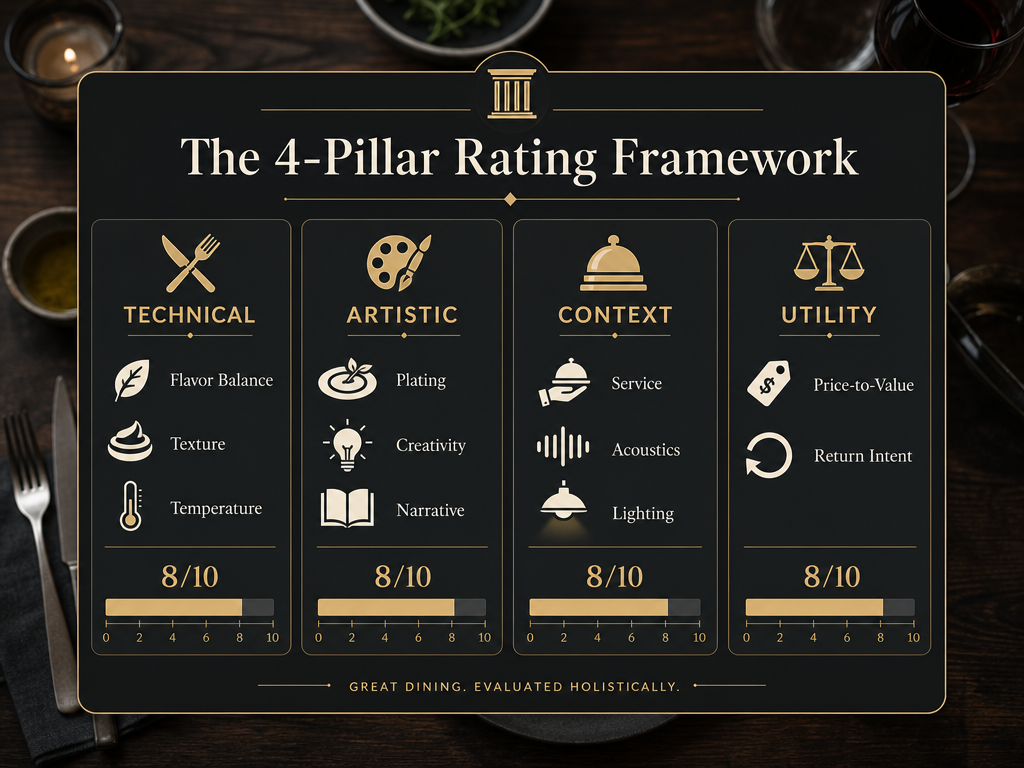
Most people rate food like they're leaving a Yelp review: "Good" or "Bad," maybe a number out of five. That's useless for memory.
A functional rating system needs structure. Here's a four-pillar framework that actually works:
The Technical
This is the craftsmanship. Flavor balance. Texture. Temperature. Is the pasta cooked correctly? Does the dish have too much salt, or not enough acid to cut the richness?
Professional tasting reports typically include an evaluation of the visual (color/clarity), olfactory (intensity/complexity), and gustatory (balance/length) aspects. You don't need to be that formal, but you do need to pay attention.
Ask yourself: Is this dish technically well-executed, or did the chef miss something fundamental?
The Artistic
Plating. Creativity. The narrative the chef is trying to tell. Does the dish show ambition? Does it surprise you in a way that feels intentional rather than gimmicky?
This is where you capture the "why" behind a dish. A perfectly grilled steak scores high on technique. A steak served with miso butter and pickled daikon scores on artistry.
The Context
Service. Acoustics. Lighting. The vibe. A dish doesn't exist in a vacuum. That same carbonara tastes different in a fluorescent-lit chain restaurant than it does in a candlelit trattoria with Sinatra playing in the background.
You're not reviewing the restaurant here, but you are acknowledging that context shapes memory. The best dish you've ever had might have been eaten at a sidewalk table in Hanoi at midnight, and the atmosphere was half the experience.
The Utility
Price-to-value ratio. Would you return? Would you recommend this specific dish to someone else, and under what circumstances?
This is the practical layer where you consider whether a dish is worth repeating or recommending based on your personal experience.
Each pillar gets its own rating. Aggregate them if you want a final number, or leave them separate. The structure matters more than the scale.
For a more detailed guide on building your own rating system, see how to review and track meals like a serious foodie.
Tools of the Trade: Analog, Digital, or Hybrid
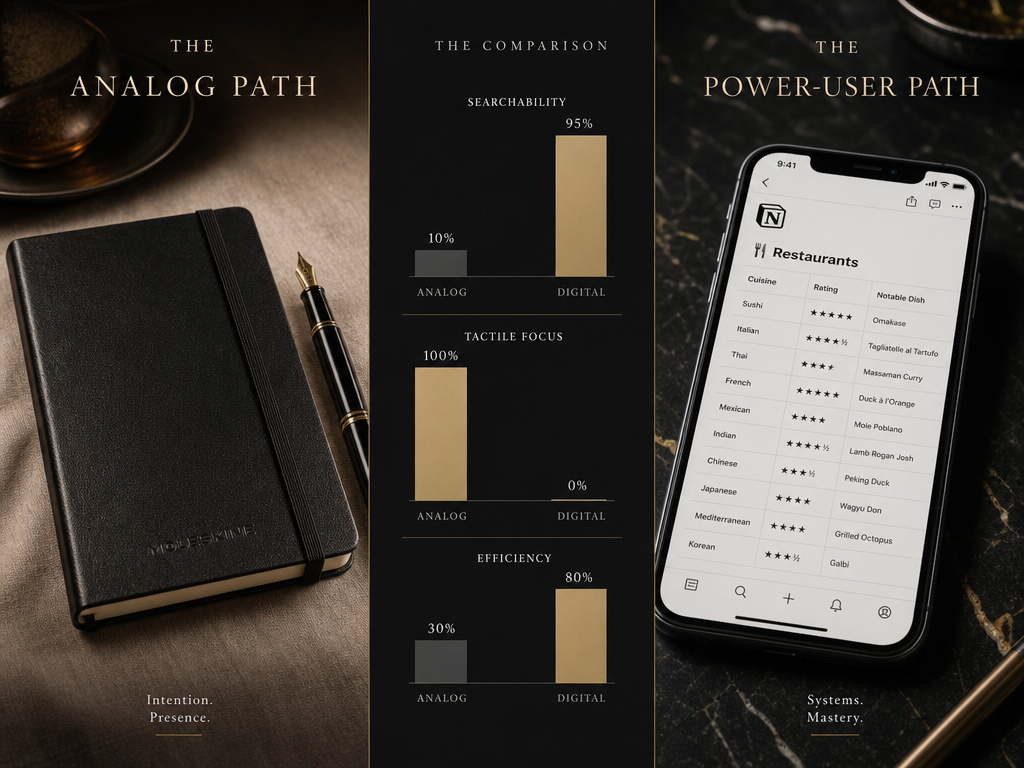
The medium you choose determines whether you'll actually use this system.
The Analog Path
Physical journals feel good. The Moleskine Passion Journal for Restaurants includes sections for 5 courses, wine pairings, and 6 tabbed sections. It's tactile. It forces you to slow down and think.
The problem: zero searchability. Three years from now, when you're trying to remember that restaurant in Paris with the perfect duck confit, you'll be flipping through 200 pages of handwritten notes.
Analog works if you're committed to the ritual of regular journaling and willing to accept the tradeoff of reduced searchability.
Alternative: a blank dot-grid notebook (Leuchtturm1917 is the power-user choice). No pre-printed sections. Complete creative freedom. Same searchability problem.
The Power-User Path
Digital databases solve the search problem. A Notion setup with proper tagging turns your journal into a query-able archive.
Create a database with these properties:
- Date
- Restaurant Name
- Location/City
- Cuisine Type
- Dish Name
- Rating (Technical, Artistic, Context, Utility)
- Notes
- Photo Link
- Tags (e.g., "Best Pasta," "Must Return," "Overrated")
Now you can filter by city, sort by rating, or pull up every 5-star pasta dish you've logged in the past two years. That's utility.
The downside: friction. Opening an app, filling out fields, and uploading photos feels like work. If the barrier is too high, you won't do it consistently.
For those interested in digital solutions, explore the best apps to track restaurant meals.
The Minimalist Path
iPhone Notes or Google Keep using voice-to-text.
You finish a meal. You walk outside. You dictate 30 seconds of thoughts into your phone: "Tonkotsu ramen at Ippudo West Side. Broth was rich but one-dimensional. Noodles perfect texture. Chashu too fatty. Would return but try the shoyu instead. 7/10."
Later - maybe weekly, maybe monthly - you transcribe these into your structured system (analog or digital). The voice note captures the memory in the moment. The transcription adds the structure.
This is the hybrid approach, and it works because it minimizes in-the-moment friction while preserving the raw data.
FoodNoms is a top-rated iOS food journal that prioritizes privacy and rapid logging via Apple Watch/Shortcuts, making it a solid choice for the minimalist who wants some structure without the overhead.
The Stealth Factor: How to Take Notes Without Looking Like a Critic
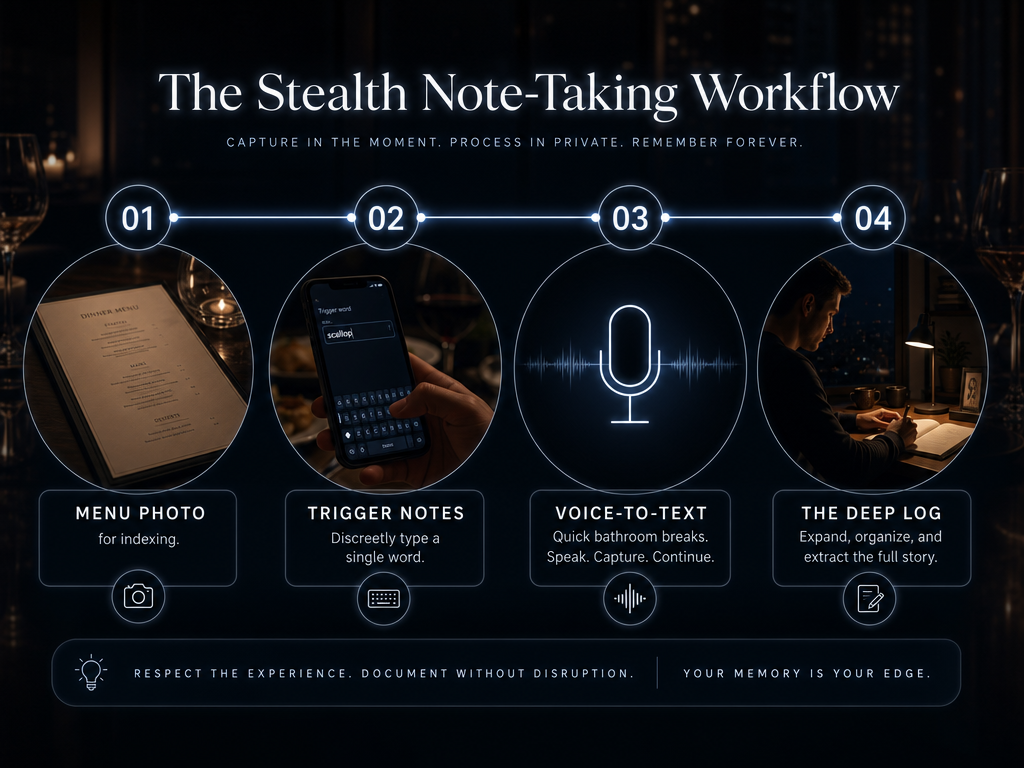
You're not a professional critic. You don't want to be "that guy" with a Moleskine open on the table at a Michelin-starred restaurant, writing furiously between courses while your date stares in confusion.
Here's how to document without disrupting:
The Menu Photo Trick
When the menu arrives, take a photo of it. This serves as your index. Later, when you're logging notes, you'll remember which dishes you ordered and what they were called. No need to memorize.
One-Word Trigger Notes
During the meal, you're present. You're tasting, talking, enjoying. But after each course, you create a one-word mental trigger. "Salty." "Mushy." "Perfect." "Boring."
Between courses or in the restroom, you open your Notes app and type those triggers. They'll unlock the full memory later when you sit down to write.
The Dimmed Phone Method
Brightness down. Phone face-down on your lap. Quick glances to type trigger words. This is less obtrusive than pulling out a journal, and it's faster than handwriting.
Apple Watch Voice Notes
If you have one, use it. A 10-second voice memo dictated into your watch looks like you're checking a text. No one notices.
The key principle: capture just enough data in the moment to reconstruct the full memory later. You're not writing the review at the table. You're preserving the raw material.
For more on managing your food photo library, see how to organize restaurant photos by restaurant.
Building Your Sensory Vocabulary
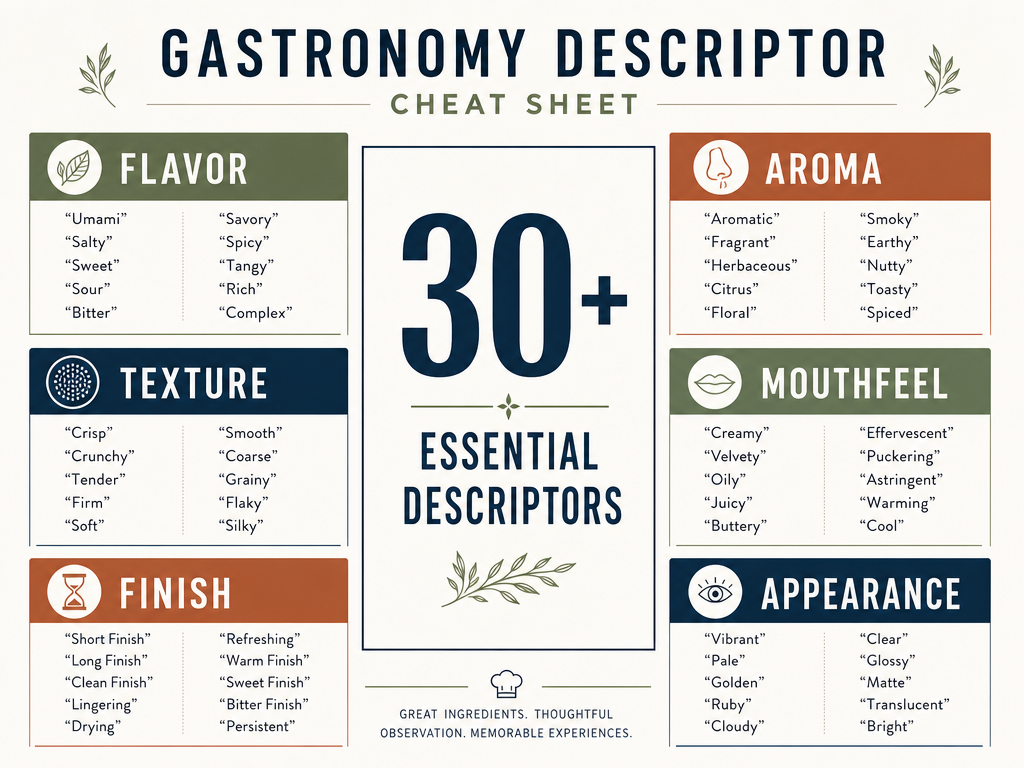
"Tasty" is not a useful descriptor. Neither is "good" or "flavorful." These words tell you nothing.
The difference between a casual diner and someone building a taste archive is vocabulary. You need words that capture nuance.
Flavor Descriptors
- Umami-forward: Rich, savory depth (soy sauce, aged cheese, mushrooms)
- Astringent: Drying sensation (over-steeped tea, unripe persimmon)
- Herbaceous: Fresh green flavors (basil, cilantro, tarragon)
- Funky: Fermented complexity (kimchi, aged meats, certain cheeses)
- Bright: High acid, lively (lemon, vinegar, pickles)
Texture Terms
- Velvety: Smooth, luxurious mouthfeel (French butter, ganache)
- Unctuous: Rich, almost oily coating (bone marrow, duck confit)
- Crisp: Clean snap, shattering texture (fresh vegetables, fried food)
- Creamy: Soft, yielding, often dairy-forward
- Chewy: Resistant, requires work (fresh mozzarella, certain breads)
Finish and Complexity
- Short finish: Flavor disappears quickly after swallowing
- Long finish: Flavor lingers, evolves on the palate
- Complex: Multiple flavors reveal themselves in stages
- One-dimensional: Single dominant flavor, no development
Use these as building blocks. "The tonkotsu broth was unctuous with a short finish, missing the complexity I expected" tells a story. "The ramen was good" does not.
The Follow-Up System: Turning Notes Into Action
A journal is only useful if you actually reference it.
Weekly Review
Every Sunday, spend 15 minutes reviewing the week's notes. Add any missing details while the memory is still fresh. Tag entries with searchable labels: "Best Sushi," "Date Night," "Solo Lunch," "Overhyped."
This is when you transfer rough notes from your phone into your structured system.
Pre-Trip Research
Before traveling, filter your journal by city. If you're heading to Tokyo and you've been before, pull up your highest-rated dishes from the last trip. Share those recommendations with friends. Book reservations at the places you marked "Must Return."
The Recommendation Protocol
When someone asks "Where should I eat in [city]?" you don't just name a restaurant. You name a dish. "Go to Da Enzo in Trastevere and get the cacio e pepe. Skip the carbonara - it's good, but the cacio is transcendent."
This level of specificity only comes from a disciplined logging system.
The Host Advantage
You're hosting a dinner party. You want to impress. You filter your journal for "Showstopper Dishes" or "Recipes to Attempt." You find that perfect miso-glazed black cod you had in Vancouver, you track down the chef's interview where he explains the technique, and you try to recreate it.
Your journal becomes a living cookbook of experiences to replicate.
For insights on building a broader restaurant library, check out how to build a personal restaurant library.
Frequently Asked Questions
How do food critics take notes?
Food critics typically balance being present during the meal with capturing important details. Common approaches include creating mental associations with flavors during dining, then recording detailed observations shortly afterward when memories are still vivid. The key is developing a system that captures sensory details without disrupting the dining experience.
What are the criteria for a good food review?
A useful food review evaluates technique (execution, balance, skill), creativity (originality, ambition), context (service, atmosphere, value), and personal utility (would you return, would you recommend it). It uses specific sensory language, avoids generic adjectives, and provides enough detail that someone reading it can make an informed decision about whether to try the dish themselves.
What is the best way to keep a food journal?
The best system is the one you'll actually use consistently. For most people, that's a hybrid approach: quick voice-to-text notes captured immediately after a meal (low friction), then transcribed weekly into a structured digital database like Notion or a dedicated app (high searchability). Purely analog systems feel good but lack utility. Purely digital systems often create too much friction to maintain.
Is there a free app to keep a food diary?
Yes, several free options exist. Google Keep and Apple Notes work for basic text entries. For more structure without cost, Notion's free tier allows unlimited personal databases. However, these general tools require manual setup. Some dedicated food apps offer free tiers, though they often focus on calorie tracking rather than taste memory. If your goal is dish-level rating rather than nutrition logging, a custom Notion template or best apps to track your favorite dishes may serve you better than generic food diary apps.
How to create a food journal?
Start with a clear purpose: are you tracking for health, for memory, or for culinary education? Choose your medium (analog notebook, digital app, or hybrid). Establish a rating framework (the four-pillar system in this article is a good starting point). Create a capture habit: allocate 60 seconds after each memorable meal to record the dish name, location, and one or two sensory observations. Schedule a weekly review session to expand those notes into full entries. Tag aggressively for future searchability. The system works only if it's sustainable.
What are the 5 taste descriptors?
The five basic tastes - sweet, salty, sour, bitter, and umami - form the foundation of flavor perception. But professional tasters go deeper, evaluating aroma (olfactory intensity, complexity), appearance (color, plating, visual appeal), texture (mouthfeel, structure), and finish (how long flavors linger). A complete dish evaluation considers all these dimensions, not just the basic taste categories.
How to describe the taste of food in writing?
Use specific, evocative language that engages multiple senses. Instead of "tasty," try "savory with a lingering black pepper heat." Instead of "good," describe the texture ("velvety mouthfeel"), the aroma ("herbaceous, almost grassy"), and the balance ("needed more acid to cut the richness"). Compare to familiar references ("tasted like a cross between aged parmesan and toasted walnuts"). Avoid clichés and focus on precision. The goal is to transport the reader into the experience.