
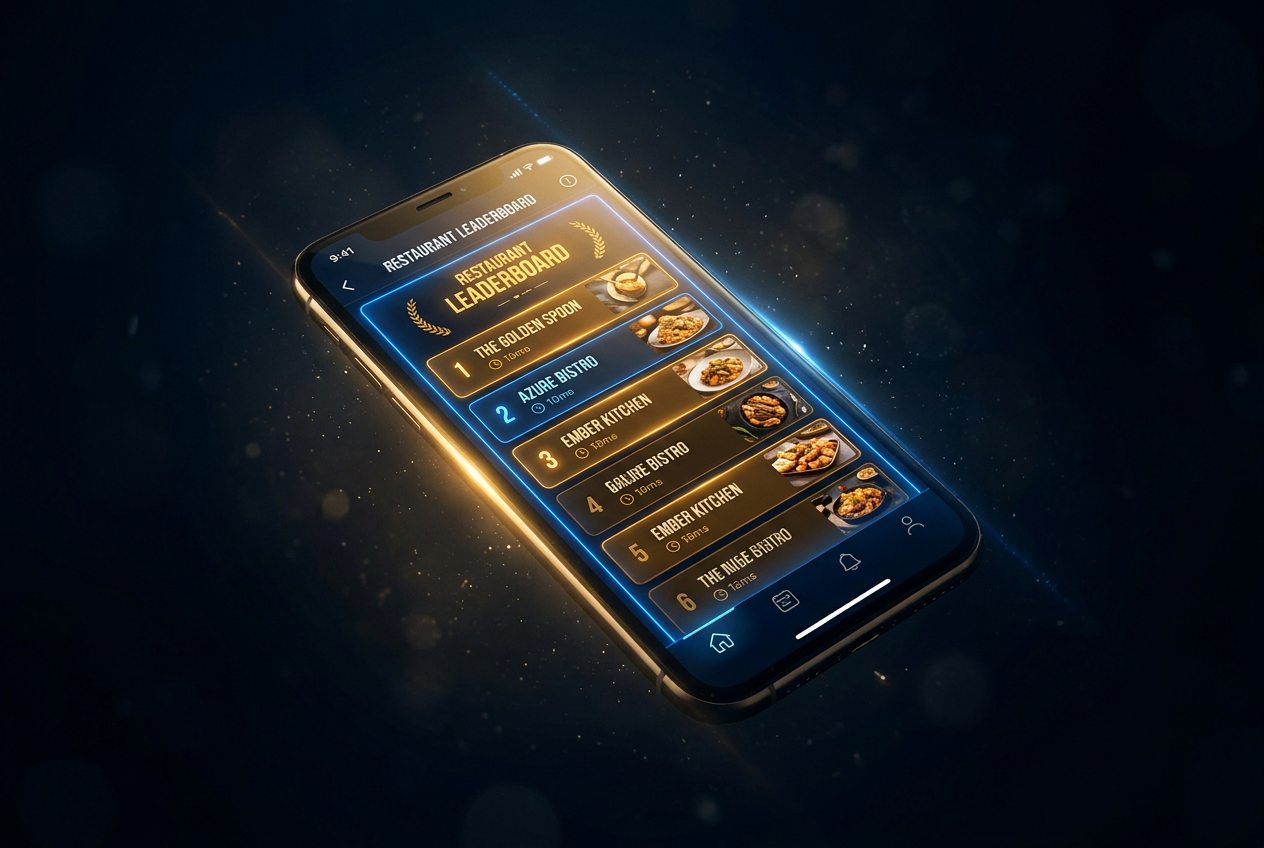
Beyond the Camera Roll: The 2026 Guide to Personal Restaurant Rank Trackers for Serious Foodies
Alex the juice queen
Alex hunts for the best juice bars and presses. She rates every sip and saves her favorites in Savor.
Beyond the Camera Roll: The 2026 Guide to Personal Restaurant Rank Trackers for Serious Foodies Most men don't realize they've eaten at 200+ restaurants this...
Beyond the Camera Roll: The 2026 Guide to Personal Restaurant Rank Trackers for Serious Foodies
Most men don't realize they've eaten at 200+ restaurants this year but can't name their top 10. Not because the meals weren't memorable. Because no one taught you the difference between a generic five-star rating and a personal leaderboard that actually works. That extraordinary bowl of ramen you had three months ago? The specific wagyu cut that changed your understanding of beef? They're buried somewhere in your camera roll alongside 2,000 other unlabeled food photos, slowly decaying into algorithmic oblivion.
The average foodie takes approximately 2,000 food photos per year, then spends an average of 3 minutes searching their camera roll for a specific meal photo from 6 months ago. Modern tracking apps can reduce food memory retrieval time to 3 seconds via searchable metadata. The gap between those two experiences is the difference between treating your culinary life like a disposable Instagram story and treating it like the curated archive it deserves to be.
What follows is the complete picture - what's actually driving the food memory crisis, why the standard "rate restaurants" approach fails, and what actually works instead for the serious foodie who refuses to forget another great meal.
Key Takeaways
- The average foodie takes 2,000 food photos annually but spends 3 minutes searching their camera roll for a single meal from 6 months ago, while modern rank trackers reduce retrieval time to 3 seconds.
- Apps like Beli have accumulated over 70 million restaurant ratings worldwide using Elo-style head-to-head comparisons instead of inflated star systems.
- Dish-level tracking captures what to order at a specific location, not just whether the restaurant is "good" - a critical distinction that generic review platforms miss entirely.
- The choice between social rank trackers like Beli and private archivers like Savor depends on whether you value community leaderboards or personal, AI-powered dish documentation.
- Data sovereignty matters: most tracking apps don't explain how to export your culinary archive if the service shuts down, leaving years of food memories hostage to a single platform.
Table of Contents
- The Camera Roll Graveyard: Why Your 2,000+ Annual Food Photos Are Useless
- The Star Rating Fallacy: Comparative Choice vs. Static Stars
- Choosing Your Tribe: Social vs. Private Tracking
- The Dish-Level Revolution: Tracking Specific Plates, Not Just Restaurants
- Operational Excellence: The Foodie Protocol for 30-Second Meal Logging
- Data Sovereignty: How to Ensure Your Food Memories Aren't Held Hostage
- What Is the Best App for Foodies to Rank Restaurants They've Visited?
- How Does the Beli Elo Ranking System Work?
- Frequently Asked Questions
The Camera Roll Graveyard: Why Your 2,000+ Annual Food Photos Are Useless
The problem isn't that you don't take enough food photos. According to Savor Internal Data from 2025, the average foodie takes approximately 2,000 food photos per year. The problem is what happens next: nothing. Those photos become digital litter - unsearchable, unlabeled, impossible to navigate when you're trying to remember which restaurant served that perfect tonkotsu ramen four months ago. Users spend an average of 3 minutes searching their camera roll for a specific meal photo from 6 months ago, per Savor Research data from 2026.
That three-minute search compounds over time. By the end of a year, you've spent hours scrolling through photo after photo, trying to reconstruct meals from visual memory alone. No restaurant name. No dish name. No notes about what made it special. Just a generic timestamp and a blurry shot of a plate.
The shift from camera roll chaos to organized archive requires one fundamental change: metadata. Modern tracking apps can reduce food memory retrieval time to 3 seconds via searchable metadata, according to the same 2026 Savor Research study. That's a 60x improvement over manual scrolling. The difference isn't just speed - it's the difference between a useless photo library and a functioning culinary database.
 Modern rank trackers turn a chaotic camera roll into a searchable database, reducing memory retrieval time by 98% for the average foodie.
The camera roll graveyard isn't a personal failing. It's a structural problem that requires a structural solution: a system that tags every meal with the restaurant name, dish name, location data, and your own personal rating the moment you photograph it. Without that system, you're not building a culinary archive - you're building a landfill.
The Star Rating Fallacy: Comparative Choice vs. Static Stars
A 4.2-star Google rating tells you nothing about the one dish you should actually order. It's an aggregate score - thousands of subjective opinions averaged into a single, meaningless number. One person gave five stars because the service was friendly. Another gave three stars because the parking was terrible. Neither review tells you whether the cacio e pepe is worth ordering or if you should skip it for the carbonara.
Static star systems suffer from rating inflation. Every restaurant clusters between 3.5 and 4.5 stars, making differentiation impossible. You can't tell the difference between "genuinely excellent" and "adequately mediocre" because both end up around 4.0. The system flattens taste into a homogenous blur.
The Elo-style ranking system used by apps like Beli replaces subjective stars with objective head-to-head comparisons. Instead of asking "How many stars does this restaurant deserve?" the system asks "Which restaurant was better: this one or that one?" Over time, those binary choices build a personal leaderboard that reflects your actual preferences, not an averaged consensus. Beli users have contributed over 70 million restaurant ratings worldwide using this comparative model, according to a 2025 SF Chronicle report.
The Elo system originated in chess. It measures relative skill by comparing head-to-head outcomes. When applied to restaurants, it removes the subjectivity of star ratings and replaces it with a cold, mathematical ranking based on your actual choices. If you consistently choose Restaurant A over Restaurant B in head-to-head comparisons, Restaurant A rises in your personal leaderboard. No stars. No inflation. Just comparative preference.
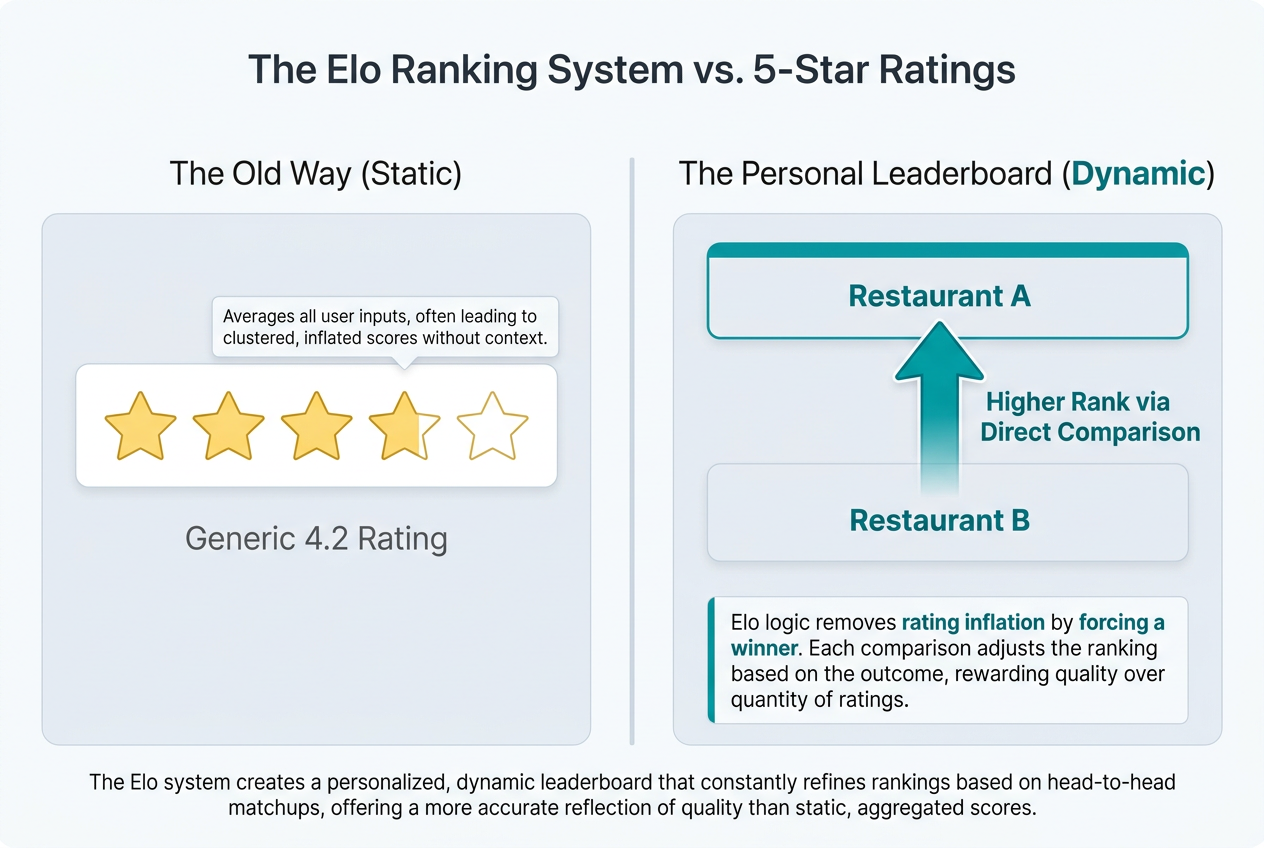 The Elo system used by apps like Beli replaces subjective stars with objective head-to-head comparisons to build a more accurate personal leaderboard.
The shift from stars to comparative choice changes how you evaluate meals. Instead of mentally assigning arbitrary numbers, you answer simple questions: Was this meal better than the last one? Would I choose this restaurant over that one? The system does the math. You just make the call.
Choosing Your Tribe: Social vs. Private Tracking
The decision between social rank trackers and private archivers isn't about features - it's about philosophy. Do you value community validation and public leaderboards, or do you want a private, AI-powered dish database that nobody sees but you? Both approaches solve the camera roll problem. They solve it in fundamentally different ways.
The Socialite: Using Beli for Community and Elo Rankings
Beli is built for the foodie who sees meals as social currency. The app operates like a public leaderboard where users compare restaurants, follow each other's recommendations, and build social status through taste. Beli CEO Judy Thelen maintains a following of over 730,000 users on the platform, according to 2025 Beli App Data reported by the SF Chronicle. Single high-performing restaurants like 'Ernest' in SF have accumulated over 4,000 individual ratings on the platform.
The social model works for discovery. If you want to know where your most trusted foodie friends are eating, Beli provides a live map of their recent visits. The trade-off is privacy. Every meal you log is visible to your network. Every ranking is public. If you're comfortable with that transparency, the community feedback loop is powerful. If you're not, it's suffocating.
Beli raised $12 million in funding since its launch in 2021, per the 2025 SF Chronicle report. The capital went into scaling the social features - friend maps, public leaderboards, influencer networks. The platform thrives on network effects: the more users log meals, the more valuable the map becomes for everyone else.
The Archivist: Using Savor for Dish-Level AI and Personal Databases
Savor operates on the opposite philosophy: meals are private. The app is designed as a personal culinary archive, not a social network. There are no public leaderboards, no follower counts, no likes. Just you, your meals, and an AI system that helps you document every dish at the level of granular detail you choose. The focus shifts from "where should I eat" to "what did I eat, and why did it matter."
The private model wins on specificity. You're not rating restaurants for public consumption - you're building a searchable database of every dish you've ever loved. The AI tagging system recognizes dishes from photos, auto-fills metadata, and creates a memory vault that's fully under your control. No social pressure. No performative posting. Just accurate archiving.
The trade-off is isolation. Savor doesn't tell you where your friends are eating. It doesn't provide discovery. It's designed for the foodie who already knows where to find great meals and just needs a system to remember them. If discovery matters more than memory, Beli wins. If memory matters more than discovery, Savor wins.
The Minimalist: Using Notes or Custom Systems for Zero-Fuss Logging
Some foodies reject both options entirely and default to Apple Notes, Google Keep, or custom spreadsheets. The appeal is simplicity: no social pressure, no subscription fees, no feature bloat. Just a text file with restaurant names and dish notes. The system works until it doesn't - usually around the 100-meal mark, when manual organization collapses under its own weight.
The minimalist approach is defensible for small datasets. If you only eat out 20 times a year and want zero friction, a Notes document does the job. But it scales poorly. You can't search by location. You can't filter by cuisine type. You can't export the data. When the system inevitably breaks, you're back to the camera roll graveyard, just in a different format.
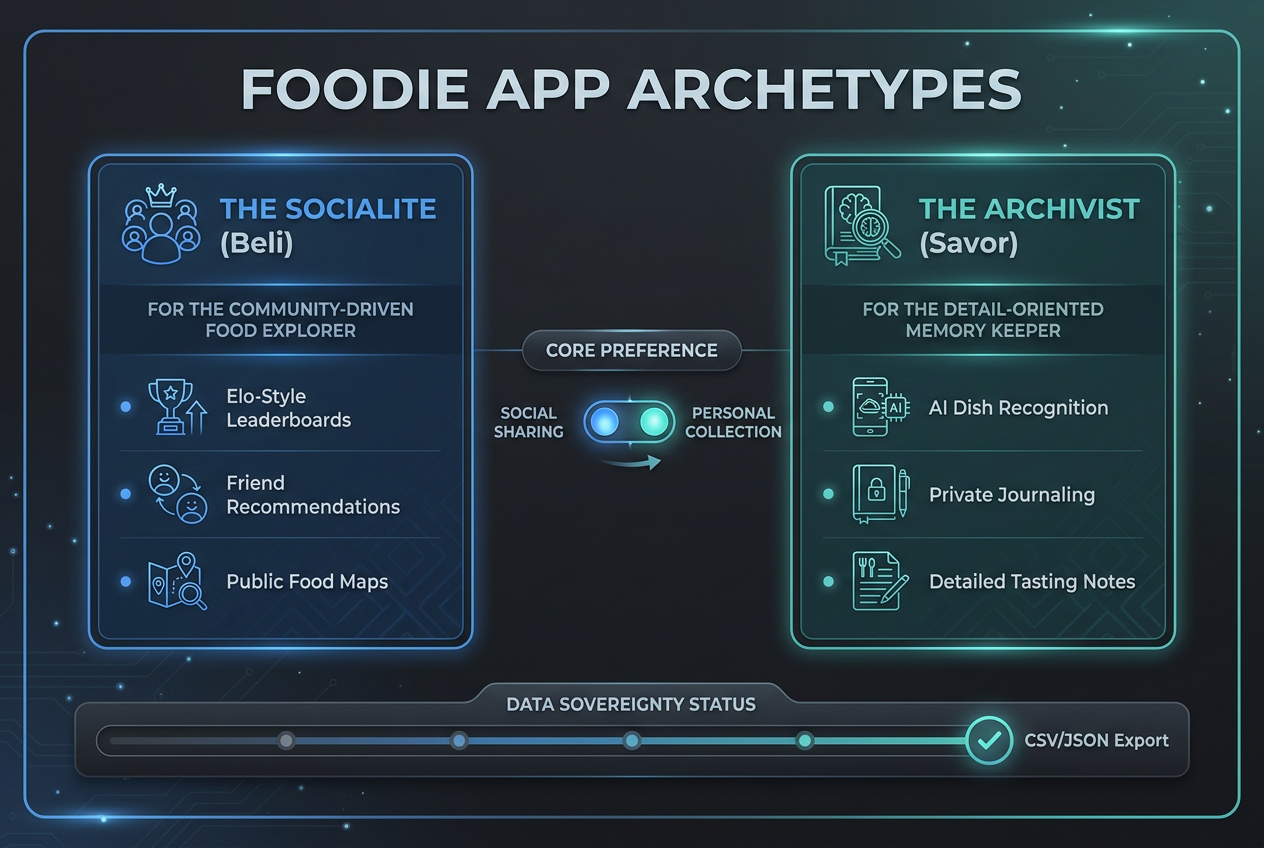 Choosing the right rank tracker depends on whether you value social status and community maps or private, AI-powered dish-level documentation.
| Feature | Beli (Social) | Savor (Private) | Notes (Minimalist) |
|---|---|---|---|
| Public leaderboard | Yes | No | No |
| AI dish recognition | No | Yes | No |
| Friend discovery | Yes | No | No |
| Data export | Limited | Full CSV | Manual copy |
| Focus | Community ranking | Personal archive | Zero friction |
| Best for | Social foodies | Memory maximalists | Casual diners |
The Dish-Level Revolution: Tracking Specific Plates, Not Just Restaurants
The most effective trackers move beyond general restaurant ratings to document specific dishes, ensuring you never forget what to order. A restaurant isn't good or bad - it's a collection of individual dishes, some exceptional, some forgettable. Tracking at the dish level solves the precision problem that generic star systems ignore.
Consider a sushi restaurant. The omakase might be transcendent. The lunch bento might be mediocre. If you rate the restaurant as a whole, you average those experiences into a useless middle score. If you rate the dishes individually, you know exactly what to order next time: the omakase, always, and never the bento. That specificity is the entire point.
Dish-level tracking requires three data points: restaurant name, dish name, and dish-specific rating. Everything else - photos, notes, price - is secondary. Without those three anchors, you're back to vague memories and unreliable reconstructions. With them, you have a precise map of every plate worth ordering in your city.
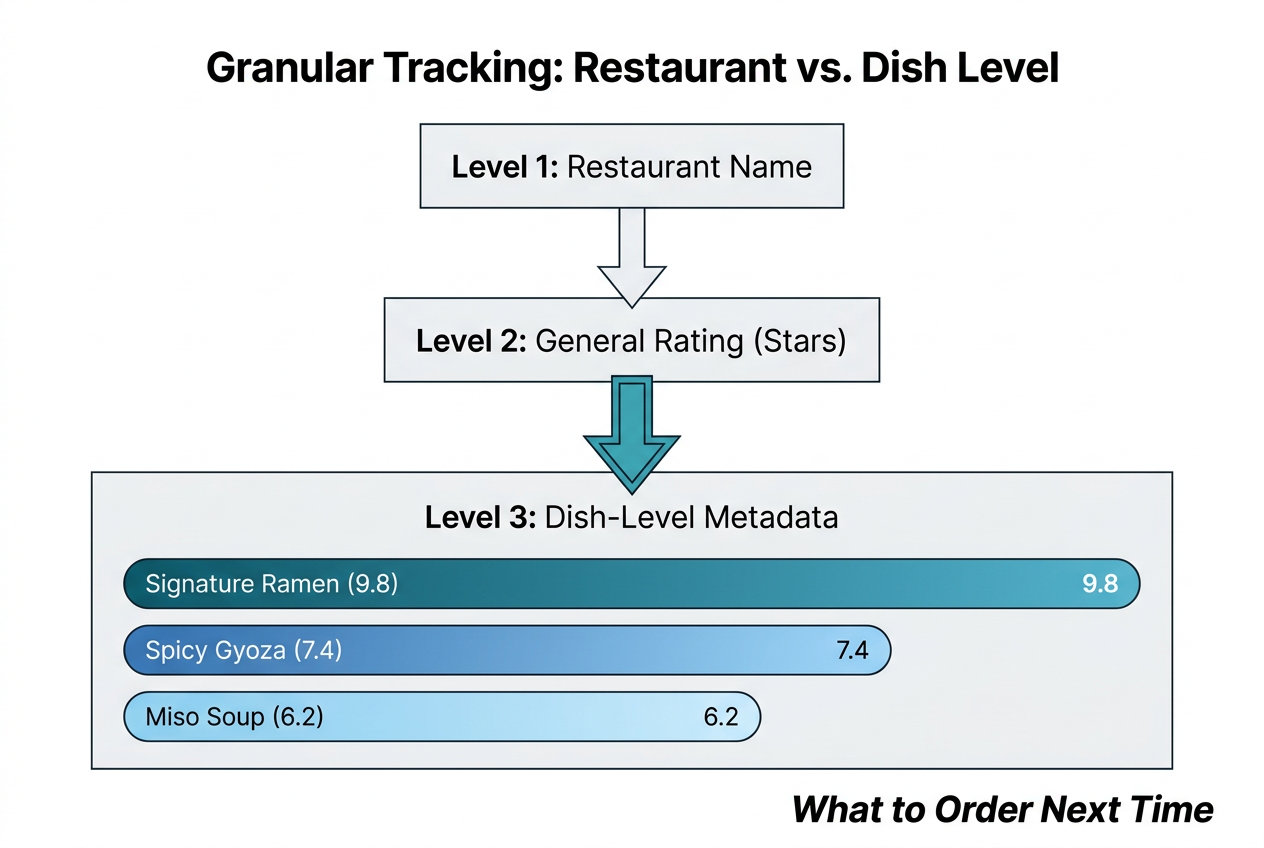 The most effective trackers move beyond general restaurant ratings to document specific dishes, ensuring you never forget what to order.
The shift to dish-level tracking changes how you approach menus. Instead of ordering randomly or following the server's recommendation, you consult your own database. You know which plates you loved, which you hated, and which you've never tried. The decision becomes data-driven, not instinct-driven. Over time, your hit rate improves. Fewer disappointing meals. More consistently excellent choices.
There are currently 3.6 million restaurant reviews in the Bay Area alone on the Beli app, according to Beli CTO Eliot Frost speaking to the SF Chronicle in 2025. That's a massive dataset. But if those reviews don't distinguish between dishes, the signal degrades. A restaurant with 4,000 ratings (like Ernest in SF) still doesn't tell you which specific plate to order. Dish-level tracking fixes that gap.
For a deeper dive into organizing and rating individual dishes, check out the 5 best apps to track and rate individual dishes.
Operational Excellence: The Foodie Protocol for 30-Second Meal Logging
The best tracking system in the world fails if you don't use it. The primary barrier to consistent logging is friction: the belief that documenting a meal requires five minutes of typing and photo editing while your dining companion stares at their phone. It doesn't. With the right protocol, you can log a meal in under 30 seconds without being "that person" at the table.
Step 1: Photo first, everything else later. Take the dish photo when it arrives, before the first bite. The photo is the anchor - everything else can be added later. Most tracking apps allow you to retroactively tag photos from your camera roll, so there's no pressure to complete the entry at the table.
Step 2: Voice memo for immediate impressions. If you want to capture first-bite reactions, use a voice memo app (built into every smartphone). Record a 10-second note: "Tonkotsu ramen at Ippudo, rich broth, perfectly cooked egg, would order again." Transcribe it later. The memo preserves the immediacy without disrupting the meal.
Step 3: Batch-process entries at the end of the day. Set aside 10 minutes before bed to tag photos, add ratings, and write notes. This ritual removes the social awkwardness of logging at the table and creates a consistent habit. Most foodies who fail at food tracking fail because they try to log in real-time. Batch processing solves that problem.
Step 4: Use app shortcuts for repeat visits. Most tracking apps allow you to favorite restaurants or create quick-access shortcuts. If you return to the same restaurant frequently, the app should auto-fill the location data. You just add the new dish and rating. Over time, this reduces per-meal logging to 15 seconds.
The 30-second protocol isn't about speed for speed's sake. It's about removing friction so that logging becomes automatic instead of optional. The moment documentation feels like work, compliance drops to zero. The protocol keeps it effortless.
If you're serious about building a restaurant tracking habit, this guide to the 5 best apps to track restaurant meals breaks down which systems work for different logging styles.
Data Sovereignty: How to Ensure Your Food Memories Aren't Held Hostage
Most rank tracker apps don't explain how to export your data if the service shuts down. That's not an accident - it's a design choice. Platforms thrive on lock-in. If your entire culinary archive lives in a proprietary database with no export function, you're hostage to that platform's survival. When the app eventually shuts down (and most apps eventually do), your data disappears with it.
The solution is data portability: the ability to export your complete archive in a non-proprietary format like CSV or JSON. Only a handful of apps support this. Savor provides full CSV export of all logged meals, dishes, ratings, photos, and notes. Beli's export options are limited - you can download your photos, but not the associated metadata or rankings. That asymmetry matters.
Why CSV matters: A CSV file is readable by any spreadsheet program (Excel, Google Sheets, Numbers) and can be imported into any future tracking system. It's the digital equivalent of owning the recipe cards, not just having access to the cookbook. If the app dies, you keep your data. If a better app launches, you migrate without loss.
The sovereignty test: Ask any food tracking app three questions before committing your archive to it. (1) Can I export my complete dataset? (2) In what format? (3) Does the export include photos or just text? If the answer to any of those questions is "no" or "we're working on it," you're building on rented land. When the landlord evicts you, your archive is gone.
The data sovereignty problem extends beyond app shutdowns. Some platforms reserve the right to use your meal data for advertising, partner deals, or algorithm training. Read the terms of service. If the app monetizes your data without explicit consent or compensation, you're not the customer - you're the product. Private archivers like Savor operate on a zero-data-monetization model. Social platforms like Beli operate on a network-effect model where your data feeds the community map. Neither approach is inherently wrong, but you should know which model you're signing up for.
For more context on building a food archive that survives platform churn, see how to build a personal restaurant library.
What Is the Best App for Foodies to Rank Restaurants They've Visited?
The best app for ranking restaurants depends on whether you prioritize social discovery or private memory archiving. For social foodies who value community leaderboards and friend recommendations, Beli remains the dominant platform with over 70 million restaurant ratings worldwide and a sophisticated Elo-based ranking system. For private archivers who want dish-level AI recognition and full data export capabilities, Savor provides the most robust personal database system with zero social pressure.
Beli excels at discovery. If you want to know where the most trusted foodies in your city are eating, Beli's friend map and public leaderboard provide real-time recommendations. The Elo ranking system eliminates star inflation by forcing head-to-head comparisons instead of subjective scores. The result is a personal leaderboard that accurately reflects your taste, not the crowd's average opinion.
Savor excels at memory. If you've already figured out where to eat and just need a system to remember every great dish, Savor's AI tagging and dish-level documentation provide the most granular archive available. The app treats meals as private data - no social features, no public sharing, just a searchable database of your culinary history. The full CSV export ensures you own your data permanently, regardless of platform survival.
Other contenders include Crumble (simplified 5-point dish ratings with a friends-only map), Yummi (visual timeline-based journaling), and Memolli (minimalist manual notes with custom fields). Each serves a specific niche, but none match the scale of Beli's social network or the granularity of Savor's private archive.
For a broader comparison of restaurant tracking tools, the 10 best restaurant tracking apps guide breaks down each platform's strengths and limitations.
How Does the Beli Elo Ranking System Work?
The Beli Elo ranking system uses head-to-head restaurant comparisons to build a personal leaderboard that reflects your actual preferences instead of inflated star ratings. Instead of asking "How many stars does this restaurant deserve?" the system asks "Which restaurant was better: this one or that one?" Over time, those binary choices generate a mathematical ranking where restaurants that consistently beat competitors rise to the top of your personal list.
The system originated in chess, where it measures relative skill by comparing match outcomes. When applied to restaurants, it removes the subjectivity of arbitrary star ratings and replaces it with cold, comparative logic. If you consistently choose Restaurant A over Restaurant B in head-to-head matchups, Restaurant A gains Elo points while Restaurant B loses them. The point differential reflects how strongly you prefer one over the other.
How it works in practice: After logging a meal at a restaurant, Beli prompts you with a head-to-head comparison: "Was this restaurant better than [Restaurant X]?" You answer yes, no, or skip. The app tracks your choices across dozens of comparisons and uses those inputs to calculate each restaurant's Elo score. Restaurants you favor rise. Restaurants you disfavor fall. The leaderboard updates dynamically as you log more meals.
Why it's better than stars: Star systems suffer from rating inflation because everyone has a different internal scale. One person's 4-star experience is another person's 3-star experience. The Elo system eliminates that noise by forcing you to make relative choices instead of absolute judgments. The question isn't "How good is this restaurant?" The question is "Is this restaurant better than that one?" That binary choice is far easier to answer consistently.
The scale problem: Elo works brilliantly for ranking within a city or cuisine type, but it breaks down when comparing across categories. Is the best sushi restaurant in San Francisco better than the best taco truck in Los Angeles? The system doesn't know. It can only rank items within a comparable set. Beli handles this by allowing users to create separate leaderboards for different categories (e.g., "SF sushi" vs. "LA tacos").
Beli users have contributed over 70 million restaurant ratings worldwide using this comparative model, according to a 2025 SF Chronicle report. That's a dataset large enough to generate statistically reliable personal leaderboards for most active users. If you've logged 50+ restaurants and made 200+ head-to-head comparisons, your Elo-based leaderboard is likely more accurate than any star-based system you've ever used.
To explore alternative ranking systems and apps, check out the best food review apps overview.
Frequently Asked Questions
Is the Beli app legit?
Yes, Beli is a legitimate restaurant ranking app with over 70 million user-contributed ratings worldwide and $12 million in funding since its 2021 launch, according to a 2025 San Francisco Chronicle report. The app uses an Elo-style ranking system to help users build personal restaurant leaderboards based on head-to-head comparisons rather than inflated star ratings. The platform operates as a social network where users follow each other's recommendations and contribute to a community-driven map of restaurants. CEO Judy Thelen maintains a following of over 730,000 users on the platform, and single high-performing restaurants like 'Ernest' in SF have accumulated over 4,000 individual ratings. The app is free to download and use, with no reports of data breaches or fraudulent activity. It's a credible tool for foodies who value social discovery and comparative ranking systems.
Is Beli still invite only?
No, Beli is no longer invite-only as of 2025. The app initially launched with an invite-only model to control growth and build a curated community of food enthusiasts, but it has since opened to the general public and is available for free download on iOS and Android. Anyone can now create an account, start logging restaurant visits, and participate in the head-to-head ranking system without needing an invitation code. The app's growth has been substantial - it now hosts over 70 million restaurant ratings worldwide, according to 2025 data reported by the SF Chronicle. While the invite-only period helped establish a core user base of serious foodies, the platform's current strategy focuses on expanding access to reach a broader audience while maintaining the quality of community recommendations.
What is the app that keeps track of restaurants?
The best app that keeps track of restaurants depends on whether you prioritize social discovery or private archiving. Beli is the leading social tracker with over 70 million user ratings worldwide, using an Elo-style ranking system to build personal leaderboards based on head-to-head restaurant comparisons. It excels at community-driven discovery and public friend maps. Savor is the leading private tracker, focusing on dish-level AI recognition and full data export capabilities for foodies who want a personal culinary database without social features. Other options include Crumble (friends-only maps with simplified 5-point dish ratings), Yummi (visual timeline-based journaling), and Memolli (minimalist manual notes with custom fields). Each serves a specific use case, but Beli and Savor dominate the category for active foodies who log 50+ meals annually. For casual diners who only need to track 10-20 restaurants a year, a simple Notes app or Google Sheet may suffice, but those systems scale poorly once your dataset exceeds 100 entries.
How to track restaurants you've been to?
To track restaurants you've been to effectively, use a dedicated rank tracker app like Beli or Savor rather than relying on your phone's camera roll. Start by taking a photo of each dish when it arrives, then either log the meal immediately using voice memos or batch-process entries at the end of the day to avoid social awkwardness. Include three essential data points for every entry: restaurant name, dish name, and your personal rating. Most tracking apps allow you to add location data, photos, and detailed notes, but those three anchors are mandatory - without them, your archive degrades into useless clutter. Set aside 10 minutes each evening to retroactively tag photos and add ratings, which reduces per-meal logging time to under 30 seconds. Over time, this ritual becomes automatic. For serious foodies, dish-level tracking (rating individual plates rather than entire restaurants) provides the most actionable data - you'll know exactly what to order on your next visit. Apps like Savor offer AI dish recognition to auto-fill metadata, while apps like Beli use head-to-head comparisons to build personal leaderboards that avoid star rating inflation.
How is Beli different from Yelp?
Beli differs from Yelp by using a personal, comparative Elo ranking system instead of public star ratings, and it's designed as a social network for foodies rather than a general business review platform. Yelp aggregates crowd-sourced star ratings from millions of users, which leads to rating inflation where most restaurants cluster between 3.5 and 4.5 stars, making differentiation impossible. Beli replaces stars with head-to-head comparisons - "Was this restaurant better than that one?" - which builds a personal leaderboard that reflects your actual preferences rather than an averaged consensus. Beli is also explicitly social: you follow other foodies, view their restaurant maps, and build status through your ranking activity. Yelp is transactional: you search for a restaurant, read reviews, and leave. Beli users have contributed over 70 million restaurant ratings worldwide using the comparative model, according to 2025 SF Chronicle data. The platform raised $12 million in funding to scale its social features, while Yelp operates as an advertising-driven review aggregator. If you want to discover where your friends are eating and build a curated taste network, Beli wins. If you want comprehensive business information (hours, photos, health scores), Yelp wins.
What does Gen Z use instead of Yelp?
Gen Z foodies increasingly use personal rank tracker apps like Beli, Savor, and Crumble instead of Yelp, prioritizing private or friend-curated recommendations over anonymous public reviews. This shift is driven by distrust of Yelp's star inflation, algorithmic manipulation, and ad-heavy interface. Beli's Elo-based ranking system and social friend maps appeal to Gen Z users who want to follow trusted tastemakers rather than read reviews from strangers. Savor's private, AI-powered dish archive appeals to users who treat meals as personal data rather than social currency. Crumble's friends-only map eliminates the noise of public reviews entirely, creating a closed ecosystem of curated recommendations. TikTok and Instagram also function as informal restaurant discovery platforms for Gen Z, where creators share specific dishes and experiences rather than generic star ratings. The common thread is personalization: Gen Z wants tools that reflect their individual taste, not the crowd's average opinion. According to 2025 usage data, Beli alone has accumulated 3.6 million restaurant reviews in the Bay Area, suggesting significant adoption among younger foodies who reject traditional review platforms.
Is there a Letterboxd for restaurants?
Yes, several apps now function as "Letterboxd for restaurants," with Beli and Savor leading the category in 2025. Letterboxd allows film enthusiasts to log, rate, and review every movie they've seen, creating a personal archive and social network around shared taste. Beli replicates this model for restaurants with an Elo-based ranking system and social friend maps, allowing users to follow each other's dining activity and build public leaderboards. Savor takes a more private approach, focusing on dish-level archiving with AI recognition and full data export, treating meals as personal memory vaults rather than social content. Both apps solve the "camera roll graveyard" problem that Letterboxd solved for film: they transform unsearchable photos into a curated, searchable database with metadata. Other contenders include Crumble (friends-only food maps) and Yummi (visual timeline journals), but neither matches the scale or feature depth of Beli and Savor. The key distinction is whether you want a social platform (Beli) or a private archive (Savor) - Letterboxd straddles both, while restaurant trackers tend to specialize in one or the other.
What is the highest rated food tracking app?
The highest-rated food tracking app varies by use case: Beli leads for social restaurant ranking with an Elo-based leaderboard system, while Savor leads for private dish-level archiving with AI recognition and full CSV export. Beli has accumulated over 70 million restaurant ratings worldwide and raised $12 million in funding since 2021, according to 2025 SF Chronicle data, making it the most widely adopted social rank tracker among serious foodies. Savor focuses on memory over discovery, providing the most granular dish documentation available with zero social pressure. Other highly rated options include MyFitnessPal (best for calorie tracking), Cronometer (best for micronutrient tracking), and Lose It! (best for weight loss). However, those apps optimize for health metrics rather than taste memory, which is the primary concern for most restaurant-focused foodies. For users who want to remember every great meal rather than track macros, Beli and Savor are the clear category leaders in 2025. App store ratings for both exceed 4.5 stars, with user reviews praising Beli's comparative ranking logic and Savor's data sovereignty features.
What is the app that makes rating restaurants fun again?
Beli is the app most commonly cited as "making rating restaurants fun again" through its gamified Elo ranking system and social leaderboard features. Instead of assigning arbitrary star ratings, Beli forces users to answer simple head-to-head questions: "Was this restaurant better than that one?" Over time, those binary choices generate a personal leaderboard that feels more like a game than a chore. The app has accumulated over 70 million restaurant ratings worldwide, with users competing to build the most comprehensive and trusted taste profiles. CEO Judy Thelen maintains a following of over 730,000 users on the platform, and single high-performing restaurants like Ernest in SF have over 4,000 individual ratings, according to 2025 Beli App Data reported by the SF Chronicle. The social element amplifies the fun: you follow friends, see their recent meals in real-time, and build status through your ranking activity. For users who find traditional review writing tedious, Beli's comparative choice model reduces friction to a single tap - "this was better than that" - which makes consistent logging feel effortless.
Your camera roll doesn't have to be a graveyard. With the right rank tracker, every meal you love becomes a searchable, permanent record - a personal leaderboard that actually reflects your taste instead of an algorithm's guess. The tools exist. The only question is whether you'll use them before the next great meal fades into memory.