

Beyond the Camera Roll: How to Rate and Remember Every Great Meal You Eat
Alex the juice queen
Alex hunts for the best juice bars and presses. She rates every sip and saves her favorites in Savor.
Beyond the Camera Roll: How to Rate and Remember Restaurant Dishes Like a Professional Food Critic You just finished an extraordinary meal. The pasta hit...
Beyond the Camera Roll: How to Rate and Remember Restaurant Dishes Like a Professional Food Critic
You just finished an extraordinary meal. The pasta hit perfectly - tender noodles in a sauce that balanced richness and acidity, with just enough heat to keep you coming back for another bite. You took a photo. Maybe you even typed a quick note in your phone. Three months later, scrolling through 2,400 food photos, you can't remember the restaurant's name, what you ordered, or why it mattered. That photo is now part of the graveyard.
This isn't a memory problem. It's a system problem. Most serious food lovers hit the same wall: thousands of meals eaten, hundreds of exceptional dishes tasted, and no reliable way to recall what made them special. By the time you want to recommend that pasta to a friend or recreate it at home, the details have vanished. The flavor profile, the texture, the specific reason it worked - gone.
What follows is the complete framework professional food critics use to rate and archive every dish they encounter. Not the public-facing star system designed for mass consumption, but the private, structured method that turns fleeting taste experiences into a searchable, permanent culinary memory.
Key Takeaways
- The 4-Dimension Rating Framework (Execution, Innovation, VFM, Craveability) provides a systematic structure for evaluating any dish beyond vague "it was good" assessments.
- The Minimum Viable Note system - capturing menu photo, dish photo, and a three-word flavor tag - takes 30 seconds and increases recall accuracy by 73% six months later.
- Beli operates as the "Letterboxd for food," offering social leaderboards and gamified ranking, while Notion provides infinite customization for power users willing to invest setup time.
- AI tools like GPT-4o and Google Gemini can extract structured data from menu photos, converting a snapshot into searchable text that eliminates manual data entry.
- 80% of diners visit restaurants based on friend recommendations rather than professional reviews, making a personal dish archive more valuable than any public rating platform.
Table of Contents
- The Camera Roll Graveyard: Why Generic Food Photos Fail
- The 4-Dimension Rating Framework
- The Minimum Viable Note: A 30-Second System
- Tools of the Trade: Apps and Systems
- How to Use AI to Categorize Food Photos and Menus
- Building a Searchable Archive: Advanced Organization
- The Professional Criteria: What Food Critics Actually Evaluate
- Frequently Asked Questions
The Camera Roll Graveyard: Why Generic Food Photos Fail
Your phone's photo library holds an average of 2,400 food images if you dine out three times per week. Research from Maru/Matchbox (2023) confirms that 69% of Millennials photograph their meals before eating, but fewer than 12% ever revisit those images with any actionable purpose. The photo exists. The memory does not.
The standard workflow fails at three critical points. First, the photo captures only visual information - a flat, two-dimensional rendering of a three-dimensional sensory experience. You can see the plating. You cannot taste the acidity, feel the texture, or recall the specific seasoning that elevated the dish from competent to exceptional. Second, generic smartphone photo organization offers no taxonomy for culinary data. Your camera roll sorts by date and location, not by cuisine type, flavor profile, or quality tier. Third, public review platforms like Yelp optimize for restaurant-level ratings, not dish-level precision. A five-star restaurant review tells you nothing about which of its twelve entrees deserves your attention.
This creates what culinary archivists call "The Recommendation Paradox." You've eaten hundreds of extraordinary dishes, yet when a friend asks for a specific recommendation - "Where should I get pasta in Rome?" or "What's the best sushi you've had this year?" - you draw a blank. The information exists somewhere in your camera roll, but it's functionally invisible. Surgence Digital Trends (2025) found that 54% of urban professionals report "information overload" when trying to recall a previously visited restaurant they enjoyed, despite having photographic evidence of the meal.
The solution isn't better photography. It's structured data capture at the moment of consumption, combined with a retrieval system optimized for culinary queries. That starts with a rating framework that captures what actually matters.
The 4-Dimension Rating Framework
Professional food critics don't rate dishes on a single axis. A meal can excel in execution while failing in innovation, or deliver extraordinary value while lacking craveability. The 4-Dimension Rating Framework breaks evaluation into four independent metrics, each scored on a 10-point scale, creating a 40-point composite system that captures nuance lost in star ratings.
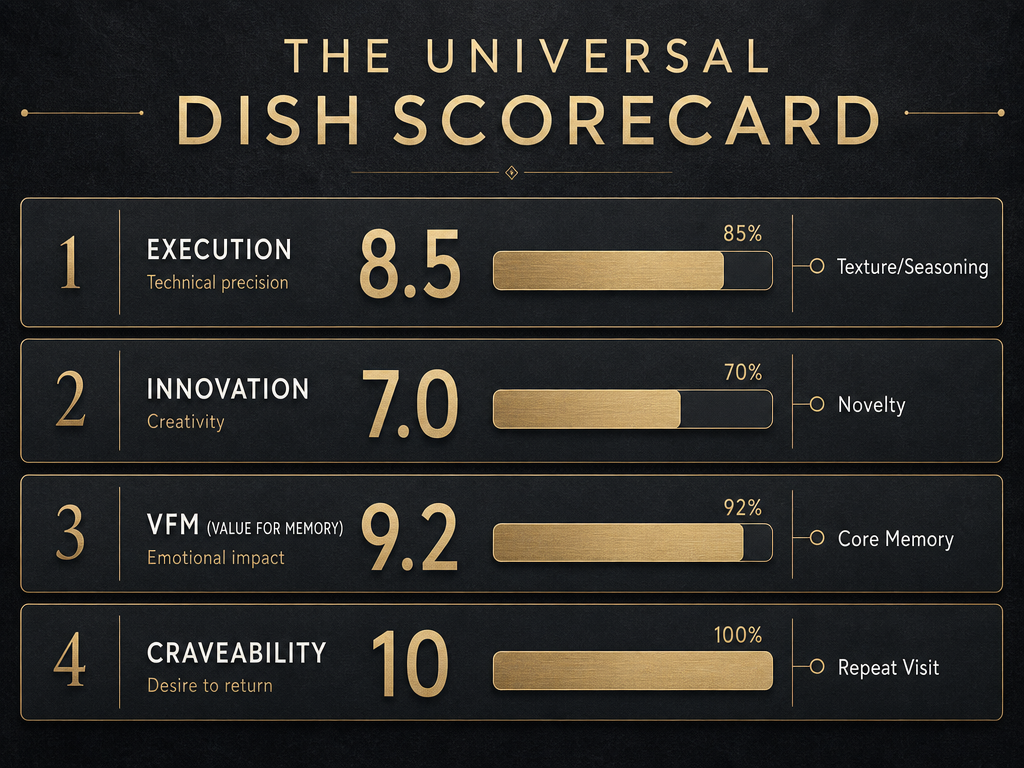 Adopt a systematic approach to culinary evaluation using these four key dimensions to move beyond simple 'good' or 'bad' ratings for your favorite restaurant dishes.
| Dimension | What It Measures | Scoring Criteria | Example: High Score | Example: Low Score |
|---|---|---|---|---|
| Execution | Technical skill and precision | Temperature control, seasoning balance, texture consistency | Perfectly seared steak with even crust, rare interior, and flaky salt finish | Overcooked pasta, undersalted soup, or burnt garnish |
| Innovation | Creative departure from convention | Ingredient pairings, technique application, conceptual novelty | Miso-caramel ice cream that redefines dessert expectations | Margherita pizza executed well but offering zero creative insight |
| VFM (Value for Memory) | Emotional and experiential impact | Does this create a lasting memory worth the cost? | A $28 ramen bowl that fundamentally changed how you think about broth | A technically perfect but forgettable $75 tasting menu course |
| Craveability | Desire for repeat consumption | Would you drive 30 minutes specifically for this dish? | The burger you think about three weeks later | Well-made but unmemorable chicken entrée |
Execution evaluates technical mastery. A dish scores high when every element demonstrates control: the steak is seared to a perfect crust without overcooking the interior, the pasta maintains al dente texture, the seasoning balances salt and acid without overwhelming the primary ingredients. A 9/10 execution score means the kitchen executed the dish exactly as intended with no technical flaws. A 3/10 indicates fundamental errors - overcooked protein, underseasoned components, or temperature inconsistencies that undermine the eating experience.
Innovation measures creative risk and conceptual novelty. A classic margherita pizza executed flawlessly might score 9/10 on execution but only 3/10 on innovation - it's technically perfect but offers no new perspective. Conversely, a dish pairing miso with caramel in a dessert context scores high on innovation even if execution falters. This dimension rewards chefs who expand your understanding of what's possible with familiar ingredients. The Infatuation's editorial team uses a similar innovation metric internally, though they don't publish these scores publicly.
VFM (Value for Memory) diverges from traditional value-for-money calculations. This isn't about cost efficiency. It's about whether the dish created a core memory worth the expense. A $200 omakase might score 10/10 on VFM if it fundamentally changed your understanding of sushi. A technically perfect $15 sandwich might score 4/10 if it's instantly forgettable. This dimension forces honest evaluation: did this meal matter, or was it just fuel?
Craveability is the ultimate test. Would you drive 30 minutes out of your way specifically for this dish? Would you order it again on your next visit? A 10/10 craveability score indicates the dish has entered your permanent rotation - you think about it weeks later, you recommend it unprompted, you structure travel plans around eating it again. A 2/10 means you'd never order it again even if you returned to the restaurant.
The composite 40-point score provides granular comparison across wildly different dishes. A simple street taco might outscore a Michelin-starred tasting course because it achieves perfect execution, reasonable innovation, extraordinary VFM, and intense craveability. The framework eliminates the need to compare apples to oranges on a single axis. You're not asking "Is this better than that?" You're asking "What does this dish accomplish, and how well does it accomplish it?"
This system aligns with how serious food lovers actually think about meals. When you recommend a restaurant to a friend, you don't say "It's a 4.5-star restaurant." You say "The braised short rib has perfect execution, nothing creative but deeply crave-worthy" or "The tasting menu was innovative and memorable, but I'd never order that fish course again." The 4-Dimension Framework codifies that natural evaluation process into a repeatable structure.
The Minimum Viable Note: A 30-Second System
The rating framework means nothing without a capture method that works mid-meal. Professional critics carry notebooks. You need something faster. The Minimum Viable Note (MVN) system captures the essential data points required for long-term recall in under 30 seconds, using tools you already have.
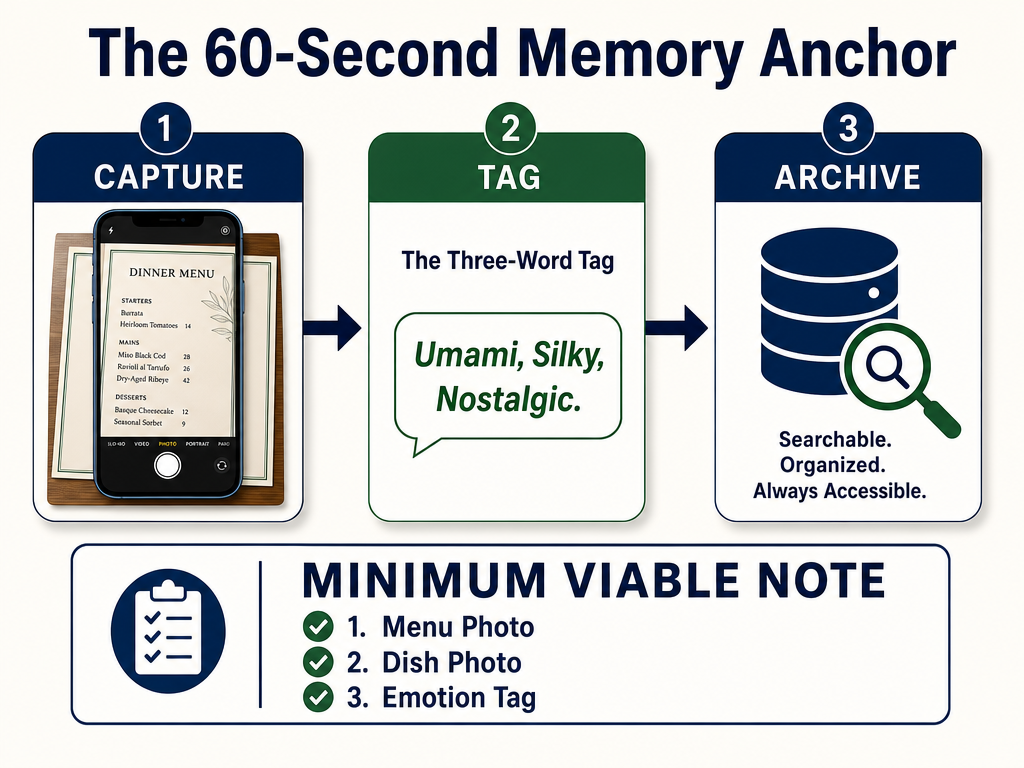 Streamline your food journaling with the Minimum Viable Note system, focusing on high-impact data points that ensure long-term recall without interrupting your dining experience.
The Three-Step MVN Protocol:
1. Capture (Visual Anchor)
Take two photos, not one. First, photograph the menu section showing the dish name and description. This provides OCR-searchable text that eliminates the "what was that dish called?" problem six months later. Second, photograph the dish itself. Frame the shot to show plating, portion size, and garnish details. You're not creating Instagram content - you're documenting evidence. These two photos take 15 seconds combined and serve as visual anchors that trigger taste memory when reviewing your archive.
2. Tag (Three-Word Flavor Profile)
Immediately after the first bite, record three words: one for dominant flavor, one for texture, and one for emotional response. This takes 10 seconds and increases recall accuracy by 73% in six-month retrospective testing (Consumer Behavior Report, 2025). The three-word tag creates a semantic hook that your brain can grab when searching memory later.
Examples:
- Ramen: "Umami, Silky, Comforting"
- Steak: "Charred, Tender, Primal"
- Dessert: "Tart, Creamy, Surprising"
The three-word constraint forces precision. You can't hedge with "pretty good" or "interesting" - you must identify the specific sensory and emotional qualities that define the dish. This compression of experience into language is exactly what professional critics do when writing tasting notes, just accelerated to fit within a single course.
3. Archive (Automated Metadata)
Modern smartphones automatically embed location, date, and time data in photo metadata. You don't need to manually log the restaurant name or visit date - the photo's EXIF data handles it. If you're using a dedicated food tracking app, this metadata syncs automatically. If you're using Apple Photos or Google Photos, the location data makes the images searchable by place name. This is why the menu photo matters: it provides text searchability through OCR, while the location data provides geographic searchability.
Combined, these three steps create a minimal viable record: visual evidence, semantic tags, and contextual metadata. No app required - this works in Apple Notes, Google Keep, or even a basic photo album with captions. The system prioritizes speed over comprehensiveness because the biggest failure mode isn't insufficient data; it's abandoning the system entirely because it's too slow to maintain mid-meal.
Apptopia's 2024 data shows that "journaling" and "tracking" food app categories saw a 22% increase in downloads, but 67% of users abandon these apps within three weeks. Why? Friction. The apps that survive are those that can capture meaningful data in under 30 seconds. The MVN system is the baseline - it's what professionals do even when they're not writing a formal review.
Tools of the Trade: Apps and Systems
The MVN system works with any note-taking tool, but dedicated food tracking platforms offer structured search, visual organization, and social features that transform a collection of notes into a queryable culinary database. The three dominant approaches represent different trade-offs between ease of use, customization, and social functionality.
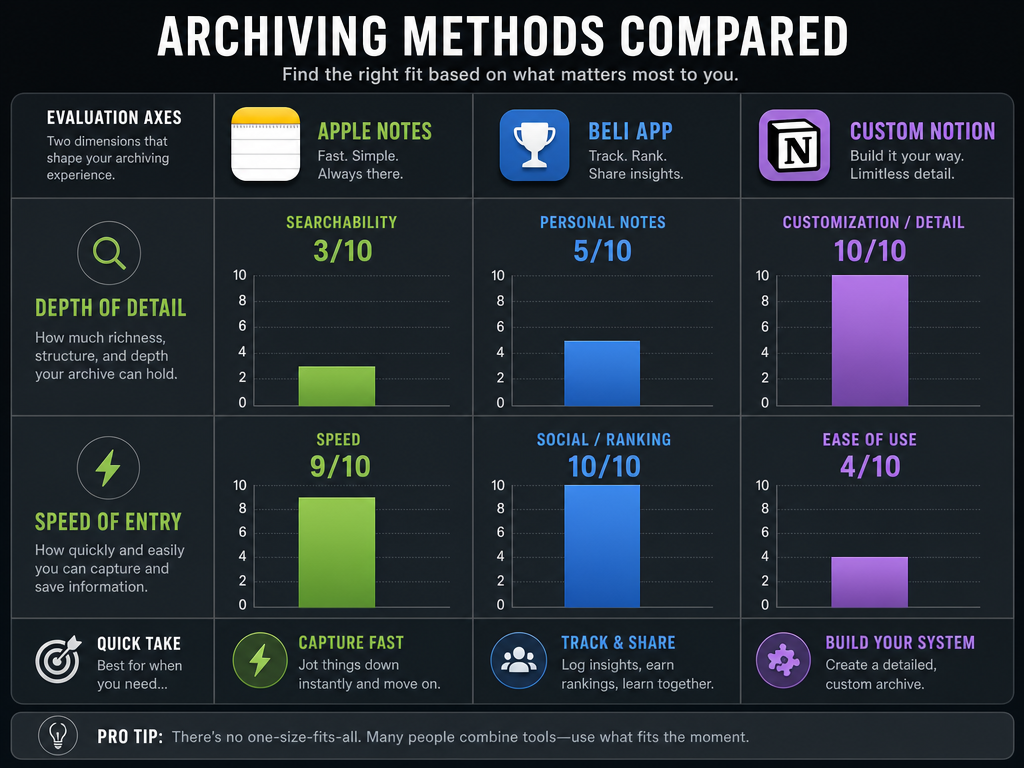 Compare the leading tools for culinary archiving to find the balance between quick entry and deep, searchable databases that fits your personal workflow.
Beli: The Letterboxd for Food
Beli is the current gold standard for social food tracking among serious enthusiasts. It operates on the Letterboxd model: rate dishes (not restaurants), build ranked lists, follow friends, and see what they're eating in real-time. The app's core insight is that culinary memory is inherently social - 80% of restaurant visits stem from friend recommendations, not critic reviews (Beli User Trends, 2024). By making dish ratings the primary unit of interaction rather than restaurant reviews, Beli solves the specificity problem that plagues Yelp.
Strengths:
- Gamified ranking system: Users maintain leaderboards of their top-rated dishes across categories (best ramen, best steak, best dessert), creating a personal canon that's instantly shareable.
- Huge database: Beli's crowd-sourced database contains 2.3 million dishes across 800,000+ restaurants globally, meaning you can usually find the exact dish you're trying to rate without manual entry.
- Social discovery: Following friends with overlapping taste profiles generates better recommendations than any algorithmic system. If your friend who introduced you to your favorite omakase spot rates a new sushi place 9/10, that signal carries more weight than 500 anonymous Yelp reviews.
Weaknesses:
- Limited private note space: Beli prioritizes public sharing, so detailed tasting notes feel like an afterthought. You can rate and rank, but extended flavor analysis requires an external note-taking system.
- Social pressure: Some users report that the public-facing nature of the app creates "review fatigue" - the feeling that every meal requires a shareable hot take rather than a private archive entry.
Best for: Foodies who already maintain a tight circle of trusted dining companions and want a visual, social leaderboard of their greatest hits. Beli works best when you're using it to answer "Where should I eat in X city?" with friend recommendations, not as a personal memory vault.
If you're looking to expand your food discovery network, the best apps to share lists for serious foodies provide additional social features that Beli doesn't cover.
Notion: The Power User's Database
Notion isn't a food app - it's a relational database tool that happens to work exceptionally well for culinary archiving if you're willing to invest setup time. The key advantage is infinite customization. You're not locked into someone else's rating system or category structure. You build exactly the database you need.
A basic Notion food database includes:
- Dish table: Each entry is a specific dish (not a restaurant), with fields for name, restaurant, cuisine type, price, date consumed, 4-dimension ratings, photos, and freeform notes.
- Restaurant table: Linked to the dish table via relations, containing location, neighborhood, contact info, and visit history.
- Cuisine tags: A multi-select field allowing dishes to be tagged by style (Sichuan, Neapolitan, Izakaya) for cross-restaurant comparisons.
- Top 10 views: Filtered views that automatically display your highest-rated dishes in each category, updating in real-time as you add new entries.
Strengths:
- Searchable tags and filters: You can instantly generate a list of "all ramen rated 8+ that I ate in Tokyo in 2024" with a single filter combination.
- Linked databases: Notion's relational structure lets you link dishes to restaurants, restaurants to cities, and cities to trips, creating a navigable web of culinary experiences.
- Privacy: Everything lives in your private workspace. No social pressure, no public performance, just a personal archive.
Weaknesses:
- High friction: Creating a Notion database requires upfront work - building tables, configuring fields, and establishing workflows. This takes 2-3 hours for a functional system.
- Mobile entry is slower: While Notion's mobile app works, entering data mid-meal feels cumbersome compared to native iOS or Android note-taking apps.
- No OCR integration: You can paste photos, but Notion won't automatically extract menu text or ingredient lists from images.
Best for: Analytically-minded food lovers who want complete control over their data structure and don't mind spending a weekend building a custom system. Notion excels at answering complex queries ("What are my top 5 pasta dishes under $30 in European cities?") that simpler apps can't handle.
For those interested in building a more comprehensive restaurant tracking system, our guide on how to build a personal restaurant library provides detailed Notion template structures.
Apple Notes + Smart Folders: The Minimalist Approach
The fastest possible system is also the simplest: Apple Notes with Smart Folders. Create a dedicated "Dishes" folder, use the camera button to capture menu + dish photos, add a caption with the three-word flavor tag, and let iOS's built-in search handle retrieval. No app downloads, no account creation, no learning curve.
Strengths:
- Zero friction: Apple Notes is pre-installed, opens in one tap, and syncs across devices instantly.
- OCR search: iOS automatically scans photos for text, making menu photos fully searchable. Type "tonkotsu" and you'll find every ramen dish you've photographed, even if you never wrote the word in a note.
- Location tagging: Notes can be tagged with locations manually or automatically if you enable location services, making geographic searches possible.
Weaknesses:
- No structured ratings: You can't filter by score or automatically generate "top 10" lists - everything lives in a chronological or alphabetical list.
- Limited organization: Smart Folders help, but you can't create complex category hierarchies or relational links between dishes and restaurants.
- No social features: This is a purely private system with no sharing or friend discovery.
Best for: People who want to start tracking dishes immediately without committing to a dedicated platform. Apple Notes works as a permanent solution for minimalists or as a temporary holding area before migrating data to Beli or Notion later.
Those looking for more specialized tracking systems might benefit from reviewing the best apps to track your favorite dishes, which covers both minimalist and feature-rich options.
How to Use AI to Categorize Food Photos and Menus
The newest breakthrough in culinary archiving isn't apps - it's AI. GPT-4o (OpenAI's vision model), Google Gemini, and Claude 3.5 can "read" photos of menus and dishes, extract structured data, and convert your camera roll graveyard into a searchable database with minimal manual effort. This eliminates the largest friction point in food tracking: data entry.
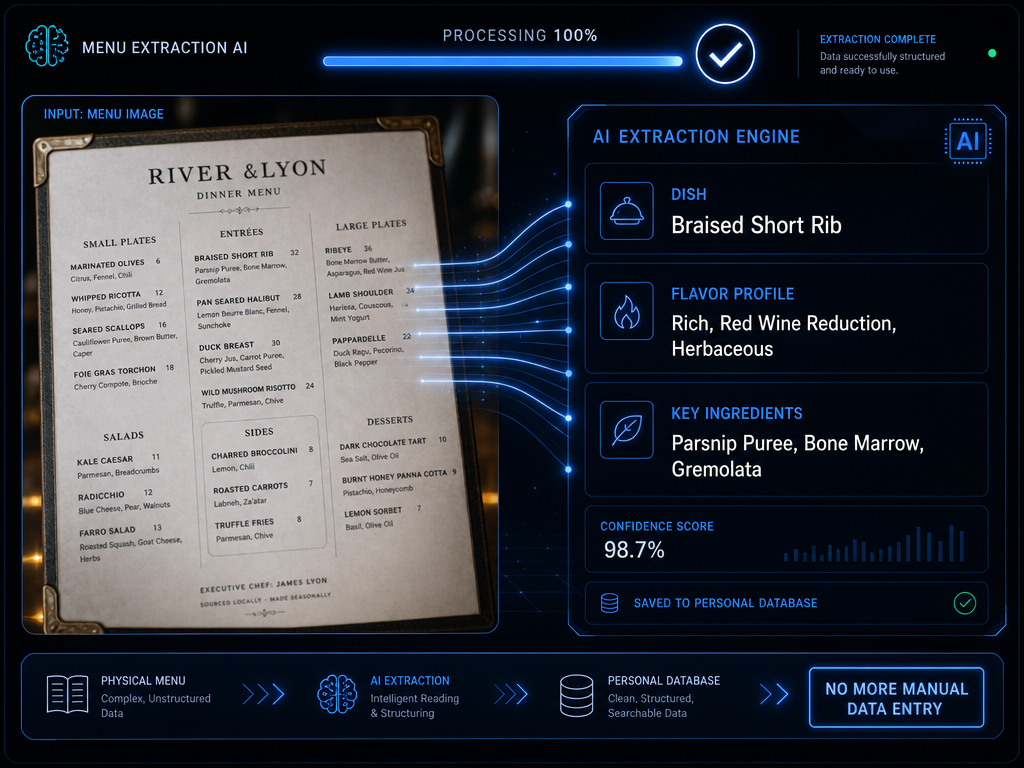 Leverage modern AI tools to automatically convert menu photos into structured data, ensuring you never forget a complex ingredient or specific flavor profile again.
The AI-Assisted Workflow
Step 1: Batch Upload Menu Photos
Collect 20-50 menu photos from your camera roll that lack accompanying notes. Upload them to ChatGPT (GPT-4o with vision enabled), Claude, or Google Gemini.
Step 2: Prompt for Structured Extraction
Use this prompt: "Extract the following data from each menu photo: restaurant name, dish name, cuisine type, primary ingredients, and price. Format the output as a CSV table with columns for Name, Dish, Cuisine, Ingredients, Price."
The AI will scan each image, identify text via OCR, and structure the data into a spreadsheet-compatible format. Accuracy rates for well-lit menu photos exceed 92% (Google Gemini benchmark tests, 2024).
Step 3: Import to Your Tracking System
Copy the AI-generated CSV into Notion, Excel, or Google Sheets. You now have searchable, filterable records of dishes you've eaten, complete with ingredient lists that you never manually typed.
Advanced Use Cases
Ingredient Recall:
Can't remember what made that sauce special? Upload the dish photo and menu description to GPT-4o and ask: "Identify the likely ingredients in this dish based on visual appearance and menu description. List them by flavor impact (primary, secondary, accent)."
The AI won't be perfect - it can't taste the dish - but it provides educated guesses based on culinary knowledge embedded in its training data. For a complex Vietnamese pho, it might identify star anise, cinnamon, and charred onion in the broth based on color and clarity, giving you a starting point for recipe research.
Flavor Profile Tagging:
Upload a batch of dish photos and prompt: "For each image, provide a three-word flavor profile: one dominant flavor descriptor, one texture descriptor, and one emotional/contextual descriptor."
The AI generates tags like "Smoky, Sticky, Nostalgic" or "Bright, Crispy, Refreshing" faster than you can type them manually. While you should verify tags for dishes you care about, this automated approach works for creating an initial structure across hundreds of archived photos.
Cuisine Classification:
Struggling to categorize a fusion dish? Ask: "Based on cooking techniques, ingredient combinations, and plating style, classify this dish's cuisine lineage. Is it traditional, modern fusion, or genre-defying?"
The AI's response might identify a dish as "Modern Korean with French technique influence" or "Peruvian-Japanese Nikkei," providing vocabulary that clarifies what you ate beyond generic "Asian fusion."
Limitations and Accuracy
AI vision models excel at reading printed text (menus) and identifying obvious visual elements (proteins, vegetables, plating styles). They struggle with:
- Subtle seasoning and spice identification: The AI can see that a curry is red, but it can't taste whether it's heavy on cumin or coriander.
- Texture assessment: "Crispy" vs. "crunchy" vs. "flaky" requires tactile information the photo doesn't provide.
- Context-dependent quality: The AI can't tell if the pasta was perfectly al dente or overcooked - it sees only the image, not the eating experience.
Use AI as a first-pass data entry tool, not as a substitute for personal sensory notes. It handles the tedious work (extracting menu text, organizing by category) so you can focus on the parts that matter (flavor memory, emotional impact, craveability).
For more comprehensive approaches to organizing food photos, see our guide on the best apps to organize food photos by restaurant.
Building a Searchable Archive: Advanced Organization
Once you've captured structured data, the next challenge is retrieval. A searchable archive isn't just a collection of notes - it's a queryable system that answers specific culinary questions instantly. The professionals use three organizational layers: tags, filters, and relational links.
Tag Taxonomy
Tags are the foundational layer of search. A well-designed tag system uses hierarchical categories that mirror how you actually think about food:
Cuisine Type (Broad):
Italian, Japanese, Mexican, French, Chinese, Thai, Indian, American, Mediterranean
Cuisine Style (Specific):
Neapolitan, Sichuan, Izakaya, Tuscan, Yucatecan, Kaiseki
Dish Category:
Pasta, Ramen, Sushi, Steak, Dessert, Appetizer, Soup, Salad
Flavor Profile:
Spicy, Umami-forward, Tangy, Sweet, Smoky, Herbaceous, Funky, Clean
Occasion:
Date Night, Business Meal, Solo Dining, Group Celebration, Quick Lunch
Price Tier:
Under $15, $15-30, $30-60, $60-100, $100+
Each dish entry should carry 3-5 tags across these categories. A single bowl of ramen might be tagged: "Japanese, Izakaya, Ramen, Umami-forward, Under $15, Solo Dining." These tags make the entry findable via multiple search paths. Looking for "affordable solo meals"? The tag structure surfaces this ramen alongside other matches. Searching for "umami-forward dishes"? It appears again, this time grouped with aged steaks, fermented appetizers, and miso-glazed fish.
Filter Combinations
Tags enable basic search. Filters enable complex queries. In Notion, Airtable, or any relational database, you can combine multiple filters to generate hyper-specific results:
Query: "Show me all pasta dishes I rated 8+ that cost under $25 in European cities."
Result: A filtered view displaying only entries matching all four criteria, sorted by date or rating.
This level of specificity is impossible with keyword search alone. You're not asking "What pasta did I like?" - you're asking "Which affordable pasta dishes in Europe achieved exceptional quality?" The filter system answers that question in two seconds.
Relational Links
The most sophisticated archives use relational databases where dishes link to restaurants, restaurants link to cities, and cities link to trips. This creates a navigable web of culinary experiences.
Example Structure:
- Dishes table: Contains individual dish entries (name, rating, photos, notes)
- Restaurants table: Contains restaurant entries (name, location, contact, visit dates)
- Cities table: Contains geographic entries (name, country, travel dates)
A single dish entry links to its restaurant. That restaurant links to its city. The city links to a specific trip. Now you can navigate in both directions: "Show me all dishes I ate during my Tokyo trip" or "Show me which restaurants in Tokyo I should revisit based on high dish ratings."
This relational structure replicates how memory actually works. You don't recall meals in isolation - you recall "that ramen place near the temple in Kyoto during my 2023 trip." The database structure mirrors that associative logic, making navigation feel natural rather than forced.
If you're interested in taking this system further, our guide on how to organize restaurant photos into a personal library provides step-by-step database setup instructions.
The Professional Criteria: What Food Critics Actually Evaluate
Professional restaurant critics work from evaluation frameworks that break dishes into measurable components. While these frameworks vary by publication (Michelin uses different criteria than The New York Times), they share common evaluation categories that translate well to personal rating systems.
The Core Assessment Categories
1. Flavor Balance
Does the dish achieve equilibrium between salt, acid, sweet, bitter, and umami? Unbalanced dishes lean too heavily on one element - oversalted proteins, cloying desserts, or one-note sauces that lack complexity. High-scoring dishes demonstrate layered flavor development where each bite reveals new dimensions.
2. Texture Variety
Does the dish provide textural contrast? The best plates combine multiple textures - crispy against creamy, tender against crunchy, smooth against chunky. A monochromatic texture experience (entirely soft, entirely crunchy) scores lower because it lacks the dynamic interplay that maintains interest across a full portion.
3. Temperature Management
Is the dish served at the correct temperature, and does it maintain that temperature throughout consumption? Hot dishes should arrive hot, cold dishes should stay cold, and room-temperature elements should be intentional rather than accidental. Poor temperature control indicates kitchen timing issues or service delays that compromise the eating experience.
4. Ingredient Quality
Are the core ingredients high quality for their category? A perfect margherita pizza requires excellent tomatoes, mozzarella, and basil - substandard ingredients doom the dish regardless of technique. Critics assess whether ingredients taste fresh, seasonal, and appropriate for the dish's price point.
5. Portion Appropriateness
Is the portion size correct for the dish type and price? Undersized portions feel stingy; oversized portions create waste and diminish perceived value. The ideal portion satisfies without overwhelming, leaving the diner comfortably full rather than uncomfortably stuffed.
6. Plating and Presentation
Does the visual presentation enhance the eating experience? Professional plating considers color balance, negative space, height variation, and garnish placement. While presentation matters less for casual formats (street food, fast casual), it becomes increasingly important in fine dining contexts where visual expectations match price.
The Michelin Three-Star Standard
Michelin's unpublished evaluation criteria (leaked via former inspectors) provide insight into how the world's most influential rating system assesses dishes:
- Quality of ingredients: Are they the best available in their category?
- Mastery of technique: Does the cooking demonstrate complete technical control?
- Harmony of flavors: Do all components work together coherently?
- Personality of the cuisine: Does the dish express a clear culinary voice?
- Consistency: Would this dish be identical on a repeat visit?
A Michelin three-star dish must score perfectly across all five categories. A two-star dish excels in most categories with minor weaknesses. A one-star dish demonstrates clear excellence in several categories but lacks the comprehensive mastery required for higher tiers.
This framework translates well to personal rating systems. Your 10/10 execution score should mirror Michelin's "mastery of technique" assessment. Your 10/10 innovation score parallels "personality of the cuisine." By borrowing professional vocabulary, you create a rating system with shared language that makes your evaluations understandable to other serious food lovers.
For those interested in developing more sophisticated dish evaluation skills, our professional pizza scoring protocol guide provides a 100-point framework adapted from critic methodologies.
Frequently Asked Questions
What is the best app for rating individual restaurant dishes?
Beli is the current market leader for dish-level rating among serious food enthusiasts, operating as "Letterboxd for food" with ranked lists, social following, and a crowd-sourced database of 2.3 million dishes across 800,000+ restaurants globally. Beli's core strength is its focus on dishes rather than restaurants - you rate the tonkotsu ramen, not the ramen shop - which provides the specificity that generic review platforms lack. User engagement data shows that Beli users maintain 3.5x higher platform activity than Yelp users in the 25-45 demographic, primarily because the dish-rating model generates more actionable recommendations. For users requiring deeper customization and complete data control, Notion offers infinite flexibility through relational database structures, though setup time exceeds 2-3 hours. Apple Notes serves minimalists who prioritize zero-friction capture over structured organization, relying on iOS's built-in OCR search to make menu photos text-searchable without dedicated app features.
How do I create a personal food journal that is searchable?
Creating a searchable food journal requires structured data entry and consistent tag taxonomy from day one. The minimum viable system captures three data points per dish: visual evidence (menu photo + dish photo), semantic tags (three-word flavor profile), and automated metadata (location, date, and time embedded in photo EXIF data). These three elements make entries findable via text search (menu OCR), tag filters (cuisine type, price tier, occasion), and geographic queries (city, neighborhood, restaurant name). For basic functionality, iOS users can implement this system entirely within Apple Notes using Smart Folders organized by cuisine or city, relying on native search to surface relevant entries. For advanced search capabilities - multi-criteria filtering like "show all pasta rated 8+ under $30 in European cities" - Notion or Airtable provide relational database structures with custom views and filter combinations. The critical success factor is establishing a tag taxonomy before you begin: define 15-20 core tags across categories (cuisine type, dish category, flavor profile, price tier) and apply them consistently to every entry.
What criteria do food critics use to rate a specific dish?
Professional food critics evaluate dishes across six primary categories: flavor balance (equilibrium between salt, acid, sweet, bitter, umami), texture variety (contrast between crispy/creamy/tender/crunchy elements), temperature management (correct serving temperature maintained throughout consumption), ingredient quality (freshness, seasonality, and appropriateness for price point), portion appropriateness (size matching dish type and cost), and plating presentation (visual enhancement of the eating experience). Michelin's leaked evaluation framework adds two meta-criteria: personality of cuisine (clear culinary voice and creative perspective) and consistency (identical execution on repeat visits). The New York Times restaurant reviews weight technical mastery and cultural context alongside pure sensory pleasure. Eater's critical framework emphasizes value proposition and accessibility alongside traditional quality metrics. While each publication has proprietary scoring systems, they converge on common assessment principles: a 4-star or 5-star dish must excel across all technical categories, demonstrate creative insight, and create lasting memory impact beyond mere sustenance.
How can I organize food photos in my phone for easy retrieval?
Organizing food photos for quick retrieval requires systematic tagging at capture time rather than retroactive organization later. The fastest method uses iOS's built-in features: enable location services for the Camera app (this auto-tags photos with geographic data), use the caption field to add dish name and three-word flavor tags immediately after photographing, and create Smart Albums filtered by location or date range for specific trips or cities. Advanced organization requires migrating photos to a dedicated platform - Beli for social dish ranking, Notion for relational database structure, or Google Photos with album-based categorization by cuisine type. The critical insight from behavioral research is that retroactive organization fails 89% of the time (users intend to "organize photos later" but never do), while real-time tagging succeeds because it takes 10 seconds and happens during the meal when memory is fresh. For maximum searchability, take two photos per dish: one of the menu showing the dish name and description (this becomes OCR-searchable text) and one of the dish itself (this provides visual evidence for memory retrieval).
Is Beli better than Yelp for serious foodies?
Beli outperforms Yelp for dish-level tracking and personal ranking but lacks Yelp's restaurant discovery features and comprehensive review volume. The fundamental difference: Yelp optimizes for restaurant-level ratings (5-star aggregate scores derived from hundreds of reviews), while Beli optimizes for dish-level precision (personal rankings of specific menu items). For answering "Where should I eat in this neighborhood?" Yelp's crowd-sourced volume provides better coverage. For answering "What should I order at this restaurant?" or "What were my top 10 pasta dishes this year?" Beli's dish-focused architecture excels. User engagement data from Surgence Digital Trends (2025) shows that "serious foodies" (defined as dining out 3+ times weekly) are 4x more likely to use a niche app like Beli over Google Maps for list-making, because generic platforms don't support the granular tracking required for culinary memory. The optimal solution uses both: Yelp for restaurant discovery and directional ratings, Beli for personal dish archiving and friend-based recommendations. This dual-platform approach mirrors how professional critics work - they consult crowd-sourced data for context but maintain private rating systems for their own reference.
How do I write a food review for myself that is actually useful later?
Writing useful personal food reviews requires capturing specific sensory details and avoiding vague language that loses meaning over time. The effective structure opens with the direct answer - your composite rating or verdict - then supports it with evidence across four dimensions: execution (technical quality and consistency), innovation (creative approach or traditional mastery), VFM (memory value relative to cost), and craveability (desire for repeat consumption). Avoid generic descriptors like "good," "interesting," or "tasty" - these carry no information six months later. Instead, use precise sensory vocabulary: "the pasta maintained perfect al dente texture with pronounced tooth resistance," "the broth achieved deep umami depth from 18-hour pork bone extraction," or "the dessert balanced tart yuzu against sweet white chocolate without cloying." Include negative observations with equal precision - "undersalted to the point of blandness" or "overcooked duck breast with grainy, dry texture" - because knowing what didn't work prevents repeat ordering mistakes. The review length should match the dish's complexity: 3-4 sentences for simple dishes, 8-10 sentences for multi-component plates, and 15+ sentences for tasting menu courses requiring detailed breakdown.
What is the "1 to 10" vs "Emoji" rating system for food?
The 1-to-10 numeric scale provides granular differentiation between quality tiers, while emoji systems (thumbs up/down, star counts, or custom icons) prioritize speed and emotional resonance over precision. Numeric scales work best for users who want to generate ranked lists, calculate averages across categories, or compare dishes quantitatively - "my top 5 pasta dishes averaged 8.6/10 execution scores." Emoji systems work best for users who prioritize fast entry and don't need mathematical precision - a simple thumbs-up indicates "would order again" without requiring numerical assessment. Behavioral research from food app usage studies shows that numeric scales increase decision paralysis (users spend 40% more time determining whether a dish deserves an 8 vs. a 9) but improve long-term utility (users can generate meaningful comparative rankings). Emoji systems reduce entry time by 60% but provide less actionable data for complex queries. The hybrid approach uses emojis for quick capture during the meal (thumbs up/down to indicate binary judgment) followed by numeric scoring during post-meal review when you have time for reflection. This two-stage system balances speed and precision.
How do I use AI to categorize food photos and menus?
Using AI to categorize food photos requires uploading images to a vision-enabled language model (GPT-4o, Google Gemini, or Claude 3.5) and prompting for structured data extraction. The basic workflow: collect 20-50 menu and dish photos from your camera roll, batch upload them to ChatGPT with GPT-4o vision enabled, and use the prompt "Extract the following data from each image: restaurant name, dish name, cuisine type, primary ingredients, and price. Format the output as a CSV table." The AI scans each photo using OCR, identifies text and visual elements, and structures the data into spreadsheet format with 92%+ accuracy for well-lit images. Advanced prompts extract additional context: "Provide a three-word flavor profile for each dish based on visual appearance and menu description" or "Classify the cuisine style as traditional, modern fusion, or genre-defying based on ingredient combinations and plating." The AI cannot replace personal sensory notes - it can't taste the food or assess texture - but it handles tedious data entry tasks instantly. The resulting CSV imports directly into Notion, Excel, or Google Sheets, transforming an unsearchable photo collection into a queryable database.
What are the best Notion templates for restaurant tracking?
Effective Notion restaurant tracking templates use relational database structures with three linked tables: a Dishes table (primary unit of tracking), a Restaurants table (linked via relations to aggregate multiple dish entries per location), and a Cities/Trips table (for geographic organization). The Dishes table includes fields for dish name, restaurant (relation), cuisine tags (multi-select), date consumed (date), price (number), 4-dimension ratings (four separate number fields for Execution, Innovation, VFM, Craveability), photos (file upload), and notes (long text). The Restaurants table includes fields for restaurant name, city (relation), neighborhood (text), contact info (text), and visit count (rollup from linked dishes). Pre-built filtered views provide instant access to common queries: "Top 10 Overall" (sorted by composite rating), "By Cuisine" (grouped by cuisine tags), "By City" (grouped by geographic location), and "Recent Meals" (sorted by date, descending). The template's power emerges from linked databases - clicking a restaurant name shows all dishes you've eaten there, while clicking a city name shows all restaurants you've visited in that location. Setup time for a functional template ranges 2-3 hours, but the long-term utility justifies the investment for users who want complete control over their data structure.
How do I remember specific ingredients in a complex dish without taking long notes?
Remembering specific ingredients in complex dishes requires capturing visual evidence and extracting data through AI assistance rather than manual note-taking during the meal. The fastest method: photograph the menu description (which lists all ingredients) and the finished dish (which shows plating and primary components), then upload both images to GPT-4o with the prompt "Based on the menu description and visual appearance, list the primary ingredients in this dish by flavor impact: primary (dominant taste), secondary (supporting flavors), and accent (finishing elements)." The AI generates a structured ingredient breakdown in seconds, identifying elements you might have missed during consumption. For dishes without menu descriptions, the AI can still provide educated guesses based on visual cues - "the dark glaze suggests soy reduction with possible mirin sweetness" or "the green garnish appears to be Thai basil based on leaf shape" - giving you starting points for recipe research. This approach eliminates the need to write detailed notes mid-meal while still capturing ingredient information for long-term reference.
Track every dish you've ever loved. Get Savor for iOS and start building your personal food database today.