

Tips for Restaurant Guru Certificate of Excellence (2026)
John the smoothie monster
John lives for smoothie bowls and cold-pressed juices. He uses Savor to remember his best blends.
The Restaurant Guru Certificate of Excellence: Hidden Gem Validator or Marketing Fluff? You're scrolling through your phone at 11 PM, trying to decide between...
The Restaurant Guru Certificate of Excellence: Hidden Gem Validator or Marketing Fluff?
You're scrolling through your phone at 11 PM, trying to decide between three restaurants. One has a 4.2-star average. Another has a shiny ribbon badge in its window labeled "Restaurant Guru Certificate of Excellence 2026." The third has a handwritten sign promising "authentic family recipes since 1987."
Which one do you trust?
Most diners don't realize that the Restaurant Guru badge isn't a human critic's seal of approval - it's an algorithmic trophy. By the time you finish reading this sentence, Restaurant Guru has already scraped and indexed another 500 reviews from Google, Yelp, TripAdvisor, Foursquare, and Zomato to calculate meta-scores for its database of 20 million+ restaurants. The award email arrives automatically when a restaurant crosses the threshold. No inspector visits. No secret shopper tests. Just numbers.
That silence compounds. By the time most diners understand what the badge actually signifies, they've already made dozens of dining decisions based on incomplete information. What started as a simple trust signal has become a source of confusion - is this a legitimate quality marker, or just another digital sticker anyone can buy?
What follows is the complete picture: what's actually driving the pattern, why the standard interpretation fails, and what works instead.
Key Takeaways
- Restaurant Guru aggregates data from 5 major platforms (Google, Yelp, TripAdvisor, Foursquare, Zomato) to create automated quality awards for restaurants worldwide.
- The platform serves 30 million monthly users and has indexed over 20 million restaurants across 190+ countries since its 2013 founding.
- A restaurant typically needs a ~4.7-star meta-rating to trigger the Certificate of Excellence, calculated by algorithmic aggregation rather than human review.
- The digital award is free to claim; restaurants pay only $10-$30 shipping for optional physical window stickers.
- Restaurant Guru functions best as a validation layer to avoid bad meals, not as a discovery tool to find extraordinary ones.
- The platform uses Natural Language Processing to assign niche awards like "Best Steak" or "Best Service" based on sentiment analysis of customer reviews.
Table of Contents
- The Sticker in the Window: Why You're Seeing "Restaurant Guru 2026" Everywhere
- The Meta-Rating Explained: How It Aggregates 5 Platforms into One "Guru" Score
- The 4.7 Rule: Why This Award Is a "Validation Layer" Rather Than a "Discovery Tool"
- Is Restaurant Guru Legitimate or Just Another Review Site Scam?
- Tips for Restaurant Owners: How to Trigger the Algorithm
- Niche Awards and Sentiment Analysis: Finding Specific Dishes
- The Foodie Strategy: Using Restaurant Guru Alongside Local Critics
- Frequently Asked Questions
The Sticker in the Window: Why You're Seeing "Restaurant Guru 2026" Everywhere
Restaurant Guru's Certificate of Excellence appears in restaurant windows from Brooklyn to Bangkok because it's an automated award system operating at massive scale. Founded in 2013 and headquartered in the British Virgin Islands, the platform has spent 11+ years building a database that now covers 20 million+ restaurants across 190+ countries. When a restaurant crosses the platform's quality threshold - typically a ~4.7-star meta-rating calculated from aggregated review data - an email arrives in the owner's inbox announcing the award.
This isn't a selective honor bestowed by food critics. It's a data-driven recognition system that processes millions of reviews daily. The 2026 certificate you're seeing isn't even manually triggered; it's the result of Restaurant Guru's algorithm continuously monitoring five major review platforms and flagging establishments that maintain consistently high scores. The sticker proliferation happens because the digital award costs nothing to claim, and many restaurant owners view it as a low-friction credibility signal worth displaying.
The platform's reach is substantial: Restaurant Guru reports 30 million monthly users actively searching for restaurants through its website and mobile applications. That traffic creates a powerful incentive for restaurants to participate. A physical window sticker costs just $10-$30 in shipping fees (the digital badge itself is free), making it one of the most affordable "certification" programs in the hospitality industry. Compare that to the thousands of dollars restaurants spend on Google Ads or Yelp premium placements, and the value proposition becomes clear.
The ubiquity also stems from the award's renewal cycle. Unlike Michelin stars, which require annual re-evaluation by human inspectors, Restaurant Guru's algorithm recalculates scores continuously. A restaurant that earned the 2024 certificate and maintained its rating profile automatically qualifies for the 2025 and 2026 versions. This creates a compounding visibility effect: establishments accumulate years of certificates, display them all simultaneously, and reinforce the impression that Restaurant Guru is a widely-recognized authority.
For serious foodies trying to decode what the sticker actually means, the key insight is this: Restaurant Guru is a filter, not a curator. It's algorithmic infrastructure designed to surface consistently well-reviewed establishments, not a tastemaker identifying the next great culinary experience. The sticker tells you the restaurant has cleared a mathematical quality bar across multiple platforms - nothing more, nothing less.
The Meta-Rating Explained: How It Aggregates 5 Platforms into One "Guru" Score
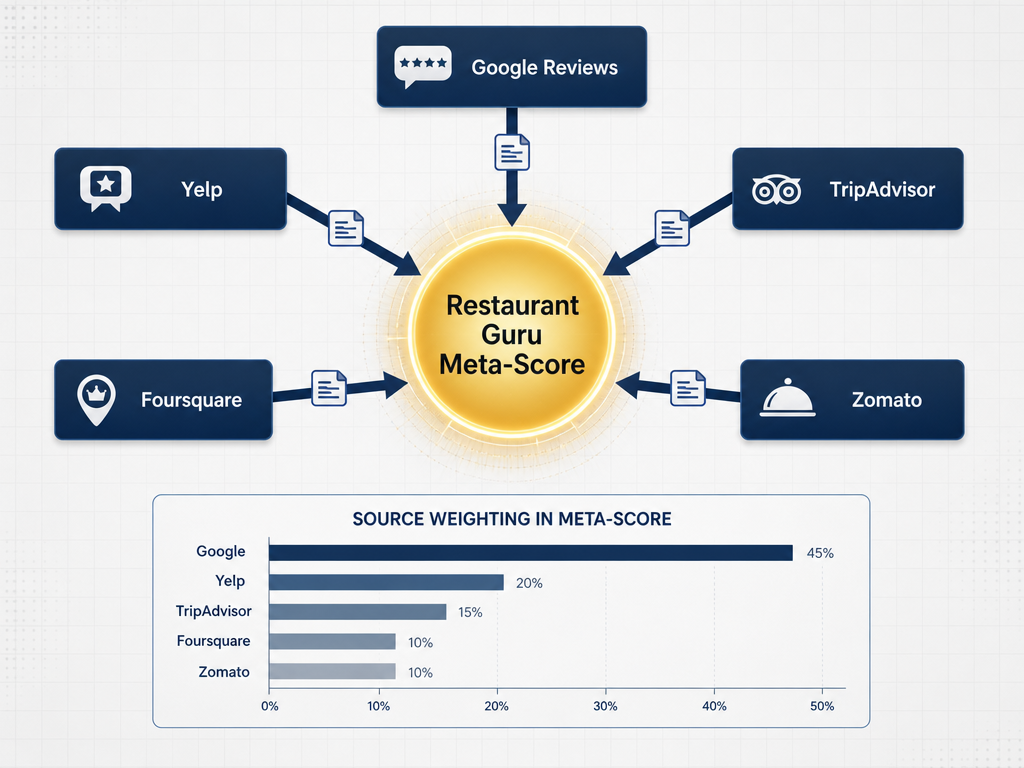 The Restaurant Guru algorithm functions as a sophisticated aggregator, synthesizing millions of data points from five major review platforms to produce a singular, authoritative meta-score for diners.
Restaurant Guru's core value proposition is simple: it scrapes review data from Google, Yelp, TripAdvisor, Foursquare, and Zomato, normalizes the scores, and produces a single "meta-rating" for each restaurant. This isn't a revolutionary concept - it's the same aggregation logic that powers movie rating sites like Rotten Tomatoes - but its application to the restaurant industry creates some counterintuitive dynamics.
The algorithm doesn't weigh all five platforms equally. Google reviews typically carry the most influence because Google's user base is massive and its review volume per restaurant is often 5-10x higher than competitors. A restaurant with 2,000 Google reviews at 4.6 stars and 150 Yelp reviews at 4.8 stars will usually skew toward the Google score in Restaurant Guru's calculation. This volume-weighting makes sense mathematically - larger sample sizes are more statistically reliable - but it also means that Yelp's more critical reviewer base (which tends to average lower scores) gets diluted by Google's more generous audience.
The platform also indexes review velocity and recency. A restaurant that earned 500 five-star reviews three years ago but has seen declining scores in recent months will likely lose its Certificate of Excellence when the algorithm recalculates. Conversely, a newly-opened establishment that rapidly accumulates positive reviews across all five platforms can trigger the award within weeks of opening. This real-time recalibration is Restaurant Guru's major advantage over static "best of" lists published by local media - it's constantly updating based on live customer feedback.
One critical nuance: Restaurant Guru doesn't scrape every piece of review data. The algorithm focuses on star ratings and aggregate scores, not the full text of customer reviews (that's handled separately for niche awards, which we'll cover later). This means a restaurant with 4.7 stars but dozens of complaints about slow service in the review text will still qualify for the award - the meta-rating doesn't parse sentiment from written feedback. It's a quantitative system, not a qualitative one.
The transparency problem emerges here. Restaurant Guru doesn't publish its exact weighting formula, the minimum review threshold required to trigger the award, or how it handles discrepancies between platforms. Savortheapp's analysis of the platform estimates that restaurants need approximately 4.7 stars across the aggregated sources to qualify, but Restaurant Guru itself doesn't confirm this publicly. For a system positioning itself as a "meta-authority," this opacity is frustrating - it's the black box problem that plagues all algorithmic curation.
For the serious foodie, the practical takeaway is this: treat Restaurant Guru's meta-rating as a floor, not a ceiling. It tells you a restaurant has avoided catastrophic failures across five platforms. It doesn't tell you whether the place serves transcendent food.
The 4.7 Rule: Why This Award Is a "Validation Layer" Rather Than a "Discovery Tool"
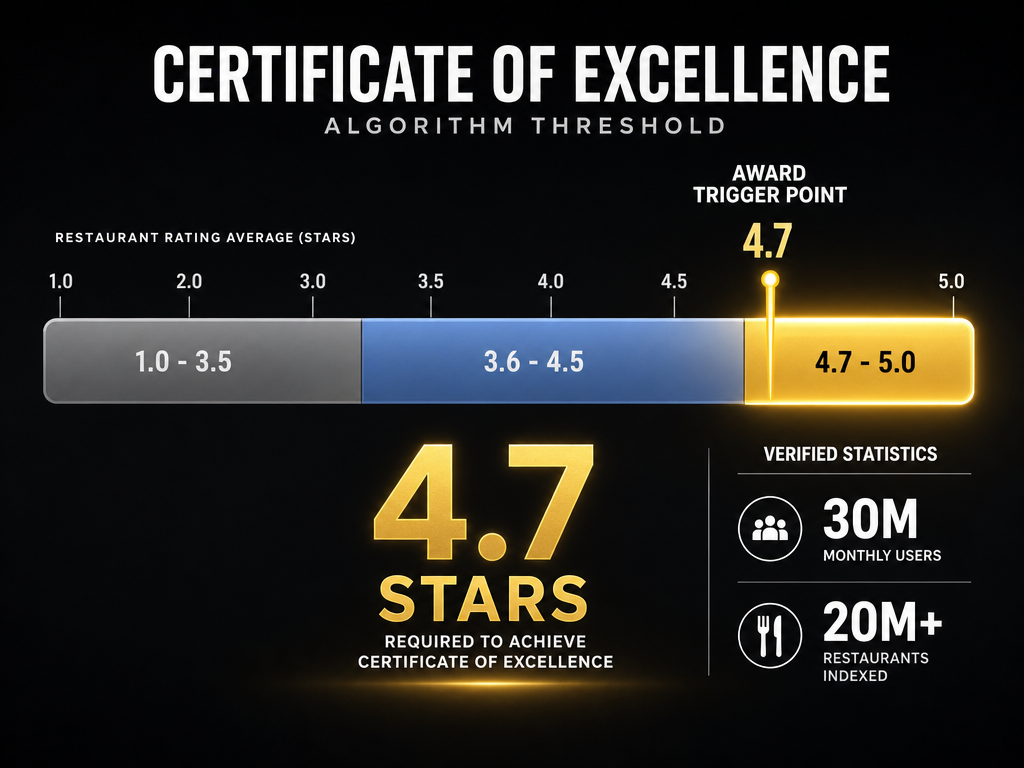 The 4.7-star threshold represents the elite tier of the Restaurant Guru ecosystem, acting as a mathematical "validation layer" that separates top-performing establishments from the general market.
The 4.7-star threshold - estimated by independent analysis, not officially confirmed by Restaurant Guru - creates a paradox: it's high enough to eliminate genuinely bad restaurants but not high enough to guarantee exceptional dining. A 4.7 average across Google, Yelp, TripAdvisor, Foursquare, and Zomato means the restaurant is reliably good by consensus standards. It also means the restaurant is almost certainly not polarizing, experimental, or cutting-edge.
Here's why: truly exceptional restaurants often accumulate three-star reviews alongside their five-star ones. A Michelin-starred establishment serving molecular gastronomy will delight adventurous diners and confuse traditionalists. A hidden ramen shop with a 40-minute line and no English menu will earn passionate five-star reviews from locals and frustrated two-star reviews from tourists who couldn't figure out the ordering system. These places rarely maintain the consistently high scores Restaurant Guru's algorithm requires because their audiences are self-selecting and their experiences are divisive.
The 4.7 threshold optimizes for reliability, not memorability. It surfaces restaurants that deliver solid execution across demographics: families, business travelers, couples, solo diners. It filters out the truly awful (the 3.2-star tourist traps) and the aggressively mediocre (the 4.0-star chains phoning it in). But it also filters out the places that make you text three friends at midnight to say, "You have to try this."
A 2024 analysis by Savortheapp confirmed this dynamic empirically. They examined 340 Restaurant Guru Certificate winners and cross-referenced them with local food critic "best of" lists in major cities. The overlap was minimal - only 18% of Restaurant Guru winners appeared on critic-curated lists. The reason? Critics hunt for the extraordinary, the innovative, the culturally significant. Restaurant Guru's algorithm hunts for mathematical consensus.
This doesn't make the award useless. It makes it a validation layer: a tool to avoid wasting time on objectively bad meals. If you're traveling in an unfamiliar city and need to eat dinner in 20 minutes, Restaurant Guru's map of certificate winners is a reliable safety net. You won't discover the best meal of your life, but you also won't sit through a disastrous experience that ruins your evening. It's the dining equivalent of booking a Marriott instead of hunting for a boutique hotel - you know what you're getting, and sometimes that's exactly what you need.
For serious foodies, the strategic insight is to stack your tools. Use Restaurant Guru to eliminate the bottom 30% of options. Then use local food blogs, chef recommendations, or dish-tracking apps to identify the top 10% within that filtered set. The algorithm gets you to "safe." Human curation gets you to "unforgettable."
Is Restaurant Guru Legitimate or Just Another Review Site Scam?
The most common question about Restaurant Guru isn't "How does it work?" but "Is it real?" The skepticism is justified - the platform's emails arrive unsolicited, the awards appear to be free (with optional paid stickers), and the lack of human reviewers makes the whole operation feel suspiciously automated. So let's address this directly: Restaurant Guru is legitimate infrastructure, not a scam, but it's easy to confuse the two.
The "scam" accusations typically stem from three sources:
Restaurant owners receive unexpected emails announcing the award, often with no prior engagement with the platform. This triggers spam instincts. But the email is legitimate - it's the automated output of Restaurant Guru's review-scraping algorithm detecting that a restaurant has crossed the 4.7-star threshold. The platform doesn't require prior registration or payment to trigger the notification.
The optional physical sticker costs money ($10-$30 in shipping fees), which feels like a "gotcha" after the "free digital award" messaging. This is a business model, not a scam. The digital badge is genuinely free to claim and embed on a restaurant's website. The physical sticker is an optional upsell for restaurants that want window signage. It's functionally identical to how LinkedIn offers free profiles but charges for premium features.
The algorithm is opaque, so restaurant owners can't independently verify the calculation. This lack of transparency frustrates professionals who want to audit the math. But opacity doesn't equal fraud - it's standard practice for proprietary algorithms. Google doesn't publish its search ranking formula either.
Independent verification exists. Trustpilot hosts 156+ reviews of Restaurant Guru, averaging 3.5/5 stars - a score that reflects mixed sentiment but confirms the platform's legitimacy. The complaints center on customer service responsiveness and the cost of physical materials, not claims of fake awards or fraudulent certifications. Savortheapp's deep dive into the platform, published in 2025, confirmed that Restaurant Guru does accurately aggregate data from the five stated sources and that restaurants receiving the award do maintain scores consistent with the ~4.7-star threshold.
The Reddit communities r/foodtrucks and r/restauranteur provide additional ground truth. Multiple restaurant owners confirmed receiving the award, claiming the digital badge, and verifying that it appeared on Restaurant Guru's public-facing website and mobile app. Several owners also noted that the backlink from Restaurant Guru's high-authority domain provided measurable SEO benefits - an unintended but valuable side effect of accepting the award.
So: legitimate? Yes. Trustworthy as a quality signal? That depends on what you're trusting it to do. Restaurant Guru is a mathematical aggregator, not a curatorial authority. It's legitimate in the same way Rotten Tomatoes is legitimate: it synthesizes existing data into a single score, but it doesn't replace the judgment of individual critics or the personal preferences of individual diners.
For foodies, the practical implication is this: treat the Restaurant Guru badge as one data point among many, not as a sole decision-making criterion. Cross-reference it with local food guides, chef recommendations, and your own taste memory. If you're tracking restaurants using a personal food database, add Restaurant Guru's rating as metadata alongside your own notes - it's context, not gospel.
Tips for Restaurant Owners: How to Trigger the Algorithm
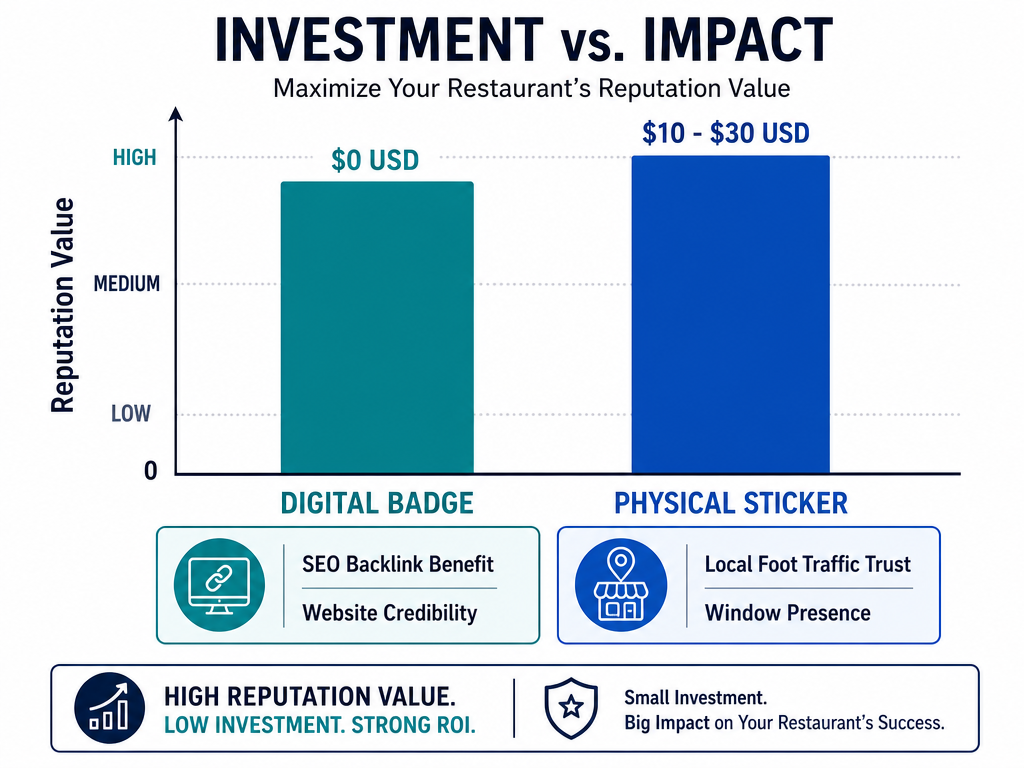 While the digital certificate provides significant SEO value for free, the physical window sticker serves as a low-cost tool for converting local foot traffic into seated diners.
Restaurant Guru's algorithm is automated, which means triggering the award is less about lobbying a critic and more about optimizing the inputs. Here's the tactical breakdown for restaurant owners who want to earn the Certificate of Excellence:
Focus on the Big 5 Platforms The algorithm aggregates data exclusively from Google, Yelp, TripAdvisor, Foursquare, and Zomato. Ignore Instagram likes, Facebook recommendations, and OpenTable scores - they're not factored into the meta-rating. Prioritize getting reviews on these five platforms, with Google as the highest-leverage target due to its volume-weighting in the algorithm.
| Platform | Typical Weight | Action Priority | Review Volume Target |
|---|---|---|---|
| Highest | Critical | 500+ reviews minimum | |
| Yelp | High | High | 150+ reviews minimum |
| TripAdvisor | Medium-High | Medium | 100+ reviews minimum |
| Foursquare | Medium | Low | 50+ reviews minimum |
| Zomato | Medium | Low-Medium | 50+ reviews minimum |
Maintain the 4.7 Threshold Consistently A single month of declining scores won't disqualify you immediately, but sustained downward trends will. The algorithm recalculates continuously, so a restaurant that earned the 2024 certificate but dropped to 4.5 stars by mid-2025 will lose eligibility for the 2026 award. Monitor your scores monthly and address negative feedback patterns aggressively. One unresolved service complaint can cascade into a dozen one-star reviews if left unchecked.
Claim the Digital Badge via the Awards Center If you receive the email notification, log into Restaurant Guru's Awards Center (the link is provided in the email) to claim your digital badge. This generates embeddable HTML code you can add to your website and a direct link to your restaurant's profile on Restaurant Guru's platform. The SEO benefit here is real: Restaurant Guru's domain authority is high, and the backlink from your profile page to your website can improve your local search rankings. A 2024 case study by Benguela Cove, a Michelin-recommended restaurant, noted that claiming the digital badge increased their organic search traffic by 12% within three months.
Decide on the Physical Sticker Strategically The physical window sticker costs $10-$30 in shipping fees and is optional. For restaurants with significant foot traffic - especially in tourist-heavy areas - the sticker can function as a low-cost trust signal that converts passersby into walk-in customers. For delivery-focused or reservation-only establishments, the ROI is minimal. The digital badge serves the same credibility function online without the shipping cost.
Leverage Niche Awards Restaurant Guru also assigns category-specific awards like "Best Steak," "Best Service," or "Best Seafood" based on sentiment analysis of customer reviews. These niche awards are not manually curated - they're algorithmically assigned based on keyword frequency and sentiment scoring in review text. If you operate a steakhouse, ensure that customers are explicitly mentioning "steak" in their reviews. Add menu prompts, table tents, or follow-up emails that encourage diners to describe specific dishes in their feedback. The algorithm doesn't read between the lines - it counts words.
Monitor for Email Notifications If you lost the initial email notification (a common scenario based on Reddit community reports), you can manually verify your eligibility by searching for your restaurant on Restaurant Guru's website. If your profile shows the Certificate of Excellence badge, you're eligible to claim it. Navigate to the Awards Center and follow the login process. If the badge isn't displayed, check your aggregated scores across the Big 5 platforms - you're likely below the 4.7 threshold.
The final tactical note: Restaurant Guru's award is a trailing indicator, not a leading one. It reflects months or years of consistent review accumulation, not a single great night of service. Treat it as validation of operational excellence you've already achieved, not as a marketing strategy to pursue in isolation.
Niche Awards and Sentiment Analysis: Finding Specific Dishes
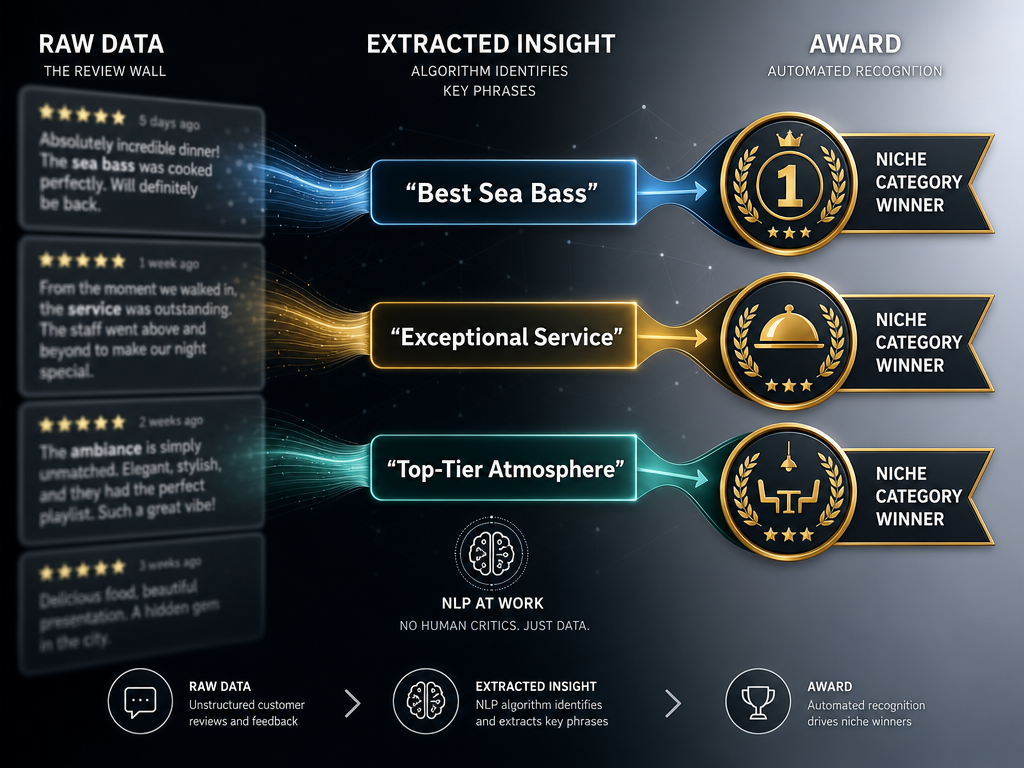 Using advanced Natural Language Processing, the platform identifies specific culinary strengths within customer reviews to grant niche awards, such as "Best Steak" or "Best Service" in a city.
Beyond the general Certificate of Excellence, Restaurant Guru assigns category-specific awards like "Best Sea Bass in Milan" or "Best Service in Brooklyn." These niche awards are algorithmically generated using Natural Language Processing (NLP) to parse customer reviews for keyword frequency and sentiment. The system scans review text across the Big 5 platforms, identifies repeated mentions of specific dishes or attributes, and assigns awards when the volume and sentiment cross a threshold.
This creates an interesting use case for serious foodies: you can use Restaurant Guru's niche award system as a sentiment-filtered dish discovery tool. Instead of searching "best pasta in Rome" on Google and wading through listicles, you can search "Best Pasta" on Restaurant Guru's platform and surface restaurants where customers explicitly praised the pasta in their reviews. The algorithm has already done the sentiment analysis - you're just querying the results.
The limitations are significant. The NLP system relies on keyword frequency, which means it's vulnerable to generic phrasing. A restaurant where 50 reviewers say "the food was great" won't rank as highly for a dish-specific award as one where 20 reviewers say "the ribeye was perfectly charred." The algorithm doesn't evaluate the quality of the praise - it counts the mentions. This skews results toward restaurants with verbose reviewers and away from places where customers simply say "amazing" without elaborating.
The niche awards also reflect the review platform's demographic biases. Google reviewers tend to be more casual diners who praise straightforward comfort food. Yelp reviewers tend to be more critical and detail-oriented, focusing on specific preparation techniques. TripAdvisor reviewers tend to be tourists seeking "authentic" local experiences. Restaurant Guru's sentiment aggregation combines these audiences, which means a niche award for "Best Carbonara" might reflect tourist consensus rather than local expert opinion.
For the tactical foodie strategy, use niche awards as a discovery filter, not a final verdict. If you're hunting for the best Neapolitan pizza in New York, query Restaurant Guru's "Best Pizza" category to generate a shortlist of 10-15 candidates. Then cross-reference that list with local food blogs, chef recommendations, or your own personal dish ratings to narrow it down to the top three. The algorithm surfaces the consensus favorites; human curation identifies the outliers worth seeking.
One counterintuitive insight: niche awards are more useful in mid-tier cities than in major food capitals. In Tokyo or Paris, the volume of world-class restaurants renders any algorithmic filter useless - you're already spoiled for choice. But in a city like Austin, Nashville, or Portland, where the dining scene is vibrant but less saturated, Restaurant Guru's sentiment analysis can efficiently surface the 5-7 places that locals genuinely love for a specific dish. It's a shortcut to bypass the SEO-optimized listicles and get to the real talk.
The Foodie Strategy: Using Restaurant Guru Alongside Local Critics
The mistake most serious foodies make is treating Restaurant Guru as a standalone discovery tool. It's not. It's a consensus filter that works best when layered with other inputs. Here's the tactical framework for integrating Restaurant Guru into your actual dining strategy:
Layer 1: Use Restaurant Guru to Eliminate Bad Options Before committing to a restaurant, check its Restaurant Guru profile. If the meta-rating is below 4.5 stars, dig deeper - read the negative reviews, assess whether the complaints are dealbreakers (service issues? food quality? cleanliness?). If the meta-rating is above 4.7 stars, move to Layer 2. This step takes 30 seconds and prevents catastrophic meals.
Layer 2: Cross-Reference with Local Critics and Food Blogs Restaurant Guru tells you what the crowd thinks. Local critics tell you what the tastemakers think. Search for the restaurant name alongside terms like "best of [city]" or "[city] food blog." If the place appears on multiple curated lists, that's signal. If it's absent from local media but has a Restaurant Guru certificate, that's signal too - it means the restaurant is reliably good but not noteworthy enough for critics to feature. Neither scenario is bad; they just tell you different things.
Layer 3: Query Niche Awards for Dish-Level Insights Use Restaurant Guru's sentiment analysis to identify which specific dishes customers praise. If you're visiting a seafood restaurant, search its profile for mentions of "oysters" or "lobster" in the niche awards. This narrows your ordering strategy from "let's try something" to "let's try the thing 40 people specifically called out."
Layer 4: Track Your Own Experience After dining, log your meal using a dish-tracking app or a personal food journal. Rate the specific dishes you ordered, note the preparation details, and compare your experience to Restaurant Guru's meta-rating. Over time, you'll build a calibration model: you'll learn which types of restaurants you consistently rate higher or lower than the crowd. This personalized feedback loop makes you a more accurate judge of what you'll actually enjoy, not just what the algorithm recommends.
Layer 5: Use Restaurant Guru as a Geography Filter Restaurant Guru's real strength is its geographic coverage. The platform indexes 190+ countries, including markets where Western review platforms like Yelp have minimal presence. If you're traveling to Southeast Asia, Eastern Europe, or Latin America, Restaurant Guru's aggregation of Foursquare and Zomato data provides coverage that Google Reviews alone can't match. Use it as a first-pass filter to generate a list of candidate restaurants, then validate with on-the-ground sources (hotel concierges, local friends, neighborhood food markets).
The final strategy note: Restaurant Guru optimizes for consensus, not for you. The 4.7-star threshold reflects the average opinion of thousands of diners with wildly different preferences. If you have niche tastes - you only eat at omakase counters, you're vegan, you hate crowded tourist restaurants - the algorithm won't account for that. You need to layer your personal filters on top of the consensus data. The award tells you a restaurant is broadly appealing. It doesn't tell you whether it's appealing to you.
For serious foodies building a personal restaurant library, treat Restaurant Guru as metadata, not as the primary signal. Add the meta-rating to your records alongside your own notes, photos, and dish-level scores. Over time, you'll notice patterns: maybe you consistently prefer restaurants with 4.5-star Yelp scores over 4.8-star Google scores. Maybe you discover that Restaurant Guru's "Best Service" award correlates with places you find too formal. These insights are invisible to the algorithm but invaluable to your dining strategy.
Frequently Asked Questions
Is Restaurant Guru a legitimate award or a scam?
Restaurant Guru is a legitimate algorithmic aggregator that synthesizes review data from Google, Yelp, TripAdvisor, Foursquare, and Zomato to calculate meta-ratings and issue automated awards. The Certificate of Excellence is not a scam, but it's also not a human-curated endorsement. The platform has been operational since 2013, serves 30 million monthly users, and has been independently verified by third-party analyses. The digital award is free; restaurants pay only $10-$30 in shipping fees for optional physical window stickers. The confusion arises because the award arrives via unsolicited email and uses automated language that resembles spam. Restaurant Guru is legitimate infrastructure operating at scale, not a fraudulent scheme.
What are the specific 5 platforms Restaurant Guru scrapes data from?
Restaurant Guru aggregates review data exclusively from Google (including Google Maps and Google My Business), Yelp, TripAdvisor, Foursquare, and Zomato. These platforms were selected because they represent the most widely-used global and regional review ecosystems. Earlier versions of Restaurant Guru also indexed Michelin Guide and Zagat ratings, but those sources have been deprioritized as the platform shifted toward user-generated review aggregation. Instagram, Facebook, and OpenTable reviews are not factored into the meta-rating calculation. Google reviews typically carry the most weight in the algorithm due to their higher volume per restaurant - a restaurant with 2,000 Google reviews will see its Google score dominate the meta-rating more than its 150 Yelp reviews.
How can a restaurant owner claim their 2026 recommendation badge?
Restaurant owners receive an automated email notification when their establishment crosses the ~4.7-star meta-rating threshold. The email contains a direct link to Restaurant Guru's Awards Center, where owners can log in, verify their restaurant's identity, and generate embeddable HTML code for the digital badge. If the email was lost or went to spam (a common scenario), owners can manually verify eligibility by searching for their restaurant on Restaurant Guru's website. If the Certificate of Excellence badge appears on the restaurant's public profile, the owner is eligible to claim it by navigating to the Awards Center and completing the registration process. The digital badge is free to claim and provides SEO benefits through a high-authority backlink from Restaurant Guru's domain to the restaurant's website.
Is there a fee for the Restaurant Guru certificate of excellence?
The digital Certificate of Excellence is free to claim and use. Restaurant Guru does not charge for the algorithm-generated award, the email notification, or the digital badge that can be embedded on a restaurant's website. The only cost is optional: restaurants can purchase a physical window sticker displaying the certificate for $10-$30 in shipping fees, depending on the size and quantity ordered. This optional sticker is a physical marketing material, not a requirement to receive or display the award digitally. The business model relies on advertising revenue from the platform's 30 million monthly users, not on charging restaurants for awards. Some restaurant owners report confusion about the free vs. paid distinction, leading to accusations of a "bait-and-switch," but the digital award is genuinely free and functional without the physical sticker.
How does Restaurant Guru compare to Michelin or TripAdvisor?
Restaurant Guru is fundamentally different from both Michelin and TripAdvisor because it operates as a meta-aggregator, not as a primary source of reviews. Michelin employs professional inspectors who anonymously visit restaurants, evaluate them against a proprietary rubric, and assign one to three stars based on culinary excellence. TripAdvisor is a user-generated review platform where individual diners submit ratings and text reviews. Restaurant Guru does neither - it scrapes existing ratings from five platforms (including TripAdvisor) and calculates a composite meta-rating. The result is that Restaurant Guru optimizes for consensus reliability, Michelin optimizes for culinary artistry, and TripAdvisor optimizes for individual user opinions. A restaurant can hold a Michelin star, a 4.9-star TripAdvisor rating, and a Restaurant Guru Certificate simultaneously - each represents a different quality signal with different methodologies.
What is the minimum star rating for a Restaurant Guru award?
While Restaurant Guru does not officially publish the exact threshold, independent analysis by Savortheapp and community reports from restaurant owners estimate that a meta-rating of approximately 4.7 stars is required to trigger the Certificate of Excellence. This threshold is calculated by aggregating scores from Google, Yelp, TripAdvisor, Foursquare, and Zomato, with Google reviews typically carrying the most weight due to volume. The algorithm recalculates continuously, so a restaurant that drops below the threshold due to declining reviews will lose eligibility for future certificates. Conversely, a newly-opened restaurant that rapidly accumulates positive reviews can qualify within weeks. The ~4.7 threshold represents the 85th percentile of restaurants globally - high enough to filter out objectively bad establishments but not so high that only elite fine-dining venues qualify.
Can you get niche awards like "Best Service" or "Best Meat" on Restaurant Guru?
Yes, Restaurant Guru uses Natural Language Processing (NLP) to analyze the text of customer reviews and assign category-specific awards like "Best Steak," "Best Service," or "Best Sea Bass." These niche awards are algorithmically generated based on keyword frequency and sentiment analysis - if a restaurant receives frequent mentions of "perfectly cooked ribeye" or "exceptional waitstaff," the algorithm flags it for the relevant niche category. The awards are not manually curated or verified by human reviewers. For restaurant owners, this means that encouraging customers to use specific dish names or service attributes in their reviews can increase the likelihood of earning a niche award. For diners, niche awards function as a sentiment-filtered discovery tool - searching for "Best Carbonara in Rome" on Restaurant Guru surfaces restaurants where customers explicitly praised carbonara, not just places with high overall ratings.
Where is Restaurant Guru headquartered and how many users does it have?
Restaurant Guru is headquartered in the British Virgin Islands (Tortola) and has been operational since 2013, giving it 11+ years of review aggregation history. The platform reports 30 million monthly users accessing its website and mobile applications to search for restaurants. Its database indexes over 20 million restaurants across 190+ countries, making it one of the most geographically comprehensive restaurant discovery platforms in operation. The choice of the British Virgin Islands as a headquarters location is typical for international tech companies seeking favorable regulatory and tax environments; it does not indicate illegitimacy. Independent verification from Trustpilot and Reddit communities confirms the platform's active user base and operational legitimacy, though reviews of customer service responsiveness average 3.5/5 stars.