

The Meaning of Restaurant Guru: Is the Sticker Legit or Just Marketing?
John the smoothie monster
John lives for smoothie bowls and cold-pressed juices. He uses Savor to remember his best blends.
The Meaning of "Restaurant Guru": Is the Sticker Legit or Just Marketing? You're walking past a new restaurant in your neighborhood. In the window, among the...
The Meaning of "Restaurant Guru": Is the Sticker Legit or Just Marketing?
You're walking past a new restaurant in your neighborhood. In the window, among the health inspection certificates and old press clippings, you spot a colorful badge: "Restaurant Guru Recommended 2025." It looks official. It has a logo. It even has a year on it.
But here's what nobody tells you: that sticker doesn't mean what you think it means. Not because it's fake - the data behind it is real - but because you're reading the wrong signal. By the time most diners understand how these awards work, they've wasted three months trusting algorithmic summaries instead of building their own taste intelligence. That badge isn't a critic's endorsement. It's a math problem that passed a threshold.
What follows is the complete picture - what Restaurant Guru actually measures, why the legitimacy debate misses the point, and how serious food lovers can use (or ignore) the platform to build something far more valuable: a personal culinary archive that remembers what you loved, not what a weighted average decided for you.
Key Takeaways
- Restaurant Guru operates as an automated meta-aggregator that synthesizes ratings from Google, Yelp, TripAdvisor, Foursquare, and Zomato across 20 million restaurants globally, not a panel of human critics.
- The "Recommended" badge is triggered when a restaurant exceeds a 4.7-star weighted threshold across these five platforms, based on a proprietary algorithm - no physical inspection or payment is required.
- With 30 million monthly users and 11+ years of operation across 190 countries, Restaurant Guru's scale makes it a useful validation tool, but not a discovery engine for your personal taste.
- The platform's TrustScore of 3.5/5 from 156 user reviews reflects frustration with aggressive email campaigns and lack of editorial curation, not the underlying data accuracy.
- Becoming a real "restaurant guru" requires moving beyond algorithmic badges to build a structured personal database that tracks dishes, not just venues - a skill the platform name implies but doesn't teach.
Table of Contents
- What is Restaurant Guru?
- What Does the "Restaurant Guru Recommended" Badge Actually Mean?
- Is Restaurant Guru Legit or Just Marketing?
- How to Use Restaurant Guru Like a Pro
- How Does Restaurant Guru Compare to Michelin, Yelp, and Other Review Systems?
- How to Become a Real-Life Restaurant Guru (Beyond the Algorithm)
- The Verdict: Algorithm vs. Intuition
- Frequently Asked Questions
What is Restaurant Guru?
Restaurant Guru is a global meta-aggregator platform that compiles and synthesizes restaurant ratings from five major review sources - Google, Yelp, TripAdvisor, Foursquare, and Zomato - to identify dining establishments that consistently perform above a specific quality threshold across the web. Founded in 2013 and operating for over 11 years, the platform maintains a database of approximately 20 million restaurants across 190 countries, making it one of the most geographically comprehensive restaurant indexing systems available.
Unlike traditional review platforms where individual users submit direct ratings, Restaurant Guru functions as a data layer that sits on top of existing review ecosystems. The platform's proprietary algorithm analyzes aggregate scores from its five source platforms, applies a weighted calculation to account for review volume and recency, and awards a "Recommended" badge to restaurants that meet or exceed its quality benchmark. This automated process runs continuously, with no human editorial board, professional inspectors, or paid partnerships influencing which establishments receive recognition.
The platform generates revenue through optional promotional services - restaurants can purchase enhanced listings, priority placement in search results, or physical award plaques and window stickers - but the core recommendation algorithm operates independently of these commercial relationships. A restaurant does not pay to receive the "Recommended" designation; it is awarded automatically based purely on aggregated public review data that Restaurant Guru scrapes and processes from third-party platforms.
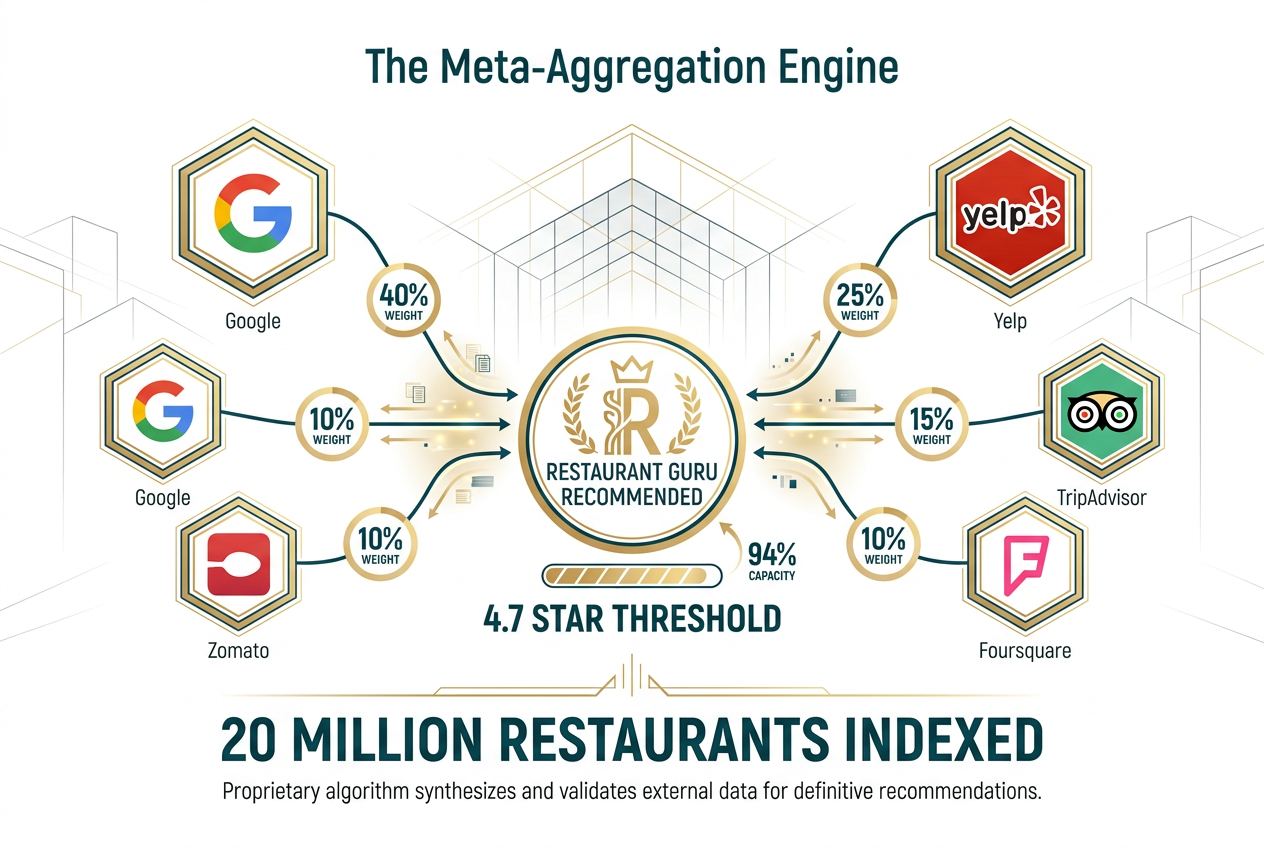 Restaurant Guru functions as a meta-aggregator, synthesizing data from five major review platforms to identify dining spots that exceed a specific 4.7-star weighted threshold across the web.
With 30 million monthly users accessing the platform in 2025, Restaurant Guru occupies a distinct niche in the restaurant discovery landscape: it is neither a crowd-sourced review platform like Yelp nor a professionally curated guide like Michelin. It is an algorithmic validation layer that answers a narrow but useful question - "Does this restaurant consistently perform well across multiple review platforms?" - but provides no insight into why it performs well or whether it will match your specific taste preferences. For the serious foodie, this distinction is critical: Restaurant Guru can confirm consensus quality, but it cannot teach you what you love.
What Does the "Restaurant Guru Recommended" Badge Actually Mean?
The "Restaurant Guru Recommended" badge means a restaurant has achieved a weighted average rating of approximately 4.7 stars or higher across the five platforms Restaurant Guru monitors - Google, Yelp, TripAdvisor, Foursquare, and Zomato - based on aggregated public review data processed through the platform's proprietary scoring algorithm. This threshold is not publicly documented by Restaurant Guru itself, but industry analysis from platforms like Savor the App, which reverse-engineered the pattern by analyzing thousands of awarded restaurants, consistently identifies 4.7 stars as the functional cutoff point.
The award is generated automatically. When a restaurant crosses this threshold, Restaurant Guru's system sends an automated email notification to the business owner (using contact information publicly available on the restaurant's Google Business Profile or other listings), informing them of the recognition and offering optional promotional services such as printable certificates, physical plaques, or window stickers featuring the "Recommended" logo. The business does not pay for the award itself - the badge is earned purely through public review performance - but businesses can purchase branded materials to display the recognition if they choose to invest in that marketing opportunity.
The Five-Platform Weighting System
Restaurant Guru's algorithm does not treat all five source platforms equally. Based on observed patterns in awarded restaurants, the weighting appears to prioritize platforms with higher review volumes and more recent activity. Google Reviews and Yelp, which typically have the largest user bases in North America and Europe, carry more algorithmic weight than Foursquare or Zomato in those regions. Conversely, in markets where TripAdvisor or Zomato dominate (such as parts of Asia or Latin America), those platforms receive greater influence in the final calculation.
This means a restaurant with a 4.9-star Google rating, a 4.5-star Yelp rating, and minimal presence on the other three platforms could still receive the "Recommended" badge if the weighted calculation crosses the 4.7 threshold. Conversely, a restaurant with a perfect 5.0 rating on Foursquare but only 4.3 stars on Google and Yelp would likely be excluded. The system rewards consistent cross-platform performance, not dominance on a single review site.
What the Badge Does Not Mean
The "Recommended" badge does not signify:
- Professional inspection by trained critics or food experts
- Editorial curation or human judgment of any kind
- Payment or partnership between the restaurant and Restaurant Guru
- Compliance with specific culinary standards, hygiene protocols, or service benchmarks
- Superiority over non-badged restaurants that may have strong ratings on fewer platforms
The badge is a statistical summary, not a subjective endorsement. It tells you that a large number of diners across multiple platforms have rated this restaurant highly, but it does not tell you why they rated it highly or whether those reasons align with your personal priorities. A restaurant could earn the badge for having excellent service but mediocre food, or vice versa - the algorithm does not distinguish between these variables. It simply measures aggregate satisfaction.
For the serious foodie, this limitation is significant. The badge validates consensus, which can be useful when choosing between unfamiliar options in a new city. But it cannot replace personal taste intelligence. Building a personal restaurant library that tracks which dishes you loved at which restaurants - not just which venues passed an algorithmic threshold - is the skill that transforms you from a badge-trusting consumer into an actual culinary expert.
Is Restaurant Guru Legit or Just Marketing?
Yes, Restaurant Guru is legitimate in the technical sense: the underlying data is real, the awards are based on actual aggregated ratings from verifiable third-party platforms, and the company operates transparently within the restaurant technology industry with 11+ years of documented operation and 30 million monthly users. The platform is not a scam. It does not fabricate ratings, sell fake awards, or require payment for the "Recommended" designation. The data it aggregates is the same publicly available review information you could manually compile yourself by checking Google, Yelp, TripAdvisor, Foursquare, and Zomato individually - Restaurant Guru simply automates that process and applies a weighted threshold to identify high performers.
However, the legitimacy of the data does not automatically translate to the legitimacy of the marketing or the user experience surrounding that data. This is where the debate intensifies.
The Trust Problem: User Sentiment and Business Practices
Restaurant Guru holds a TrustScore of 3.5 out of 5 on Trustpilot based on 156 user reviews as of 2024, placing it in the "average" performance category. The most common complaints from users and restaurant owners include:
Aggressive Email Campaigns: Many restaurant owners report receiving unsolicited emails from Restaurant Guru notifying them of their "Recommended" status, followed by repeated promotional pitches to purchase physical plaques, window stickers, or premium listing upgrades. These emails, while technically legal, often feel like a bait-and-switch: the award is free, but the visibility and credibility associated with displaying the award require payment.
Lack of Transparency on Methodology: Restaurant Guru does not publicly disclose the exact weighting algorithm, the specific threshold for receiving an award, or how frequently ratings are updated. This opacity creates skepticism among both diners and restaurateurs, who cannot independently verify whether the algorithm is applied consistently or whether it favors certain types of establishments (e.g., high-volume casual dining vs. low-volume fine dining).
No Editorial Oversight or Dispute Resolution: Because the awards are generated algorithmically, there is no human editorial team to appeal to if a restaurant believes it has been unfairly excluded or included. Similarly, diners have no mechanism to report awards that seem inaccurate based on their personal experience - the algorithm is the final arbiter, regardless of on-the-ground reality.
The Data Is Real, But the Context Is Missing
The core question is not "Is the data fake?" but "Does this data tell me what I actually need to know?" A restaurant with 4.8 stars across five platforms has undeniably pleased a large number of diners. But why did it please them? Was it the food quality, the portion size, the Instagram-worthy ambiance, the convenience of location, or the low prices? The algorithm does not distinguish. It simply confirms that the venue exceeded a satisfaction threshold - a useful signal for avoiding truly terrible restaurants, but a weak signal for discovering great ones that match your specific taste.
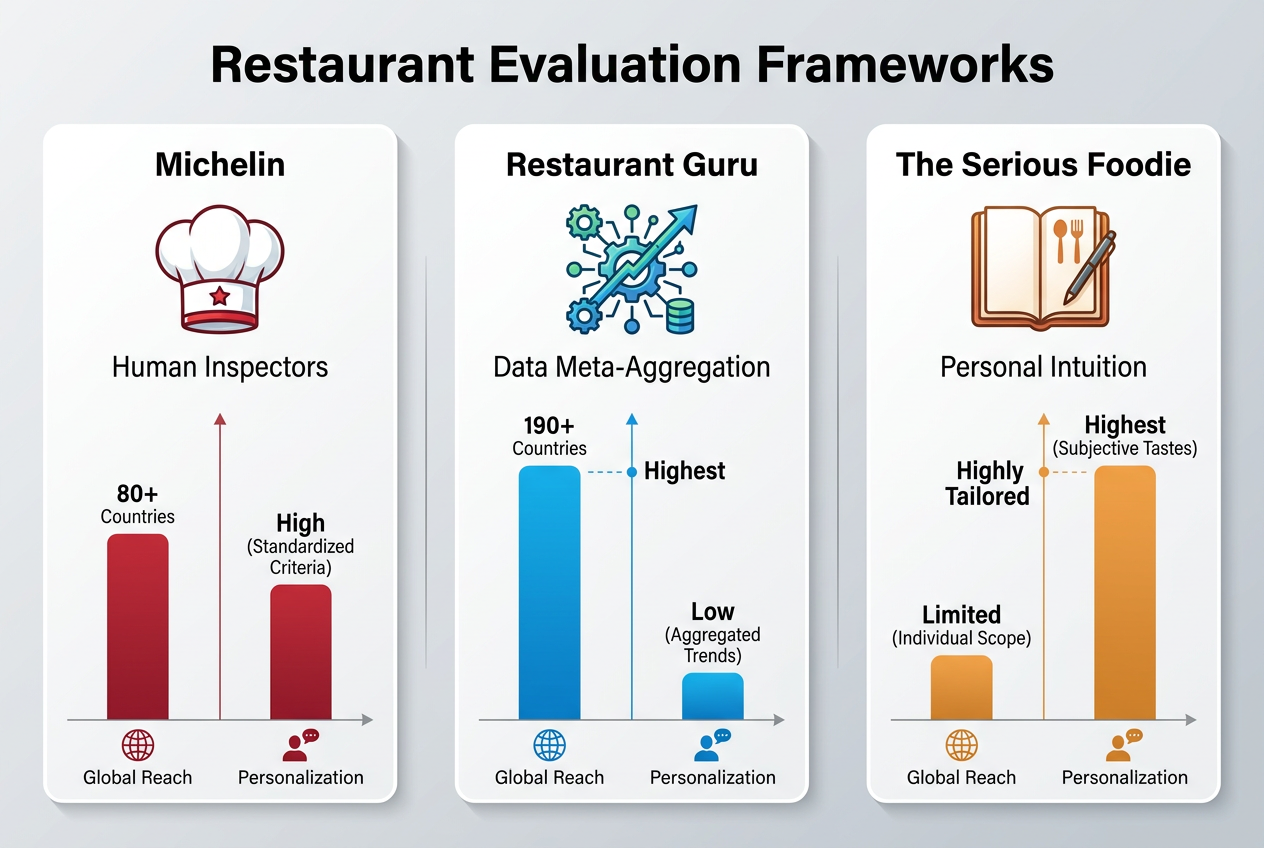 While Michelin relies on professional inspectors, Restaurant Guru uses a broad algorithmic reach across 190 countries, leaving a gap for your own personal expert intuition to fill.
For serious food lovers, the most effective approach is to treat Restaurant Guru as a baseline validation tool - a way to quickly filter out poorly rated establishments when traveling to an unfamiliar city - while investing in personal food tracking systems that capture the nuance the algorithm cannot: which dishes were extraordinary, which flavor profiles resonated with you, and which restaurants you would actually return to versus which you would merely recommend to someone else. The algorithm can tell you what the crowd thinks. Only you can tell you what you think.
How to Use Restaurant Guru Like a Pro
Restaurant Guru is most effective when treated as a validation tool, not a discovery engine. Its strength lies in confirming that a restaurant has consistently satisfied a large number of diners across multiple platforms - a useful data point when you need to make a quick decision in an unfamiliar city or filter out objectively poor options from a long list. Its weakness lies in its inability to tell you why a restaurant is rated highly or whether those reasons align with your personal taste. Professional food critics and serious foodies use Restaurant Guru strategically, as one input among many, rather than as a definitive answer.
Use Case 1: Pre-Travel Validation in Unfamiliar Cities
When traveling to a new city where you have no local knowledge or trusted recommendations, Restaurant Guru's global database of 20 million restaurants across 190 countries provides a rapid baseline filter. Search for a cuisine or neighborhood, identify restaurants with the "Recommended" badge, then cross-reference those results with your own priorities by diving deeper into the source platforms (Google, Yelp, TripAdvisor) to read actual reviews and examine specific dishes mentioned by diners.
Pro Workflow: Use Restaurant Guru to generate a shortlist of 5-7 high-performing restaurants in your target area, then export those names into a personal food tracking app where you can annotate each venue with specific dishes to try, flavor profiles to expect, and contextual notes (e.g., "Recommended by locals on Reddit for the dry-aged ribeye, not the pasta"). This two-step process preserves the algorithm's efficiency while adding the human intelligence the algorithm lacks.
Use Case 2: Discovering Consensus Favorites in Competitive Dining Scenes
In cities with hyper-competitive restaurant markets (New York, Paris, Tokyo, Barcelona), the sheer volume of options creates decision paralysis. Restaurant Guru's cross-platform aggregation cuts through the noise by identifying restaurants that have achieved consensus approval across multiple review ecosystems - a signal that the venue is not just gaming one platform's algorithm but delivering a genuinely consistent experience that satisfies a wide demographic.
Pro Workflow: Use Restaurant Guru's "Top 10" lists for specific cuisines (e.g., "Top 10 Italian Restaurants in Milan") as a starting point, but do not treat those lists as definitive. Instead, analyze the distribution of ratings: Are the top-ranked restaurants all fine-dining establishments, or is there diversity in price points and styles? Are there any restaurants with slightly lower aggregate scores but passionate niche followings (visible in individual platform reviews)? This contextual analysis - which requires reading beyond the badge - reveals opportunities that the algorithm's one-dimensional ranking obscures.
Use Case 3: Avoiding Tourist Traps in High-Traffic Areas
One of Restaurant Guru's most practical applications is filtering out restaurants that exist primarily to serve tourists rather than locals. Because the platform aggregates data from Google, Yelp, TripAdvisor, Foursquare, and Zomato - which collectively represent a mix of tourist-heavy platforms (TripAdvisor) and local-heavy platforms (Google, Yelp) - a restaurant must perform well across both demographics to earn the "Recommended" badge. This cross-platform validation reduces (though does not eliminate) the risk of choosing a venue that locals actively avoid.
Pro Workflow: When evaluating a "Recommended" restaurant in a tourist-heavy district, check the review distribution on TripAdvisor versus Google. If TripAdvisor reviews are overwhelmingly positive but Google reviews (which skew more local) are mediocre, the restaurant may be optimized for one-time visitors rather than repeat customers. Use this signal to deprioritize the venue unless you are explicitly seeking a tourist-friendly experience (e.g., multilingual menus, accommodating service).
What Not to Do: Trusting the Badge Alone
The most common mistake diners make is treating the "Recommended" badge as a substitute for personal research. The badge confirms that a restaurant has met a statistical threshold - nothing more. It does not tell you whether the restaurant specializes in the specific dish you want to eat, whether the atmosphere matches your dining preferences, or whether the restaurant's strengths align with your priorities (e.g., you value ingredient sourcing and the badge-winning restaurant excels at portion size and speed).
For serious food lovers, the solution is to build a parallel system that tracks your own experiences rather than relying on algorithmic summaries of other people's experiences. Organizing your restaurant photos and reviews by dish, flavor profile, and personal rating creates a database that becomes more valuable over time - a personalized "guru" system that outperforms any global algorithm because it is calibrated to your palate, not the crowd's.
How Does Restaurant Guru Compare to Michelin, Yelp, and Other Review Systems?
Restaurant Guru occupies a distinct category in the restaurant evaluation landscape: it is neither a professionally curated guide like Michelin nor a crowd-sourced review platform like Yelp, but rather a meta-aggregator that synthesizes data from multiple existing platforms to identify consensus high performers. Understanding how it differs from - and complements - other review systems is essential for using it strategically.
| Evaluation System | Methodology | Geographic Reach | Review Volume | Editorial Oversight | Best Use Case |
|---|---|---|---|---|---|
| Michelin Guide | Professional inspectors conduct anonymous, in-person evaluations based on ingredient quality, technique, creativity, consistency, and value. | 40+ countries, primarily Europe, Asia, and major U.S. cities. | Not applicable (inspector-based, not crowd-sourced). | High - trained culinary experts with strict protocols. | Identifying elite fine-dining destinations and emerging culinary talent. |
| Restaurant Guru | Algorithmic aggregation of ratings from Google, Yelp, TripAdvisor, Foursquare, and Zomato. Awards "Recommended" badge to venues exceeding 4.7-star weighted threshold. | 190 countries, 20 million restaurants. | High - aggregates millions of public reviews from five platforms. | None - fully automated, no human editorial input. | Rapid baseline validation of consensus quality in unfamiliar cities. |
| Yelp | Crowd-sourced reviews from individual users, filtered by Yelp's proprietary recommendation algorithm to suppress suspected fake or biased reviews. | Primarily U.S., Canada, and select European cities. | Very high - over 250 million reviews globally. | Moderate - algorithmic fraud detection, but no professional editorial curation of content. | Discovering local favorites, reading detailed user experiences, and identifying service issues. |
| Google Reviews | Crowd-sourced reviews integrated with Google Maps and Google Search, with no editorial filtering beyond basic spam detection. | Global, embedded in Google Maps for nearly all restaurants. | Extremely high - largest review volume of any platform. | Low - minimal fraud detection, no editorial curation. | Checking broad consensus, viewing recent photos uploaded by diners, and confirming operational details (hours, location). |
| TripAdvisor | Crowd-sourced reviews with algorithmic ranking (Travelers' Choice awards) and fraud detection. Skews heavily toward tourists rather than locals. | Global, with strong presence in tourist destinations. | Very high - over 1 billion reviews across all categories. | Moderate - algorithmic fraud detection, editorial awards for top performers. | Researching restaurants in tourist-heavy areas, comparing international dining options. |
The Professional Inspector Model: Michelin and Its Analogues
Michelin represents the opposite end of the spectrum from Restaurant Guru. Michelin inspectors are trained culinary professionals who dine anonymously, pay for their own meals, and evaluate restaurants based on five explicit criteria: quality of ingredients, mastery of technique, harmony of flavors, expression of the chef's personality, and consistency over time. A Michelin star is not a popularity contest - it is a professional certification that a restaurant has achieved a specific level of culinary excellence as judged by experts whose opinions carry industry authority.
Michelin's strength is precision: when a restaurant earns a star, you know exactly what the evaluators valued and can trust that the assessment reflects culinary expertise rather than consumer sentiment. Michelin's weakness is scale: with coverage limited to 40+ countries and fewer than 3,000 starred restaurants globally, the vast majority of the world's dining landscape falls outside its purview. Restaurant Guru, by contrast, covers 20 million restaurants across 190 countries but offers no insight into why a restaurant is rated highly.
For the serious foodie, the two systems are complementary: use Michelin to identify proven culinary excellence in markets where it operates, and use Restaurant Guru to validate options in markets where professional curation does not exist.
The Crowd-Sourced Model: Yelp, Google, and the Wisdom of the Crowd
Yelp and Google Reviews rely on the "wisdom of the crowd" principle: if enough people rate a restaurant highly, the aggregate opinion is likely to reflect genuine quality. This model has enormous reach and captures far more dining experiences than any professional inspector network could document. However, crowd-sourced reviews suffer from several well-documented weaknesses:
Demographic Skew: Reviewers on Yelp and Google skew younger, more urban, and more price-sensitive than the general dining population. A restaurant that excels at affordable comfort food will typically outperform a high-end tasting menu on these platforms, regardless of actual culinary quality.
Motivational Bias: People are more likely to leave reviews after extremely positive or extremely negative experiences, creating a U-shaped distribution that under-represents average but satisfactory meals. This distortion makes aggregate star ratings less reliable than they appear.
Fraud and Manipulation: Despite algorithmic fraud detection, fake reviews - both positive (purchased by restaurants) and negative (posted by competitors) - remain a persistent issue on crowd-sourced platforms. Yelp's recommendation algorithm filters suspected fake reviews, but the process is opaque and sometimes removes legitimate reviews, frustrating both users and businesses.
Restaurant Guru does not solve these problems - it aggregates data from platforms that suffer from them - but by requiring consensus across five platforms, it reduces the impact of manipulation on any single platform. A restaurant that has gamed Yelp's algorithm but performs poorly on Google and TripAdvisor will not receive the "Recommended" badge.
The Meta-Aggregator Advantage: When Consensus Matters
Restaurant Guru's unique value lies in cross-platform validation. In markets where review fraud is rampant or where user demographics vary wildly between platforms, the algorithm's requirement for consistent performance across multiple ecosystems acts as a quality filter that no single platform can provide. This makes Restaurant Guru particularly useful in developing markets or tourist-heavy cities where Michelin does not operate and where individual review platforms may be less reliable.
However, this advantage comes with a critical tradeoff: by optimizing for consensus, the algorithm inherently favors restaurants that appeal to the broadest demographic. It cannot identify niche excellence - the hole-in-the-wall ramen shop that locals worship but tourists overlook, or the avant-garde tasting menu that divides critics but transcends conventional rating systems. For those discoveries, you need human intelligence, not algorithmic aggregation.
The most effective strategy for serious food lovers is to treat Restaurant Guru as a floor, not a ceiling: use it to eliminate objectively poor options and validate consensus favorites, then invest in building your own restaurant tracking system that captures the nuance and specificity the algorithm cannot provide. The badge tells you what the crowd thinks. Your personal database tells you what you think - and over time, that becomes the only opinion that matters.
How to Become a Real-Life Restaurant Guru (Beyond the Algorithm)
The term "Restaurant Guru" implies expertise - the ability to navigate dining landscapes with confidence, recommend hidden gems, and articulate why a dish works or fails. But the platform that carries this name offers no pathway to developing that expertise. The "Recommended" badge is a statistical output, not a skill. Becoming a true restaurant guru requires moving beyond algorithmic validation and building three core competencies: palette mastery, experiential organization, and personal ranking systems.
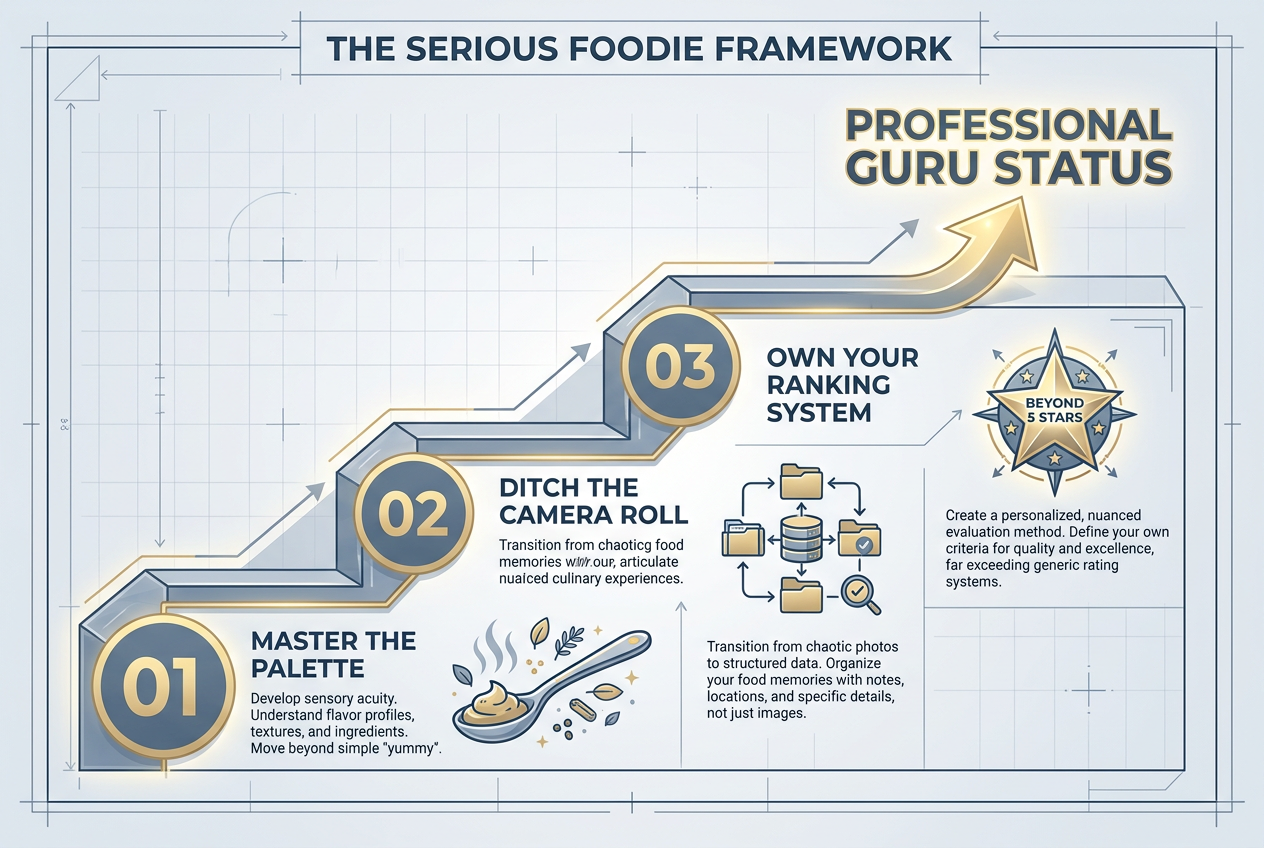 Becoming a true restaurant guru requires moving beyond the automated algorithm and developing a structured personal database to track culinary experiences and distinct flavor profiles.
Step 1: Master the Palette (Vocabulary)
The difference between a casual diner and a culinary expert is language. Casual diners say "It tasted good." Experts say "The miso added umami depth without overpowering the delicate sweetness of the scallops." This precision is not pretentious - it is functional. It allows you to identify patterns in your own preferences, communicate those preferences to others, and evaluate whether a restaurant's execution matches its intent.
Develop a Flavor Vocabulary: Start tracking dishes using descriptive categories beyond "liked it" or "didn't like it." Learn to identify and name the five basic tastes (sweet, salty, sour, bitter, umami), common cooking techniques (braised, seared, confit, sous-vide), and textural contrasts (crispy, creamy, chewy, tender). When you taste a dish, force yourself to articulate what you're tasting and why it works or doesn't.
Calibrate Your Palate Across Cuisines: A true guru can evaluate excellence across multiple culinary traditions, not just their personal favorites. If you only eat Italian food, you cannot assess whether a Thai curry is well-executed or whether a Japanese kaiseki demonstrates proper technique. Deliberately expose yourself to unfamiliar cuisines and learn the specific markers of quality within each tradition - what constitutes a great ramen broth versus a great pho broth, or how Neapolitan pizza differs from Roman pizza in dough hydration and cooking method.
Track Your Learning: Use a food journaling app to record new vocabulary, flavor combinations, and technical observations as you encounter them. Over time, this database becomes your personal culinary education - a reference library you can consult when evaluating new restaurants or recommending dishes to others.
Step 2: Move Beyond the Camera Roll (How to Organize Food Memories)
Your camera roll holds 2,000 food photos, but how many of those meals can you actually recall with specificity? The typical food lover's workflow is capture the photo, post it to Instagram, and forget the experience within 48 hours. This is the opposite of expertise. Expertise requires memory, and memory requires organization.
Ditch Passive Documentation for Active Curation: Stop treating food photos as disposable content and start treating them as archival material. Every dish you photograph should be tagged with at least four data points: restaurant name, dish name, date, and a brief taste note (1-2 sentences describing what made the dish memorable or forgettable). This metadata transforms a random photo collection into a searchable database.
Organize by Dish, Not by Venue: Most restaurant review platforms organize by venue - you can see all the dishes you ate at Restaurant X, but you cannot easily compare the carbonara you had at Restaurant X versus the carbonara you had at Restaurant Y. For serious food lovers, this is backward. Organize your food memories by dish so you can track how different chefs interpret the same concept, identify your favorite version, and articulate what distinguishes a great example from a mediocre one.
Use Structured Tools, Not Generic Note Apps: While it is technically possible to organize food memories using your phone's default notes app, the lack of search functionality, filtering options, and photo integration makes this approach unsustainable once your database exceeds 50-100 entries. Specialized dish tracking apps designed for foodies provide structured fields, tagging systems, and visual browsing that scale with your experience.
Step 3: Develop Your Own "Guru" Ranking System (Moving Beyond 5-Star Genericism)
The standard five-star rating system is too reductive to capture meaningful culinary judgment. A 4.5-star rating tells you nothing about why a dish earned that score or how it compares to other 4.5-star dishes you've eaten. Professional food critics use multi-dimensional frameworks that evaluate execution, creativity, value, and emotional impact separately before synthesizing those dimensions into a final assessment. You can do the same.
Create a Personal Rating Framework: Design a scoring system that reflects your actual priorities as a diner. For example:
- Execution (1-10 points): Technical skill and consistency - was the dish cooked correctly?
- Flavor (1-10 points): Taste and seasoning - did the dish deliver on its intended flavor profile?
- Creativity (1-10 points): Originality and thoughtfulness - did the dish offer something unexpected or elevate a familiar concept?
- Value (1-10 points): Price relative to quality - was the dish worth the cost?
- Emotional Impact (1-10 points): Memorability and personal resonance - will you think about this dish a week from now?
This 50-point framework provides far more actionable data than a single aggregate star rating. A dish might score 9/10 on execution but 3/10 on creativity, signaling that it is technically flawless but unoriginal - a useful distinction when deciding whether to return to the restaurant.
Track Comparative Rankings Within Categories: Instead of rating every pasta dish you eat on an absolute scale, rank them relative to each other: "This carbonara is better than the one at Restaurant X but not as good as the one at Restaurant Y." Over time, these comparative rankings create a hierarchy that reflects your actual preferences, not an arbitrary star system.
Share Your Framework with Others: The final step in becoming a guru is teaching. Once you have a structured system for evaluating and ranking dishes, share that system with friends, family, or online communities. The act of explaining why you rated a dish a certain way forces you to refine your criteria and makes your recommendations more credible than generic five-star reviews.
For serious food lovers, the goal is not to replicate Restaurant Guru's algorithm - which measures consensus, not excellence - but to build a better system calibrated to your own taste. Curating a personal restaurant library that captures what you loved, why you loved it, and how it compares to similar experiences is the skill that transforms you from a passive consumer of reviews into an active culinary authority. The algorithm can tell you what the crowd thinks. Only you can tell you what you think - and that is the only opinion that matters.
The Verdict: Algorithm vs. Intuition
After 11 years of operation, 20 million indexed restaurants, and 30 million monthly users, Restaurant Guru has proven one thing conclusively: algorithmic aggregation at scale works as a baseline quality filter. If a restaurant consistently earns 4.7+ stars across Google, Yelp, TripAdvisor, Foursquare, and Zomato, it is almost certainly not terrible. The data is real. The threshold is meaningful. The badge is legitimate.
But legitimacy is not the same as utility for the serious foodie.
The fundamental limitation of Restaurant Guru - and every algorithmic review system - is that it optimizes for consensus, not discovery. It tells you what a large, demographically diverse group of diners collectively approved of, but it cannot tell you whether those diners share your taste, your priorities, or your tolerance for risk. A restaurant can earn the "Recommended" badge by serving competent, crowd-pleasing food that satisfies tourists, business travelers, and families with children. That is a valuable signal when you need to avoid disaster in an unfamiliar city. It is not a valuable signal when you are searching for the hole-in-the-wall ramen shop that locals worship but casual diners overlook.
The restaurants you remember - the ones that change how you think about food - are rarely consensus favorites. They are polarizing. They take risks. They serve dishes that half the room loves and half the room hates. The algorithm cannot identify these places because the algorithm is designed to suppress variance, not celebrate it.
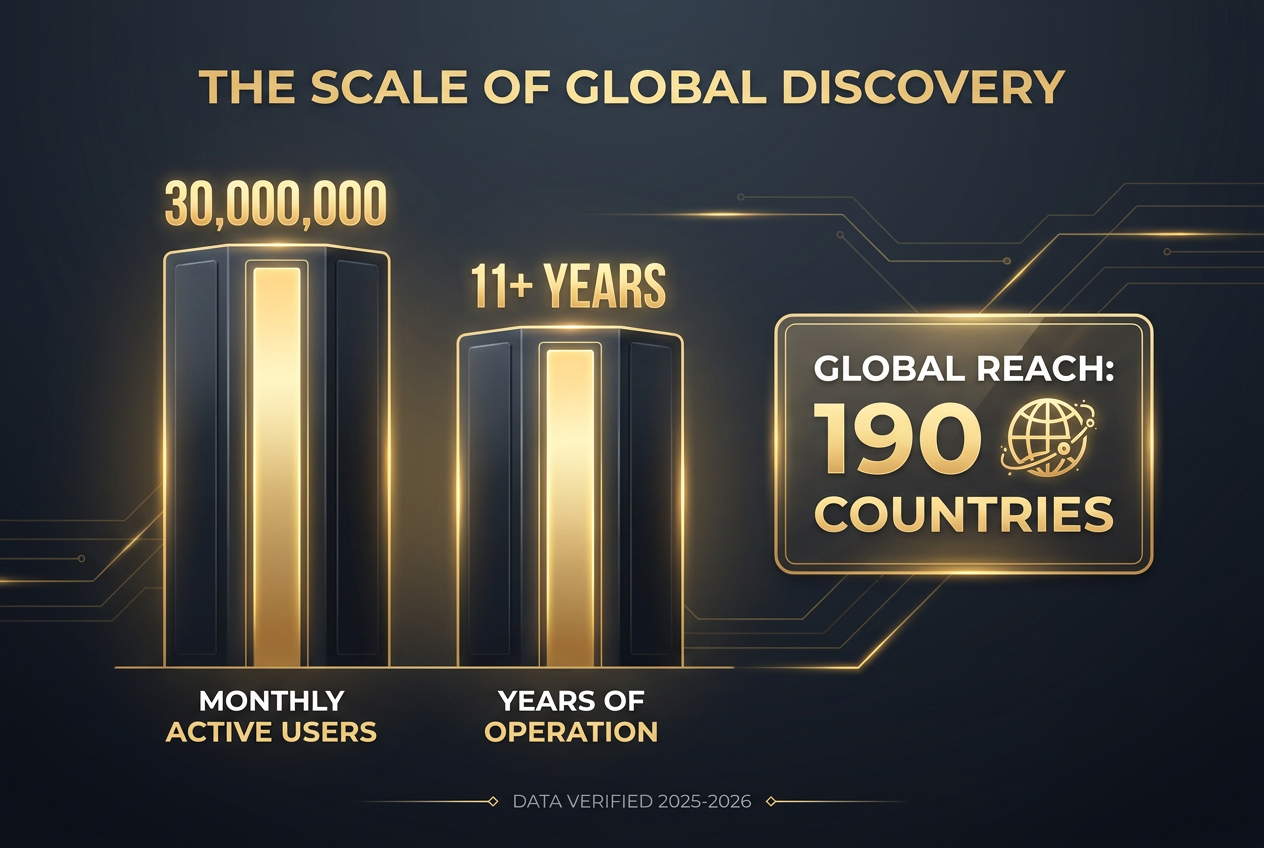 With over a decade of data and 30 million monthly users, the scale of Restaurant Guru's database makes it a formidable tool for macro-level dining discovery.
For professionals in the food industry - critics, chefs, hospitality consultants - Restaurant Guru serves a narrow but useful function: it provides a high-level view of consensus quality across markets where professional curation does not exist. It is a triage tool, not a discovery tool. It answers the question "What is universally considered good?" but not "What is exceptional?" or "What will resonate with me?"
For serious food lovers, the solution is not to abandon algorithmic tools entirely but to use them strategically as one input among many, while investing the majority of your effort in building a parallel system that captures what the algorithm cannot: your own taste intelligence. Tracking individual dishes, not just venues, organizing your food memories by flavor profile and technique, and developing a personal ranking framework that reflects your actual priorities creates a database that becomes more valuable over time because it is calibrated to you, not the crowd.
The badge tells you what the algorithm thinks. Your database tells you what you think. One is static. The other evolves. One measures the past. The other predicts the future. The algorithm can confirm that a restaurant is safe. Only your intuition can tell you whether it is worth remembering.
That is the difference between validation and expertise. Restaurant Guru offers the former. You must build the latter yourself.
Frequently Asked Questions
What is the meaning of a Restaurant Guru award?
The Restaurant Guru award means a restaurant has achieved a weighted average rating of approximately 4.7 stars or higher across five major review platforms - Google, Yelp, TripAdvisor, Foursquare, and Zomato - as calculated by Restaurant Guru's proprietary aggregation algorithm. This threshold is determined automatically based on public review data, not by human critics or paid partnerships. The award certifies that the restaurant has earned consistent approval from a large number of diners across multiple review ecosystems, indicating consensus quality rather than editorial endorsement. Restaurants receive the award via automated email and can optionally purchase physical plaques or window stickers to display the recognition.
Is Restaurant Guru a legitimate website or a scam?
Restaurant Guru is a legitimate technology platform that has operated for over 11 years (founded in 2013) and serves 30 million monthly users across 190 countries. The underlying data used to generate awards is sourced directly from publicly available reviews on Google, Yelp, TripAdvisor, Foursquare, and Zomato - not fabricated or manipulated. The awards are free and automated; restaurants do not pay to receive the "Recommended" badge, though they can purchase optional promotional materials. However, the platform's business model (selling plaques, stickers, and premium listings) and aggressive email marketing campaigns create trust concerns, reflected in its 3.5/5 Trustpilot score from 156 reviews. The data is legitimate, but the user experience and promotional tactics generate skepticism.
How are Restaurant Guru awards determined?
Restaurant Guru awards are determined by an automated algorithm that aggregates ratings from five review platforms - Google, Yelp, TripAdvisor, Foursquare, and Zomato - and applies a proprietary weighting formula to calculate a composite score. When a restaurant's weighted average exceeds approximately 4.7 stars (the specific threshold is not publicly disclosed), the system automatically generates a "Recommended" badge and sends an email notification to the restaurant owner. The algorithm runs continuously and updates as new reviews are posted on source platforms, meaning awards can be earned or lost based on ongoing review performance. No human inspectors, editorial boards, or paid partnerships influence the award process - it is purely data-driven.
Can you trust the Restaurant Guru "Top 10" lists?
Restaurant Guru's "Top 10" lists are algorithmically generated rankings of restaurants within a specific category (e.g., "Top 10 Italian Restaurants in Rome") based on the same 4.7-star weighted aggregation methodology used for awards. These lists reflect consensus quality as measured by aggregate ratings across five platforms, not editorial curation or professional judgment. They are useful for quickly identifying high-performing restaurants in unfamiliar cities or filtering out objectively poor options, but they should not be treated as definitive culinary guides. The lists favor restaurants with broad demographic appeal and high review volumes, which often excludes niche gems, new openings, or establishments that locals prefer but tourists overlook. Use the lists as a starting point, not a final answer, and cross-reference results with platform-specific reviews and personal dish tracking systems to make informed decisions.
How do I get my restaurant listed on Restaurant Guru?
Restaurant Guru automatically indexes restaurants that have public profiles on Google, Yelp, TripAdvisor, Foursquare, or Zomato. If your restaurant is already listed on any of these platforms, it will eventually appear in Restaurant Guru's database as the platform's web crawlers discover and process your business information. There is no manual submission process or application required. To improve your chances of receiving a "Recommended" award, focus on encouraging satisfied customers to leave reviews on the five source platforms and maintaining a consistent 4.7+ star average across them. Restaurant Guru offers optional services (premium listings, enhanced visibility) for a fee, but these do not affect whether your restaurant receives an award - awards are based solely on aggregated review performance.
What is the difference between a Michelin star and a Restaurant Guru award?
A Michelin star is awarded by professional culinary inspectors who anonymously dine at restaurants and evaluate them based on five explicit criteria: ingredient quality, technique, flavor harmony, chef personality, and consistency. Michelin stars represent expert editorial judgment and are limited to approximately 3,000 restaurants globally across 40+ countries. A Restaurant Guru "Recommended" badge, by contrast, is generated by an automated algorithm that aggregates crowd-sourced ratings from Google, Yelp, TripAdvisor, Foursquare, and Zomato across 20 million restaurants in 190 countries. Michelin measures culinary excellence as judged by trained experts; Restaurant Guru measures consensus satisfaction as reported by the general public. The two systems are complementary: Michelin identifies elite fine-dining destinations, while Restaurant Guru validates broad appeal in markets where professional curation does not exist.
Is there a physical award or sticker for Restaurant Guru that you have to pay for?
The Restaurant Guru "Recommended" award itself is free and automatically granted when a restaurant exceeds the 4.7-star threshold. However, physical materials to display the award - such as printable certificates, window stickers, or metal plaques featuring the Restaurant Guru logo and "Recommended" designation - are sold as optional promotional products. Prices for these materials vary and are not publicly standardized, but industry reports suggest costs range from $50 to $300 depending on the product and customization. Purchasing these materials is entirely optional and does not affect a restaurant's eligibility for the award or its ranking in Restaurant Guru's database. The business model relies on restaurants purchasing physical branding to capitalize on the credibility of the award, not on charging for the award itself.
How can a person become a "guru" in the restaurant world?
Becoming a restaurant guru - a trusted culinary authority - requires three core skills: developing a sophisticated flavor vocabulary to articulate why a dish works or fails, building a structured personal database that organizes food memories by dish rather than venue, and creating a multi-dimensional ranking system that evaluates execution, creativity, value, and emotional impact separately. This process cannot be automated or outsourced to algorithmic review platforms. It requires deliberate practice: eating widely across cuisines, tracking experiences with dedicated food journaling tools, and refining your ability to compare dishes within categories to identify patterns in your own taste. Over time, this personal database becomes your competitive advantage - a culinary memory bank calibrated to your preferences that outperforms any crowd-sourced review system because it reflects your expertise, not the crowd's opinion.