
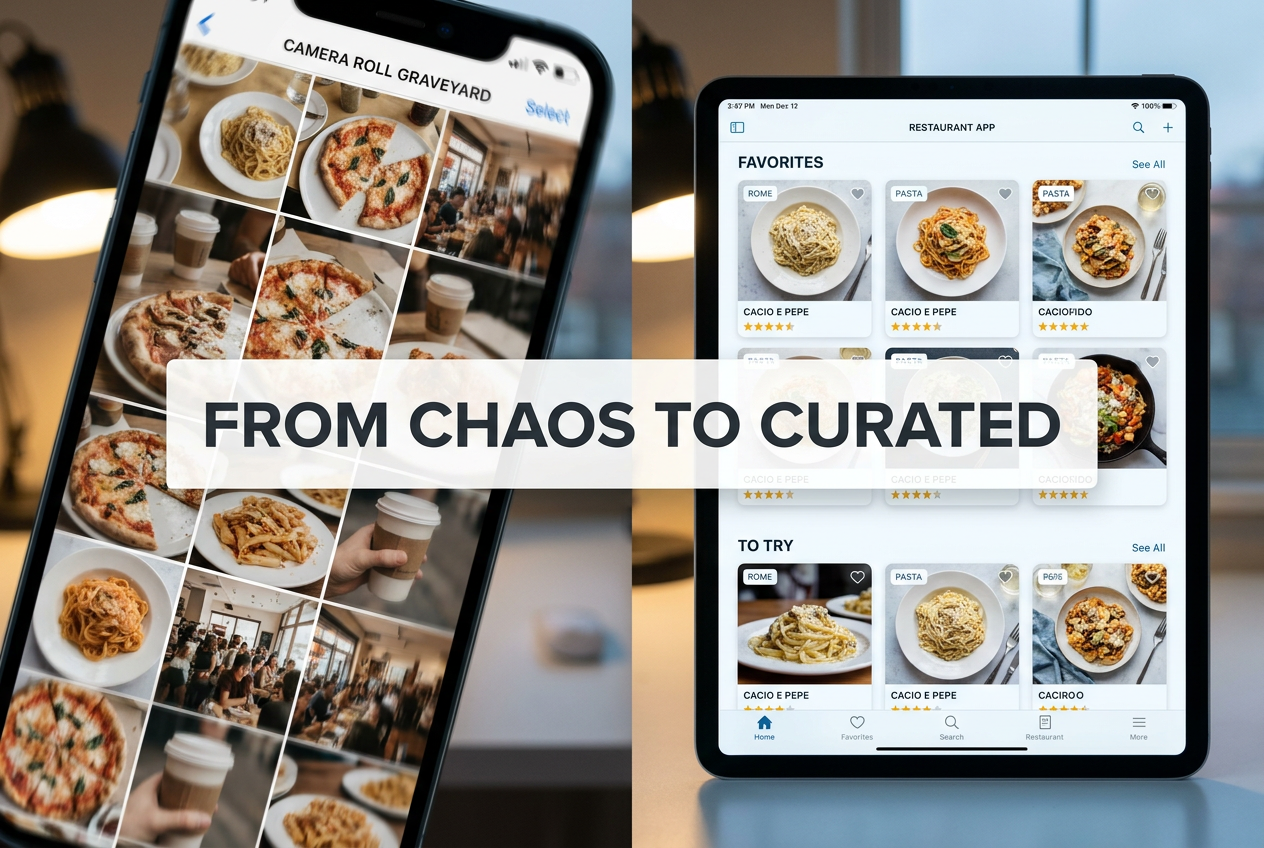
How Restaurant Tracking Apps Finally Solved the Food Photo Graveyard
Alex the juice queen
Alex hunts for the best juice bars and presses. She rates every sip and saves her favorites in Savor.
The End of the Food Photo Graveyard: Why Restaurant Tracking Apps Are the New Food Diary You’ve scrolled through 2,400 unsearchable food photos looking for...
The End of the Food Photo Graveyard: Why Restaurant Tracking Apps Are the New Food Diary
You’ve scrolled through 2,400 unsearchable food photos looking for that life-changing pasta. You remember it was somewhere in Rome. You think it was a cacio e pepe. The restaurant name? Gone. The neighborhood? A blur. All you have is a grainy iPhone photo buried between selfies and screenshots.
This is the Camera Roll Graveyard - and it’s costing you more than just lost memories.
The serious foodie’s problem isn’t a lack of great meals. It’s a lack of a system to remember them. Traditional restaurant review platforms like Yelp treat your refined palate like it’s the same as someone who thinks Olive Garden is "authentic Italian." They average your discerning taste into a meaningless 4-star blur. Meanwhile, your camera roll becomes a digital landfill of extraordinary moments you’ll never be able to recreate.
But there’s a better way. Restaurant tracking apps designed for serious eaters are transforming how we document, search, and relive our culinary history. This isn’t about public performance or influencer flexing - it’s about building a private archive of your taste memory, searchable by dish, ingredient, neighborhood, or that specific feeling you’re craving.
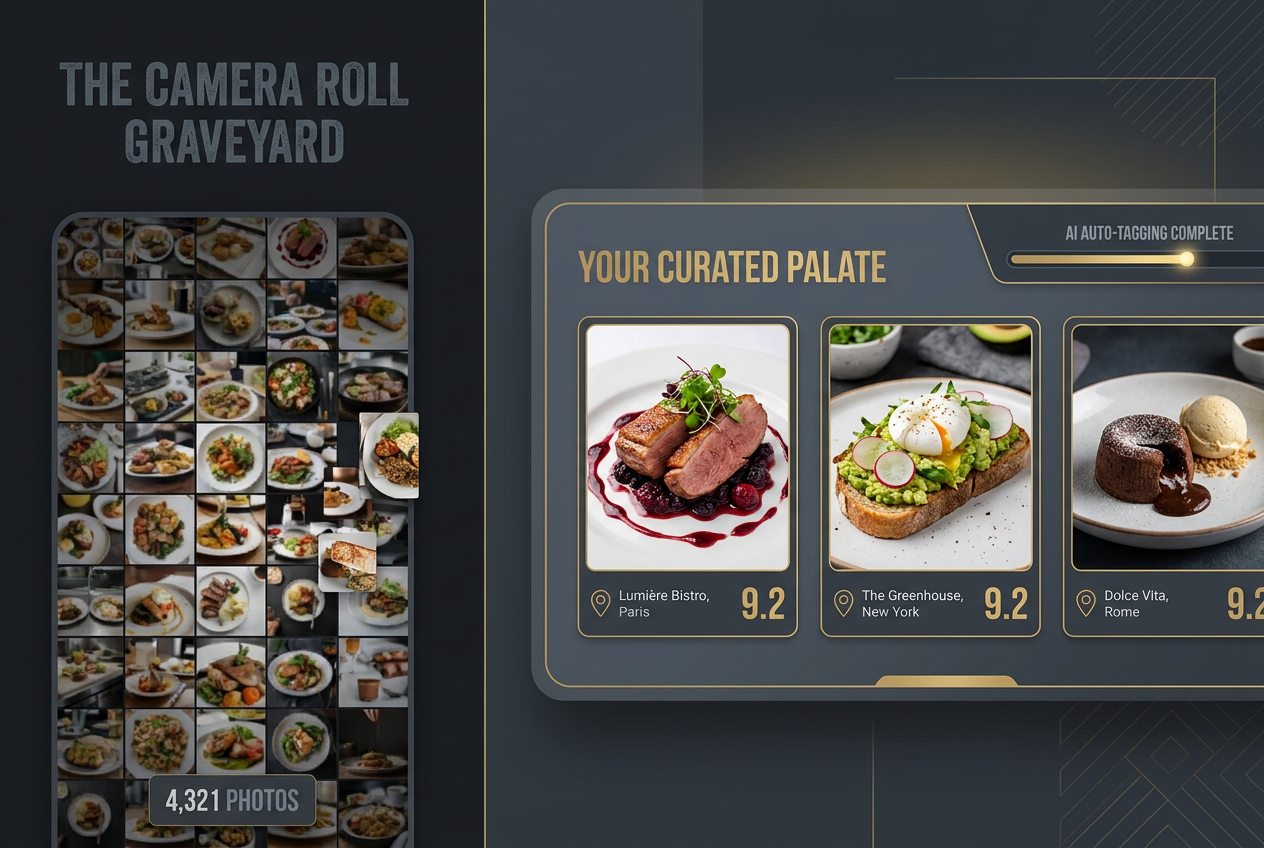 Transform your chaotic mess of unsearchable food photos into a curated digital archive that makes your culinary history searchable and valuable in seconds.
Table of Contents
- The Camera Roll Scroller’s Remorse
- Why Public Reviews Are Performance Art (Not Truth)
- The Death of the Star Rating
- How Restaurant Tracking Apps Actually Work
- AI Auto-Tagging: Your Meals, Instantly Organized
- The ELO of You: Ranking Your Own History
- The "Near Me" Past: Your Personal Culinary Map
- Data Sovereignty: Owning Your Food History
- The Migration Tool: Escaping Platform Lock-In
- Offline Mode: Logging Meals Without Wi-Fi
- Stop Documenting. Start Curating
- Frequently Asked Questions
The Camera Roll Scroller’s Remorse
Eight months ago, you had the best pasta of your life in Rome. You remember the moment: golden afternoon light, a quiet side street, the waiter’s recommendation that turned out to be transcendent. You took a photo. You probably took three.
Now you’re back home, trying to recommend that place to a friend visiting Rome. You open your camera roll. Scroll. Scroll. Scroll. Was it before or after the Colosseum? Was it the same day as that gelato place? The photo offers no context - just a beautiful plate of pasta that could be from literally anywhere.
This is Scroller’s Remorse, and it’s the hidden cost of our photo-first culture. We document everything and remember nothing. The average food lover takes 150+ food photos per month. That’s 1,800 meals per year vanishing into an unsearchable void.
The traditional solution - posting to Instagram or Yelp - doesn’t solve the problem. It just trades one form of chaos for another. Public reviews are performative. They’re written for an audience, not for you. And six months later, when you’re trying to remember if that ramen was actually worth the hype or just Instagrammable, your own review is useless.
What serious foodies need isn’t another way to broadcast their meals. It’s a private system to archive them - searchable by the details that actually matter.
Why Public Reviews Are Performance Art (Not Truth)
Let’s be honest about what happens when you write a public restaurant review. You’re not recording your actual experience. You’re crafting a narrative for strangers, for the chef who might read it, for your followers who need to know you have Good Taste.
The Yelp review becomes theater. You soften criticism because you don’t want to seem mean. You exaggerate praise because mediocre reviews are boring to write. You describe the "ambiance" and "service" because that’s what reviews are supposed to include - even though what you really care about is whether that specific dish was worth $30.
This performative pressure ruins the utility of the review. When you return to it months later, you can’t trust your own words. Did you really think that pasta was "transcendent," or were you just in a good mood that day? Was the waiter actually "attentive," or were you performing gratitude for an audience?
Private tracking changes everything. When you log a meal for yourself - no audience, no performance - you record the truth. You note that the octopus was rubbery, that the dessert was skippable, that you’d absolutely return for the duck but nothing else. This is the only review that matters: the one written for Future You, trying to decide where to eat.
The serious foodie’s insight: The best food journal is the one no one else sees.
The Death of the Star Rating
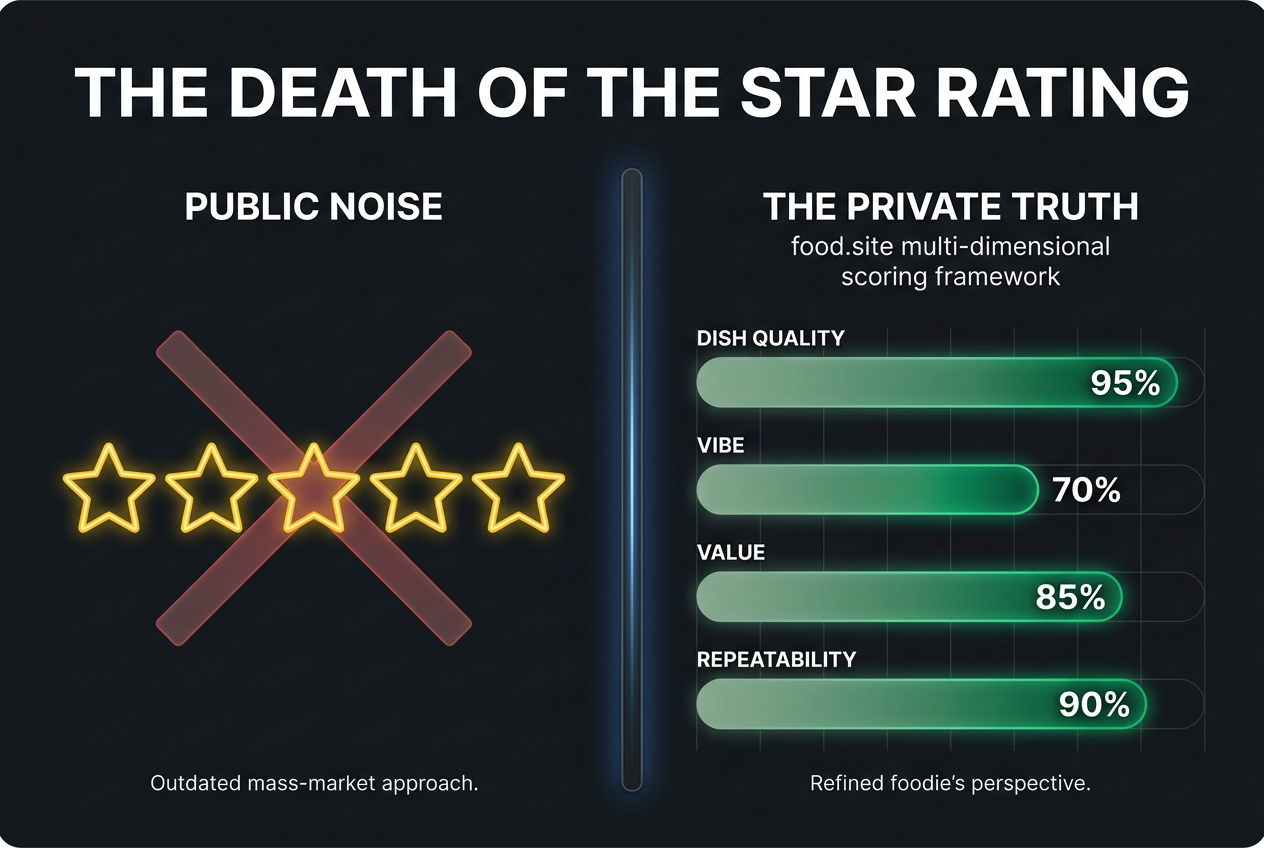 Standardized star ratings fail serious foodies; our multi-dimensional scoring system allows you to track the specific metrics that actually define a world-class dining experience.
Here’s a mathematical fact that ruins traditional reviews: a 4-star rating is meaningless.
A 4-star rating for a Michelin-starred tasting menu and a 4-star rating for a $6 taco truck communicate nothing about quality, value, or whether you’d return. They’re different universes of expectation, price point, and context - mashed into the same five-point scale.
This is why serious foodies are abandoning star ratings entirely. The future of personal food tracking is multi-dimensional scoring - breaking down each meal into the metrics that actually matter:
- Dish Quality (0-10): Was this the best version of this dish you’ve ever had? A 10-point score for the cacio e pepe, a 6 for the bland risotto.
- Vibe (0-10): Would you bring your partner here for an anniversary? Your parents? A first date? Scoring atmosphere separately from food quality reveals hidden gems.
- Value (0-10): Not "was it cheap," but "was it worth the price?" A $200 omakase can be a 10. A $40 pasta that’s merely good is a 5.
- Repeatability (0-10): The ultimate question: would you come back? This score cuts through everything else.
This framework solves the comparison problem. You’re not rating restaurants against each other. You’re building a personal index of what’s worth your time and money. That 8/10 neighborhood bistro becomes more valuable than the 7/10 Michelin spot - because you’ve learned what you actually want.
The shift from public stars to private scores is the defining characteristic of the modern restaurant tracking app. It’s the difference between performing taste and actually tracking it.
For more on building your personal rating system, check out our guide to the best apps to track restaurant meals.
How Restaurant Tracking Apps Actually Work
A proper restaurant tracking app isn’t a review site. It’s a personal operating system for your palate - designed to capture, organize, and surface the meals you actually care about.
The workflow is deceptively simple:
- Snap a photo of your dish (or don’t - some meals are just for you).
- AI auto-tags the restaurant, location, and dish name from the image and metadata.
- Score the meal using your personal rating system (dish quality, vibe, value, repeatability).
- Add notes that Future You will actually find useful: "Ask for extra anchovy," "Skip the dessert," "The Tuesday lunch special is the move."
- Search and filter your entire history by dish type, neighborhood, price range, or specific ingredients.
This system works because it’s friction-free. Logging a meal takes 30 seconds - before your food gets cold. There’s no pressure to write a polished review, no audience to perform for, no worrying about whether you sound pretentious. You’re building a database of your taste, one meal at a time.
The best apps make this process invisible. You don’t think about "tracking." You just record what you loved, what you’d skip, and what you need to remember for next time. Over months and years, this casual documentation becomes a searchable archive of your culinary life.
AI Auto-Tagging: Your Meals, Instantly Organized
The breakthrough feature that separates modern restaurant tracking apps from digital notebooks is AI auto-tagging. You snap a photo of your plate, and the app automatically extracts:
- Restaurant name (pulled from GPS and visual recognition)
- Location and neighborhood (so you can search "best pasta near Columbia Heights")
- Dish name (often with surprising accuracy - "Tonkotsu Ramen," not just "noodles")
- Cuisine type (Italian, Japanese, New American)
- Price tier (inferred from menu text or your past entries)
This removes the biggest friction point in food journaling: data entry. You’re not typing "Piccolo Café" and "Cacio e Pepe" and "Mount Pleasant, DC" into separate fields. You’re just taking the photo you were going to take anyway - and the app does the rest.
The accuracy varies by platform. The best systems use a combination of computer vision (analyzing the actual food), GPS data (where you are), and OCR (reading menu text from your photos). They get smarter over time, learning your habits and common restaurants.
What this means in practice: you can log 30 meals in a weekend food tour of Tokyo without ever typing a single restaurant name. Six months later, when you’re trying to remember which ramen shop in Shibuya had the perfect soft egg, you just search "ramen + Tokyo + egg" and find it instantly.
This is the killer feature. Not public reviews. Not social sharing. Just searchable, organized memory - built automatically from photos you were already taking.
The ELO of You: Ranking Your Own History
Once you’ve logged 50, 100, 200 meals, a new problem emerges: how do you rank them against each other?
This is where personal ELO scoring comes in - a concept borrowed from chess rankings. Instead of trying to assign absolute scores (is this pasta a 7 or an 8?), the app occasionally asks you simple comparison questions:
- "Which did you prefer: the duck at Restaurant A or the lamb at Restaurant B?"
- "If you could only eat one again: the omakase at Sushi Nakazawa or the tasting menu at Atomix?"
Based on your answers, the system builds a ranked list of every meal you’ve ever logged - ordered by your actual preferences, not arbitrary numbers. This solves the scoring fatigue problem. You don’t have to remember if last year’s carbonara was "really" an 8 or a 9. You just pick which one you liked better, and the algorithm does the math.
Over time, this creates something remarkable: a brutally honest ranking of your culinary history. The $15 Korean fried chicken that outranks the $300 French tasting menu. The neighborhood spot you’ve visited 12 times that somehow beats every Michelin restaurant in your city.
This is the difference between performing taste (public reviews) and measuring it (private tracking). The ELO system doesn’t lie. It reveals what you actually want to eat, stripped of price expectations, hype, and social performance.
The "Near Me" Past: Your Personal Culinary Map
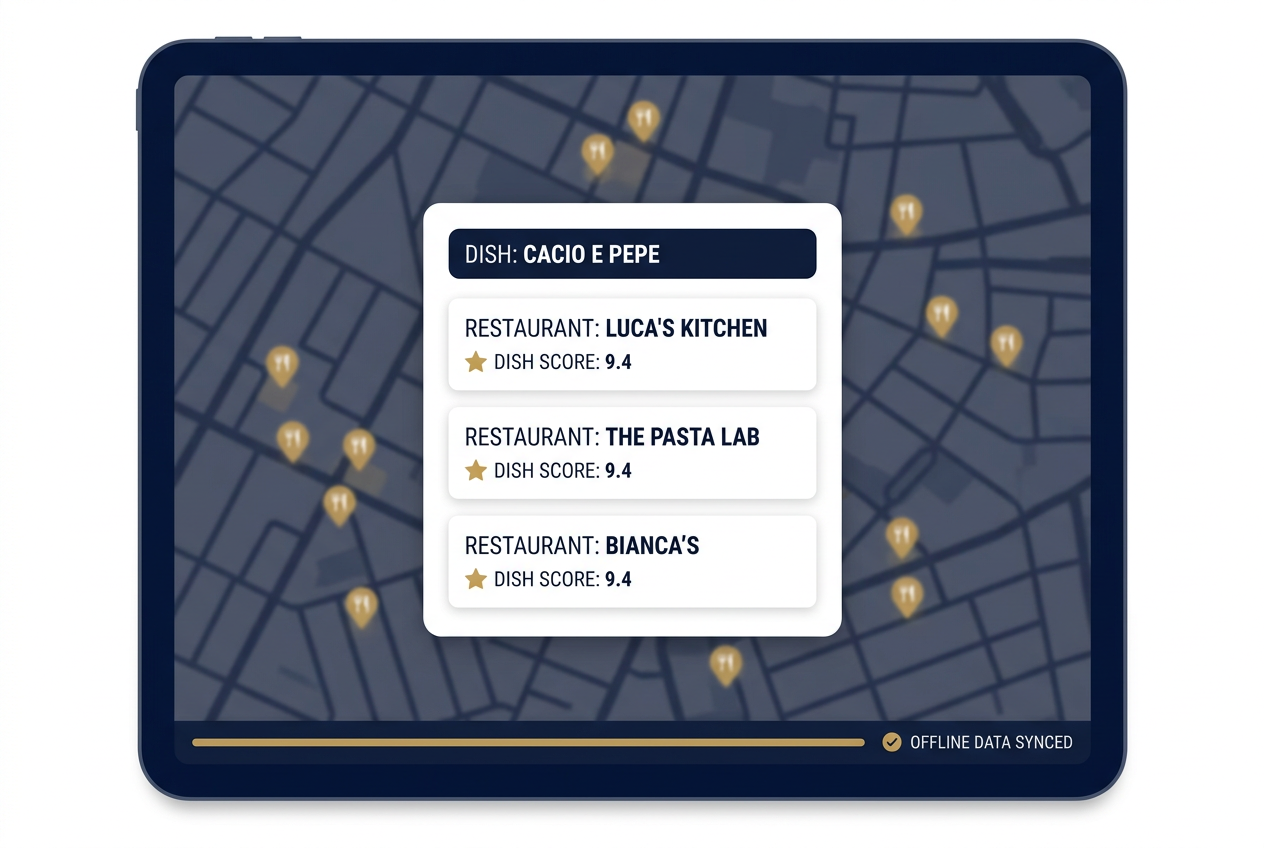 Stop searching the public web for recommendations; use your own history to find exactly where you had that life-changing dish with dish-level granularity.
You’re walking through a neighborhood you haven’t visited in months. You pull out your phone and open the map view of your restaurant tracking app. Suddenly, the city transforms.
Instead of seeing anonymous Yelp pins (4.2 stars, 847 reviews, who knows if it’s good), you see your own history: color-coded by your personal ratings. The green pin marks the ramen shop where you had a perfect 10/10 tonkotsu. The yellow pin is the decent-but-skippable taco spot (6/10). The red pin? That overpriced disappointment you never want to repeat.
This is the "Near Me" Past - and it’s transformative. You’re not relying on strangers’ opinions or algorithmic recommendations. You’re navigating by your own taste memory.
The best apps let you filter this map in real-time:
- "Show me everywhere I’ve had great pasta within 1 mile."
- "Where did I eat in this neighborhood that scored 8+ for value?"
- "I’m craving duck - where have I had it before?"
Suddenly, your culinary history becomes a living guide. You’re not Googling "best restaurants near me." You’re searching your own database of proven winners - filtered by exactly what you want right now.
This is especially powerful when traveling. Drop your map pin in Tokyo, Paris, or Mexico City, and instantly see everywhere you’ve eaten on past trips - scored, tagged, and searchable. It’s like having a local food guide written by the only person whose taste you completely trust: yourself.
For more on organizing your restaurant history, see our guide on how to build a personal restaurant library.
Data Sovereignty: Owning Your Food History
Here’s the nightmare scenario: you’ve logged 500 meals over three years. You’ve built a searchable database of your entire culinary life. Then the app shuts down, gets acquired, or pivots to a subscription model you hate. Your data - every photo, every note, every rating - disappears.
This is why data portability is the most underrated feature in restaurant tracking apps. The serious foodie’s question isn’t just "Does this app work well?" It’s "Can I export my data if I need to leave?"
The gold standard: apps that offer full CSV or JSON exports of your entire database - restaurants, dishes, scores, photos, notes, dates. This means you can:
- Migrate to a different platform without starting over
- Back up your data independently (not just trusting the app’s cloud)
- Analyze your history in custom ways (spreadsheets, visualizations, trends over time)
- Own your culinary archive even if the service dies
This matters more than most people realize. Food memories are personal and irreplaceable. The pasta you had the night you got engaged. The ramen shop you visited on every trip to Tokyo. The neighborhood spot that closed during the pandemic but lives on in your photos. These aren’t just "reviews" - they’re life documentation.
Apps that lock your data behind proprietary formats or make export difficult are betting you’ll never leave. Apps that make export easy are betting you’ll stay because the product is good - not because switching is impossible. That’s the difference worth paying attention to.
Before committing to any platform, ask: "Can I download everything I’ve ever logged?" If the answer isn’t a clear yes, keep looking.
The Migration Tool: Escaping Platform Lock-In
You’ve been using Yelp for years. You have 200+ reviews, carefully written, scattered across dozens of cities. They represent hundreds of hours of dining experiences. But Yelp’s algorithm is broken, the app is cluttered with ads, and you’re ready to switch to something better.
The problem: all that history is trapped.
This is where migration tools become essential. The best restaurant tracking apps offer one-click imports from Yelp, Google Maps, TripAdvisor, and other platforms - automatically converting your old reviews into structured, searchable entries in your new system.
Here’s how it works:
- Export your Yelp data (most platforms offer this, though it’s often buried in settings)
- Upload the file to your new tracking app
- AI processing extracts restaurant names, locations, ratings, and your review text
- Instant database of your entire food history, now in a better format
This solves the high switching cost problem. You’re not choosing between losing your history or staying on a platform you’ve outgrown. You’re preserving everything while upgrading to better tools.
For serious foodies with years of documentation across multiple platforms, this feature is non-negotiable. Your food history is too valuable to abandon. The apps that recognize this - and build tools to help you migrate - are the ones worth your time.
Offline Mode: Logging Meals Without Wi-Fi
You’re in a basement speakeasy in Mexico City. No cell signal. No Wi-Fi. The mezcal selection is extraordinary, and you just had the best mole of your life. You want to log it - but your tracking app requires an internet connection to save entries.
By the time you resurface two hours later, you’ve forgotten the mezcal’s name and the specific notes you wanted to record. The moment is lost.
This is why offline mode is critical for serious food travelers. The best restaurant tracking apps let you:
- Capture photos and notes without any connection
- Queue entries to sync when you’re back online
- Access your full history even when traveling internationally without data
This feature separates hobbyist apps from professional-grade tools. When you’re eating through Tokyo fish markets, Oaxacan mezcalerías, or remote Italian villages, you can’t rely on Wi-Fi. The app needs to work anyway.
The technical implementation matters. Some apps claim "offline mode" but only let you view past entries - not create new ones. The real test: can you log a complete meal - photo, restaurant, dish name, score, notes - while completely disconnected, then sync everything seamlessly when you reconnect?
For travelers who take their food documentation seriously, this isn’t a nice-to-have feature. It’s essential infrastructure. Your culinary archive shouldn’t have gaps just because you visited places without reliable internet.
To learn more about apps that work offline, explore our roundup of the best apps to track and rate meals.
Stop Documenting. Start Curating
The shift from camera roll chaos to organized food memory isn’t about taking better photos. It’s about building a system that serves Future You - the version of yourself trying to remember where you had that perfect martini, which neighborhood spot is worth revisiting, or what dish made that anniversary dinner unforgettable.
This requires three mindset changes:
1. Private beats public. Stop writing reviews for strangers. Start logging meals for yourself. The best food diary is the one that’s brutally honest - which means it can’t be public.
2. Dish-level beats venue-level. "This restaurant is great" tells you nothing. "The duck was transcendent, skip the dessert" tells you everything. Track specific plates, not general impressions.
3. Searchable beats chronological. Your camera roll is organized by date - which is useless when you’re trying to find "that ramen place in Tokyo." Your food archive should be searchable by dish, ingredient, neighborhood, price, and mood.
These shifts transform food documentation from a chore into a tool. You’re not scrolling through 2,000 photos hoping to stumble across a memory. You’re searching "pasta + Rome + 10/10" and finding it in three seconds.
This is what modern restaurant tracking apps enable: a personal culinary operating system that gets smarter with every meal you log. Stop letting your best food memories die in your camera roll. Start building an archive that actually serves you.
Move your camera roll to a system that works. Your Future Self - hungry, undecided, craving something specific - will thank you.
Frequently Asked Questions
What is a restaurant tracking app?
A restaurant tracking app is a personal food diary designed to log, organize, and search your dining history. Unlike public review platforms, these apps focus on private documentation - helping you remember specific dishes, score meals using your own criteria, and build a searchable archive of everywhere you’ve eaten. Think of it as a database for your taste memory, not a social network for food photos.
How is restaurant tracking different from Yelp or Google Reviews?
The fundamental difference is audience and purpose. Yelp and Google Reviews are public platforms where you write for strangers, chefs, and algorithms. Restaurant tracking apps are private tools where you write for yourself. This changes everything - you can be brutally honest, track dish-level details instead of venue-level impressions, and use custom scoring systems that actually reflect your taste. Public reviews are performative. Private tracking is useful.
Do I need to be a "foodie" to use a restaurant tracking app?
Not at all. These apps serve anyone who’s ever forgotten where they had a great meal or wasted money returning to a restaurant that was only mediocre the first time. Whether you eat out twice a month or twice a day, the core problem is the same: your camera roll is an unsearchable mess, and your memory isn’t reliable. A tracking app solves that for casual diners and serious food lovers alike.
Can I import my existing Yelp or Google reviews into a tracking app?
Many modern restaurant tracking apps offer migration tools that let you import your review history from Yelp, Google Maps, or TripAdvisor. The process typically involves exporting your data from the old platform (usually available in account settings) and uploading it to the new app, which uses AI to extract restaurant names, locations, ratings, and review text. This eliminates the switching cost - you don’t lose years of food history just because you want better tools.
What’s the benefit of scoring dishes instead of restaurants?
Restaurant-level ratings are too blunt. A single venue might have a perfect signature dish and three mediocre sides - giving it "4 stars" tells you nothing useful. Dish-level scoring lets you track exactly what’s worth ordering: the duck at Restaurant A (10/10), skip the pasta (5/10), the wine list is exceptional. Six months later, when you’re deciding whether to return, you know exactly what to order and what to avoid. This granularity is what makes private food tracking actually useful.
Do these apps work offline when traveling internationally?
The best restaurant tracking apps include full offline functionality - letting you capture photos, add restaurants, score dishes, and write notes without any internet connection. Your entries queue locally and sync automatically when you reconnect. This is essential for serious travelers eating through markets, remote villages, or any location with unreliable Wi-Fi. Always test offline mode before a big trip - some apps claim to support it but only let you view past entries, not create new ones.
How long does it take to log a meal in a tracking app?
With AI auto-tagging, logging a complete meal takes about 30 seconds. You snap a photo of your dish, the app extracts the restaurant name and location from GPS and visual recognition, you add a quick score and optional notes, and you’re done. This is fast enough to do before your food gets cold - which is the real test of friction. Apps that require manual entry of every field (restaurant name, address, cuisine type, dish name) won’t survive in real-world use.
Can I export my food data if I want to switch apps later?
Any tracking app worth using offers full data export - typically as CSV or JSON files containing your complete history of restaurants, dishes, scores, photos, notes, and dates. This ensures you own your culinary archive, not the platform. Before committing to an app, check whether it supports export and how comprehensive the export actually is. Apps that make it easy to leave are confident their product is good enough to make you stay.