
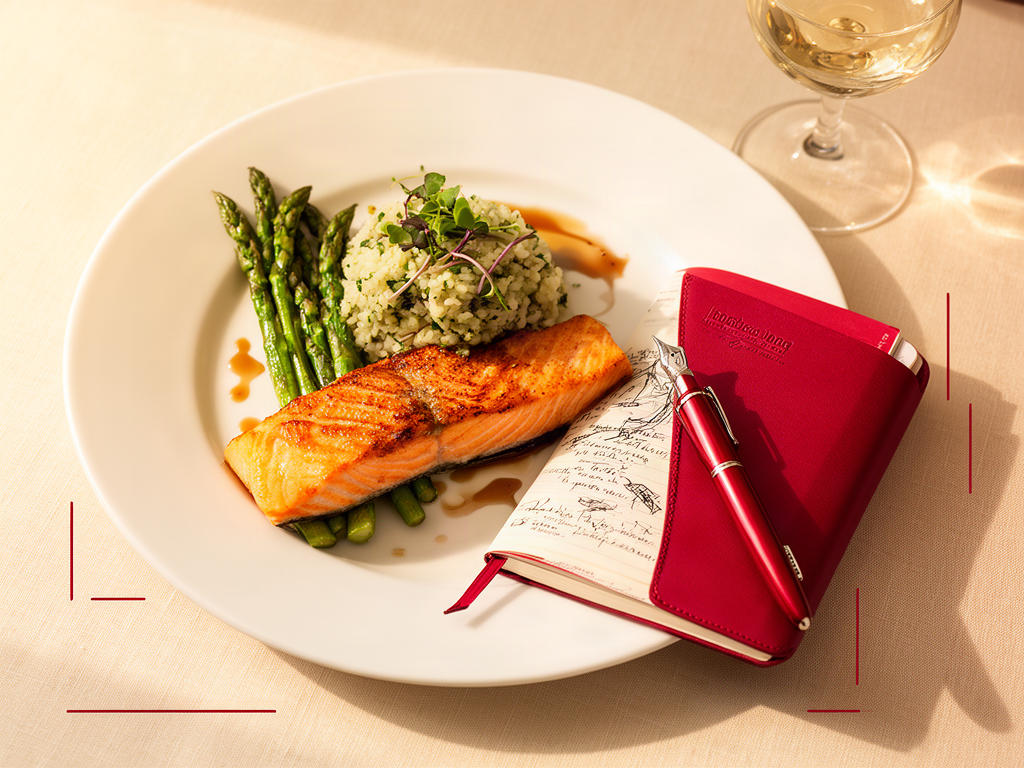
How to Score Food Like a Critic: A Framework for Serious Foodies
John the smoothie monster
John lives for smoothie bowls and cold-pressed juices. He uses Savor to remember his best blends.
How to Score Food Like a Critic: The Complete Framework for Serious Foodies You just finished an extraordinary meal. The flavors were perfect, the execution...
How to Score Food Like a Critic: The Complete Framework for Serious Foodies
You just finished an extraordinary meal. The flavors were perfect, the execution flawless, the ambiance memorable. Three months later, you're trying to recall the details, and all you have is a vague sense of "it was really good" and a blurry photo buried in your camera roll.
In 2024, 55% of Americans preferred dining out at restaurants over ordering takeout or delivery, up from 43% in 2023. We're treating dining as cultural exploration, not just sustenance. Yet most of us have no systematic way to evaluate, catalog, and actually remember what made those meals exceptional.
This isn't about becoming a professional restaurant critic. It's about developing a personal methodology - a repeatable rubric and workflow - that turns you from a passive diner into an active curator of culinary experiences.
Table of Contents
- What Makes a Food Critic Qualified?
- The Mindset Shift: From Star Ratings to Personal Standards
- The Personal Rubric: Building Your 100-Point System
- The Sensory Upgrade: Moving Beyond "Good" and "Delicious"
- The Digital Sommelier: Cataloging Your Meals
- What Are the Criteria for a Good Food Review?
- How Does the Michelin Star Rating System Work?
- Writing for Yourself vs. The World
- Frequently Asked Questions
What Makes a Food Critic Qualified?
Professional food critics aren't qualified because they took a test or earned a degree. They're qualified because they've developed a structured methodology for evaluation, a deep sensory vocabulary, and - most importantly - consistency in how they judge meals.
The real barrier isn't credentials. It's having a framework that lets you describe why a dish worked or didn't, beyond "the flavors were amazing" or "the presentation was beautiful."
Your qualification as a personal food critic comes from three things:
- A structured rubric that you apply to every meal
- A sensory vocabulary that moves beyond generic adjectives
- A cataloging system that preserves your evaluations for future reference
Professional critics visit restaurants anonymously, order strategically, and take extensive notes. You can adopt these same practices - not to write public reviews, but to build a personal culinary archive that actually serves your life.
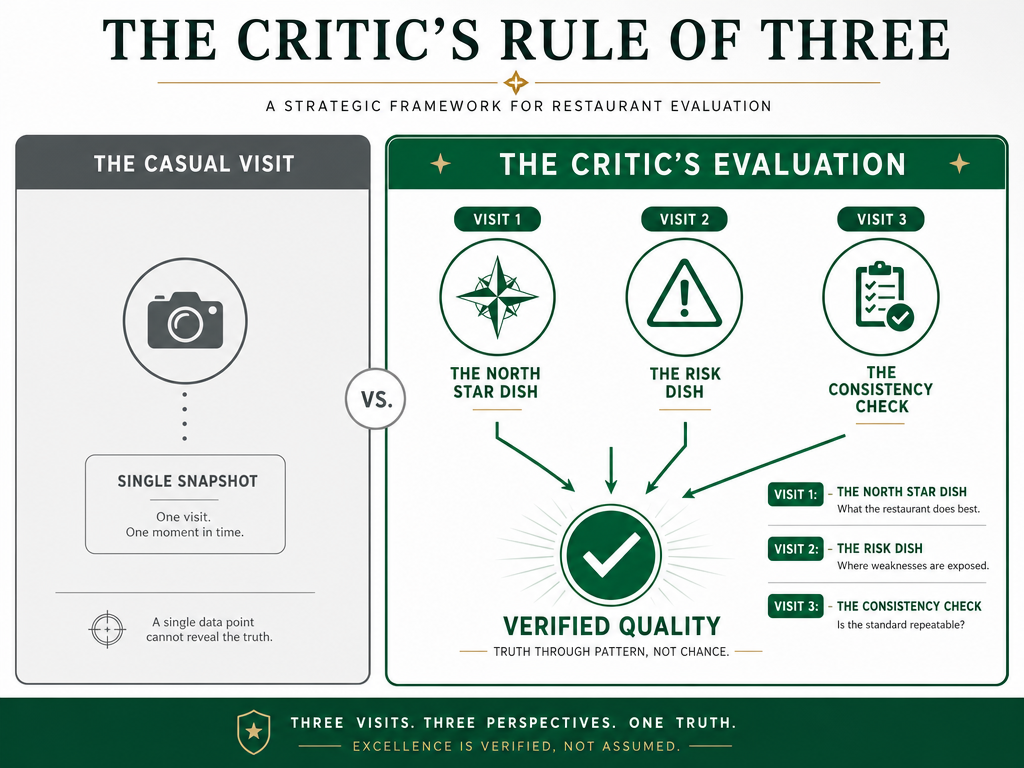 True food critics never judge a restaurant on a single meal. The 'Rule of Three' ensures you experience the kitchen's range and consistency across different days.
The Mindset Shift: From Star Ratings to Personal Standards
The Rule of Three
Professional critics never judge a restaurant on one visit. For the serious foodie, suggest the "Visit vs. Order" logic: if you can only visit once, order the "North Star" dish - the one they're known for - plus one "Risk" dish that reveals the kitchen's range.
The consistency question matters. A restaurant having a lucky night versus delivering excellence reliably are two different propositions. If you can return, visit at different times: a weekday lunch, a Friday dinner, a Sunday brunch. You'll see the kitchen's true form.
Anonymity 2.0
Don't announce you're "reviewing." Don't ask the server to customize dishes beyond reasonable dietary needs. Stay low-profile. You want to experience what every other diner gets, not the VIP treatment that masks a kitchen's real capabilities.
In the age of Instagram, total anonymity is nearly impossible. But there's a practical middle ground: be a respectful guest who observes carefully, not a spectacle who disrupts the room.
The Personal Rubric: Building Your 100-Point System
The star rating is too vague. A "4-star experience" means different things to different people. Numbers without criteria are just noise.
Modern "Serious Foodie" rubrics break down scoring into five 20-point categories: Taste, Execution, Appearance, Aesthetic, and Sanitation. This structure gives you a repeatable framework that applies to any meal, from street tacos to Michelin-starred tasting menus.
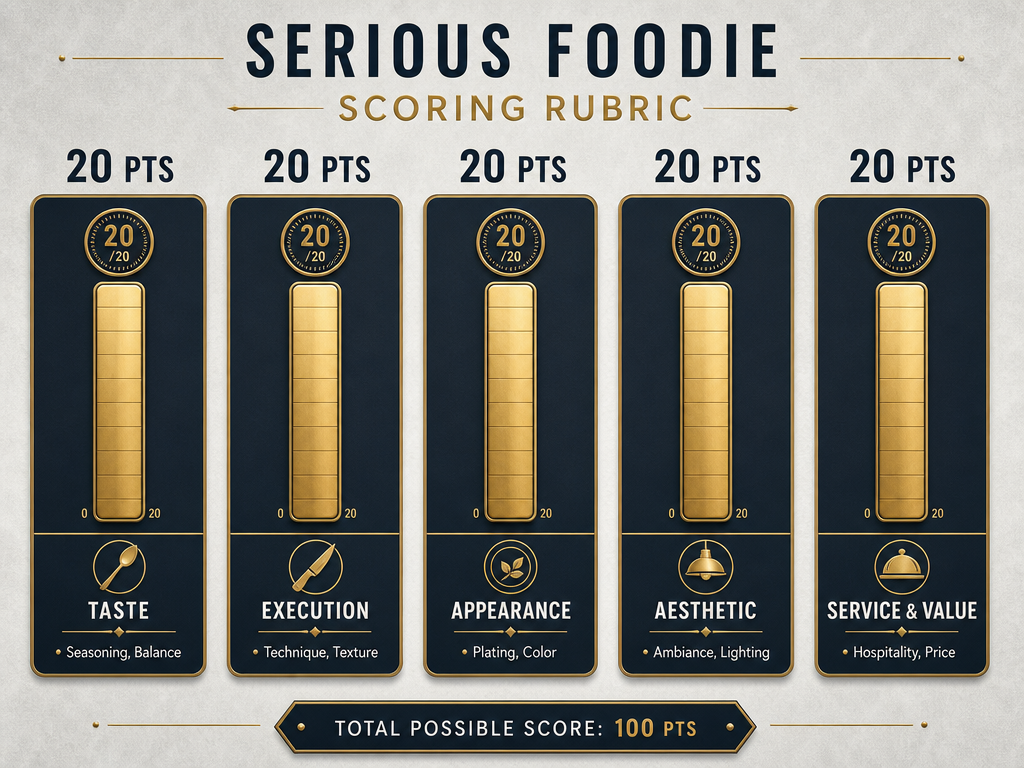 A systematic 100-point rubric allows serious foodies to move beyond 'good' or 'bad' ratings, providing a structured framework for evaluating every aspect of a meal.
The Five Pillars (20 Points Each)
1. Taste (20 points)
This isn't just "does it taste good." It's about three specific qualities:
- Authenticity: Does the dish honor its cultural or regional roots? A carbonara made with cream isn't badly executed - it's incorrectly conceived.
- Seasoning: Are the flavors balanced? Is there enough salt, acid, fat, heat?
- Harmony: Do the components work together, or are they fighting for dominance?
Score a dish low on taste if it's under-seasoned, unbalanced, or doesn't deliver on its promise. Score it high if each bite reveals intentional layering and the seasoning enhances rather than masks the core ingredients.
2. Execution (20 points)
This evaluates technical skill:
- Technique: Was the protein cooked to the correct doneness? Is the pasta al dente? Did the sauce emulsify properly?
- Temperature: Is hot food served hot? Cold food served cold? Nothing kills a dish faster than lukewarm soup.
- Texture: Does the dish have textural contrast - crispy skin against tender meat, a creamy sauce against toothsome grains?
A dish can have excellent ingredients and still fail on execution. Overcooked fish, gummy pasta, or a broken sauce all signal technical problems.
3. Appearance (20 points)
This isn't Instagram aesthetics. It's about intentional plating:
- Plating: Is the dish composed thoughtfully? Does the presentation make you want to eat it?
- Color: Are there visual contrasts? Monochrome plates often signal a lack of ingredient variety.
- Context: Does the presentation match the restaurant's concept? A casual taqueria and a fine-dining establishment should plate differently.
A beautiful plate that tastes mediocre is still a failure. But a great-tasting dish that looks sloppy suggests the kitchen doesn't respect the diner's full sensory experience.
4. Aesthetic (20 points)
This is where you evaluate the full dining environment:
- Ambiance: Does the space enhance the meal? Lighting, music, noise levels all matter.
- Soundscape: Can you hold a conversation without shouting? Is the background music thoughtfully curated?
- Service: Is the staff knowledgeable, attentive without being intrusive, and genuinely hospitable?
A transcendent meal in a chaotic, uncomfortable environment is diminished. Conversely, a merely good dish in a thoughtfully designed space becomes more memorable.
5. Service & Value (20 points)
This is the most subjective pillar, but it matters:
- Hospitality: Does the staff make you feel welcome? Do they handle special requests gracefully?
- Value for money: Not "is it cheap," but "does the quality justify the price?" A $15 bowl of ramen can be extraordinary value. A $200 tasting menu can feel like a ripoff.
Note that this differs from the MICHELIN Guide's five universal criteria: ingredient quality, harmony of flavors, mastery of techniques, chef's personality, and consistency, which explicitly excludes service and décor from star ratings. Michelin judges only what's on the plate. You're judging the complete experience.
If you want to explore how professional critics structure their reviews systematically, check out how to review and track meals like a serious foodie.
The Sensory Upgrade: Moving Beyond "Good" and "Delicious"
The fastest way to improve your scoring is to improve your vocabulary. "Good" tells you nothing. "Herbaceous, with a bright citrus finish and a slightly chalky mouthfeel" tells you everything.
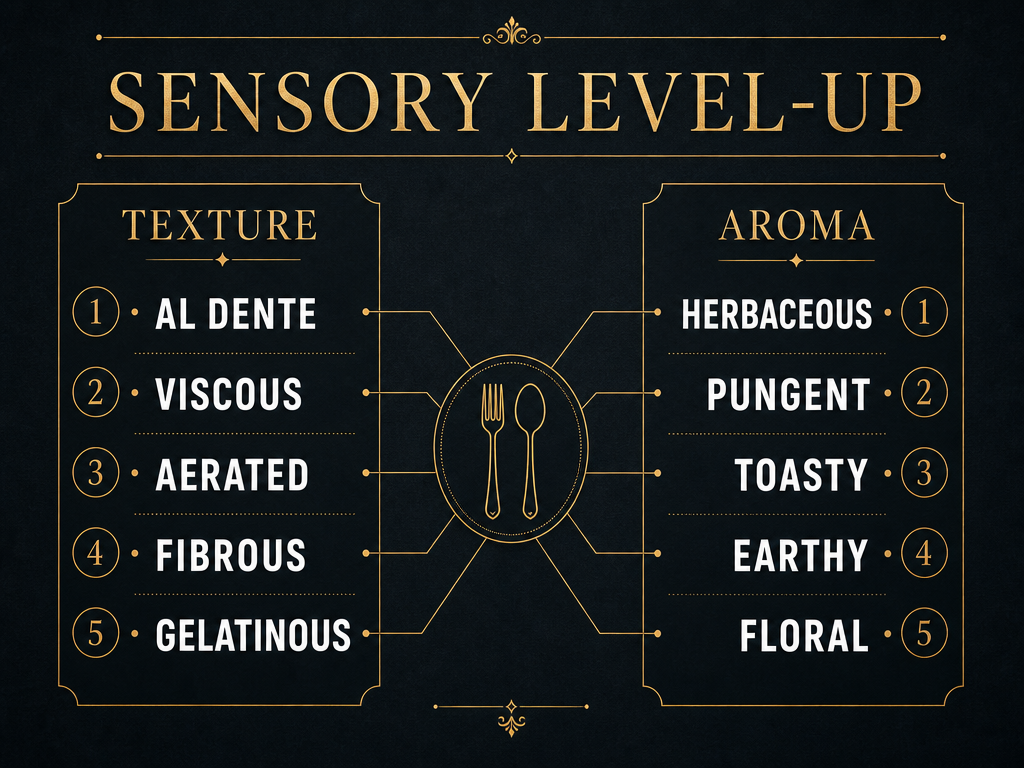 Upgrade your culinary reviews by swapping generic adjectives for professional sensory descriptors that specifically address the mouthfeel and aromatic profile of a dish.
Texture Dictionary
Instead of "crunchy," try:
- Al dente: Firm to the bite (pasta, vegetables)
- Aerated: Light, foamy, whipped
- Viscous: Thick, syrupy, coating
- Fibrous: Stringy, chewy in a way that reveals structure
- Gelatinous: Jiggly, bouncy, collagen-rich
- Silky: Smooth, luxurious mouthfeel
- Flaky: Layered, delicate, shatters easily
- Creamy: Rich, smooth, often dairy-forward
Aroma Profiles
Instead of "smells good," describe what you're actually detecting:
- Herbaceous: Fresh herbs, grassy, green
- Floral: Perfumed, aromatic, delicate
- Pungent: Sharp, strong, assertive (garlic, blue cheese, fish sauce)
- Toasty: Nutty, caramelized, roasted
- Earthy: Mushrooms, beets, truffles
- Fruity: Bright, sweet, citrus or stone fruit notes
- Umami: Savory, meaty, deeply satisfying
Keep a note on your phone with these terms. Pull it up at the table. At first, it'll feel forced. After ten meals, it becomes second nature.
For more on developing your sensory language, explore what is a flavor profile and what is umami flavor.
The Digital Sommelier: Cataloging Your Meals
You need a system for capturing and organizing your evaluations. Your camera roll isn't it.
The Photo Protocol
Take four specific photos, in order:
- The Menu: Capture the dish names, descriptions, and prices. This is your reference.
- The Table: Wide shot of the space, lighting, and vibe. Context matters.
- The Hero Dish: One top-down shot, one 45-degree angle. Natural light if possible.
- The Receipt: Date, final price, and any notes scribbled on it.
These four photos give you everything you need to reconstruct the meal months later.
 Standardize your meal documentation with the Menu-Photo-Receipt protocol to ensure you never forget the details, price, or specific names of the dishes you enjoyed.
Organization Hack
Use your iPhone's "Add Caption" feature. After each meal, write 3-5 keywords: "Best Uni NYC," "Overpriced Carbonara Rome," "Perfect Al Pastor Austin."
This makes your photos searchable. Months later, when you're trying to remember that incredible sea urchin, you can type "uni" into your Photos app and instantly find it.
The App Stack for 2026
Generic review apps focus on restaurants. You need tools that focus on dishes.
Consider apps like:
- Savor: Built specifically for tracking individual dishes, not just restaurants. Natural language search, dish-level ratings, and private memory vaults.
- Pepper: A newer app focused on creating visual food journals with meal mapping.
- AteMate: Reflection-based journaling that asks why a dish worked, not just if it was good.
These aren't calorie counters or social networks. They're personal archival tools. For a full breakdown of dish-tracking apps, see the best apps to track your favorite dishes.
You can also explore best food review apps or best apps to organize food photos for more specialized tools.
What Are the Criteria for a Good Food Review?
A good food review - whether public or private - answers five questions clearly:
- What did you eat? Specific dish names, preparation methods, key ingredients.
- What did it taste like? Sensory details: flavors, textures, aromas.
- How was it executed? Technical assessment: doneness, seasoning, plating.
- What was the context? Ambiance, service, price point, who you were with.
- Would you order it again? A simple verdict that summarizes your judgment.
A review that lacks any of these components is incomplete. "The pasta was amazing" doesn't help your future self. "The cacio e pepe had perfectly al dente rigatoni, a creamy pecorino sauce with assertive black pepper, but was slightly under-salted - still worth ordering again" does.
For more on structuring reviews, read how to write restaurant reviews.
How Does the Michelin Star Rating System Work?
Notice what's not on that list: service, décor, ambiance, or value. Michelin inspectors judge only what's on the plate. A one-star restaurant can have uncomfortable chairs and indifferent service. If the food is extraordinary, it gets the star.
Stars are awarded as follows:
- One star: High-quality cooking, worth a stop
- Two stars: Excellent cooking, worth a detour
- Three stars: Exceptional cuisine, worth a special journey
Michelin inspectors visit anonymously, multiple times, and always pay for their meals. They're looking for consistency above all else. A restaurant that delivers brilliance one night and mediocrity the next won't earn a star.
Your personal system can be more forgiving. You're not running a global guide. You're building a memory archive. But the principle of consistency - evaluating meals against the same criteria every time - is worth adopting.
Writing for Yourself vs. The World
Most advice on food criticism assumes you're writing for publication. You're not. You're writing for your future self.
A public review needs to be diplomatic, comprehensive, and defensible. A private review can be blunt, shorthand, and deeply personal. "Under-seasoned, lifeless, won't return" is a perfectly valid private note.
Your dining diary is a cultural archive of your life. Years from now, you won't remember the exact flavors. But if you've captured the sensory details, the context, and your honest reaction, you'll be able to reconstruct the experience.
The goal isn't to critique restaurants fairly. It's to preserve the meals that mattered.
If you want to transform your scattered food memories into a searchable archive, explore how to keep a food journal or how to track dishes you've tried.
Frequently Asked Questions
What is the typical structure of a restaurant review?
A structured restaurant review typically follows this format: an opening that establishes context and intent, a description of the restaurant's concept and ambiance, detailed evaluations of 3-5 signature dishes (with sensory and technical analysis), an assessment of service and value, and a concluding verdict that summarizes whether the experience is worth recommending. For personal reviews, you can simplify this to: what you ate, what it tasted like, and whether you'd return.
What 5 areas do restaurants need to be considered for a MICHELIN Star?
The MICHELIN Guide uses five universal criteria: ingredient quality, harmony of flavors, mastery of techniques, chef's personality, and consistency. Notably, Michelin inspectors do not consider service, décor, or ambiance when awarding stars - they evaluate only what appears on the plate. Consistency is measured through multiple anonymous visits to ensure the kitchen delivers the same level of excellence reliably.
What is an example of a sensory evaluation of food?
A sensory evaluation describes what you perceive through sight, smell, taste, texture, and sound. For example: "The duck breast had a deeply caramelized, mahogany skin with an audible crackle. The aroma was toasty and slightly gamey, with hints of orange zest. The meat itself was rosy and tender, with a silky, unctuous texture. The flavors were savory and rich, balanced by a bright, acidic gastrique." This level of detail captures the full sensory experience, far beyond "it was delicious."
How does The New York Times' restaurant review rating system work?
The New York Times uses a 0-4 star scale, where zero stars means "poor," one star means "good," two stars mean "very good," three stars mean "excellent," and four stars mean "extraordinary." Critics visit restaurants multiple times, always anonymously, and pay for their meals. The Times evaluates the complete dining experience - food, service, ambiance, and value - not just the quality of individual dishes. Unlike Michelin, which judges only the plate, the Times considers whether the entire evening justifies the price and effort.
What is the best app for food journaling?
The best app depends on your goal. For culinary memory and dish-level tracking, Savor is purpose-built to catalog individual dishes with natural language search and private rating systems. For general meal logging with nutritional data, MyFitnessPal remains popular but focuses on macros, not memories. For reflection-based journaling that asks why a dish worked, AteMate offers a thoughtful alternative. Choose based on whether you're tracking calories, cataloging experiences, or building a searchable culinary archive. For a detailed comparison, see best food diary apps.
What are the different types of food sensory descriptors?
Food sensory descriptors fall into five categories: Taste (sweet, sour, salty, bitter, umami), Texture (creamy, crunchy, flaky, gelatinous, fibrous, silky), Aroma (herbaceous, floral, pungent, toasty, earthy, fruity), Temperature (hot, warm, room temperature, chilled, frozen), and Mouthfeel (oily, dry, astringent, coating, effervescent). Professional critics combine these descriptors to create precise sensory profiles. For example, "a silky, herbaceous purée with a toasty aroma and a slightly astringent finish" gives far more information than "a good soup."
How to take better food photos with my phone?
Use natural light whenever possible - sit near a window or shoot outdoors during golden hour. Avoid overhead fluorescent lighting, which flattens colors. Compose your shot using the rule of thirds: place the hero element slightly off-center. Shoot from a 45-degree angle for depth, or directly overhead for flat-lay compositions. Clean the plate edges and remove distractions from the frame. Use your phone's portrait mode to blur the background and draw focus to the dish. Never use the flash. For a complete guide, see how to photograph food and how to take better food photos.