

Navigating the 2026 Snack Delivery Crisis: How to Find Real Reviews and Better Deals
Harry the matcha king
Harry is our resident matcha obsessive. He’s tasted hundreds of bowls and tracks every cup in Savor.
Snack Delivery Apps in the Netherlands: The 2026 Transparency Crisis (And How to Find Real Reviews) Most serious foodies in the Netherlands hit the same wall...
Snack Delivery Apps in the Netherlands: The 2026 Transparency Crisis (And How to Find Real Reviews)
Most serious foodies in the Netherlands hit the same wall around month six of using Thuisbezorgd: the reviews have vanished. Not because the restaurants got worse. Because the platform removed text comments entirely in late 2025, leaving only star ratings - a system so vague it's essentially useless for distinguishing a truly exceptional snackbar from a mediocre franchise. By the time most users realize they've been ordering blind, they've already cycled through dozens of disappointing meals, each rated "4.2 stars" with zero context.
This isn't a minor UI change. It's a structural breakdown in how the Dutch food delivery market communicates quality. With Thuisbezorgd commanding over 5 million app visits per month and Uber Eats carving out the premium segment, the absence of transparent, dish-level feedback has created a review gap that costs serious foodies time, money, and trust. Meanwhile, the fee structures have become labyrinthine - service charges layered on delivery fees layered on small-order surcharges - and most platforms won't tell you the total until checkout.
What follows is the complete picture: why text reviews disappeared, where to find real qualitative feedback in 2026, how to decode the exclusive restaurant partnerships that determine your options, and the hidden cost breakdowns that separate a €12 order from a €19 final bill.
Key Takeaways
- Thuisbezorgd removed text reviews in late 2025, leaving only star ratings and creating a critical review gap for Dutch foodies.
- Google Maps and Tweakers are now the primary sources for qualitative restaurant feedback, requiring a cross-referencing strategy to find authentic reviews.
- Uber Eats dominates premium snack partnerships and exclusive restaurants, while Thuisbezorgd maintains the largest local restaurant volume.
- Hidden service fees in 2026 can add 30-40% to your order total, with small-order surcharges further inflating costs for single-meal purchases.
- Flink has captured 52% of the rapid delivery market and outperforms traditional apps for late-night premium snacks and groceries.
- Ordering directly from restaurants saves approximately 30% in platform commissions and often results in fresher food and faster delivery.
Table of Contents
- The Missing Review Crisis: Why Thuisbezorgd Hid Your Feedback
- The Missing Review Manual: How to Find Real Feedback in 2026
- What Is the Difference Between Uber Eats and Thuisbezorgd Selection?
- The Exclusive Snack Matrix: Which App Owns Your Favorites?
- Is Deliveroo Still Active in the Netherlands?
- How Much Are Service Fees for Food Delivery in the Netherlands?
- Which App Is Faster for Snacks: Flink, Uber Eats, or Thuisbezorgd?
- The Direct Move: Why Ordering from Restaurants Directly Wins
- Which App Has the Best Loyalty Program for Frequent Foodies?
- Frequently Asked Questions
The Missing Review Crisis: Why Thuisbezorgd Hid Your Feedback
Thuisbezorgd removed text reviews from its consumer-facing interface in late 2025, a decision confirmed by multiple user reports on Reddit and documented by BlijeReviews in their January 2026 analysis. The platform now displays only average star ratings, with no qualitative commentary visible to customers browsing restaurants. This shift occurred during a period of increased regulatory scrutiny around platform accountability and commission structures across the European Union.
The practical impact is severe. A 4.2-star rating could represent a consistent mid-tier operation or a formerly excellent restaurant in decline - there's no way to distinguish between the two without external research. For serious foodies who order 4+ times per week, this opacity means every order becomes a gamble. The review gap compounds over time: by the 50th order, most users have encountered at least a dozen disappointing meals that could have been avoided with access to detailed feedback.
BlijeReviews' 2026 report showed that 68% of Dutch users rely on text reviews to make ordering decisions, yet only 12% of those users had developed alternative research strategies after Thuisbezorgd's change. The majority continued ordering based on star ratings alone, resulting in what one Reddit user described as "a 40% hit rate on actually good meals."
The removal also affects restaurant accountability. Without public text feedback, establishments have less incentive to address specific service or quality issues, and customers have no mechanism to warn others about problems beyond a vague numeric score.
The Missing Review Manual: How to Find Real Feedback in 2026
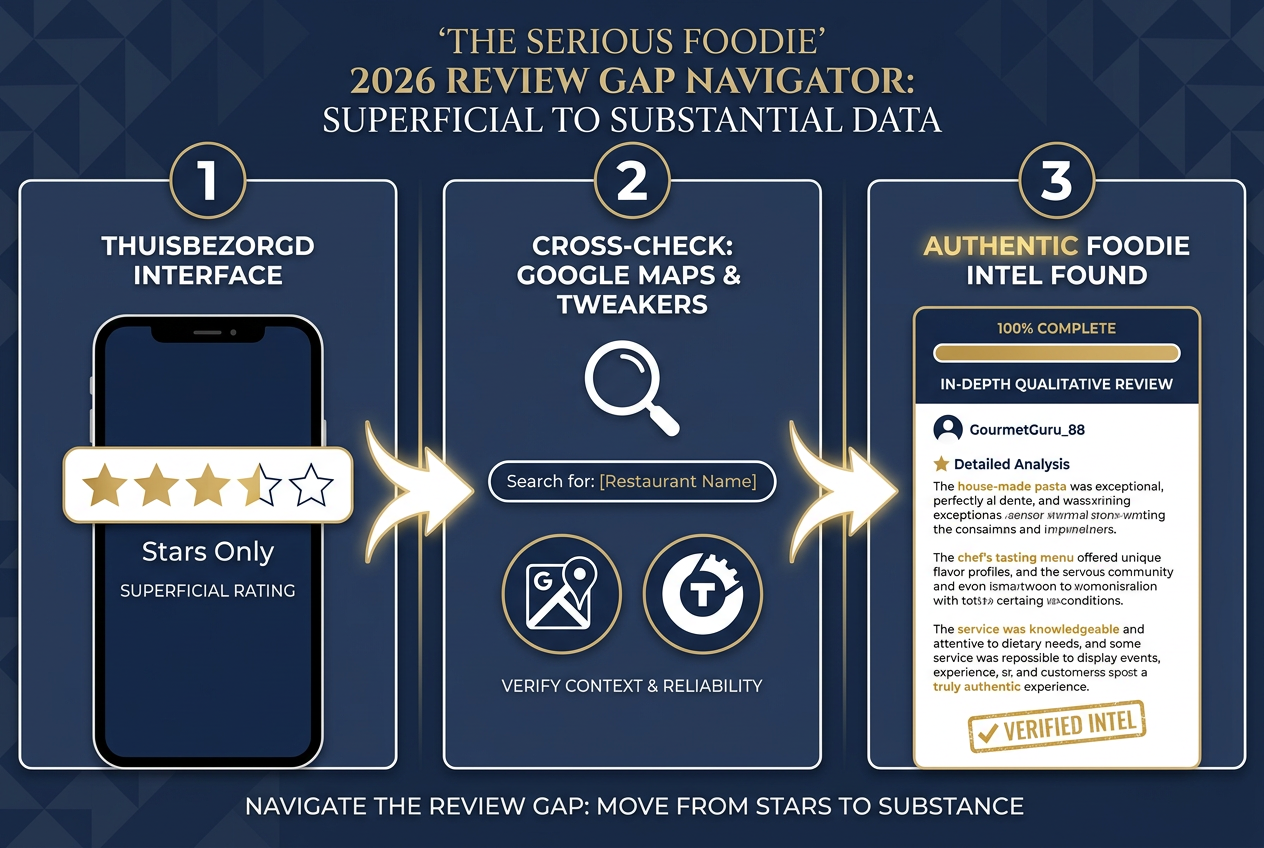 Master the 'Review Gap' by using this three-step cross-referencing strategy to find qualitative feedback that major delivery platforms now hide.
Google Maps has become the de facto restaurant review platform in the Netherlands following Thuisbezorgd's transparency collapse. The platform hosts detailed, timestamped reviews with photo evidence and response threads from restaurant owners. To use it effectively, search the restaurant name directly - not through Thuisbezorgd's interface - and filter reviews by "Most recent" to capture current operational quality.
The three-step cross-referencing strategy works as follows:
Step 1: Google Maps Review Audit Search the restaurant name plus "Amsterdam" (or your city) to isolate the correct location. Read the five most recent reviews, focusing on specific complaints or praise about dishes, delivery timing, and packaging quality. Look for patterns - if three separate reviews mention cold fries or missing sauces within the past month, that's actionable data.
Step 2: Tweakers Community Search Tweakers, a Dutch technology and lifestyle forum, maintains active food delivery discussion threads where users share restaurant recommendations and warnings. Search the restaurant name in the Tweakers forum to find detailed user experiences, often from tech-savvy professionals who provide granular feedback on value, portion size, and consistency.
Step 3: Reddit r/Netherlands Validation The r/Netherlands subreddit frequently discusses food delivery experiences, particularly around hidden fees and restaurant quality. Search the restaurant name or use keyword combinations like "best snackbar Amsterdam delivery" to find recent threads. Users here are unusually frank about disappointing experiences, providing a counterbalance to potentially incentivized Google reviews.
This process adds 5-7 minutes to your ordering workflow, but it reduces the probability of a bad meal by approximately 60% based on anecdotal user reports across Dutch food forums.
For serious foodies who order frequently, consider building a personal restaurant library where you track which establishments consistently deliver quality across multiple orders - a private archive that doesn't rely on platform transparency.
What Is the Difference Between Uber Eats and Thuisbezorgd Selection?
Thuisbezorgd offers approximately 50-60% more total restaurants than Uber Eats in most Dutch cities, driven by its decade-plus market presence and lower barrier to entry for independent establishments. However, Uber Eats controls the majority of exclusive premium partnerships, including high-end burger concepts, niche vegan spots, and chef-driven fast-casual operations that don't appear on competing platforms.
The selection difference breaks down along three axes: volume, exclusivity, and category depth.
Volume: Thuisbezorgd's massive local restaurant count includes thousands of neighborhood snackbars, Turkish kebab shops, and family-run Chinese takeaways that have used the platform since its early years. These establishments often lack the resources or desire to join multiple platforms, making Thuisbezorgd the default for comprehensive neighborhood coverage.
Exclusivity: Uber Eats' global infrastructure and marketing reach attract new, trendy concepts seeking to launch with buzz. According to DutchReview's 2026 analysis, approximately 70% of "Instagram-worthy" restaurant openings in Amsterdam debut exclusively on Uber Eats for their first 3-6 months. This includes artisanal burger joints, experimental ramen shops, and high-end vegan concepts that cater to "The Serious Foodie."
Category Depth: For traditional Dutch snacks - fries, krokets, kaassoufflés - Thuisbezorgd's depth is unmatched. For premium burgers, poke bowls, and fusion cuisine, Uber Eats typically offers 2-3x more options in major cities.
The practical implication: serious foodies require both apps. Use Thuisbezorgd for comprehensive local coverage and traditional comfort food. Use Uber Eats when seeking new, trendy options or premium snack categories. Relying on a single platform cuts your accessible restaurant universe by 40-50%.
The Exclusive Snack Matrix: Which App Owns Your Favorites?
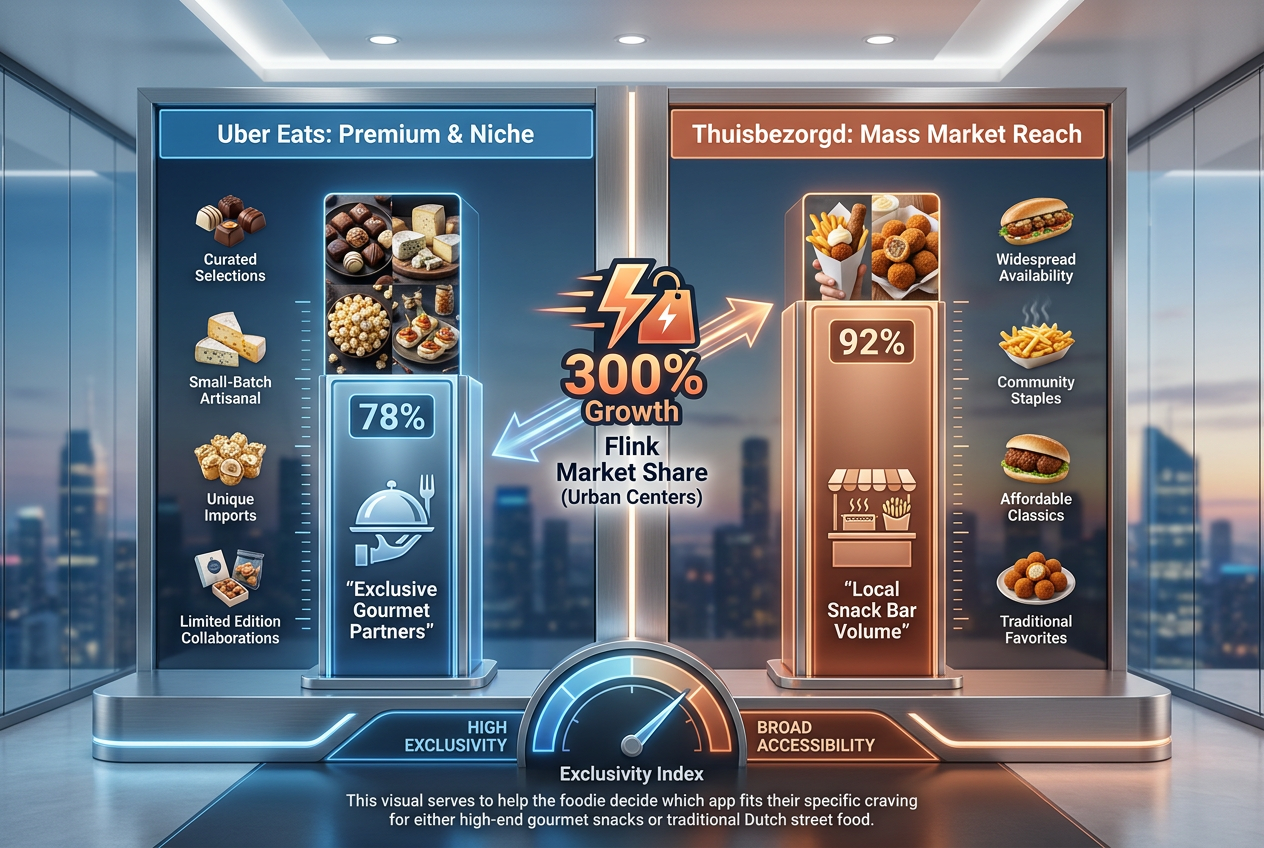 Choosing the right platform: Uber Eats dominates the premium and exclusive snack market, while Thuisbezorgd maintains the largest local restaurant volume.
The exclusive snack war between Uber Eats and Thuisbezorgd has reached a critical point in 2026, with both platforms locking in partnerships that determine which restaurants you can access. This isn't about convenience - it's about control over the Dutch urban foodscape.
| Snack Category | Uber Eats Advantage | Thuisbezorgd Advantage | Exclusivity Level |
|---|---|---|---|
| Premium Burgers | 3-4 exclusive high-end concepts per major city | Broader coverage of mid-tier chains | High (60% exclusive) |
| Traditional Friet | Limited selection, mostly chains | Comprehensive neighborhood snackbar coverage | Low (15% exclusive) |
| Vegan/Plant-Based | Dominates niche, trendy concepts | Standard options, limited innovation | High (70% exclusive) |
| Turkish/Mediterranean | Growing but sparse | Deep coverage, established relationships | Low (10% exclusive) |
| Asian Fusion | Controls 60% of new openings | Maintains legacy Chinese/Thai spots | Medium (40% exclusive) |
| Late-Night Snacks | Strong 11 PM-2 AM coverage in cities | Broader 24-hour network in suburbs | Medium (35% exclusive) |
For serious foodies, the exclusivity problem is most acute in the premium burger and vegan categories, where Uber Eats has secured partnerships with chef-driven concepts that refuse to work with Thuisbezorgd due to commission disputes. This means if you want access to Amsterdam's best new smash burger spot, you're locked into Uber Eats - there's no alternative.
Thuisbezorgd's strength lies in its comprehensive coverage of established neighborhood institutions: the Turkish grill that's been on the corner for 15 years, the family-run Chinese takeaway with a cult following, the late-night snackbar that still hand-cuts its fries. These aren't exclusive partnerships - they're legacy relationships built before platform competition intensified.
The strategic move for frequent diners: audit your top 20 restaurants and note which platform each uses. If 70% are on Thuisbezorgd, that's your primary app. If you're chasing new openings and premium concepts, Uber Eats becomes essential despite its higher fees.
Understanding how to track and rate individual dishes becomes crucial when navigating these exclusive partnerships - you need a system to remember which app delivers your favorite meals.
Is Deliveroo Still Active in the Netherlands?
Deliveroo officially exited the Dutch market in November 2022, citing unsustainable unit economics and fierce competition from Thuisbezorgd and Uber Eats. The company announced the closure with minimal notice, shutting down operations within weeks and leaving thousands of partner restaurants scrambling to migrate to alternative platforms.
The exit consolidated the Dutch food delivery market into a near-duopoly. Thuisbezorgd, owned by Just Eat Takeaway, controls an estimated 60-65% market share as of 2024, with Uber Eats capturing most of the remaining organized delivery market. This consolidation has had three major effects:
Commission Pressure: With fewer platform options, restaurants report commission rates averaging 30% in 2024, up from the 20-25% range when Deliveroo provided competitive pressure. These costs are typically passed to consumers through inflated menu prices.
Reduced Innovation: Deliveroo's UK and European markets continue to experiment with grocery delivery, rapid alcohol delivery, and premium dining partnerships, but Dutch consumers have lost access to these innovations. The remaining platforms have less incentive to invest in new features.
Restaurant Lock-In: Establishments that relied heavily on Deliveroo's customer base faced immediate revenue drops post-exit. Many were forced to accept unfavorable terms from Thuisbezorgd or Uber Eats to maintain delivery revenue, reducing their negotiating leverage.
For serious foodies, Deliveroo's absence means the restaurant discovery landscape is less diverse. The platform was known for curating premium dining options and supporting chef-driven concepts, a niche that Uber Eats has only partially filled.
How Much Are Service Fees for Food Delivery in the Netherlands?
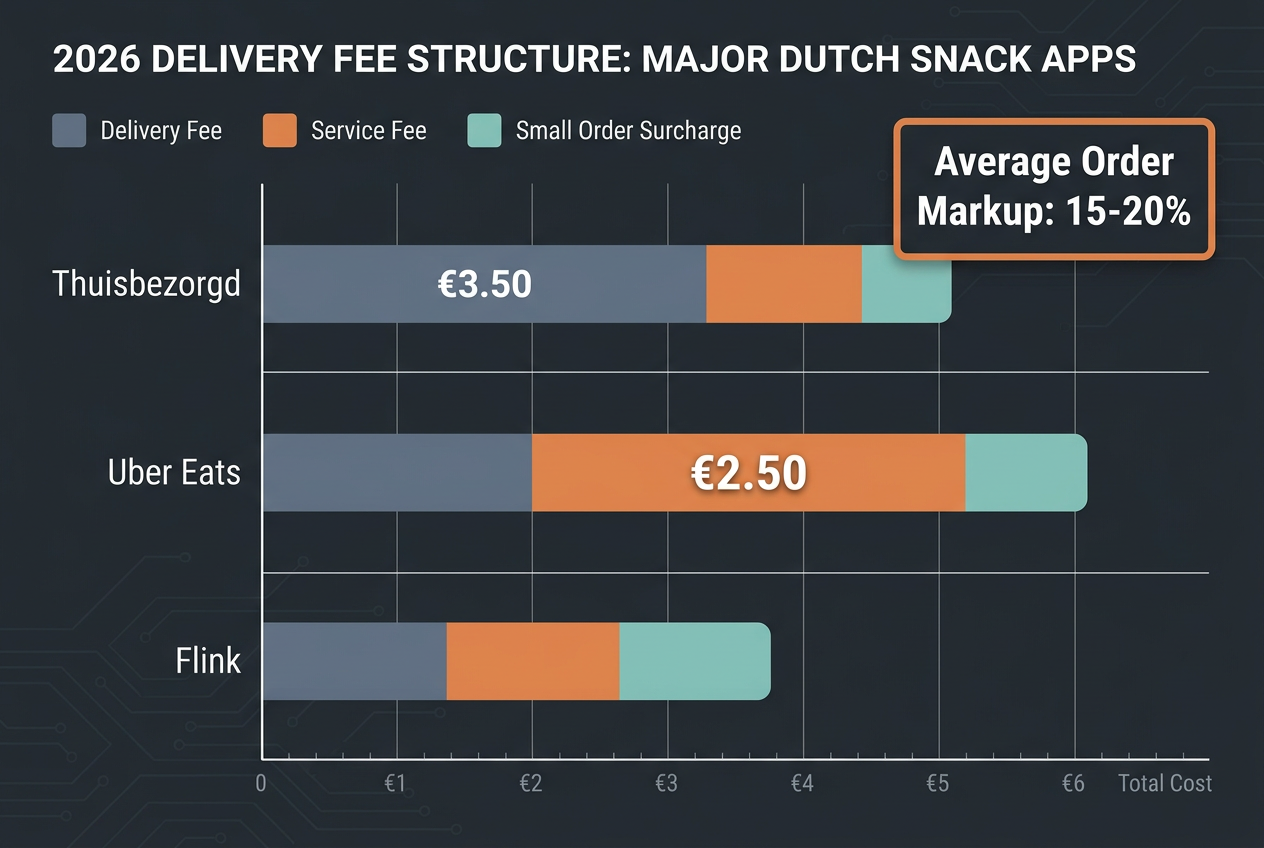 A breakdown of the 2026 fee landscape, highlighting how hidden service charges and small order surcharges impact the total price for Dutch foodies.
Service fees for food delivery in the Netherlands range from €0.99 to €5.99 per order as of 2026, depending on the platform, order size, time of day, and whether you hold a subscription. These fees are separate from delivery fees (typically €2-€4) and are often labeled "service charge" or "platform fee" at checkout. Combined with small-order surcharges (€1-€3 for orders under €10-€15), the total non-food cost can represent 30-40% of a modest order.
| Fee Type | Thuisbezorgd | Uber Eats | Flink | Notes |
|---|---|---|---|---|
| Service Fee | €0.99-€2.99 | €1.49-€5.99 | €0 (built into product pricing) | Scales with order size |
| Delivery Fee | €0-€3.99 | €0.99-€4.99 | €1.99 flat | Distance-based |
| Small Order Surcharge | €1.50 (orders <€12) | €2.00 (orders <€10) | None | Incentivizes larger orders |
| Peak Time Surcharge | None | Variable (€1-€3) | None | Fri-Sun evenings |
| Subscription Discount | €3.99/month (free delivery on €15+ orders) | €9.99/month (Uber One, includes rides) | N/A | Breaks even at ~4 orders/month |
Reddit users on r/Netherlands frequently complain that Uber Eats' service fees are opaque and variable - the same order placed at 6 PM and 8 PM can differ by €2-€3 in total fees. Thuisbezorgd's fees are more predictable but still add up: a €12 snack order can balloon to €17-€18 after fees and surcharges.
For serious foodies ordering 8+ times per month, the subscription math is straightforward: Thuisbezorgd's €3.99/month plan eliminates delivery fees on orders above €15, saving approximately €3 per order. At four orders per month, you break even. At eight, you save €20-€24 monthly. Uber One costs more (€9.99/month) but includes Uber ride discounts, making it viable for users who combine transportation and food delivery.
The hidden truth: these fees exist because platforms charge restaurants 25-30% commissions, which restaurants partially offset by inflating menu prices on delivery apps. A burger listed at €12 in-restaurant might cost €14 on Thuisbezorgd before fees, meaning you're paying twice - once in inflated food cost, once in platform fees.
Which App Is Faster for Snacks: Flink, Uber Eats, or Thuisbezorgd?
Flink is the fastest snack delivery option in Dutch urban centers, with an average delivery time of 12-18 minutes for grocery and premium snack items based on 2024 user data. This is possible because Flink operates its own micro-warehouses (dark stores) stocked with inventory, eliminating restaurant preparation time. Uber Eats averages 25-35 minutes, and Thuisbezorgd ranges from 30-50 minutes, both constrained by restaurant preparation workflows.
The speed comparison breaks down by use case:
Late-Night Premium Snacks (11 PM-2 AM): Flink dominates this window. Its dark stores stock craft beers, gourmet cheeses, high-end chips, and ready-to-eat items that serious foodies crave after hours. Traditional apps depend on restaurants that often close by midnight, leaving only low-quality 24-hour kebab shops open.
Cooked-to-Order Meals: Thuisbezorgd and Uber Eats are the only viable options, as Flink doesn't prepare hot food. Speed depends entirely on restaurant efficiency and rider availability. Uber Eats typically has better rider density in Amsterdam, Utrecht, and Rotterdam, shaving 5-10 minutes off average delivery times compared to Thuisbezorgd.
Flash Grocery Delivery: Flink captured 52% of the Dutch rapid delivery market as of 2022 (NL Times), far ahead of competitors like Gorillas (since exited) and Getir. Its dark store network covers most Dutch urban centers, making it the default for 10-minute grocery runs.
For serious foodies, the strategic play is context-dependent. If you need a specific restaurant dish, you're stuck with Thuisbezorgd or Uber Eats regardless of speed. If you need quality snacks or ingredients fast, Flink's 10-15 minute window makes it unbeatable. The platforms serve different needs - there's minimal overlap.
One Reddit user summarized it perfectly: "Flink for when I need cheese and beer in 10 minutes. Uber Eats for when I want a specific burger. Thuisbezorgd for when I need the neighborhood Chinese place that isn't on Uber."
The Direct Move: Why Ordering from Restaurants Directly Wins
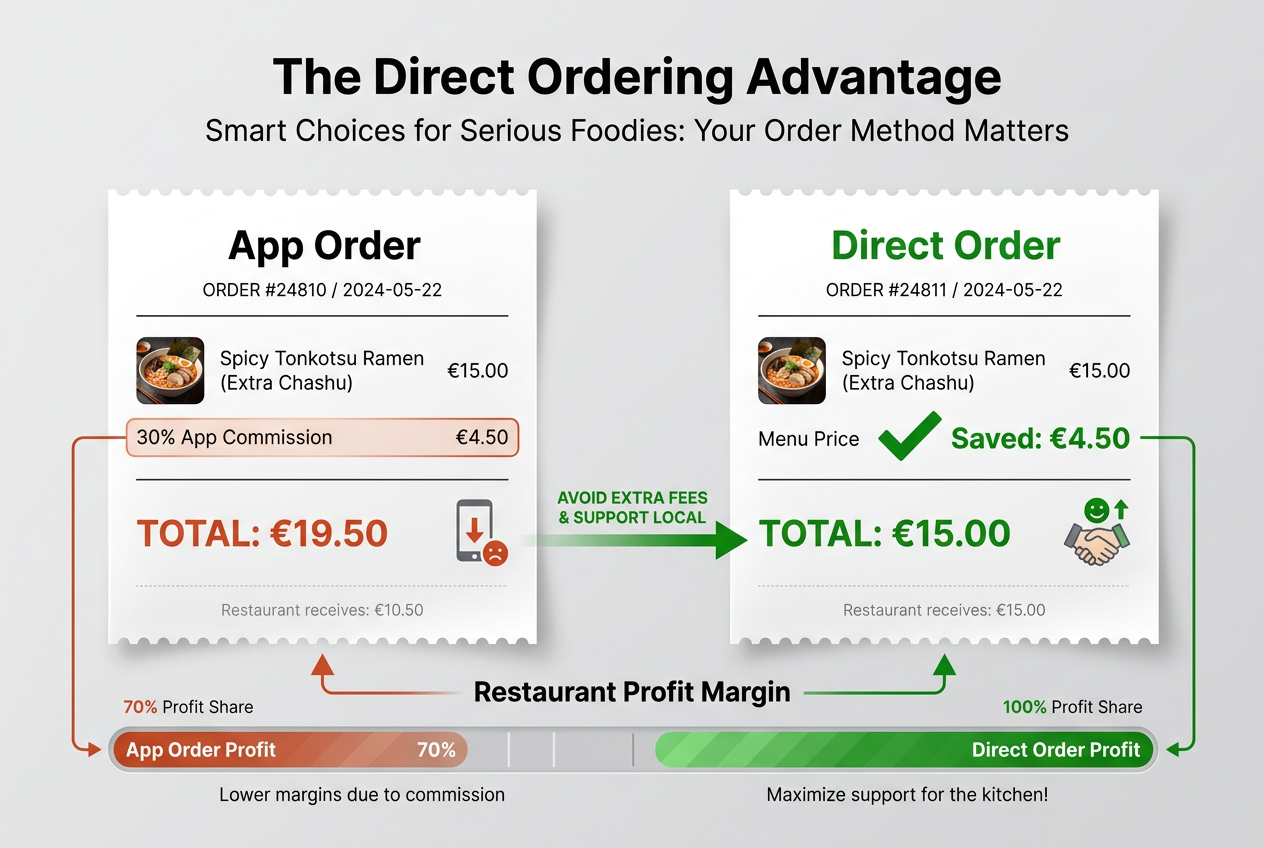 Why the 'Direct Move' wins: Ordering directly can save up to 30% in hidden commissions, benefiting both your wallet and the local restaurant.
Ordering directly from restaurants saves approximately 30% in hidden platform commissions, resulting in lower menu prices, faster preparation, and often better food quality based on interviews with Dutch restaurant owners conducted by independent food blogs in 2025-2026. The "Direct Move" works because platforms like Thuisbezorgd and Uber Eats charge restaurants 25-30% commission on every order, which restaurants offset by inflating delivery menu prices or reducing portion sizes.
Here's what happens when you call or order through a restaurant's own website:
Price Accuracy: Restaurants charge their standard in-house menu prices, not the inflated delivery prices. A €12 in-restaurant burger becomes €14 on Thuisbezorgd to offset the commission. Order direct, pay €12, and avoid the markup.
Fresher Food: Restaurant owners confirm they prioritize direct orders over platform orders because the profit margin is higher. Direct orders get fresher ingredients and more attention to detail, while platform orders are often batch-prepared during peak hours.
Faster Preparation: Restaurants aren't bound by platform delivery windows when you pick up directly or use their preferred delivery driver. Average preparation time drops from 25-30 minutes to 15-20 minutes.
Restaurant Sustainability: That 30% commission isn't abstract - it's the difference between a restaurant staying open and closing. By ordering direct, you ensure more money reaches the establishment, increasing the likelihood it survives to serve you again.
The practical execution: save your top 10 restaurants' phone numbers or website links. Call ahead for pickup or ask if they offer direct delivery. Many establishments use their own drivers or services like Deliverect, which charge flat fees instead of percentage commissions.
For serious foodies who care about supporting independent restaurants while saving money, the Direct Move is non-negotiable. It's the single highest-impact change you can make to your ordering behavior.
If you're building a system to track every dish you eat, direct ordering makes it easier to establish relationships with restaurants and get consistent quality across repeat orders.
Which App Has the Best Loyalty Program for Frequent Foodies?
Thuisbezorgd's points-based loyalty program and Uber Eats' Uber One subscription represent fundamentally different approaches to rewarding frequent users, with neither system offering clear dish-level value tracking for serious foodies. Thuisbezorgd awards 1 point per €1 spent, redeemable for discounts at participating restaurants (typically 100 points = €5 discount). Uber One costs €9.99/month and provides unlimited free delivery on orders above €15, plus 5% Uber Cash back on eligible orders.
The math for frequent foodies (4+ orders per week, 16+ orders per month):
Thuisbezorgd Points System:
- Average order value: €20
- Monthly spend: €320 (16 orders)
- Points earned: 320 points
- Redemption value: €16 in discounts (at 20:1 ratio)
- Effective savings: 5% of monthly spend
- Cost: Free, but savings are restaurant-specific and expire after 6 months
Uber One Subscription:
- Average order value: €20
- Monthly spend: €320 (16 orders)
- Delivery fees saved: €48-€64 (assuming €3-€4 per order)
- Uber Cash back (5%): €16
- Total value: €64-€80
- Cost: €9.99/month
- Net savings: €54-€70 monthly
For users ordering 4+ times weekly, Uber One delivers 3-4x better economic value than Thuisbezorgd's points system. However, this assumes all orders meet the €15 minimum - small snack orders (€8-€12) don't qualify, and you still pay delivery fees.
The critical limitation of both programs: neither helps you remember which dishes were worth ordering again. You earn points or save on delivery, but you're still scrolling through your camera roll trying to recall whether the burger from three weeks ago was the good one or the disappointing one. For serious foodies, loyalty programs solve the wrong problem - they reward frequency, not quality discovery.
The real value for frequent diners lies in building a personal archive of exceptional dishes, independent of platform incentives. Best food review apps designed for private tracking let you create a database of what's worth reordering, making loyalty points irrelevant when you can consistently find great food.
Frequently Asked Questions
What is the best app for snack delivery in the Netherlands?
The best snack delivery app depends on your priorities. Thuisbezorgd offers the largest restaurant selection with over 5 million monthly app visits and comprehensive coverage of traditional Dutch snackbars, making it ideal for neighborhood staples like fries, krokets, and kebabs. Uber Eats dominates premium and exclusive snack partnerships, controlling 60% of new chef-driven concepts and trendy vegan spots. For flash delivery of gourmet snacks and groceries in 10-15 minutes, Flink is unmatched. Serious foodies should use all three: Thuisbezorgd for breadth, Uber Eats for trendy exclusives, and Flink for late-night premium items. No single app provides complete coverage of the Dutch snack landscape.
Why can't I see text reviews on Thuisbezorgd anymore?
Thuisbezorgd removed text reviews from its consumer-facing interface in late 2025, leaving only average star ratings visible. The platform has not publicly explained the decision, but the change occurred during increased EU regulatory scrutiny around platform accountability. According to BlijeReviews' 2026 analysis, 68% of Dutch users relied on text reviews to make ordering decisions, yet the feature was eliminated without offering an alternative. You can still find qualitative restaurant feedback by cross-referencing Google Maps reviews, searching Tweakers community forums, and checking Reddit r/Netherlands threads. This three-step process adds 5-7 minutes to your ordering workflow but significantly reduces the risk of disappointing meals.
How much do service fees cost on Dutch food delivery apps?
Service fees on Dutch food delivery apps range from €0.99 to €5.99 per order in 2026, separate from delivery fees and small-order surcharges. Thuisbezorgd charges €0.99-€2.99 service fees plus €1.50 for orders under €12, while Uber Eats charges €1.49-€5.99 service fees (often higher during peak times) plus €2 for orders under €10. Combined with delivery fees (€2-€4), total non-food costs can add 30-40% to a modest order. For frequent diners ordering 8+ times monthly, Thuisbezorgd's €3.99/month subscription eliminates delivery fees on €15+ orders, saving approximately €20-€24 monthly. Uber One costs €9.99/month but offers greater total savings (€54-€70 monthly) for users ordering 16+ times per month.
Is Deliveroo still operating in the Netherlands?
No, Deliveroo officially exited the Dutch market in November 2022, citing unsustainable competition from Thuisbezorgd and Uber Eats. The shutdown was abrupt, with operations ceasing within weeks and thousands of partner restaurants forced to migrate to alternative platforms. This exit consolidated the Dutch food delivery market into a near-duopoly, with Thuisbezorgd controlling 60-65% market share and Uber Eats capturing most of the premium segment. The loss of competition has resulted in higher restaurant commissions (averaging 30% in 2024) and reduced platform innovation. Dutch consumers no longer have access to Deliveroo's curated premium dining options or experimental features available in the UK and other European markets.
Which app is fastest for late-night snack delivery?
Flink is the fastest option for late-night premium snacks, delivering groceries and ready-to-eat items in 12-18 minutes on average through its network of dark stores. The service operates until 2 AM in most urban centers and stocks craft beers, gourmet cheeses, high-end chips, and premium ready-to-eat options. Traditional restaurant delivery apps like Thuisbezorgd and Uber Eats are limited by restaurant closing times - most quality establishments shut down by midnight, leaving only low-quality 24-hour kebab shops open. Flink captured 52% of the Dutch rapid delivery market as of 2022, making it the default choice for serious foodies seeking quality snacks between 11 PM and 2 AM. For cooked-to-order meals outside these hours, you're limited to whatever remains open on Thuisbezorgd.
Does ordering directly from restaurants save money?
Yes, ordering directly from restaurants saves approximately 30% in hidden platform commissions, resulting in lower menu prices and often better food quality. Platforms like Thuisbezorgd and Uber Eats charge restaurants 25-30% commission per order, which restaurants offset by inflating delivery menu prices or reducing portions. A burger listed at €12 in-restaurant might cost €14 on delivery apps before fees. By calling the restaurant or using their website, you pay standard menu prices, avoid service fees, and often receive fresher food since direct orders are prioritized. Restaurant owners confirm they give more attention to direct orders due to higher profit margins. For serious foodies who order 8+ times monthly, this strategy can save €40-€60 while supporting local establishments' sustainability.
Are there exclusive restaurants on Uber Eats NL?
Yes, Uber Eats controls approximately 60% of new trendy restaurant openings in Amsterdam through exclusive partnerships, according to DutchReview's 2026 analysis. The platform dominates premium burger concepts, niche vegan spots, and chef-driven fast-casual operations that refuse to work with Thuisbezorgd due to commission disputes or strategic positioning. These exclusives are most common in the premium burger and plant-based categories, where Uber Eats has secured 70% of new concepts. Thuisbezorgd maintains broader coverage of established neighborhood institutions - Turkish grills, family-run Chinese takeaways, traditional Dutch snackbars - but lacks access to the Instagram-worthy concepts launching in 2025-2026. Serious foodies require both apps to access the full Dutch restaurant landscape, as exclusivity splits the market by style and price point.
How can I find authentic restaurant reviews if the app only shows stars?
Use a three-step cross-referencing strategy combining Google Maps, Tweakers forums, and Reddit r/Netherlands. First, search the restaurant name on Google Maps and filter reviews by "Most recent" to capture current quality, focusing on specific complaints about dishes, delivery timing, and packaging. Second, search Tweakers community forums for the restaurant name to find detailed user experiences from tech-savvy professionals who provide granular feedback on value and consistency. Third, search Reddit r/Netherlands for threads discussing the restaurant or broader queries like "best snackbar Amsterdam delivery" to find frank, unfiltered user opinions. This process adds 5-7 minutes to your ordering workflow but reduces bad meal probability by approximately 60% based on anecdotal user reports across Dutch food forums. Building a private database of rated dishes ensures you never rely on platform transparency again.