
How to Track Your Favorite Pasta Dishes by Region: A Systematic Guide for Foodies
John the smoothie monster
John lives for smoothie bowls and cold-pressed juices. He uses Savor to remember his best blends.
How to Track Your Favorite Pasta Dishes by Region: A Complete System for the Serious Foodie Your camera roll holds somewhere between 2,000 and 3,000 food...
How to Track Your Favorite Pasta Dishes by Region: A Complete System for the Serious Foodie
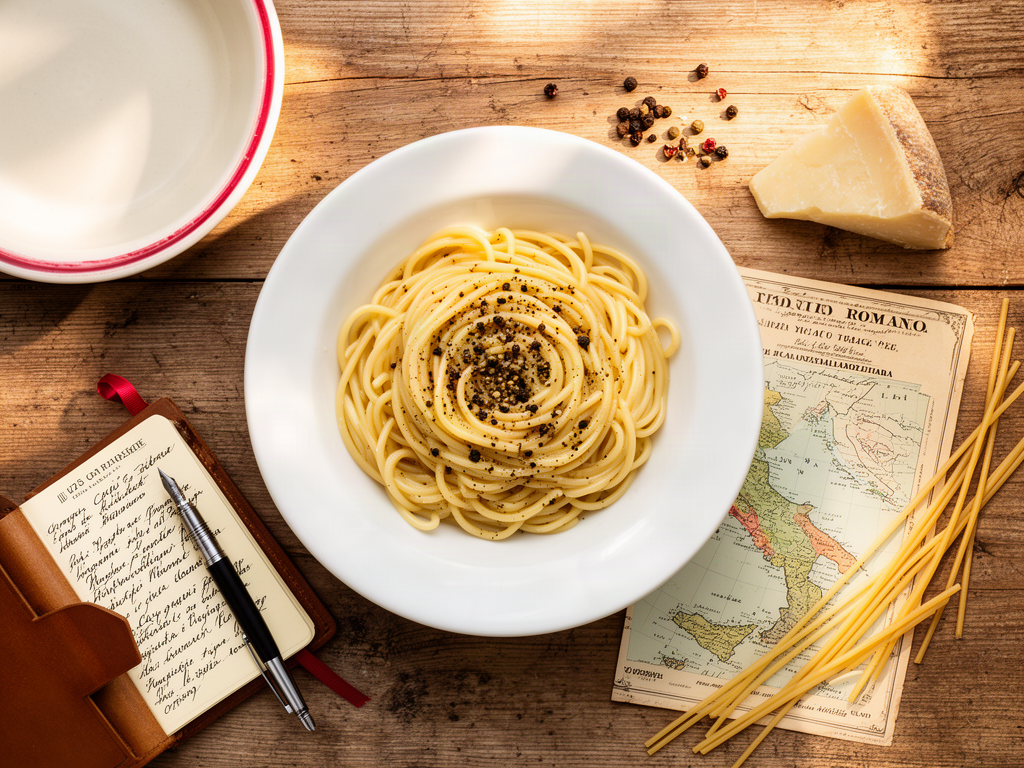
Your camera roll holds somewhere between 2,000 and 3,000 food photos. Somewhere in that digital graveyard is that perfect cacio e pepe you had in Rome three years ago - the one where the cheese formed a silky veil around each strand of tonnarelli, where the pepper bite lingered just long enough to make you order a second portion. You remember the feeling. You can almost taste the texture. But you can't recall the name of the trattoria, the neighborhood, or the exact preparation that made it different from the other seventeen cacio e pepes you've photographed since.
This isn't a memory problem. It's a system problem.
Most people think tracking regional pasta is about collecting recipes or compiling "top 10" lists. That's tourism. What you actually need is a framework - a structured way to catalog, compare, and retrieve the specific regional markers that define an authentic dish. You need to know why Piedmontese agnolotti del plin requires that signature "pinch" seal, why Emilia-Romagna's tagliatelle demands a specific width, and how to distinguish a legitimate Roman carbonara from the cream-laden imposters cluttering your Instagram feed.
This guide will show you how to build a personal pasta archive that actually works - one that lets you search by region, compare technical markers, and finally answer the question: "Where did I have that extraordinary dish?"
Table of Contents
- What Makes Regional Pasta Tracking Different From Recipe Collection
- The Five Essential Italian Pasta Regions You Need to Map
- Technical Authenticity Markers: How to Verify What You're Eating
- The Three-Tool Tracking System
- Building Your 5-Minute Pasta Log Protocol
- Expert Tips for Foodie Travel: Using Technology to Back-Catalog Your History
- Common Mistakes That Destroy Your Pasta Archive
- How to Compare the Same Dish Across Multiple Cities
- Frequently Asked Questions
What Makes Regional Pasta Tracking Different From Recipe Collection
Recipes tell you how to make a dish. Regional tracking tells you how to recognize, evaluate, and remember it.
When you track regional pasta, you're building a personal reference library organized around geography and technique. You're not just noting that you had "good pasta" in Bologna - you're documenting that the tagliatelle measured 6-7mm wide (the width officially registered by the Italian Academy of Cuisine in October 1982), that the ragù contained beef, pancetta, and soffritto rather than the tomato-heavy American interpretations, and that the pasta itself had the rough, porous texture that comes from bronze-die extrusion.
This level of specificity serves two purposes: First, it creates a searchable database in your mind (and on your phone) that lets you distinguish between the seventeen carbonaras you've photographed. Second, it trains your palate to recognize regional authenticity - a skill that transforms you from a casual diner into a culinary archivist.
The difference between collecting recipes and tracking dishes is the difference between reading about architecture and keeping field notes as you visit buildings. One is passive consumption. The other is active documentation.
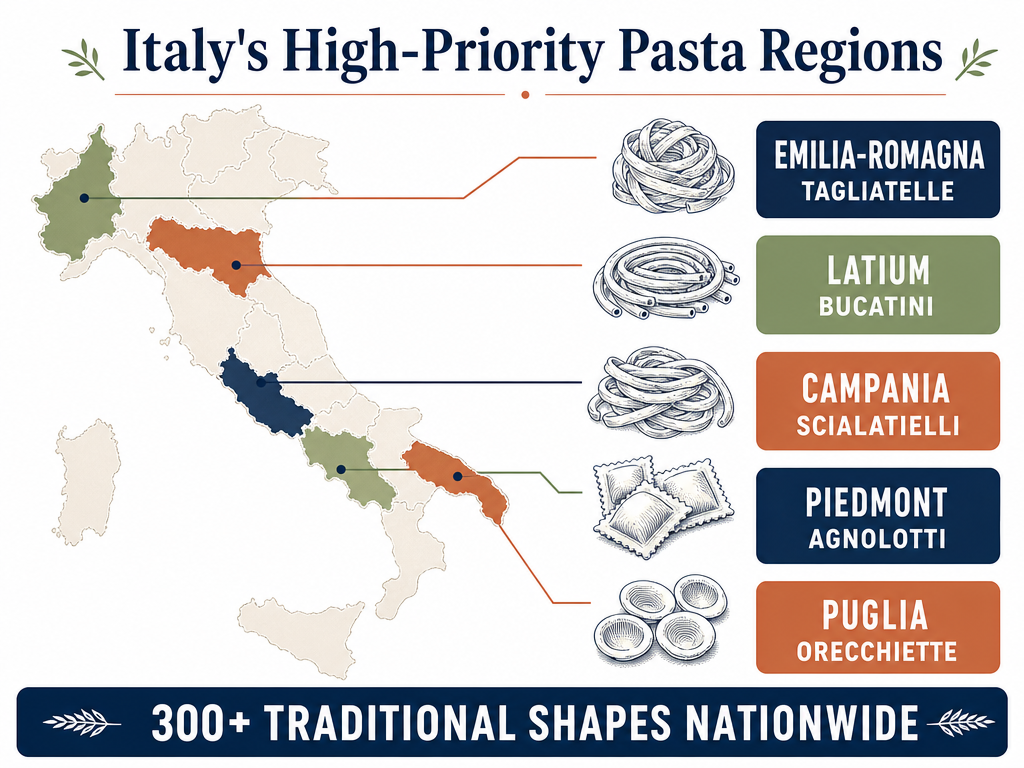 Mastering the regional geography of Italian pasta is the first step for any serious foodie looking to transition from casual dining to systematic culinary tracking.
The Five Essential Italian Pasta Regions You Need to Map
Italy recognizes approximately 300 distinct pasta shapes, each traditionally paired with specific sauces and preparation methods. Attempting to track all 300 is a recipe for paralysis. Instead, start with the five regions that offer the most distinct and historically significant pasta traditions.
Emilia-Romagna: The Fresh Egg Pasta Empire
Signature Dish: Tagliatelle al ragù alla Bolognese
Defining Shape: Flat ribbon, 6-7mm wide
Authenticity Marker: Officially registered recipe from 1982 that specifies exact proportions and cooking time
Emilia-Romagna is where pasta means fresh, egg-enriched dough rolled thin and cut into ribbons. The region's dishes - tagliatelle, tortellini, lasagne - share a common technical foundation: soft wheat flour (tipo 00) combined with whole eggs at a ratio that creates supple, porous sheets capable of holding rich meat sauces.
When you eat tagliatelle in Bologna, look for pasta that's slightly rough to the touch, not slick or shiny. The roughness indicates proper rolling and drying. The sauce should cling to each strand rather than pooling at the bottom of the plate.
Latium (Lazio): The Roman Four
Signature Dish: Cacio e pepe
Defining Shape: Tonnarelli (square spaghetti) or rigatoni
Authenticity Marker: Only three ingredients - Pecorino Romano, black pepper, pasta water
Rome's four classic pasta dishes (cacio e pepe, carbonara, amatriciana, gricia) share a philosophical commitment to minimalism. These aren't recipes that hide mediocre ingredients under complex sauces. They're technical exercises in extracting maximum flavor from a handful of components.
A proper cacio e pepe requires emulsification - the transformation of grated cheese and pasta water into a glossy, unified sauce through constant motion and precise temperature control. If you see cream, butter, or flour, you're not eating the authentic version.
Campania: The Durum Wheat Stronghold
Signature Dish: Spaghetti alle vongole
Defining Shape: Bronze-extruded spaghetti or paccheri
Authenticity Marker: Rough surface texture that grips sauce; firm bite even after proper cooking
Southern Italy's pasta tradition runs on durum wheat semolina - a high-protein flour that creates dried pasta with structural integrity and a distinctly wheaty flavor. Campanian pasta is meant to be cooked al dente and maintain that resistance even as it sits on the plate.
When tracking dishes from this region, pay attention to the pasta's surface. Industrial smooth pasta slides through sauce. Artisanal bronze-die pasta grabs it. That textural difference is everything.
Piedmont: The Egg Yolk Maximalists
Signature Dish: Agnolotti del plin
Defining Shape: Small, pinched ravioli
Authenticity Marker: Pasta dough can contain up to three times the standard amount of egg yolks; filling traditionally includes three types of roasted meat
Piedmont takes Emilia-Romagna's egg pasta tradition and pushes it further. The region's signature agnolotti del plin gets its name from the Piedmontese word for "pinch" - the sealing method that creates small, tightly-packed parcels of meat filling surrounded by impossibly rich egg dough.
The authentication test here is twofold: Look for the visible pinch marks along the sealed edge, and note the deep golden color of the pasta itself, which comes from the high egg yolk content.
Puglia: The Orecchiette Specialists
Signature Dish: Orecchiette con cime di rapa
Defining Shape: Small, ear-shaped pasta with a rough, thumb-pressed texture
Authenticity Marker: Hand-formed concave shape that catches vegetable pieces and sauce
Puglia's pasta is fundamentally different from the northern regions. It's made from durum wheat and water (no eggs), shaped by hand using a knife tip and thumb pressure, and dried slowly to create a dense, chewy texture that pairs with the region's assertive vegetables - bitter greens, tomatoes, olive oil.
When you find authentic orecchiette, each piece will be slightly irregular. The center will be thinner than the edges. The surface will have visible ridges from the shaping process. This isn't rustic charm - it's functional design that creates pockets for sauce to collect.
Technical Authenticity Markers: How to Verify What You're Eating
A regional pasta archive is only as good as your ability to distinguish authentic versions from approximations. Here's how to verify what you're actually consuming.
The Flour Test
Northern Italian fresh pasta uses soft wheat flour (tipo 00). Southern Italian dried pasta uses durum wheat semolina. This isn't a minor detail - it's a fundamental difference in texture, flavor, and structure.
Soft wheat pasta should be tender and pliable when cooked, with a delicate, almost neutral flavor that lets the sauce dominate. Durum wheat pasta should maintain a firm, resistant bite with a pronounced wheaty flavor that stands up to assertive sauces.
If you're eating "fresh pasta" in Puglia or "dried egg pasta" anywhere, you're dealing with a hybrid that doesn't represent regional tradition.
The Shape Verification Protocol
Many pasta shapes carry regional significance that goes beyond aesthetics. Take agnolotti del plin - the shape's name literally describes its most important technical feature. The term "plin" comes from the local dialect for "pinch," referring to the sealing method that creates small, tightly-packed parcels.
When you photograph a dish, look for these regional shape signatures:
- Piedmont's tajarin: Ultra-thin ribbon cut to 2-3mm width, noticeably thinner than standard tagliatelle
- Rome's tonnarelli: Square cross-section, not round like spaghetti
- Liguria's trofie: Hand-rolled into twisted, irregular spirals
- Puglia's cavatelli: Rolled and pressed with three fingers to create a shell shape
If the shape doesn't match the region's traditional form, you're eating a variation - which is fine, but worth noting in your tracking system.
The Sauce Pairing Logic
Regional Italian pasta follows strict pairing rules based on shape, texture, and sauce weight. These aren't arbitrary preferences - they're the result of centuries of empirical testing.
Ribbon pastas (tagliatelle, pappardelle, fettuccine) pair with meat ragùs because the flat surface provides maximum contact area for thick sauces to cling.
Tubular pastas (rigatoni, paccheri, penne) pair with chunky vegetable or tomato sauces because the hollow center captures pieces of filling.
Strand pastas (spaghetti, bucatini, linguine) pair with oil-based or seafood sauces because the round shape allows for even coating without overwhelming the delicate proteins.
When a restaurant serves spaghetti bolognese or penne carbonara, they're violating these regional pairing principles. That doesn't necessarily mean the dish tastes bad - but it does mean you're not eating the authentic regional version.
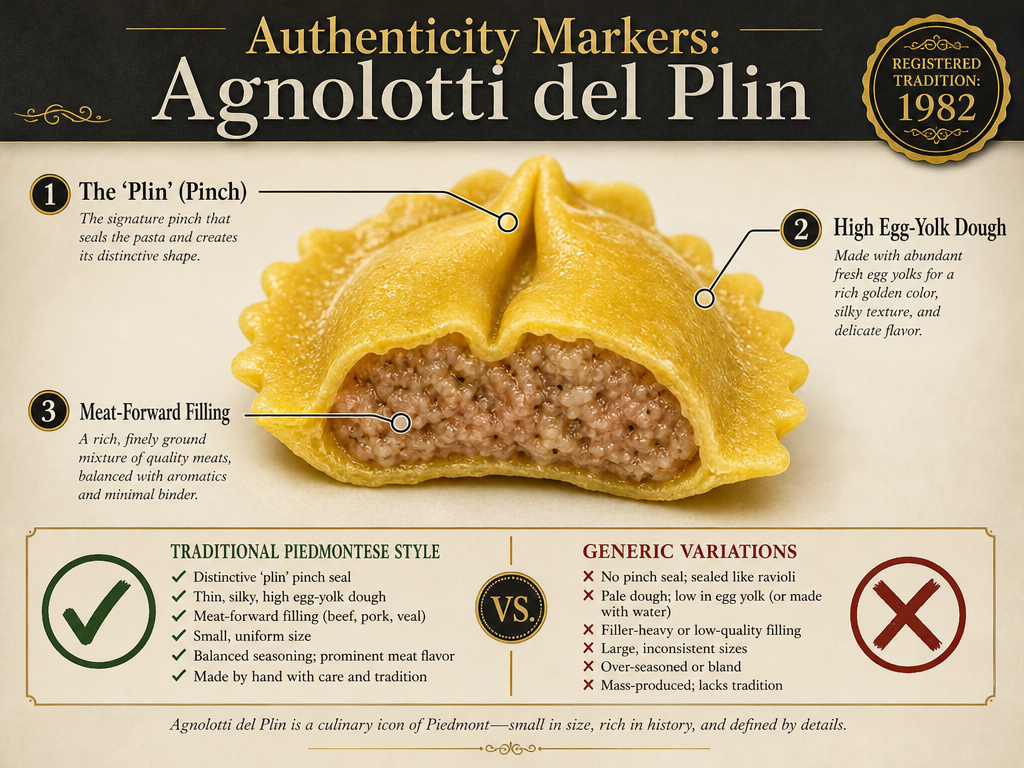 True culinary archiving requires looking for technical markers, such as the signature 'pinch' of a Piedmontese Agnolotti, to verify a dish's regional authenticity.
The Three-Tool Tracking System
Your camera roll can't tell you which of seventeen carbonaras was worth remembering. You need a structured system that captures location, technical details, and sensory evaluation in a format you can actually search later.
Most food tracking apps fall into one of three categories, each optimized for different use cases:
The List-Maker: Beli
Best for: Social recommendations and collaborative lists
Limitation: Tracks restaurants, not individual dishes
Use case: Building a shared "must-visit" list with friends for an upcoming trip
Beli organizes your food life around places, not plates. It's designed for the question "Where should we eat?" rather than "What should I order?" If your primary goal is compiling restaurant recommendations by neighborhood, Beli provides clean mapping and social sharing features.
The weakness for regional pasta tracking is fundamental: You can save a restaurant, but you can't easily tag which specific dish made it worth saving. When you're trying to remember whether it was the amatriciana or the cacio e pepe that earned your five-star rating, Beli won't help.
The Mapper: Mapstr
Best for: Visual location memory and offline access
Limitation: Minimal structured data entry for dish details
Use case: Creating a personal geographic food map you can reference while traveling
Mapstr excels at answering "Where was that place?" It provides a clean, personal map interface with custom tags and offline capability. For travelers who think geographically, it's intuitive.
But regional pasta tracking requires more than dots on a map. You need to record flour type, sauce composition, texture notes - details that don't fit naturally into Mapstr's location-first interface. You'll end up writing long notes in a text field rather than capturing structured data you can filter and compare later.
The Sensory Journal: Savor
Best for: Dish-level tracking with structured rating criteria
Limitation: Requires more intentional logging than quick photo-based apps
Use case: Building a searchable database of individual dishes with technical details and sensory evaluation
Savor organizes around the dish, not the venue. You log the specific pasta, record technical markers (shape, sauce, preparation), and evaluate using a professional-grade rating system based on five specific pillars: Aroma, Texture, Flavor Balance, Presentation, and Overall Impression.
This structure matters for regional pasta tracking because it lets you compare the same dish across different locations. You can pull up every cacio e pepe you've logged, see which scored highest in each category, and identify which technical markers correlated with the best versions.
The tradeoff is logging time. Instead of quickly snapping a photo and adding a restaurant to a list, you're spending five minutes capturing structured data. For casual dining, that's overkill. For the extraordinary pasta dish you want to remember and recreate, it's essential.
Building Your 5-Minute Pasta Log Protocol
The difference between a useful food archive and a neglected one is friction. If your tracking system requires ten minutes of typing per dish, you'll abandon it after three entries. The goal is capturing essential information quickly while the sensory memory is still fresh.
Here's a streamlined protocol that takes roughly five minutes per dish:
Step 1: Capture the Core Metadata (60 seconds)
Open your tracking app while you're still at the table. Record:
- Dish name (as written on the menu)
- Restaurant name and location
- Date
- Region of origin (if known)
Don't overthink the name. If the menu says "Tagliatelle al Ragù," record exactly that, even if you know it's more properly called "Tagliatelle al Ragù alla Bolognese." Consistency with menu language makes future searches easier.
Step 2: Document the Technical Markers (90 seconds)
This is where regional tracking separates itself from generic food logging. Record the physical characteristics that define authenticity:
- Pasta shape and dimensions (ribbon width, tube diameter, strand thickness)
- Surface texture (smooth vs. rough, glossy vs. matte)
- Flour type (if you can determine it from taste/texture)
- Sauce components (list all visible ingredients)
- Cooking doneness (al dente, slightly overcooked, properly tender for fresh pasta)
You don't need to write paragraphs. Short descriptors work: "7mm ribbon, rough texture, clings to fork, visible egg color, firm bite."
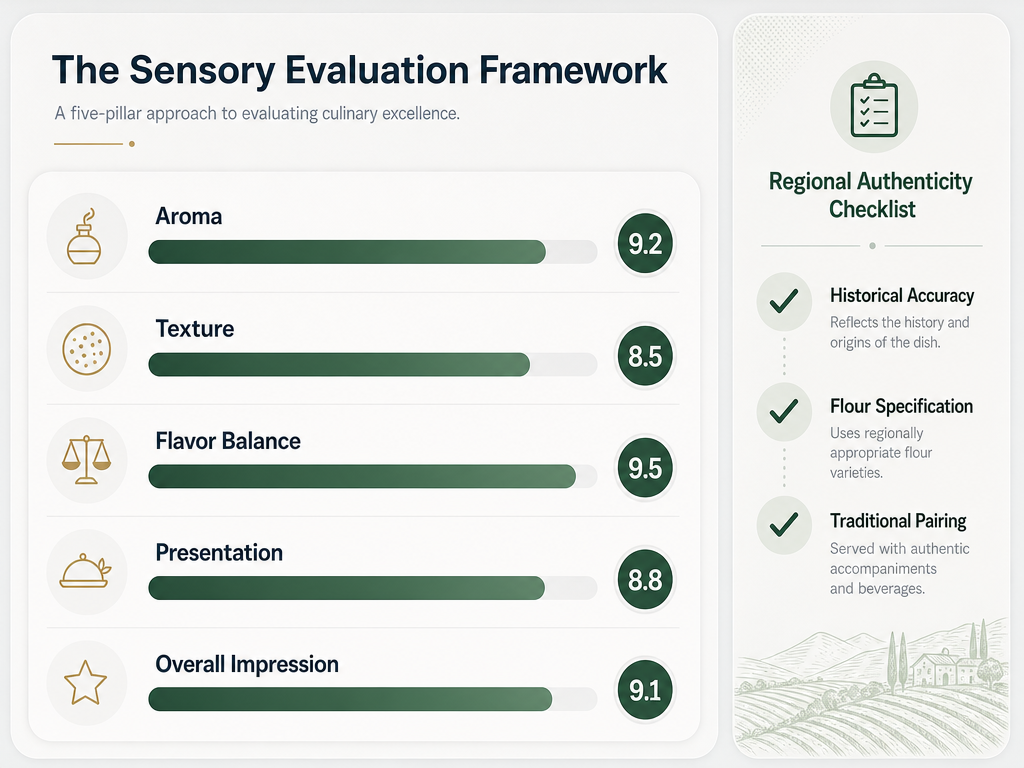 Beyond 'delicious,' use these five data-driven sensory pillars to objectively evaluate and archive every regional pasta dish you encounter on your culinary journey.
Step 3: Grade Using the Five Sensory Pillars (90 seconds)
Professional dish rating uses five specific evaluation criteria: Aroma, Texture, Flavor Balance, Presentation, and Overall Impression. Rate each on a 10-point scale.
Aroma: Does it smell like the primary ingredients (garlic, cheese, meat) or generic "pasta"?
Texture: Is the pasta cooked properly for its type? Does the sauce coat or pool?
Flavor Balance: Do you taste all the components, or does one dominate inappropriately?
Presentation: Does the plating suggest care or rushed assembly?
Overall Impression: Would you order this again, recommend it to others, or forget about it?
The numerical scores matter less than the act of forcing yourself to evaluate discrete elements. "It tasted good" is useless six months later. "Perfect texture, under-seasoned sauce, 7/10 overall" gives you actionable information for future comparisons.
Step 4: Add the Authenticity Check (60 seconds)
Based on the regional markers you've learned, make a simple binary assessment: Does this dish represent an authentic regional preparation, or is it a variation/interpretation?
This isn't a value judgment. A restaurant can serve an excellent non-traditional carbonara. But when you're building a regional pasta archive, you need to flag which entries represent the canonical version and which are creative departures.
Record your reasoning in one sentence: "Authentic - follows traditional Emilia-Romagna egg-to-flour ratio and proper ribbon width" or "Variation - uses cream in carbonara, which isn't traditional Roman preparation."
Step 5: Photograph Strategically (30 seconds)
Take three photos:
- Full plate from above: Shows overall presentation and portion
- Close-up of pasta texture: Captures surface detail and sauce interaction
- Cross-section if applicable: For filled pasta, shows ratio of filling to dough
Your camera roll becomes useful when each photo set tells a complete visual story you can interpret later without needing extensive captions.
The entire protocol takes five minutes. Do it immediately after the first few bites, while you're still tasting the dish and can accurately assess each pillar. Waiting until you get home means relying on degraded memory and losing the sensory specificity that makes the archive valuable.
Expert Tips for Foodie Travel: Using Technology to Back-Catalog Your History
The five-minute protocol works for new meals. But what about the 2,000 pasta dishes you've already photographed and forgotten?
Mining Your Camera Roll for Location Data
Modern smartphones embed GPS coordinates in photo metadata. You can use this to reconstruct where you ate, even if you don't remember the restaurant name.
On iPhone: Open Photos, select a food picture, swipe up to reveal the map. The embedded location will show you exactly where you were standing. Cross-reference that location with Google Maps or Yelp reviews from the same date to identify the restaurant.
On Android: Open Google Photos, select the image, tap the info icon (i) to see location data. The process is identical.
This works for any photo taken with location services enabled - which means you can potentially recover the venue for every pasta dish you've photographed in the past five years.
Using Visual Recognition for Shape Identification
If you have photos but can't remember which regional shape you ate, several tools can help:
Google Lens: Point your camera at a pasta photo and search. Google's image recognition can often identify common shapes (penne, rigatoni, farfalle) and sometimes suggest specific regional variations.
Pinterest Visual Search: Upload your pasta photo and search for similar images. Pinterest's algorithm is particularly good at finding matches for food items and often surfaces recipe pages that name the exact shape.
Neither tool is perfect - they'll confidently misidentify unusual regional shapes - but they're useful starting points for cataloging your back archive of photos.
Creating Batch Import Templates
If you're serious about back-cataloging hundreds of old pasta dishes, create a simplified import template with fewer fields than your current 5-minute protocol:
- Restaurant name and city
- Approximate date (month/year is fine)
- Pasta shape if identifiable
- One-sentence memory note
- Simple 1-5 rating
The goal isn't to reconstruct perfect records for old meals. It's to capture enough information that you can find them later when you're trying to remember "that amazing pasta I had in Florence in 2019."
Batch processing old photos in 30-minute sessions (roughly 20-30 dishes per session) is far more sustainable than attempting to back-catalog your entire history in one exhausting evening.
Common Mistakes That Destroy Your Pasta Archive
Most food tracking systems fail not because people lose interest, but because they're built on unsustainable practices that collapse under real-world use.
Mistake #1: Optimizing for Instagram Instead of Memory
The most common failure mode: Taking beautiful overhead shots that lack the technical detail you need for future identification.
That perfectly styled photo of your tagliatelle looks great as a social post. Six months later, you can't tell if the pasta was fresh or dried, what the sauce components were, or whether the ribbon width matched regional standards.
Solution: Take your Instagram photo first, then take three additional working photos that capture texture, cross-section, and technical details. The working photos stay in your food archive. The Instagram photo goes on your feed.
Mistake #2: Rating Restaurants Instead of Dishes
Every restaurant has a best dish and a worst dish. When you rate the venue as a whole, you lose the granularity that makes comparative analysis possible.
A three-star Roman trattoria might serve the best cacio e pepe of your life alongside a mediocre carbonara. If you've only logged "Trattoria Giovanni: 4/5," you've created a useless record. You don't remember which dish earned the rating, and you can't compare your cacio e pepe experiences across multiple restaurants.
Solution: Always track at the dish level. Rate each pasta separately. Tag them with the same restaurant name so you can view all dishes from a venue, but maintain individual records for each plate.
Mistake #3: Trusting Menu Descriptions of Regional Origin
Menus lie. Not maliciously - just casually. A menu will claim "traditional Tuscan pappardelle" for a dish that uses dried pasta (Tuscany's tradition is fresh), cream sauce (not traditional), and machine-cut ribbons (hand-cutting matters).
Solution: Record what the menu claims, then note your own regional assessment based on technical markers. Over time, this creates a personal database of which restaurants honor regional traditions and which play fast and loose with historical accuracy.
Mistake #4: Forgetting to Tag by Region
The whole point of regional tracking is being able to answer questions like "Which Roman pastas have I tried?" or "Show me all the Emilia-Romagna dishes I've logged in the past two years."
If you're not consistently tagging each dish with its region of origin, you're building a flat database that can only be sorted chronologically or by restaurant name.
Solution: Create a standardized regional tag system (Piedmont, Emilia-Romagna, Tuscany, Latium, Campania, Puglia, Sicily) and apply one tag to every pasta dish you log. If a dish blends multiple regional traditions, tag it with all applicable regions.
Transform your chaotic camera roll into a searchable, data-rich personal archive by following this systematic four-step workflow for every regional pasta discovery.
How to Compare the Same Dish Across Multiple Cities
The real value of a regional pasta archive reveals itself when you start comparing versions of the same dish eaten in different contexts. This is where casual food photography becomes systematic culinary analysis.
Building a Comparison Framework
Let's say you've eaten cacio e pepe in six different Roman restaurants over three years. Your archive should let you pull up all six entries and compare them side-by-side across the five sensory pillars.
Here's what that comparison actually reveals:
Texture scores clustering around 9-10: The restaurants that understand proper emulsification
Flavor Balance scores varying from 6-10: The difference between under-peppering and proper seasoning
Presentation scores that don't correlate with taste: Beautiful plating means nothing if the sauce breaks
When you view this data together, patterns emerge. You discover that the highest-rated version came from the restaurant that used square-cut tonnarelli instead of round spaghetti - a technical choice that improved sauce adhesion. You learn that excessive pepper (what seemed impressive initially) actually dominated the pecorino's flavor in ways that reduced overall balance.
These insights are impossible to extract from memory alone. You need structured data captured consistently across multiple experiences.
The Side-by-Side Photo Review
Pull up your photos of the same dish from different restaurants and look for visual differences:
- Sauce consistency: Which versions show proper emulsification vs. broken/oily sauce?
- Pasta color: Do egg-based versions show variation in yolk content?
- Cheese integration: Can you see chunks of undissolved cheese (a technical failure) or smooth coating?
The photos become evidence for your sensory scores. If you rated texture 9/10 but the photo clearly shows broken sauce pooling at the bottom of the plate, either your rating was wrong or your photography didn't capture the dish at its best moment.
Creating Your Personal "Best Of" Rankings
After logging dishes consistently for six months, you'll have enough data to create meaningful regional rankings. Not "best restaurants in Rome" (that's Yelp territory), but "best cacio e pepe I've personally eaten, ranked by technical execution."
This personal ranking serves several purposes:
- It gives you a reference point for future versions (Can this beat my current #1?)
- It lets you guide friends with specific recommendations (Go to Restaurant X for cacio e pepe, Restaurant Y for carbonara)
- It creates a historical record of your evolving palate (Did your preferences change over time?)
The rankings only work if you've been honest and consistent in your logging. If you inflate scores because you're caught up in the moment of a beautiful meal, your archive becomes unreliable.
Frequently Asked Questions
What's the easiest way to track my food?
The easiest approach depends on what you want to remember. For quick restaurant bookmarking with minimal effort, Beli or Mapstr let you drop pins and add basic tags. For systematic dish-level tracking that supports future comparison and analysis, Savor's structured logging system requires more upfront time but creates searchable records. The "easiest" method is whichever you'll actually use consistently - which usually means matching the tool's complexity to your actual commitment level.
What are the best apps for foodies?
The term "best" masks the real question: best for what purpose? Modern food apps cluster into three categories - restaurant discovery platforms (helping you find new places), dish-level memory tools (helping you remember what you ordered), and recipe management systems (helping you cook at home). For regional pasta tracking specifically, you need dish-level logging with geographic and technical tagging. Apps designed primarily for restaurant reviews or social sharing lack the structured data fields that make comparison analysis possible.
How can I keep track of restaurant inventory?
Restaurant inventory tracking is an operational concern for business owners, not a personal food archiving question. If you're asking as a diner trying to remember which restaurants have which dishes, you're looking for a personal dish database rather than inventory software. If you're asking as a restaurant operator, you need specialized point-of-sale and inventory management systems that integrate with your ordering and prep workflows - a completely different category of software from personal food tracking tools.
Is Beli still invite only?
Beli's access model changes periodically based on their platform capacity and growth strategy. Rather than relying on current status (which may change), the more useful question is whether Beli's restaurant-first tracking model fits your needs. For regional pasta documentation that requires dish-level detail, technical markers, and comparative analysis, you'll hit limitations regardless of whether you have immediate access. The app's strength is collaborative restaurant lists, not systematic dish evaluation.
How do I rate a pasta dish beyond "it tasted good"?
Professional dish rating uses five discrete evaluation pillars: Aroma, Texture, Flavor Balance, Presentation, and Overall Impression. For regional pasta specifically, Texture deserves extra attention - you're evaluating whether the pasta achieved proper al dente (for dried) or tender without mushiness (for fresh), whether the sauce properly coated or pooled, and whether the shape's functionality worked as intended. Flavor Balance assesses whether you can taste all the declared ingredients or whether one component overwhelms. This structured approach turns vague impressions into specific, comparable data.
Which pasta shape is non-negotiable for specific Italian regions?
Several regional dishes are inextricably linked to specific shapes: Emilia-Romagna's tagliatelle al ragù demands the 6-7mm ribbon width registered in 1982, Rome's cacio e pepe traditionally uses tonnarelli (square spaghetti) rather than round, and Piedmont's agnolotti del plin requires the signature pinch seal that gives the dish its name. Using alternative shapes isn't automatically wrong, but it signals you're eating an interpretation rather than a canonical version - information worth capturing in your archive.
Can I track regional dishes by geographic map automatically?
Most food apps can plot your meals on a map using GPS data from your photos. The limitation isn't geographic display - it's semantic tagging. A map showing dots where you ate doesn't answer "Show me all the Emilia-Romagna dishes I've tried" unless you've consistently tagged each entry with regional origin. The automation happens at the photo level (extracting location from metadata). The regional intelligence requires manual classification unless you're using a specialized tool that includes a regional taxonomy of pasta types.
What is the difference between "fresh with eggs" and "durum wheat" regional traditions?
Northern Italian pasta (Emilia-Romagna, Piedmont) uses soft wheat flour mixed with eggs to create fresh dough that's rolled, cut, and cooked immediately or after brief drying. Piedmontese pasta can contain up to three times the standard egg yolk ratio, creating an intensely rich, golden dough. Southern Italian pasta (Campania, Puglia, Sicily) uses durum wheat semolina mixed only with water, extruded or shaped, then dried thoroughly. The difference isn't just ingredients - it's texture (tender vs. firm), flavor (neutral vs. wheaty), and traditional sauce pairings (delicate vs. assertive).
Your camera roll's 2,000 food photos don't have to remain a graveyard of forgotten meals. With a structured approach to regional pasta tracking - one that captures technical markers, evaluates sensory pillars, and organizes by geography - you can transform casual dining into a searchable culinary archive. The next time you're trying to remember where you had that extraordinary cacio e pepe, you won't be scrolling through thousands of unlabeled photos. You'll be pulling up a filtered list of every Roman pasta you've logged, sorted by your own ratings, with photos and technical notes that let you reconstruct exactly what made that particular dish worth remembering.
Start with one region. Master its signatures. Then expand. The goal isn't to catalog every pasta in Italy - it's to build a system that actually works when you need it.