
Stop Eating, Start Curating: The 2026 Guide to Food Software for the Serious Foodie
John the smoothie monster
John lives for smoothie bowls and cold-pressed juices. He uses Savor to remember his best blends.
Stop Eating, Start Curating: The 2026 Guide to Food Software for the Serious Foodie You’ve taken 5,000 food photos this year. You can’t remember half the...
Stop Eating, Start Curating: The 2026 Guide to Food Software for the Serious Foodie
You’ve taken 5,000 food photos this year. You can’t remember half the restaurants, the names of the dishes, or why that particular carbonara in Rome was so much better than the one you had in Boston. Your camera roll has become a graveyard of incredible meals, and a generic Yelp search pulls up the same chain restaurants that dominate every city block.
Here’s the uncomfortable truth: the way you track and discover food is fundamentally broken. Not because you’re doing it wrong, but because the tools were never built for someone like you - someone who cares about food at a level that goes beyond convenience and into culture, craft, and personal taste.
This is the state of food software in 2026. The keyword "food software" doesn’t just mean inventory management systems for restaurants anymore. It’s bifurcated into something far more intimate: Personal Restaurant Management & Curation Systems built for the serious foodie. These are tools designed to answer a single, urgent question: How do I capture, organize, and actually use the culinary experiences that define my life?
This guide is your strategic blueprint for building a personal food tech stack that finally respects your palate. We’ll break down the landscape, identify which tools match your personality, and show you how to stop losing the meals that matter most.
Table of Contents
- The Three Types of Food Software Users
- The Competitive Ranker: Building Your Personal Leaderboard
- The Memory Keeper: Rescuing Your Camera Roll
- The Purist: Private Notes and Expert Curation
- Critical Feature Checklist: What Actually Matters
- Comparison Matrix: Finding Your Stack
- The End of the Generic Review
- Frequently Asked Questions
The Three Types of Food Software Users
Not all foodies are created equal. The software that works for your friend who just wants pretty Instagram posts won’t serve you if you’re building a definitive ranking of every ramen shop in San Francisco. The first step in selecting food software is identifying which of three user profiles you align with most closely.
The Competitive Ranker wants a definitive answer to one question: Where does this meal sit in my all-time hierarchy? These users don’t want to assign arbitrary five-star ratings that mean nothing three months later. They want head-to-head comparisons, Elo-style rankings, and the ability to say with absolute certainty, "This is the seventh-best pizza I’ve ever eaten."
The Memory Keeper has a different problem entirely. Their camera roll is chaos - 2,000 photos with no metadata, no tags, no way to search "that place in Kyoto with the incredible tsukemen." They need software that can auto-tag locations, extract dish names from photos, and turn a disorganized visual diary into a searchable database.
The Purist is actively fleeing the noise. They don’t want algorithmic recommendations from strangers with objectively bad taste. They want a private journal, chef-curated lists, or a social circle limited to people whose palates they actually trust. For them, the software must prioritize curation quality over crowd size.
Which one are you? You might be all three at different times, which is why understanding the strengths and trade-offs of each approach matters. The right food software isn’t the most popular app - it’s the one that mirrors how your brain already organizes taste memories.
The Competitive Ranker: Building Your Personal Leaderboard
Picture this scenario: You’ve just finished a transcendent meal at a new sushi spot. Your dining companion asks, "How was it?" and you freeze. Was it better than that omakase in Tokyo? Better than the hole-in-the-wall in Los Angeles? You have no idea, because you’ve never forced yourself to make those comparisons explicit.
This is where Beli dominates the food software landscape. The app’s core mechanic is deceptively simple: after every meal, it asks you to compare it head-to-head against previous meals in the same category. Over time, this builds an Elo-style ranking - a mathematical system borrowed from chess that ensures your top-ranked meals have genuinely earned their position through repeated comparisons, not recency bias.
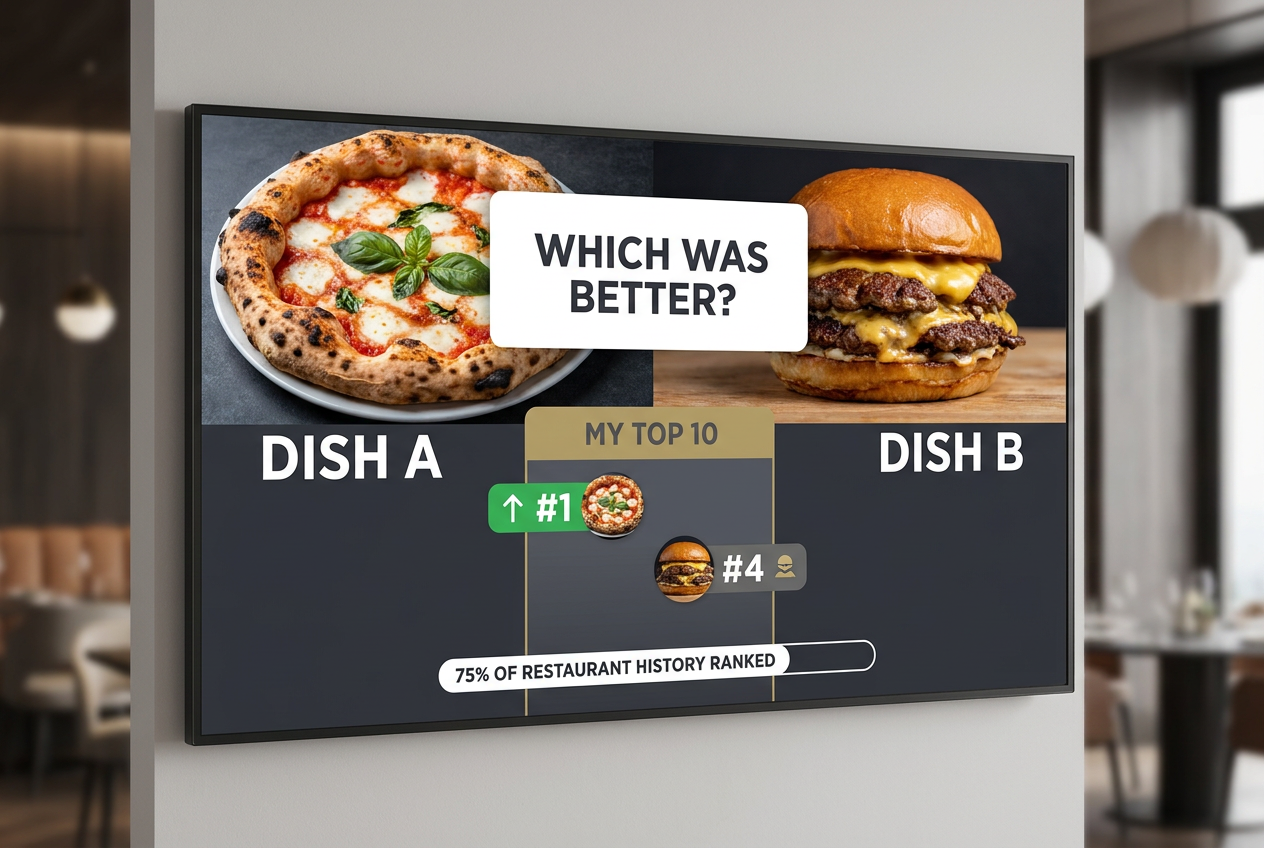 Beyond generic stars, modern food software uses head-to-head Elo-ranking to help serious foodies establish a definitive, personalized hierarchy of their favorite meals.
The brilliance of this approach is that it solves a problem most foodies don’t realize they have: rating inflation. When you use a traditional five-star system, everything good becomes a four or five. Three months later, you can’t remember which five-star meal actually mattered. Elo-ranking forces difficult decisions. It asks, "Would you rather eat X or Y again?" and uses your answer to build a hierarchy that reflects your true preferences.
But there’s a trade-off. Beli’s social features can make the app feel performative. Some users report that the public-facing leaderboards create pressure to eat at "cool" restaurants rather than quietly beloved neighborhood spots. The software is excellent at what it does - quantifying your taste - but it’s less useful if you primarily want a private diary.
For competitive rankers, the key question is whether you want your rankings to be social proof or personal truth. If you’re comfortable with friends seeing your top 50, Beli is unmatched. If you’d rather keep those rankings private, you’ll need to look elsewhere. Learn more about apps designed specifically for tracking individual dishes.
The Memory Keeper: Rescuing Your Camera Roll
Let’s talk about the unsearchable camera roll problem. You have 3,000 food photos. Zero organization. You vaguely remember an incredible Vietnamese spot in Portland, but you can’t recall its name, the neighborhood, or even the year you went. You scroll for 20 minutes and give up. The memory is lost.
Yummi built an entire product around solving this exact frustration. The app uses OCR (optical character recognition) and location data to automatically tag food photos with restaurant names, dates, and even extracted menu items. It creates what the company calls "Foodprints" - a visual map of everywhere you’ve eaten, organized by geography and chronology.
The standout feature is automated data extraction. You take a photo of a menu, and the software reads it. You photograph a dish, and it attempts to identify what’s on the plate. Over time, this builds a searchable database where typing "duck confit" or "Mission District" actually returns useful results instead of making you scroll through 3,000 untagged JPEGs.
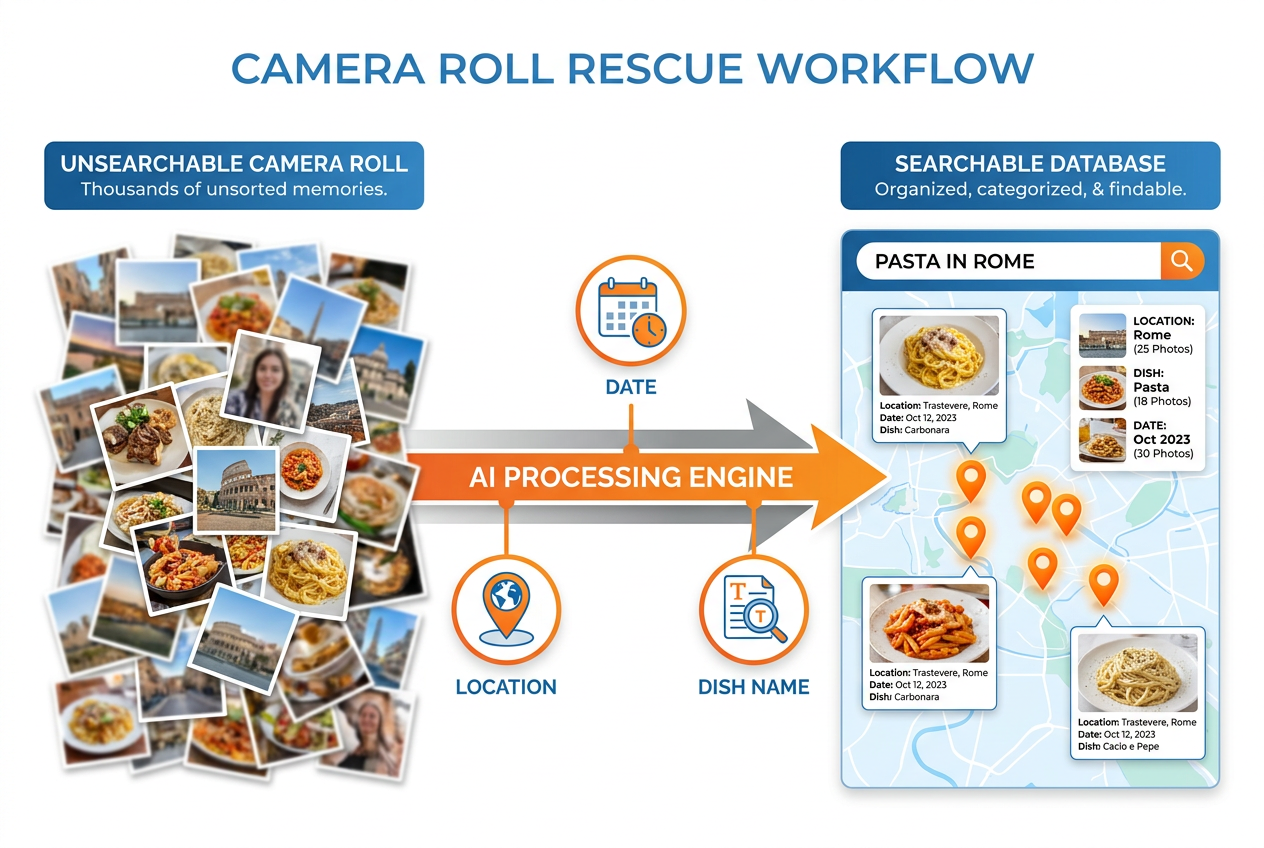 Automated data extraction transforms your disorganized food photos into a powerful, searchable database, ensuring you never forget a meal or a location again.
But Yummi’s interface reveals its priorities: utility over lifestyle. The app feels more like a filing system than a curated gallery. Users who want elegant design or social sharing features may find it underwhelming. This is software for people who value function above form - a searchable archive matters more than a beautiful one.
The real power move for memory keepers is to pair Yummi’s auto-tagging capabilities with a more thoughtful journaling app. Use Yummi to handle the tedious data entry, then export that metadata to a tool where you can add tasting notes, scores, and context. This hybrid approach solves the "I can’t remember anything" problem without forcing you into a single ecosystem.
For more on rescuing your food photos from digital oblivion, check out how to organize your restaurant photo library.
The Purist: Private Notes and Expert Curation
Some foodies have no interest in social validation. They don’t want to see what strangers rated four stars. They don’t want algorithmic recommendations based on "people who liked this also liked..." They want two things: chef-vetted quality and a private space to record their own thoughts without performing for an audience.
This is where the food software landscape splits into two distinct camps: World of Mouth for discovery and Memolli for private documentation.
World of Mouth operates on a fundamentally different model than Yelp. Every restaurant in their database has been visited and vetted by professional chefs, food critics, or verified culinary experts. There are no user-submitted reviews from people whose idea of fine dining is Cheesecake Factory. The trade-off is obvious: limited coverage. If you’re in a major food city, the curation is exceptional. If you’re in a secondary market, you might find three recommendations.
The app is expensive - subscription-based with no free tier - but for travelers who want a reliable shortlist of the best meal in any given city, it eliminates the noise. You’re not sifting through 400 reviews trying to figure out which ones are legitimate. You’re seeing the seven places that actual professionals think are worth your time and money.
Memolli takes the opposite approach: 100% private, 100% manual. The app is essentially a beautifully designed notebook optimized for food memories. No social features, no discovery algorithm, no ads. You write what you ate, where you ate it, and how you felt about it. That’s the entire product.
For purists, this minimalism is the point. The act of writing forces you to articulate why a meal mattered, which is far more valuable than assigning a numeric score. The downside is obvious: no automation means more effort. If you’re not willing to manually log every meal, Memolli becomes a graveyard of good intentions.
The purist’s dilemma is whether you value curation quality or personal reflection more. World of Mouth curates for you. Memolli forces you to curate yourself. Both approaches are valid, but they serve different psychological needs. If you want to explore more ways serious foodies are moving beyond Yelp, see the best apps to share lists without the noise.
Critical Feature Checklist: What Actually Matters
When evaluating food software, most people fixate on surface-level features - photo filters, social sharing, pretty maps. But the features that separate utility tools from indispensable companions are far more subtle. Here’s what actually matters in 2026.
Cross-Platform Booking Integration is table stakes for any serious food app. Can the software connect directly to Resy, OpenTable, or Tock? Can you move from "I want to eat here" to "I have a reservation" without switching apps? This single integration saves hours over a year and dramatically increases the likelihood you’ll actually visit the places you save.
Elo-Ranking Capability (or equivalent comparison systems) solves the rating inflation problem. Any tool that only offers star ratings or numeric scores will eventually fail you. The human brain is bad at assigning absolute values but excellent at making relative comparisons. Software should mirror how you actually think about food: "I’d rather eat X than Y."
OCR and Auto-Tagging is the difference between a tool you use daily and one you abandon after three weeks. If the software can’t extract menu text from photos, auto-populate restaurant names from location data, or learn your common dish categories, you’ll spend so much time on manual data entry that the system becomes unsustainable. Automation isn’t about laziness - it’s about reducing friction to the point where logging becomes habitual.
Automated data extraction transforms your disorganized food photos into a powerful, searchable database, ensuring you never forget a meal or a location again.
Exportability and Data Ownership are features you don’t appreciate until you need them. Can you export your entire meal history as a CSV, PDF, or custom Google Map? Or are your memories locked in a proprietary format that becomes useless if the company shuts down? The best food software treats your data like yours, not theirs.
Custom Tagging and Filtering separates power users from casual browsers. Can you create tags like "Worth a Plane Ride," "Date Night Tier," or "Brings Out the Umami"? Can you filter your history by protein type, preparation method, or price range? Generic categories (Italian, Mexican, American) are useless for someone who’s eaten at 200 Italian restaurants.
One feature you might not expect: Offline Access. The best meals often happen in places with terrible cell service - rural farmhouses, underground speakeasy bars, international destinations. If your food software requires constant internet connectivity to function, it fails precisely when you need it most.
These aren’t flashy features that make good marketing copy. They’re the structural decisions that determine whether software becomes part of your daily routine or collects digital dust. For more on building a system that actually sticks, read about building your personal restaurant library.
Comparison Matrix: Finding Your Stack
Here’s the uncomfortable truth: no single app solves every problem. The serious foodie’s tech stack in 2026 typically involves 2-3 tools working in concert, each handling the parts it does best. Understanding the trade-offs is how you build a system that actually serves your needs.
| Feature | Beli | Yummi | World of Mouth | Memolli |
|---|---|---|---|---|
| Primary Strength | Elo-ranking / Social leaderboards | Auto-tagging / Photo organization | Chef-curated discovery | Private journaling |
| Best For | Competitive rankers who want definitive hierarchies | Memory keepers drowning in camera roll chaos | Purists seeking expert-vetted quality | Writers who value reflection over data |
| Social Features | High (public leaderboards, friend comparisons) | Low (optional sharing) | None (solo experience) | None (fully private) |
| Privacy Level | Low to Medium | Medium | High | Very High |
| Automation Level | Medium (some manual entry required) | Very High (OCR, auto-tagging) | N/A (discovery-focused) | Very Low (fully manual) |
| Data Export | Limited | Good (CSV, map export) | N/A | Good (PDF, plain text) |
| Maintenance Effort | Medium (requires comparison decisions) | Low (automated capture) | N/A | High (manual logging) |
| Price | Free tier available | Subscription ($5/month) | Expensive ($15/month) | One-time purchase ($10) |
| Coverage | User-generated (global but uneven quality) | User-generated (depends on OCR accuracy) | Expert-curated (major cities only) | User-generated (entirely personal) |
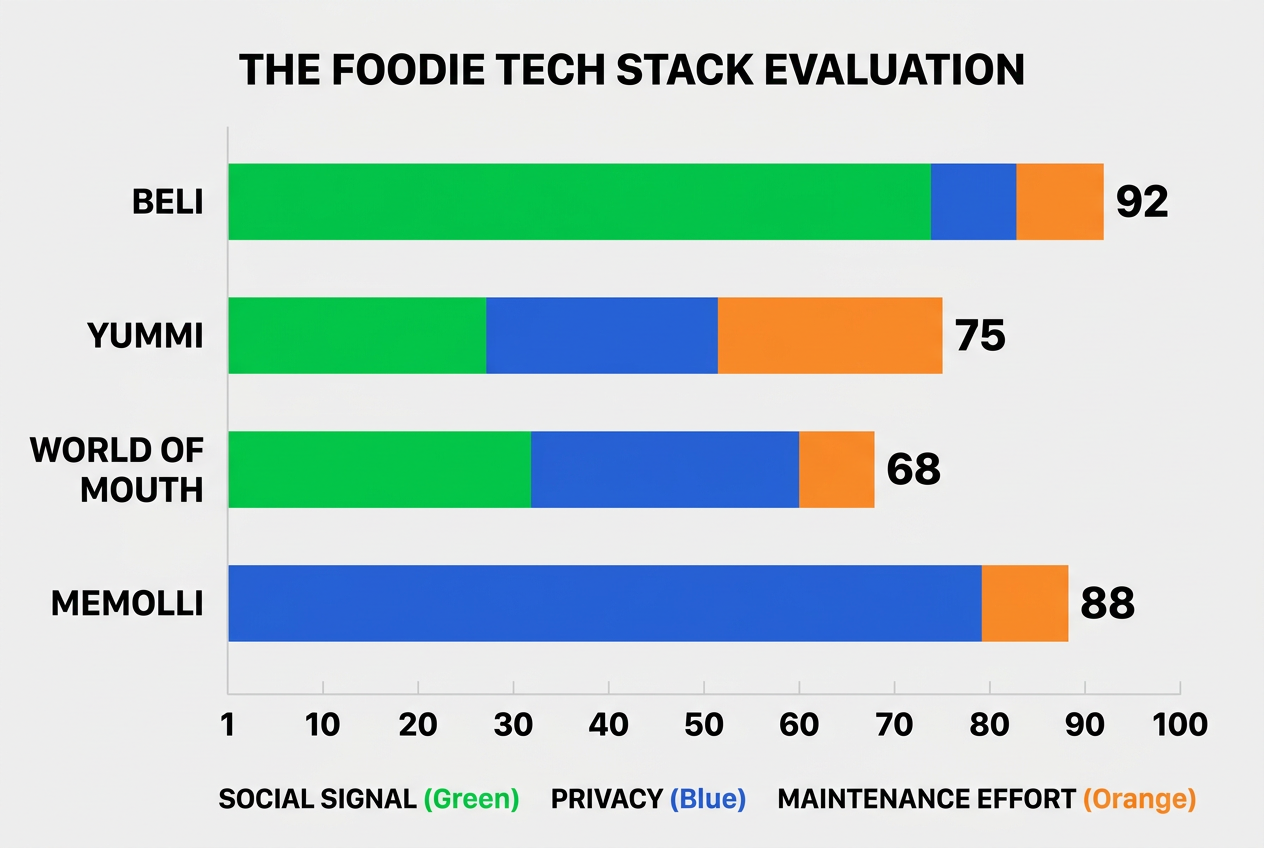 This comparison matrix highlights the trade-offs between social competition and private curation, helping you select the software that fits your personal foodie persona.
The matrix reveals a pattern: you’re choosing between social validation, automated convenience, and curation quality. You can optimize for two of those variables, but rarely all three. Beli gives you social proof and some automation but sacrifices privacy. Yummi automates everything but lacks curation depth. World of Mouth delivers exceptional curation but requires a subscription and offers limited coverage. Memolli provides total privacy and reflection space but demands manual effort.
The power-user move is to combine tools strategically. Use Yummi to capture and organize photos automatically, then export the ones that matter into Memolli for deeper reflection. Or use World of Mouth for discovery when traveling, but maintain your personal rankings in Beli. The software landscape is modular enough that you can build a custom stack without duplicating effort.
For more comparisons between modern food tracking approaches, see the best restaurant tracking apps or explore how serious foodies organize their food memories.
The End of the Generic Review
Let’s address the elephant in the algorithm: why the 1-5 star rating system is intellectually bankrupt. When you rate a restaurant "4 stars," what information have you actually communicated? Is that a 4-star rating for the neighborhood? For the city? For the cuisine type? For your personal standards? The number is meaningless without context, and most review platforms provide zero context.
The fundamental problem is that crowdsourced ratings optimize for the average opinion of the crowd, and the average person has average taste. A Michelin-starred restaurant might have a lower Yelp rating than a mediocre chain because the crowd includes people who think Olive Garden is authentic Italian food. The wisdom of crowds breaks down when the crowd has no expertise.
This is why the shift toward personal curation software matters. A single friend whose palate you trust telling you, "This is an 8.5 out of 10 for modern Japanese" is infinitely more valuable than seeing "4.2 stars from 847 reviews." You know that friend’s baseline. You know their biases, their tolerances for spice or sweetness, their budget. That context transforms a number into actionable intelligence.
The future of food software isn’t about building larger databases of generic opinions. It’s about building smarter filters that surface the right opinions - the ones that align with your taste, your values, your culinary education level. This might mean limiting your social circle to 10 trusted friends instead of broadcasting to 10,000 strangers. It might mean valuing a professional critic’s single annotation more than 1,000 amateur photos.
In practice, this means the best food software in 2026 doesn’t try to be TripAdvisor or Yelp. It embraces smaller, higher-signal networks. It assumes you care more about depth than breadth. It respects that your personal ranking system - however idiosyncratic - is more useful to you than any algorithmic recommendation could be.
The serious foodie’s rebellion against generic reviews isn’t snobbery. It’s a recognition that taste is personal, context-dependent, and impossible to aggregate meaningfully across millions of users. The software that wins is the software that helps you build your own system, not the software that imposes someone else’s system onto you. For related reading on why Yelp fails serious foodies, explore the best food review apps that respect individual taste.
Frequently Asked Questions
What is food software for serious foodies?
Food software for serious foodies refers to personal restaurant management and curation tools designed to help you track, organize, rank, and remember the dishes and meals that define your culinary life. Unlike nutrition tracking apps or generic review platforms, these tools prioritize taste memory, personal rankings, and high-signal discovery over calorie counting or crowdsourced opinions. They’re built for people who treat eating as a serious hobby rather than a utilitarian necessity.
How is food software different from restaurant review apps like Yelp?
The fundamental difference is signal quality and personalization. Yelp aggregates opinions from anyone with an internet connection, which dilutes signal with noise from people whose taste you don’t trust. Modern food software focuses on either building your own private ranking system, auto-organizing your food photos into a searchable database, or connecting you to expert-curated recommendations from professional chefs. You’re optimizing for personal truth or high-quality curation, not crowd consensus.
Do I need multiple food tracking apps or just one?
Most serious foodies in 2026 use 2-3 tools working in concert because no single app excels at everything. You might use Yummi for automated photo organization and OCR tagging, Beli for building your personal leaderboard, and Memolli for private reflection on particularly meaningful meals. The key is identifying which specific problems you’re trying to solve - discovery, memory, ranking, or journaling - and selecting tools that handle those functions well rather than expecting one app to do everything adequately.
What’s the best food software for someone with thousands of unorganized food photos?
If your primary pain point is an unsearchable camera roll full of food photos, prioritize apps with strong OCR and auto-tagging capabilities. Yummi is purpose-built for this problem - it extracts restaurant names from location data, reads menu text from photos, and builds a searchable map of your eating history. Alternatively, apps designed to organize food photos by restaurant can rescue your visual archive from chaos and make those memories genuinely useful.
Is it worth paying for food software subscriptions?
This depends entirely on how seriously you approach food. If you eat out once a month and don’t care about remembering meals beyond a casual Instagram post, free tools are sufficient. But if you’re someone who eats 200+ restaurant meals per year, travels for food, or genuinely wants to develop your palate over time, subscription-based tools with better curation (like World of Mouth) or automated features (like Yummi) save time and mental energy that justify the cost. The math is simple: does the software save you more time or improve decision-making enough to offset $5-15 per month?
Can food software help me remember why I liked a specific dish?
Yes, but only if you choose tools that prioritize note-taking and context over simple numeric scores. Apps like Memolli are designed specifically for this - they give you space to write reflective notes about flavor profiles, preparation techniques, atmosphere, or emotional associations. Generic rating platforms usually offer only a star rating and maybe a short comment field, which isn’t enough to capture the nuance of why a particular bite of uni was transcendent or why a seemingly simple roast chicken changed how you think about seasoning. Learn how to keep a food journal that captures those details effectively.
How do I choose between social and private food tracking apps?
This comes down to personality and what you want from the software. Social apps like Beli motivate through friendly competition and discovery - you see friends’ rankings, compare notes, get inspired by their top lists. Private apps like Memolli eliminate the performance pressure and let you be brutally honest without worrying about public perception. Ask yourself: do you want external validation and social motivation, or do you want an entirely personal reflection space? There’s no right answer, only what serves your goals better.
What does Elo-ranking mean in food software?
Elo-ranking is a mathematical system borrowed from chess that builds hierarchies through repeated head-to-head comparisons rather than absolute scoring. Instead of rating a restaurant "4 stars," the software asks, "Would you rather eat at Restaurant A or Restaurant B again?" Over time, these binary choices create a ranked list where the top-rated meals have genuinely beaten numerous competitors in direct comparisons. This solves the "rating inflation" problem where everything good becomes 4 or 5 stars and you can’t differentiate between genuinely transcendent meals and merely solid ones.