
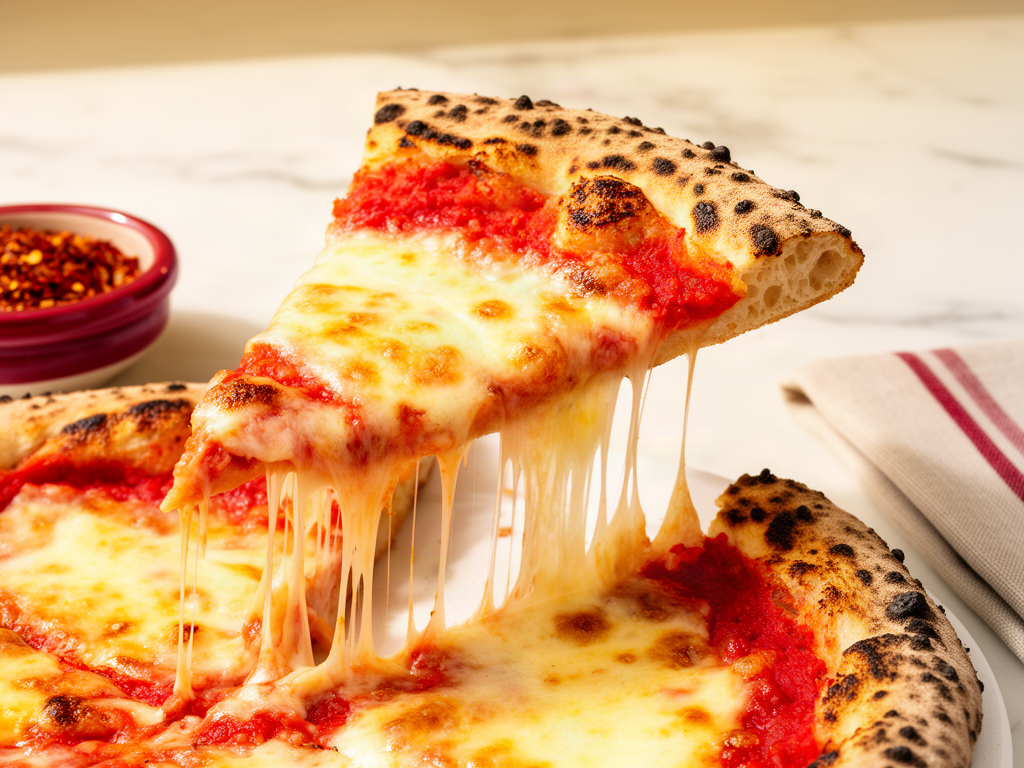
How to Track the Best Pizza Slices Across Different Cities
John the smoothie monster
John lives for smoothie bowls and cold-pressed juices. He uses Savor to remember his best blends.
How to Track the Best Pizza Slices Across Different Cities Your phone holds 2,847 food photos. Somewhere between photo 847 and 1,203 is that life-changing...
How to Track the Best Pizza Slices Across Different Cities
Your phone holds 2,847 food photos. Somewhere between photo 847 and 1,203 is that life-changing Detroit-style slice from your trip to Michigan - the one with the caramelized cheese crust you still think about. But you can't remember the pizzeria's name, the neighborhood, or even which city it was in.
You're not alone. Most serious pizza enthusiasts have lost track of dozens of exceptional slices simply because "4 stars on Yelp" doesn't capture the difference between a mediocre margherita and a transcendent one.
This guide is about building a personal pizza archive - a searchable, private database where you track exactly which slices were worth the carbs, which cities delivered the best regional styles, and which specific variables (under-carriage char, fold test, frico factor) made each slice memorable.
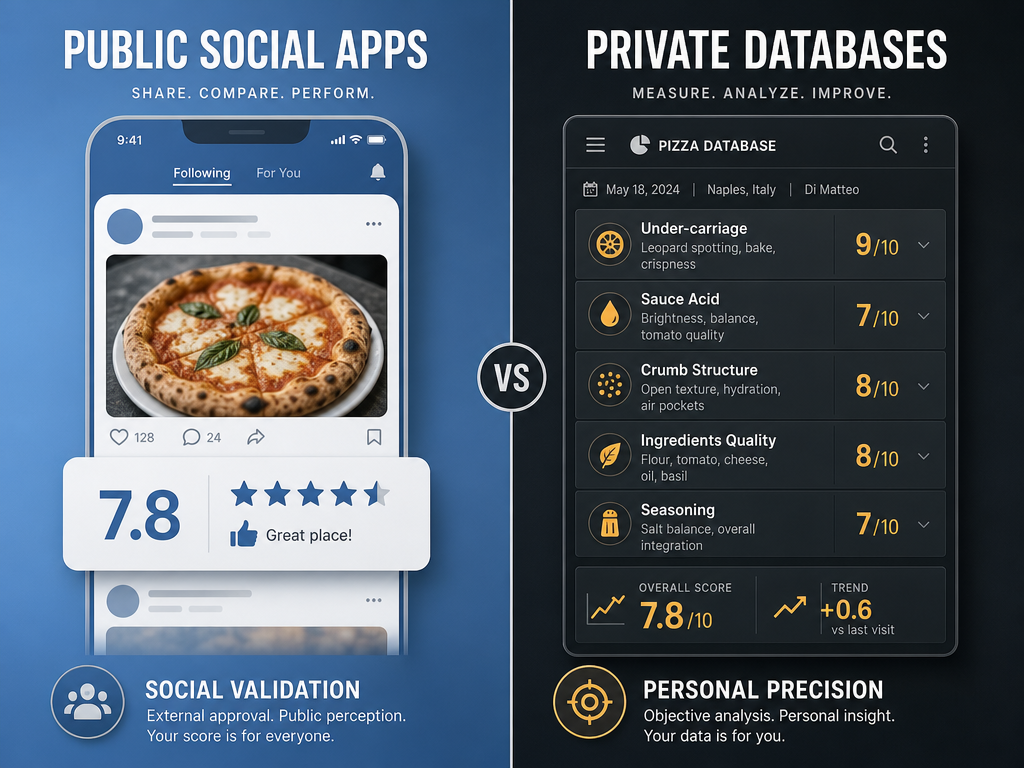 Choose your tracking philosophy: social apps prioritize community engagement and quick ratings, while private databases allow for granular, bias-free analysis of every slice.
Table of Contents
- The Problem with Generic Restaurant Ratings
- The Two Philosophies: Public Performance vs. Private Precision
- How to Rate Pizza Like a Professional
- The Pizza Tracking Toolkit
- The 30-Second Workflow: Photo to Map
- Regional Pizza Appendix
- Frequently Asked Questions
The Problem with Generic Restaurant Ratings
You've seen it a hundred times: a pizzeria with 4.3 stars on Google Maps. But what does that actually tell you? The score averages together opinions on the ambiance, the service, the garlic knots, and yes, somewhere in there, the pizza itself. One person gave five stars because the staff was friendly. Another gave two stars because they don't deliver past 9 PM.
When you're tracking pizza specifically - and tracking it across cities - this restaurant-level noise becomes unusable. You don't care that the Denver location has better parking than the Brooklyn one. You care that the Brooklyn slice had superior leoparding on the crust and the Denver slice was undercooked.
The solution isn't to read more reviews. It's to shift to dish-first documentation: rating the slice itself, not the venue.
The Two Philosophies: Public Performance vs. Private Precision
Before you pick a tracking method, you need to decide what kind of pizza archive you're building.
Public Validation apps like One Bite or Beli are designed for social discovery. You're performing for an audience. Your reviews become recommendations. Your map becomes a public guide. This works if your goal is to build influence or discover new spots through community consensus.
Private Precision systems - whether that's Savor, a custom spreadsheet, or even a Notion database - prioritize honesty and granularity. No one sees your scores. You're not inflating a 7.2 to an 8.0 because it "feels mean" to give a local spot a middling score. You're building a personal reference library for your own future decisions.
Most serious pizza enthusiasts eventually realize they need both: a public app to discover new places and a private system to remember which specific slices were actually worth traveling for. If you're interested in dish-level tracking beyond pizza, consider exploring the best apps to track your favorite dishes.
How to Rate Pizza Like a Professional
Generic star ratings fail because they collapse too many variables into a single number. A professional pizza critic evaluates specific, measurable qualities. According to competitive pizza judging, professional pizza competition scoring typically includes five core categories: Appearance, Construction, Crust, Taste, and Overall Impression.
But here's the critical insight: not all variables matter equally for every style. A New Haven apizza should be evaluated differently than a Detroit-style square. Your scoring rubric needs to be weighted by regional expectations.
The Under-Carriage Test
Flip the slice over. Is the bottom pale and doughy, or does it have those signature char marks from a properly heated oven? This is the single most reliable indicator of oven mastery. A limp, undercooked base will never deliver that satisfying crunch, no matter how good the toppings are.
The Foldability Factor (NYC/New Haven Specific)
Can you fold the slice lengthwise without the tip drooping or cheese sliding off? A proper New York slice should support its own weight when folded in half. If the slice flops, either the dough wasn't developed properly or it's overloaded with wet toppings.
The Frico Factor (Detroit Specific)
For Detroit-style square pies, the caramelized cheese crust - called frico - is the defining feature. It should shatter like glass when you bite into the edge. If the cheese along the rim is merely melted (not browned and crispy), the pizzeria doesn't understand the style.
The Sogginess Question (Neapolitan)
This is where your personal standard matters. Traditional Neapolitan pizza often has a slightly wet center where the sauce pools - this is by design in Italy. American pizza enthusiasts frequently dock points for this. You need to decide: are you scoring against the authentic standard or your personal preference?
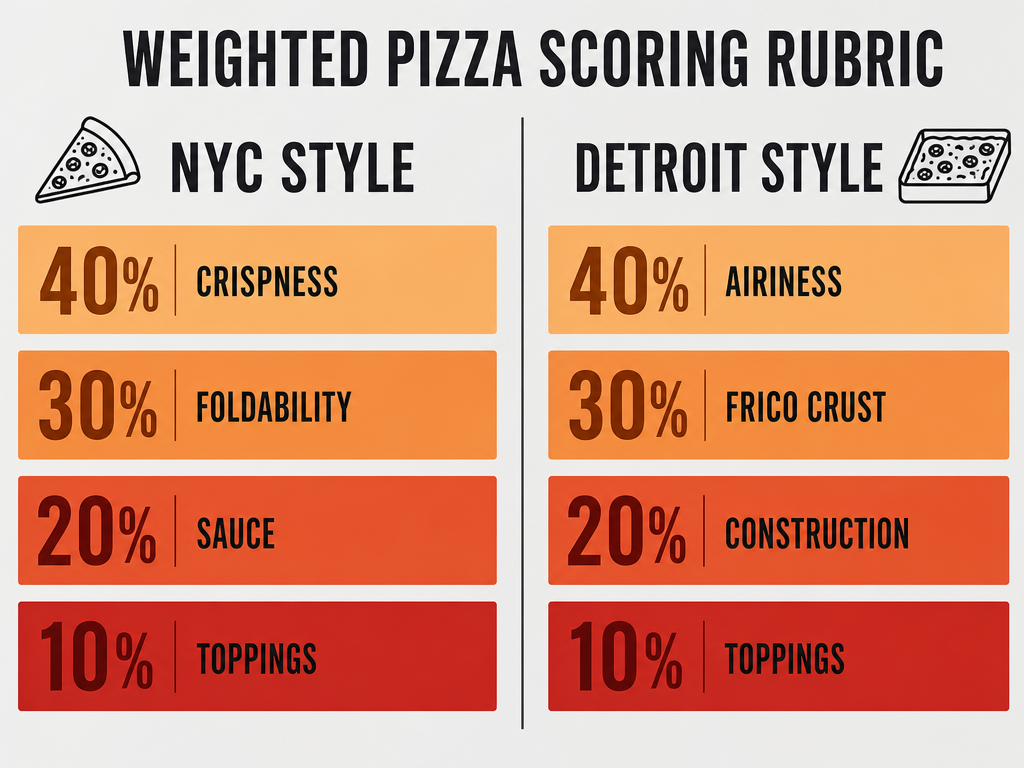 Professional scoring requires a flexible rubric; weighting your criteria based on regional pizza styles ensures your personal database remains accurate across different culinary traditions.
Building Your Personal Scale
The One Bite (Barstool) ratings are based on a 1-10 scale where scores near 8.0 are "really good" and a perfect 10 is almost never awarded. This creates a useful reference point, but many serious trackers prefer a higher-resolution system. The Savor app uses a 10-point scale to allow for "high resolution" ranking between "good" (7.0) and "actively worth a detour" (9.0+).
The difference between a 7.2 and a 7.8 might seem trivial today, but three months from now when you're trying to remember whether the slice in Chicago was better than the one in Austin, that granularity becomes essential.
The Pizza Tracking Toolkit
Let's review the primary tools and what they're actually good for.
One Bite: The Community Standard
One Bite is Dave Portnoy's viral pizza review platform. It's pizza-only, uses a simple 1-10 scale, and has a massive social community. The app's strength is discovery - you can see what's been reviewed in any city and compare your taste to other reviewers.
The weakness: your reviews are public, which creates subtle psychological pressure to inflate scores. Also, there's no way to add private notes about specific variables (like "under-carriage was perfect but sauce was too sweet"). It's a broadcast tool, not a personal reference system.
Beli: The Social Ranking Algorithm
Beli uses a comparative ranking system: you tell the app whether Restaurant A was better than Restaurant B, and over time it builds a personal leaderboard. It's designed for social sharing and creating public "lists" of your favorite spots.
The limitation: Beli operates at the restaurant level, not the slice level. If a pizzeria makes an exceptional margherita but a mediocre pepperoni, you can't capture that nuance. You're rating the entire venue.
Savor: The Private Archive
Savor is built specifically for dish-level tracking with a 10-point scale and AI-powered photo tagging. Your data is private by default, which eliminates score inflation bias. You can search your archive by cuisine type, city, or specific dishes (like "best Detroit-style pizza I've had in the Midwest").
The tradeoff: it's not a social discovery tool. You won't stumble upon new pizzerias through community recommendations. It's a personal reference library, not a crowd-sourced guide. If you want to expand beyond pizza tracking, check out apps to organize food photos by restaurant.
Google Maps Lists: The Universal Fallback
Every serious foodie eventually creates a custom Google Maps list called "Pizza" or "Worth a Detour." It's free, works everywhere, and lets you pin locations with notes.
The problem: there's no structured data. You can't sort by score. You can't filter by style. And six months later, when you're looking at a pin labeled "Amazing pizza!!" you won't remember if it was amazing because of the crust, the sauce, or just the vibe.
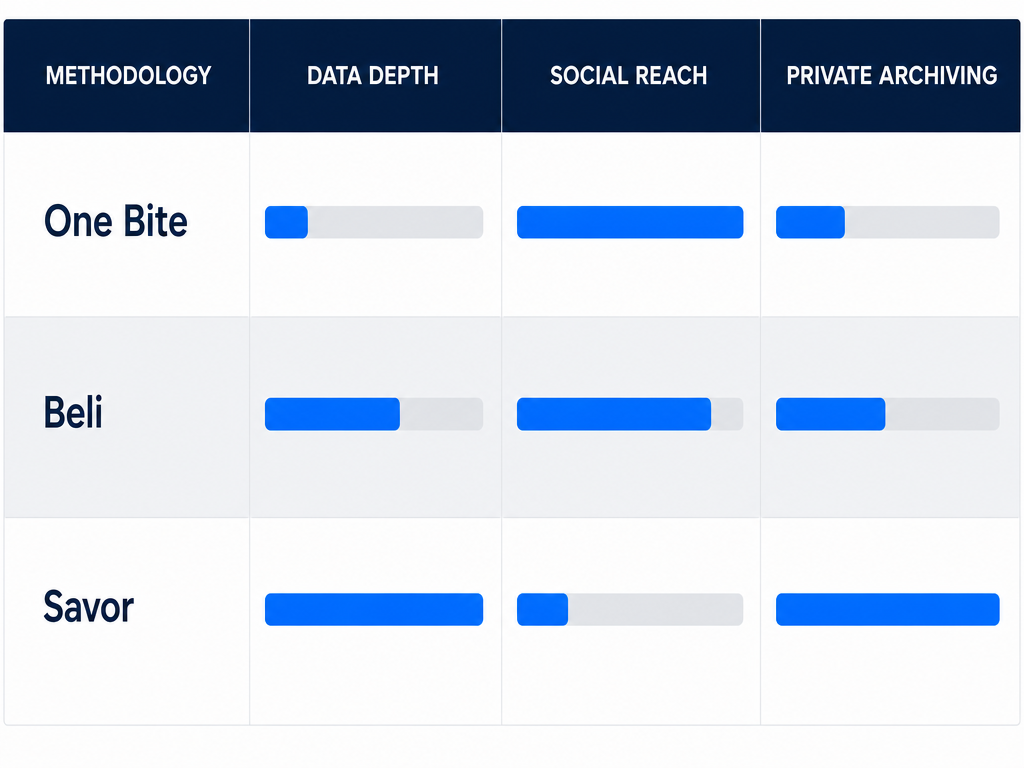 Select the right tool for your goals: use social platforms for discovery and community, or dedicated archiving apps for high-resolution private data and personal mapping.
The Power User Setup: Notion or Sheets
Some people build their own pizza database in Notion or Google Sheets. This gives you total control - you can create custom fields for "oven type" or "dough hydration" or "foldability score." You can build weighted formulas that adjust for regional style.
The cost: friction. Every entry requires manually typing in the restaurant name, location, date, and notes. After a few weeks, most people abandon it. The system works best if you're genuinely obsessive and find data entry meditative.
The 30-Second Workflow: Photo to Map
Here's the system that actually works long-term, whether you're using Savor, Beli, or a custom tool:
- Take the photo immediately (before you start eating, while the slice still looks good).
- Rate the slice within 60 seconds of finishing it, while the taste memory is fresh.
- Add one sentence of context about what made it memorable or disappointing.
- Tag the regional style (NYC, Neapolitan, Detroit, New Haven, etc.).
- Let the app archive it to your map automatically.
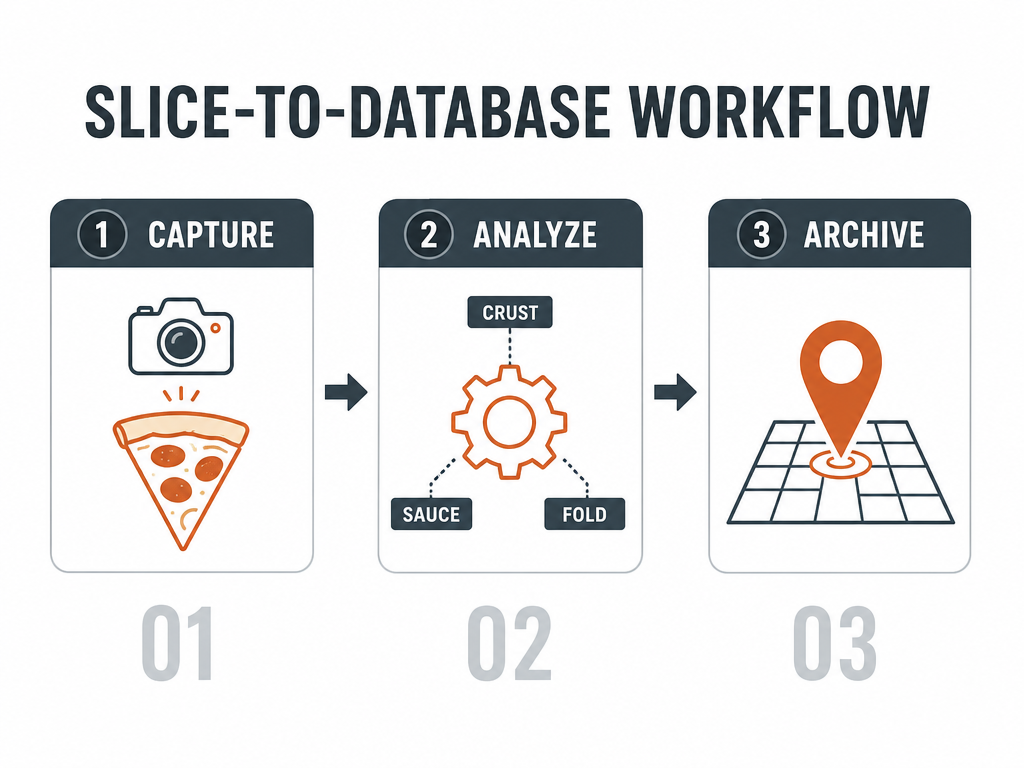 Streamline your culinary archiving by following a consistent workflow: capture the image immediately, analyze specific regional variables, and instantly archive the data to your city-by-city map.
The key is keeping the friction low. If it takes more than 30 seconds to log a slice, you'll skip entries. And every skipped entry is a lost memory.
For broader meal tracking strategies, read more about how to track every dish you've ever eaten.
Regional Pizza Appendix
Different cities demand different evaluation criteria. Here's what to prioritize in each major pizza region.
New York City: The Fold Test
A proper NYC slice should be large, thin, and foldable. The crust should have a slight char on the bottom but remain pliable. If you need two hands to hold it, something went wrong. Look for: structural integrity when folded, ratio of sauce to cheese (they should be balanced), and a thin crust that's crispy on the edges but slightly chewy in the center.
New Haven: The Char Is the Point
New Haven apizza (pronounced "ah-BEETZ") is cooked in coal-fired ovens at scorching temperatures. The defining characteristic is aggressive char - black spots all over the crust that taste smoky, not burnt. If your slice doesn't have leoparding, you're not at a real New Haven pizzeria. Look for: intense char marks, a chewy-crispy crust, and clam pizza (the regional specialty).
Detroit: The Frico and the Airiness
Detroit-style is a thick, square pizza baked in a steel pan. The cheese goes all the way to the edges, where it caramelizes into a crunchy, lacy crust. The interior should be airy - almost focaccia-like - not dense like Sicilian. Look for: caramelized cheese crust (frico), an open crumb structure, and sauce ladled on top (not under the cheese).
Neapolitan: Embrace the Wet Center
Authentic Neapolitan pizza from a wood-fired oven will have a wet, almost soupy center where the fresh mozzarella and tomato sauce meet. This is correct. The crust should be puffy and charred in spots, but the interior will be soft and delicate. If you're scoring against the Italian standard, don't penalize the wet center. Look for: puffy, leopard-spotted crust, fresh mozzarella (not low-moisture), and a soft, delicate interior.
St. Louis: The Cracker-Thin Anomaly
St. Louis-style pizza is unleavened, cracker-thin, and cut into squares (not triangles). It uses Provel cheese, a processed blend that's divisive - people either love the tangy, gooey texture or find it off-putting. This is the most polarizing regional style. Look for: cracker-thin crust, Provel cheese, and square cuts (called "party" or "tavern" cut).
Chicago Tavern-Style: Not Deep Dish
When people say "Chicago pizza," they usually mean deep dish. But locals eat thin-crust tavern-style more often - a crispy, crackery crust cut into squares. It's closer to St. Louis style than New York. Look for: thin, crispy crust, square cuts, and sausage as a topping (the regional standard).
Frequently Asked Questions
Is there an app to keep track of restaurants?
Yes, but most restaurant tracking apps operate at the venue level, not the dish level. If your goal is to remember which specific pizza was excellent (not just which pizzeria), you need a dish-first tool like Savor or a custom database. Apps like Beli and Google Maps Lists work for bookmarking locations, but they don't capture the nuance of "the margherita was a 9.2, but the pepperoni was a 6.8." For more on dish-level tracking, see best food review apps for tracking and discovering meals.
What is the slice pizza app?
"The slice pizza app" likely refers to either One Bite (Dave Portnoy's viral pizza review platform) or Slice (an online pizza ordering service). If you're looking to review slices, One Bite is the community standard. If you're looking to order pizza for delivery, Slice connects you with local pizzerias. Neither is designed for private, long-term archiving of your personal pizza history.
Has Dave Portnoy ever rated a 10?
Dave Portnoy from Barstool's One Bite reviews has an extremely high bar. While he occasionally awards scores in the high 9s, a perfect 10 is almost never given, maintaining the integrity of his rating system. This scarcity makes high scores more meaningful.
How do I make a party pizza?
A "party pizza" typically refers to tavern-style pizza cut into squares rather than triangular slices. It's designed for sharing at gatherings. The crust is usually thin and crispy, and the square cuts make it easy to grab pieces of varying sizes. St. Louis and Chicago tavern-style are the most common regional versions. If you're making one at home, use a rectangular baking sheet, roll the dough thin, and cut into 2-inch squares after baking.
What is the best app for restaurant reviews?
It depends on your goal. For social discovery and crowd-sourced opinions, Yelp and Google Maps dominate. For pizza-specific reviews with a viral community, One Bite is the standard. For private, dish-level tracking that won't get lost in your camera roll, Savor offers the highest data fidelity. Most serious food enthusiasts use a combination: public apps for discovery, private apps for memory. Learn more about modern food reviews.
Is Beli still invite only?
Beli was initially launched as an invite-only app to control growth and maintain community quality. As of 2026, availability varies by region. Check the App Store or Beli's official website for current access requirements. If you're looking for alternatives that don't require an invite, Savor and Google Maps Lists are immediately accessible.
What is the number one rated pizza?
There's no universal "number one" pizza because rating systems vary widely and personal taste is subjective. One Bite's highest-rated pizzerias fluctuate based on community voting. Michelin-starred restaurants rarely serve pizza. And the "best" slice in Naples won't satisfy someone expecting a New York fold test. The better question is: what's the number one pizza for your personal criteria in your tracking system?
What is the 2 hour rule for pizza?
The "2-hour rule" is a food safety guideline: perishable foods (including pizza with cheese and meat toppings) shouldn't sit at room temperature for more than 2 hours. After that, bacterial growth accelerates. If you're at a pizzeria taking photos and rating slices, this isn't relevant. If you're bringing pizza home for later, refrigerate it within 2 hours to maintain safety.
Is New Haven known for its pizza?
Yes, New Haven, Connecticut is one of the most significant pizza cities in America. It's the birthplace of "apizza" (pronounced "ah-BEETZ"), a coal-fired style with aggressive char and chewy-crispy crust. Frank Pepe Pizzeria Napoletana and Sally's Apizza are legendary institutions. The city's white clam pizza is considered a regional treasure. Any serious pizza tracker should visit New Haven at least once.
What is the main difference between New York pizza and Neapolitan pizza?
New York pizza evolved from Neapolitan pizza but adapted to American tastes and large-scale production. The key differences: New York crust is thinner, larger, and foldable; Neapolitan crust is puffy with a soft, delicate interior. New York uses low-moisture mozzarella; Neapolitan uses fresh mozzarella. New York is cooked in gas ovens around 500-600°F; Neapolitan is cooked in wood-fired ovens at 800-900°F for about 90 seconds. New York slices are meant to be eaten on the go; Neapolitan pies are meant to be eaten with a fork and knife immediately.
Your camera roll will never be a good pizza database. It's time to build a searchable, city-by-city archive that actually helps you remember which slices were worth the calories - and which cities deliver the best regional styles. Start with one app, rate consistently, and within six months you'll have a personal pizza map that's more useful than any crowd-sourced review site.