

The Savor Toolkit: How to Master Financial Rewards and Culinary Memories
John the smoothie monster
John lives for smoothie bowls and cold-pressed juices. He uses Savor to remember his best blends.
The Savor Toolkit: How to Apply Financial Rewards and Culinary Memory to Your Dining Life Your camera roll holds 2,400 food photos. You spend $10,000 a year at...
The Savor Toolkit: How to Apply Financial Rewards and Culinary Memory to Your Dining Life
Your camera roll holds 2,400 food photos. You spend $10,000 a year at restaurants. You can't remember which specific ramen shop changed your life in Tokyo, and you're leaving $300 in cash back on the table every year because you don't have the right credit card.
That's not a dining habit. That's financial waste and memory loss compounding into a system that's failing you. By the time most serious foodies realize they need structure around their dining life, they've lost years of culinary moments and thousands in unclaimed rewards. The photos are there. The receipts exist. But the searchable, meaningful system to track, optimize, and relive it all? Nowhere.
What follows is the complete Savor Toolkit - the dual-axis strategy that turns disorganized restaurant spending into a documented, rewarded, and infinitely searchable culinary archive.
Key Takeaways
- The Capital One Savor credit card delivers unlimited 3% cash back on all dining and entertainment purchases, effectively paying you $300 annually for every $10,000 spent.
- Serious foodies spending $1,000+ monthly on dining who don't use a dining-specific rewards card leave substantial value unclaimed year after year.
- The Savor food app solves the "camera roll graveyard" problem by turning unsearchable photos into an AI-tagged, searchable culinary library organized by ingredient, cuisine, and location.
- AI-powered dish tagging in the Savor app allows users to instantly retrieve specific meals from years of dining history, replacing generic Yelp reviews with a private, personal food database.
- Combining the Savor credit card's financial optimization with the Savor app's memory architecture creates a complete system for managing the serious foodie lifestyle.
 The modern foodie's dual-threat strategy: use the Savor credit card to maximize financial returns while leveraging the Savor app to organize your palate.
Table of Contents
- The Serious Foodie's Dilemma: You Eat Well, but You Remember Nothing
- Phase 1: Financial Application (The Capital One Savor Card)
- How to Apply for the Capital One Savor Card with a 700+ Credit Score
- What Counts as "Dining and Entertainment" for Savor Rewards?
- Phase 2: Workflow Application (The Savor Food App)
- The Searchable Palate: How AI Tagging Replaces the Camera Roll
- The Savor Ecosystem: Financial Rewards vs. Culinary Curation
- Comparative Analysis: Savor Card vs. Competitors and Savor App vs. Alternatives
- Frequently Asked Questions
The Serious Foodie's Dilemma: You Eat Well, but You Remember Nothing
Most serious foodies dine out 4 times a week, spending between $800 and $1,500 monthly on meals that matter. They photograph everything. They develop strong opinions. They build mental maps of their favorite cities based on where they've eaten.
But ask them to find that specific tonkotsu ramen they loved in Shibuya six months ago, and they're scrolling through 4,000 unsorted photos with no metadata, no tags, and no memory of the restaurant's name. The photo exists. The memory is gone. That's the paradox of the modern foodie lifestyle: abundant documentation, zero retrieval.
The average American now spends approximately $1,850 per year on food delivery alone, according to 2025 industry data compiled by SavorTheApp. Add sit-down dining, groceries for serious home cooking, and the occasional splurge meal, and the dedicated foodie easily crosses $10,000 in annual food-related spending.
That spending represents two opportunities most people miss entirely:
Opportunity 1: Financial optimization through dining-specific rewards cards that return 3-8% cash back on every transaction.
Opportunity 2: Memory architecture through AI-powered food apps that transform unsearchable photos into a queryable personal database.
Most people address neither. They use a generic 1.5% cash-back card and let their camera roll become a graveyard of forgotten meals. That's leaving hundreds in rewards unclaimed and thousands of culinary moments lost to the void.
The Savor Toolkit solves both problems. It's a two-phase system: apply the financial tool (the Capital One Savor credit card) to maximize rewards on unavoidable spending, then apply the organizational tool (the Savor food app) to build a searchable archive of every meal that matters.
This isn't about adding complexity. It's about applying structure to spending and memory habits you already have.
Phase 1: Financial Application (The Capital One Savor Card)
If you spend $10,000 annually on dining and entertainment, using a generic 1.5% cash-back card earns you $150. Switching to the Capital One Savor card, which offers unlimited 3% cash back on those same purchases, earns you $300. That's a $150 annual swing for doing absolutely nothing differently except choosing the right card at checkout.
The Capital One Savor card is built around a simple value proposition: it returns an unlimited 3% cash back on dining, entertainment, and streaming services, with no spending caps or category rotations. According to NerdWallet's 2026 card review, it's one of the few flat-rate dining cards on the market that doesn't throttle rewards after a spending threshold.
Current welcome offer: $250 bonus cash back after you spend $500 in the first three months. For someone already dining out regularly, hitting that threshold happens in about six weeks.
Here's the arithmetic for the serious foodie:
- Monthly dining spend: $833 ($10,000 annual)
- Annual cash back at 3%: $300
- First-year bonus: $250
- Total first-year value: $550
That's real money. Not points with blackout dates. Not miles that expire. Cash back you can apply to your statement, deposit, or spend however you want.
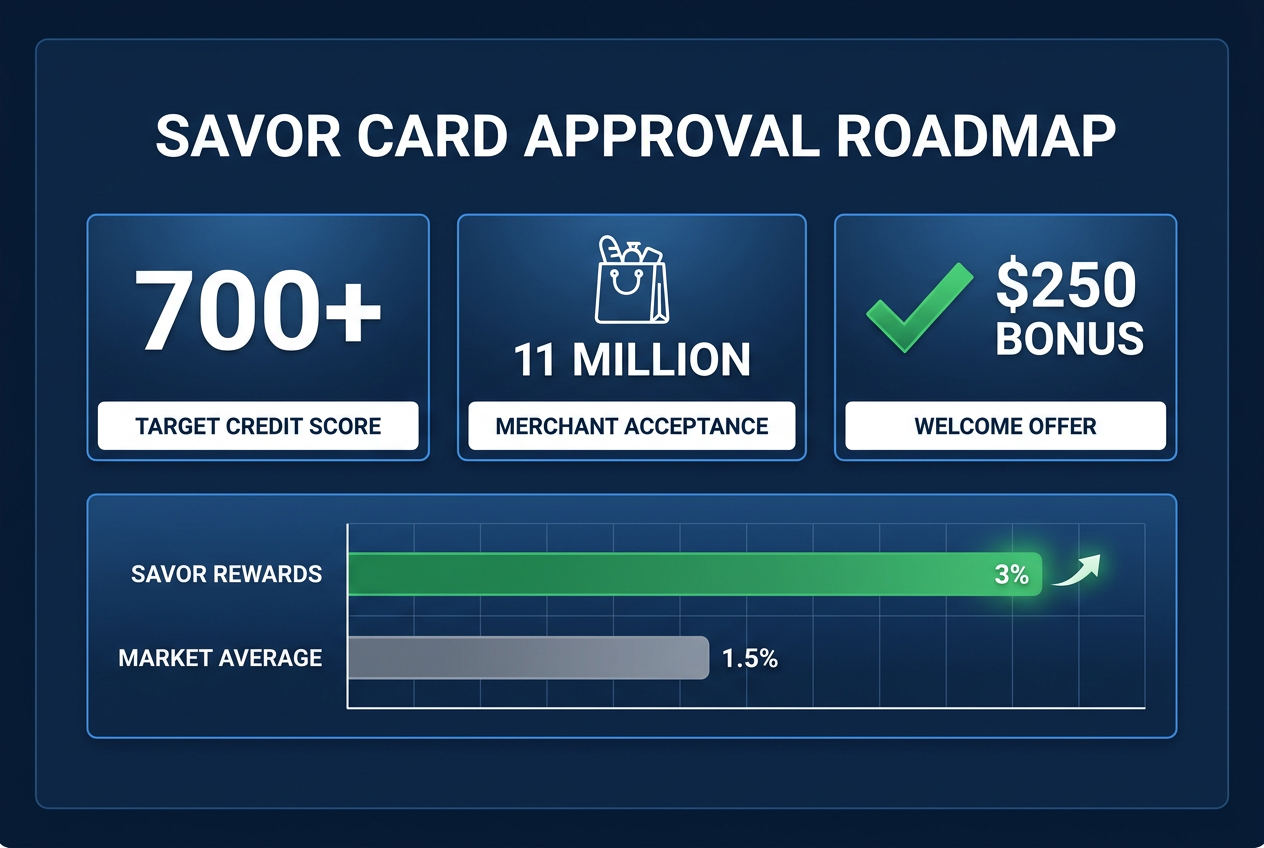 Before you apply, ensure your financial profile meets the 700+ credit score benchmark to unlock the unlimited 3% dining and entertainment rewards tier.
The card does carry a $95 annual fee, which means your net benefit in year one (after the bonus) is $455, and $205 annually thereafter. For anyone spending less than $6,333 per year on dining, the no-annual-fee SavorOne card (which offers 3% cash back but no signup bonus) becomes the better choice. But for the serious foodie hitting $800+ in monthly restaurant spend, the math tilts decisively toward the full Savor card.
One additional perk worth noting: Capital One Savor cardholders can earn 8% cash back on Capital One Entertainment purchases, which includes concert tickets, sporting events, and theater bookings made through the Capital One portal. That's a meaningful accelerator if you treat dining and live entertainment as a unified lifestyle category.
How to Apply for the Capital One Savor Card with a 700+ Credit Score
Capital One Savor requires a credit score of 700 or higher for the best approval odds, per WalletHub's 2026 approval data. That places it in the "good to excellent credit" category, meaning applicants with limited credit history or recent late payments will likely be declined or offered a lower-tier product instead.
Step 1: Check Your Credit Profile Before Applying
Pull your credit report from AnnualCreditReport.com (the only genuinely free source) and verify your FICO score through your existing bank or credit card issuer's free score tool. Look for:
- Current FICO score above 700
- No delinquencies in the past 12 months
- Credit utilization below 30% across all cards
- At least one year of credit history (two years preferred)
If your score sits between 680 and 699, you're in the approval gray zone. Capital One may approve you, but often at a lower credit limit or with a request for additional income verification. If your score is below 680, consider waiting and rebuilding before applying to avoid a hard inquiry that won't result in approval.
Step 2: Gather Required Information
Capital One's application process asks for:
- Full legal name and date of birth
- Social Security Number
- Current residential address (must match credit report exactly)
- Annual gross income (include salary, freelance income, bonuses, investment income - anything reportable)
- Monthly housing payment (rent or mortgage)
Income matters more than most applicants realize. Capital One wants to see that your income supports the credit limit you'll need. For a card you'll use for $800+ monthly spend, indicating annual income of $50,000 or higher strengthens your application.
Step 3: Apply Online via Capital One's Website
Navigate to CapitalOne.com/credit-cards/savor and click "Apply Now." The application takes approximately five minutes. Capital One will run a hard credit inquiry, which temporarily drops your score by 3-5 points but recovers within three to six months.
Most applicants receive instant approval or denial. Some applications enter "pending review," which means Capital One needs to verify information manually. This typically resolves within 7-10 business days via mail or phone call.
Step 4: Activate and Set Up Rewards Tracking
Upon approval, your physical card arrives within 7-10 business days. Activate it via the Capital One mobile app or website, then immediately set it as your default card for all dining and entertainment purchases. Enable purchase notifications so you can track your progress toward the $500 signup bonus threshold in real time.
One pro move: link the card to your preferred payment apps (Apple Pay, Google Pay) so you can use it at contactless terminals without carrying the physical card.
Capital One reports that the Savor card is accepted at roughly 11 million merchants nationwide, according to their FAQ documentation, which includes virtually every restaurant, bar, streaming service, and entertainment venue in the U.S.
What Counts as "Dining and Entertainment" for Savor Rewards?
The 3% cash-back category sounds simple until you try to expense a specific purchase and wonder whether it qualifies. Capital One defines "dining" and "entertainment" based on merchant category codes (MCCs), the behind-the-scenes classification system that credit card processors use to categorize transactions.
Dining (Earns 3%)
- Restaurants (full-service, fast-casual, fast-food)
- Bars, breweries, wineries, distilleries
- Coffee shops and cafes
- Food trucks
- Bakeries and dessert shops
- Catering services
Entertainment (Earns 3%)
- Movie theaters
- Concert venues and music festivals
- Sporting events (stadiums, arenas)
- Amusement parks and theme parks
- Bowling alleys, arcades, mini-golf courses
- Theater and performing arts venues
Streaming Services (Earns 3%)
- Netflix, Hulu, Disney+, HBO Max, Amazon Prime Video
- Spotify, Apple Music, YouTube Premium
- Audible, Scribd, audiobook services
What Doesn't Count (Earns 1%)
- Grocery stores (including prepared food sections)
- Convenience stores (even if they sell hot food)
- Delivery fees on third-party apps (DoorDash, Uber Eats service fees are often coded separately from the restaurant purchase)
- Hotel restaurants (sometimes coded as "lodging" instead of "dining")
- Airline food and beverage purchases
The grocery store exclusion trips up many cardholders. Whole Foods, Trader Joe's, and Safeway all code as grocery, not dining, even if you're buying prepared meals from the hot bar. If maximizing rewards on groceries matters, pair the Savor card with a grocery-specific card like Amex Blue Cash Preferred (6% on groceries) to cover both categories.
Delivery app purchases require attention. When you order through DoorDash or Uber Eats, the restaurant charge usually codes as dining (earning 3%), but the delivery fee and service charges often code as "delivery services" (earning 1%). Check your Capital One statement after a few orders to see how your preferred apps code transactions.
For borderline cases, Capital One's merchant coding is final. If a venue you expect to earn 3% only returns 1%, it's because the merchant registered under a different category. You can't dispute it or request recategorization.
One workaround for serious foodies: many high-end restaurants now offer wine club memberships or recurring tasting-menu subscriptions that code as "dining" rather than "membership fees." If you're spending $200+ monthly at a favorite spot anyway, structuring it as a subscription can ensure consistent 3% returns.
Phase 2: Workflow Application (The Savor Food App)
You've optimized the financial side. Now the memory problem: you have 2,400 food photos in your camera roll, and finding that specific oxtail ragu from three months ago requires scrolling for 10 minutes while squinting at thumbnails. That's not a food diary. That's a data graveyard.
The Savor food app exists to solve the retrieval problem. It's a private, AI-powered culinary database that turns unsearchable photos into a tagged, indexed, instantly queryable archive of every dish you've eaten. Think of it as the organizational layer your camera roll is missing.
Here's the workflow in three steps:
Step 1: Snap the Photo (You're Already Doing This)
You're at a restaurant. You order something exceptional. You take a photo before the first bite. That habit doesn't change. The Savor app simply becomes the destination for that photo instead of your default camera roll.
Step 2: AI Tags the Dish (This Happens Automatically)
Upload the photo to Savor, and the app's AI instantly analyzes the image and generates tags based on:
- Cuisine type (Italian, Japanese, Mexican, French, etc.)
- Primary ingredients (short rib, burrata, uni, truffle, etc.)
- Dish category (pasta, ramen, steak, dessert, etc.)
- Cooking method (grilled, fried, braised, raw, etc.)
- Location (if you enable GPS tagging)
You're not manually typing these tags. The AI reads the visual and generates them. You can edit or add custom tags afterward, but the base structure is automatic.
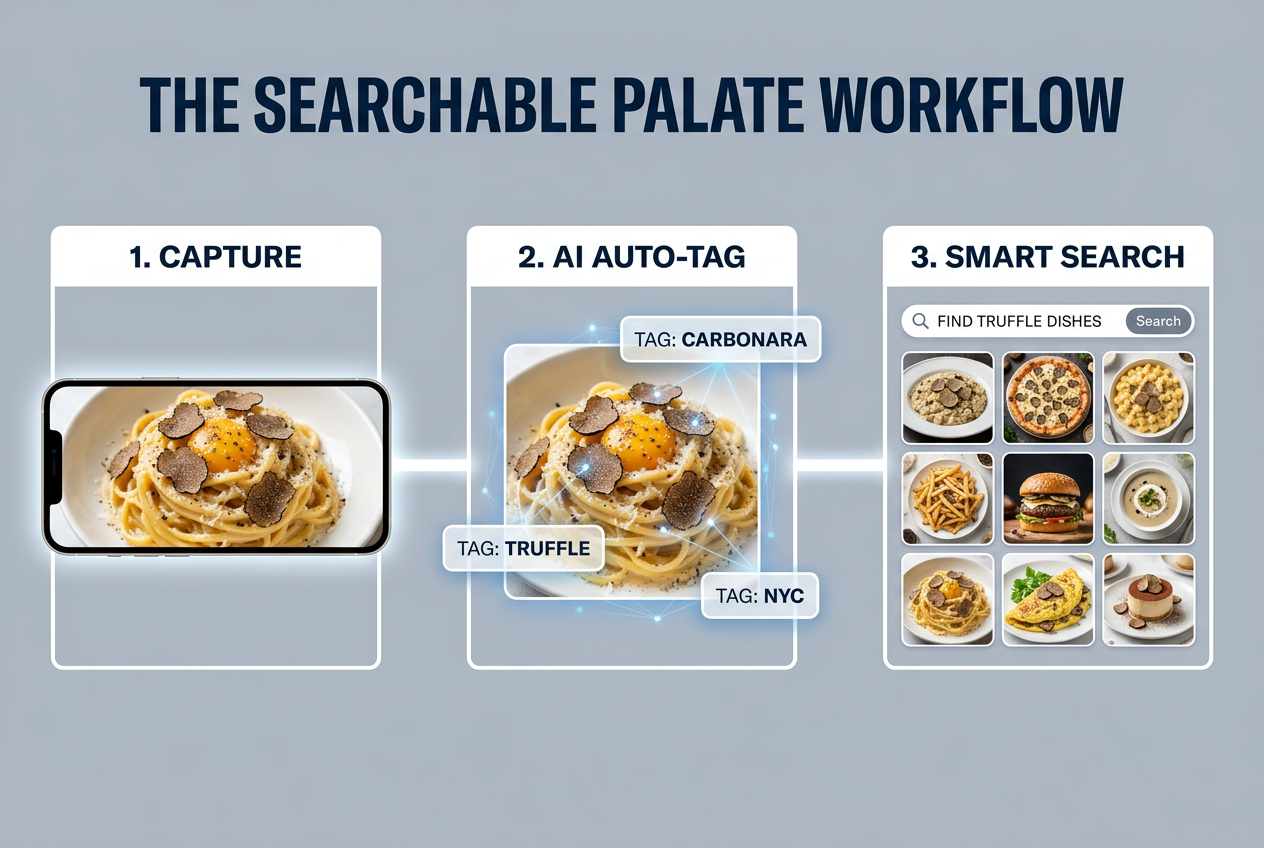 Transition from a cluttered camera roll to a searchable palate. The Savor app's AI automatically tags ingredients and locations for instant future retrieval.
Step 3: Log, Rate, and Archive (Optional but Powerful)
Add a quick note if you want: "Best cacio e pepe outside Rome" or "Ask for extra broth next time." Rate the dish on a 10-point scale to build your personal hierarchy of taste. Tag it with the restaurant name, dining companion, or occasion.
The beauty of this system is that it scales with effort. If you're in a rush, the photo and AI tags alone make the dish searchable. If you have two minutes, add context that makes the entry infinitely more useful six months from now.
Now, when you think, "Where was that incredible short rib I had last spring?" you open Savor, type "short rib," and the app surfaces every instance of short rib you've ever logged, sorted by date, rating, or location. That's the power of applied structure.
The Savor app doesn't require the Savor credit card, and the credit card doesn't require the app. But together, they create a closed-loop system: the card rewards you financially for every dining transaction, and the app ensures you remember and can retrieve every meaningful dish from that spending.
For serious foodies tracking 150+ restaurants per year, that combination - financial optimization and memory architecture - turns scattered dining habits into a documented, rewarded, infinitely searchable culinary life.
Curious about other ways to organize your dining life? Check out how to build a personal restaurant library or explore the best apps to track your favorite dishes.
The Searchable Palate: How AI Tagging Replaces the Camera Roll
The difference between a camera roll and a searchable food database is metadata. Your iPhone's Photos app can recognize faces, objects, and scenery, but it can't tell the difference between tonkotsu ramen and shoyu ramen, and it certainly can't filter by "dishes with uni" or "meals from June 2025 in Tokyo."
AI-powered dish tagging solves this by reading the visual composition of the food and assigning semantic labels that turn images into data points.
How the AI Actually Works
Modern food-recognition AI (like the system Savor uses) is trained on millions of labeled food images. When you upload a photo of, say, a bowl of ramen, the algorithm compares the visual patterns - the color gradient of the broth, the shape of the noodles, the presence of soft-boiled eggs and chashu pork - against its training set and assigns the most statistically likely tags.
For a bowl of ramen, the AI might generate:
- Cuisine: Japanese
- Dish type: Ramen
- Ingredients: Pork, egg, nori, scallions
- Likely preparation: Tonkotsu (based on broth opacity)
You're not typing any of that. The system infers it from the image and populates the tags automatically. If the AI misidentifies something (maybe it calls your shoyu ramen "tonkotsu" based on lighting), you can manually correct the tag in about three seconds. Over time, the system learns from your corrections and gets more accurate for your personal taste patterns.
Why This Matters for Retrieval
Tags are the difference between browsing and searching. Without tags, finding a specific dish requires scrolling chronologically through hundreds of photos, hoping you remember roughly when you ate it. With tags, you query the database:
- "Show me all ramen I've rated 8 or higher"
- "Find every dish with burrata from the past year"
- "What did I eat in Rome in October?"
The app surfaces the answer instantly because every photo is a structured data point, not just a JPG file in a folder.
The Private Food Library Advantage
Unlike Yelp, Google Reviews, or Instagram, the Savor app is private by default. You're not writing for an audience. You're building a reference tool for yourself. That means:
- No pressure to write polished captions
- No algorithmic feed showing your posts to strangers
- No public rating that affects a restaurant's reputation
- No ads, no influencer noise, no engagement metrics
It's a food diary optimized for memory and retrieval, not social validation. If you want to share a specific list (your top 10 pasta dishes, for example), Savor allows private list sharing with friends, but the default state is closed. Your food history is yours.
This architecture appeals to serious foodies who are tired of Instagram's performative food culture and Yelp's public-facing review system. Sometimes you just want to remember what you ate without broadcasting it to 500 followers.
If you're interested in alternatives to public platforms, the best apps to share lists for serious foodies breaks down how private curation tools compare to traditional social food apps.
The Savor Ecosystem: Financial Rewards vs. Culinary Curation
Let's address the naming collision head-on. "Savor" refers to two distinct products: the Capital One Savor credit card (a financial tool) and the Savor food app (an organizational tool). They don't share ownership, infrastructure, or integration. They just happen to target the same audience: people who spend serious money and attention on food.
That creates confusion, but also an opportunity. Used together, they form a complete system for managing the serious foodie lifestyle.
The Financial Tool: Capital One Savor Card
- Purpose: Maximize cash-back returns on unavoidable dining and entertainment spending
- Primary benefit: 3% unlimited cash back on every restaurant, bar, and streaming purchase
- Who it's for: Anyone spending $6,300+ annually on dining and entertainment who values simplicity over category optimization
- Key limitation: No integration with food-tracking apps; purely a transaction-rewards vehicle
The Organizational Tool: Savor Food App
- Purpose: Transform unsearchable food photos into a private, AI-tagged culinary database
- Primary benefit: Instant retrieval of any dish you've ever logged, filtered by ingredient, cuisine, location, or rating
- Who it's for: Serious foodies tired of losing memorable meals in their camera roll
- Key limitation: No financial rewards, no payment integration
Why Use Both?
Because they solve complementary problems. The card ensures you're earning maximum rewards on money you're already spending. The app ensures you're documenting and retrieving the experiences that money buys.
Most serious foodies optimize one or the other, rarely both. They'll use a dining rewards card but lose track of what they ate, or they'll meticulously photograph every dish but leave hundreds in unclaimed rewards on the table every year. Applying both creates the closed loop:
- Pay for the meal with the Savor card (earn 3% cash back)
- Photograph and log the dish in the Savor app (make it retrievable forever)
- Repeat 150-200 times per year
By year's end, you've earned $300+ in cash back and built a searchable archive of your entire culinary year. That's the Savor Toolkit in practice.
One Word of Caution
The similarity in branding creates the false expectation that the two products should integrate or share data. They don't. There's no automatic sync between Capital One transactions and the Savor app's food logs. You won't see your credit card purchases auto-populate in the app's database. They're separate tools that happen to serve the same lifestyle.
If automatic transaction-to-food-log integration matters to you, you'll need to manually bridge the gap or use a third-party expense tracker that can export data to a food diary format.
Comparative Analysis: Savor Card vs. Competitors and Savor App vs. Alternatives
No tool exists in a vacuum. Both the Savor credit card and the Savor food app compete in crowded markets where similar products promise overlapping benefits. Here's how they stack up.
Credit Card Comparison: Savor vs. Amex Gold
| Feature | Capital One Savor | Amex Gold |
|---|---|---|
| Annual Fee | $95 | $250 |
| Dining Rewards | 3% cash back (unlimited) | 4x Membership Rewards points at restaurants (uncapped) |
| Grocery Rewards | 1% cash back | 4x points at U.S. supermarkets (up to $25,000/year) |
| Welcome Bonus | $250 after $500 spend | 60,000 points after $6,000 spend (3 months) |
| Streaming Rewards | 3% cash back | 1x points |
| Acceptance | Visa (accepted everywhere) | Amex (declined at ~15% of U.S. merchants) |
| Best For | Simplicity, flat-rate rewards, wide acceptance | High-volume dining and grocery spend, points-transfer optimization |
Verdict: If you spend $12,000+ annually on dining and groceries combined, and you're comfortable with Amex's acceptance gaps, the Amex Gold's 4x earning rate delivers higher total value. But it requires redeeming points strategically through airline transfers to extract full value. If you prefer cash back and want a card that works everywhere, Savor wins on simplicity and liquidity.
For the serious foodie in the 25-45 urban professional category, Savor is the lower-friction choice. Amex Gold is the power-user's card for those willing to manage points portfolios.
Food App Comparison: Savor vs. Instagram vs. Notes App
| Feature | Savor App | Notes App | |
|---|---|---|---|
| Primary Function | Private food diary with AI tagging | Public photo sharing | General text/image note-taking |
| Search by Ingredient | Yes (AI-generated tags) | No (only hashtags you manually add) | No |
| Search by Location | Yes (GPS-tagged) | Only via geotags (inconsistent) | No |
| Rating System | Built-in 10-point scale | None (only likes/comments) | None |
| Privacy | Private by default, optional sharing | Public by default | Private, not shareable |
| Instant Lists | Yes (curated, shareable lists) | Stories only (temporary) | Manual lists only |
| Export Data | Yes (CSV export for backup) | No | No |
| Best For | Serious foodies building a searchable culinary archive | Social food content and discovery | Quick, unstructured notes |
Verdict: Instagram is a broadcast tool, not a memory tool. The Notes app is a catch-all, not a purpose-built database. Savor sits in the gap: it's structured enough to be searchable, private enough to be honest, and focused enough to solve one problem exceptionally well - remembering what you ate.
If you want to impress strangers, use Instagram. If you want to remember your own dining history, use Savor.
Looking for more app comparisons? The best apps to remember every dish and meal you've ever eaten evaluates nine food-tracking tools across retrieval, tagging, and export features.
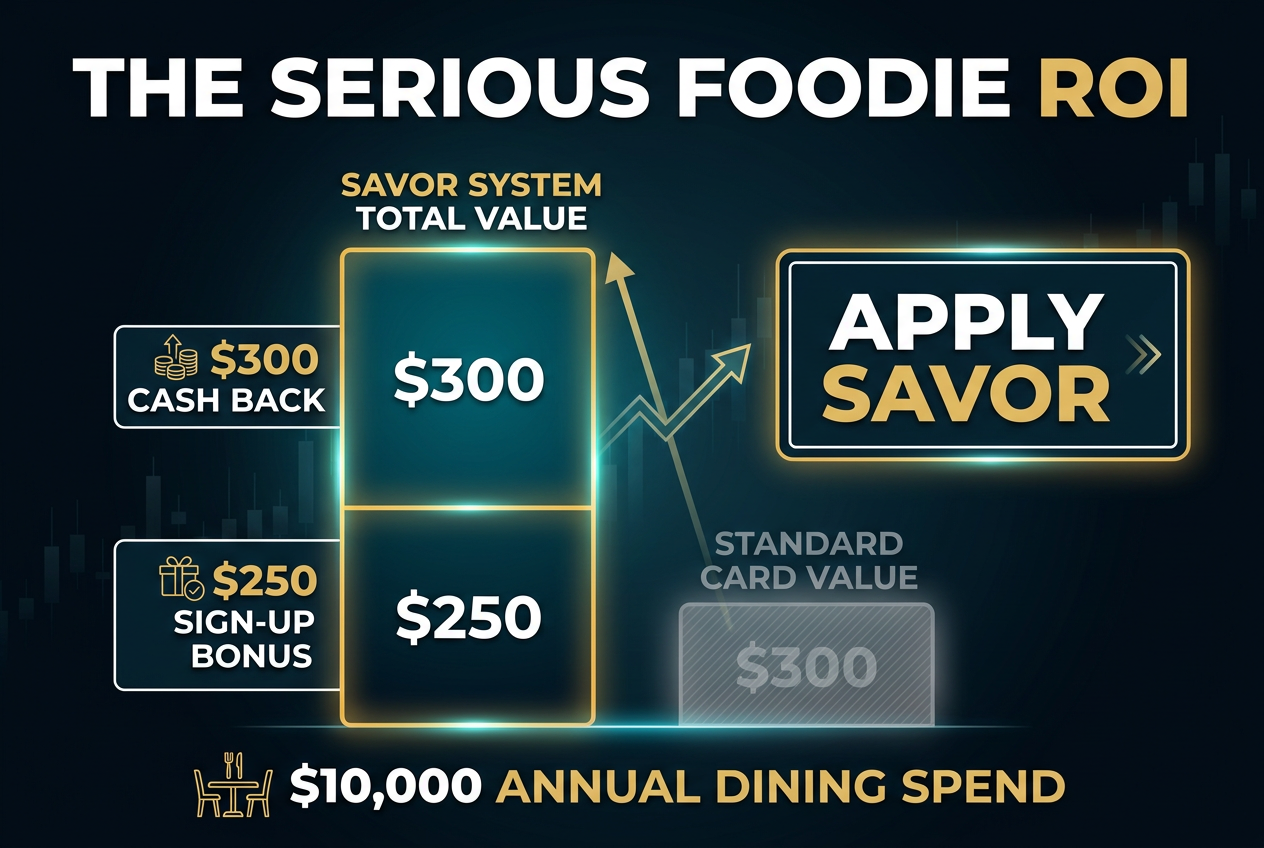 Maximize your culinary investment. For the serious foodie spending $10k annually, the Savor system provides over $500 in tangible value in the first year.
Frequently Asked Questions
Is the Capital One Savor card hard to get?
The Capital One Savor card is moderately difficult to obtain, requiring a credit score of 700 or higher for the best approval odds. WalletHub's 2026 approval data shows that applicants with scores between 680-699 enter a gray zone where approval is possible but not guaranteed, often with lower initial credit limits. If your score is below 680, Capital One will likely decline the application or offer a lower-tier product like SavorOne instead. The card isn't as exclusive as premium travel cards (which often require 750+ scores), but it's not available to fair-credit applicants either. Income also matters - Capital One wants to see that your income supports the spending you'll put on the card, so indicating $50,000+ annual income strengthens your application significantly.
How to get approved for the Savor card?
To maximize approval odds for the Capital One Savor card, ensure your credit score is 700 or higher, your credit utilization is below 30% across all cards, and you have no delinquencies in the past 12 months. Apply directly through Capital One's website, providing accurate income information (include all reportable income sources like salary, bonuses, and freelance work). Most applicants receive instant decisions, though some enter "pending review" status, which resolves within 7-10 business days. If denied, Capital One will send a letter explaining the reason - common issues include insufficient credit history, high existing debt levels, or too many recent credit inquiries. Wait at least six months before reapplying to avoid multiple hard inquiries that can further damage your score.
What credit score is needed for the Savor card?
A credit score of 700 or higher is needed for the Capital One Savor card to achieve strong approval odds, according to WalletHub's analysis of real-user approval patterns. Applicants with scores in the 680-699 range may still be approved, but often with conditions such as lower initial credit limits or requests for additional income verification. Scores below 680 generally result in denial or an offer for a different Capital One product with less favorable terms. Capital One uses FICO scoring models and considers additional factors like income-to-debt ratio, credit utilization, and length of credit history, but the 700+ threshold is the most consistent predictor of approval for the full Savor card (not the no-fee SavorOne version).
What are the drawbacks of the SavorOne card?
The SavorOne card eliminates the annual fee but sacrifices the $250 welcome bonus and caps rewards at 3% cash back on dining and entertainment (same as Savor). For anyone spending less than $6,333 annually on dining, SavorOne is the better choice because the annual fee on the full Savor card ($95) outweighs the value of the signup bonus and ongoing rewards. However, SavorOne doesn't offer any special perks or accelerated rewards categories beyond the basic 3% on dining and entertainment, making it a straightforward, low-maintenance card that works best for moderate spenders who want simplicity without annual fees. If you're a serious foodie spending $10,000+ on dining annually, the full Savor card's first-year bonus and higher long-term value make it the objectively better choice.
Is Capital One Savor good for food?
Yes, the Capital One Savor card is exceptionally good for food because it offers unlimited 3% cash back on all dining purchases, including restaurants, bars, coffee shops, food trucks, and catering services. For serious foodies spending $800+ monthly on dining, that translates to $300 in annual cash back with no spending caps or rotating categories to manage. The card's flat-rate structure means you don't need to track quarterly bonus categories or activate rewards - every dining transaction earns 3% automatically. The only limitation is that grocery stores don't count as "dining" under Capital One's merchant category codes, so prepared food from Whole Foods or Trader Joe's earns only 1% cash back. If you dine out frequently and want to maximize rewards without complexity, Savor is one of the best food-focused credit cards available in 2026.
What is the difference between the Savor credit card and the Savor food app?
The Capital One Savor credit card is a financial rewards tool that earns 3% cash back on dining, entertainment, and streaming purchases, while the Savor food app is a private AI-powered food diary that helps users track, tag, and retrieve every dish they've eaten. The two products share a name but are entirely separate - there is no ownership connection, no data integration, and no automatic syncing between card transactions and app food logs. The card solves the financial optimization problem (earning rewards on unavoidable dining spend), while the app solves the memory problem (transforming unsearchable food photos into a queryable culinary database). Used together, they create a complete system for the serious foodie: the card rewards you financially for every meal, and the app ensures you remember and can retrieve every meaningful dish from that spending.
Can I share private meal lists from the Savor app with friends?
Yes, the Savor app allows users to create curated lists (like "Top 10 Ramen Spots in Tokyo" or "Best Burrata Dishes") and share them privately with selected contacts via direct link. The app is private by default, meaning your full food diary isn't visible to anyone, but you control which specific lists you choose to share. This makes it ideal for foodies who want to document their dining history for personal use while still being able to send targeted recommendations to friends without broadcasting everything on social media. Shared lists display only the dishes you've chosen to include, not your entire food archive, so you maintain full control over what becomes public versus private.
How do I maximize cash back on a $1,000+ monthly dining budget?
To maximize cash back on a $1,000+ monthly dining budget, use the Capital One Savor card for all restaurant, bar, and entertainment purchases to earn unlimited 3% cash back ($360 annually on $12,000 annual spend). Pair it with a grocery-specific card like Amex Blue Cash Preferred (6% on groceries) to cover the food-spending categories Savor doesn't reward at the higher rate. Avoid splitting purchases across multiple low-reward cards - consolidate all dining transactions onto Savor to hit the $500 signup bonus threshold quickly and ensure every meal contributes to your annual rewards total. For even greater optimization, use the Savor app to log and rate every meal you pay for, creating a searchable record of which restaurants and dishes deliver the best value per dollar spent, so future dining decisions are informed by your own documented preferences.
The serious foodie's life is expensive, memorable, and often disorganized. The Savor Toolkit - combining the financial discipline of a dining-rewards credit card with the memory architecture of an AI-powered food app - brings structure to both problems. You're already eating out. You're already taking photos. Apply the right tools, and those habits transform into a system that rewards you financially and preserves every meal you'll ever want to remember.
Continue Reading
Start Tracking Your Dishes Today
Transform your food photos into a searchable, ratable culinary memory bank.
Download Savor App