
How to Score Dishes Consistently When Dining Out: The Serious Foodie’s Framework
John the smoothie monster
John lives for smoothie bowls and cold-pressed juices. He uses Savor to remember his best blends.
How to Score Dishes Consistently When Dining Out: The Serious Foodie's Framework You just had an extraordinary bowl of ramen. The broth was rich, the noodles...
How to Score Dishes Consistently When Dining Out: The Serious Foodie's Framework
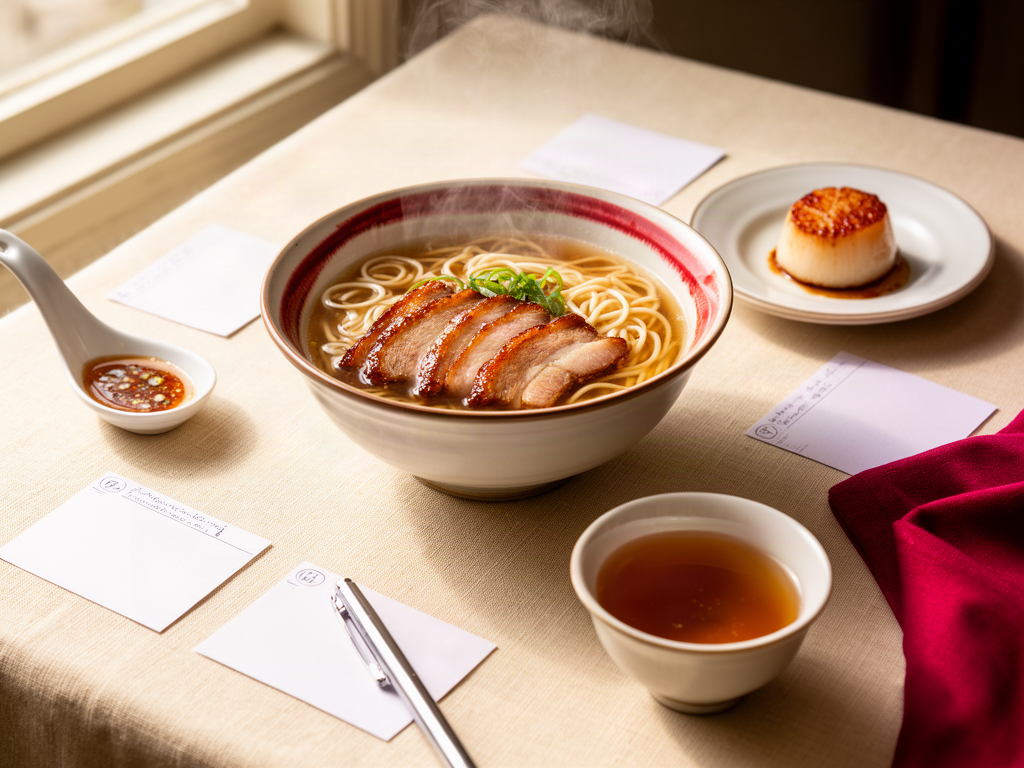
You just had an extraordinary bowl of ramen. The broth was rich, the noodles had perfect chew, the pork belly melted on your tongue. You snap a photo, make a mental note to come back, and move on with your life.
Three months later, you're trying to remember: Was that the place with the great ramen, or was it the other spot? Was it really that good, or are you just romanticizing it? Your camera roll holds 2,400 food photos, but they're all equally silent.
This is the serious foodie's paradox. We eat extraordinary food, we photograph it religiously, but we have no systematic way to evaluate, compare, or remember it. Generic five-star systems don't help - they're too reductive, and they rate restaurants, not individual dishes. Your camera roll isn't searchable. And your memory? It's unreliable at best.
The solution isn't more stars. It's a consistent framework that allows you to score dishes with the same rigor a wine critic brings to a vintage - a system that works whether you're evaluating a $15 street taco or a $150 truffle risotto.
This guide will show you how to build that system.
Table of Contents
- Why the Five-Star System Fails for Dishes
- The Core Principle: Technique-to-Intent Scoring
- The Five Objective Anchors for Dish Evaluation
- The 80/20 Weighted Scoring System
- Choosing Your Scale: 10-Point vs. 100-Point
- Building Your Personal Rubric
- Managing Subjectivity Bias
- Digital Tools That Actually Work
- The 30-Second Post-Meal Workflow
- Frequently Asked Questions
Why the Five-Star System Fails for Dishes
The traditional five-star rating system wasn't designed for what serious foodies actually need. It was built for quick, reductive judgments about entire venues - not for granular dish-level evaluation.
Here's the mathematical problem: roughly 95% of restaurants cluster between 3 and 4.5 stars, rendering the scale nearly useless for fine-grain comparison. When everything's "pretty good," nothing stands out.
Even worse, the economic stakes are high. Research from Berkeley economists shows that restaurants sell out up to 34% more frequently when they see a half-star increase on Yelp. This creates incentive for gaming the system, but it also reveals a deeper truth: half-star differences matter enormously, yet most rating systems don't give you the precision to capture them.
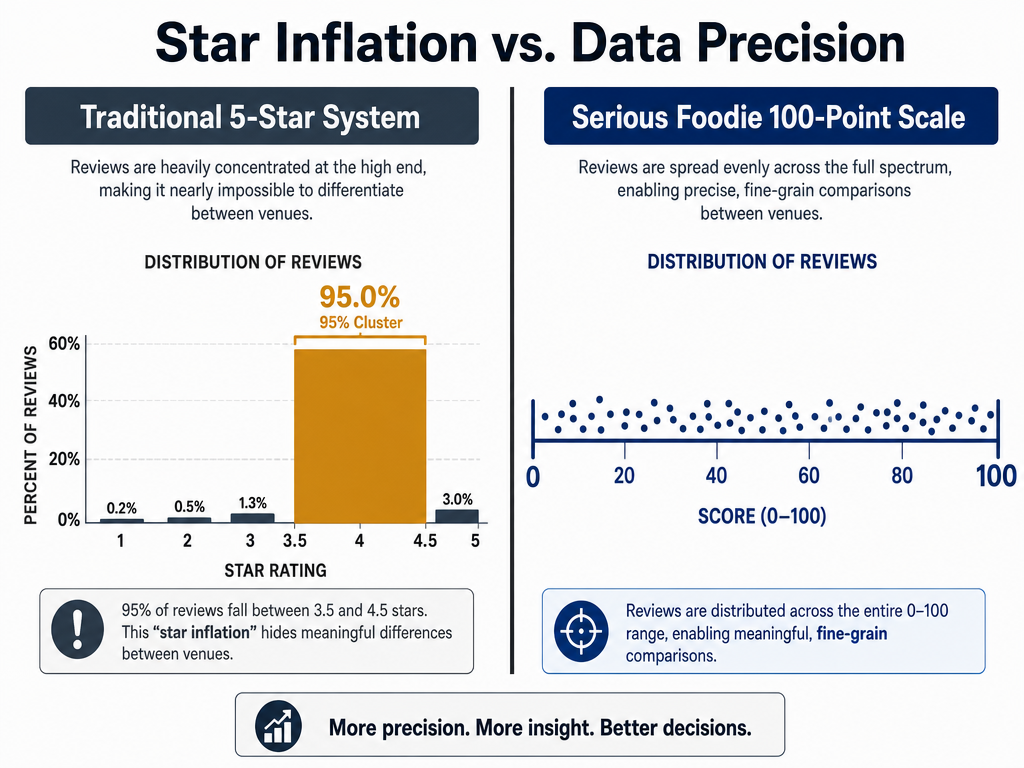 Traditional 5-star systems suffer from 'star inflation,' where 95% of restaurants cluster in a narrow range. A 100-point scale restores mathematical variance for serious evaluation.
The five-star system also conflates venue with dish. A restaurant might deserve four stars for ambiance and service, but the pasta you ordered could be transcendent while the risotto next to it is forgettable. Rating the restaurant tells you nothing about which specific dishes to order on your next visit.
For serious foodies, the goal isn't to rate restaurants. It's to build a personal archive of dishes - a searchable memory bank that helps you answer questions like "What was that incredible tonkotsu I had?" or "Which version of carbonara was better, the one in Rome or the one in Brooklyn?"
That requires a different approach entirely.
The Core Principle: Technique-to-Intent Scoring
The hardest challenge in dish evaluation is comparing across cuisines and price points. How do you objectively compare a $4 street taco to a $40 plate of sushi to a $400 tasting menu course? They're fundamentally different experiences.
The answer is what I call "Technique-to-Intent" scoring: Did this dish achieve the best version of what it tried to be?
This framework separates execution from category. A perfect street taco should score just as high as perfect omakase, because both represent flawless execution within their own context. The taco isn't trying to be kaiseki - it's trying to deliver bright, balanced flavor in a tortilla. Judge it on those terms.
This is how professional critics think. A Michelin inspector evaluating a taco stand in Mexico City and a three-star restaurant in Paris uses the same underlying question: Is this the platonic ideal of what it's trying to accomplish?
Your scoring system should work the same way. When you evaluate technique-to-intent, you're asking:
- Did the chef execute the core techniques required for this dish correctly?
- Did the dish deliver on the sensory promise it made (through menu description, visual presentation, or cultural context)?
- Was the result the best possible version of this specific thing, or was it a compromise?
This approach lets you build a scoring system that's both consistent and contextual. A 95 on your personal scale means "platonic ideal," whether that's a banh mi or a beef Wellington.
The Five Objective Anchors for Dish Evaluation
To score consistently, you need consistent criteria. These five anchors provide the foundation for every dish evaluation, regardless of cuisine or price point.
1. Texture
Texture is where technique becomes tangible. It's the difference between al dente pasta and mush, between a properly rendered pork belly and one that's flabby and unrendered.
Great dishes almost always have textural contrast - something crisp against something silky, something chewy against something that melts. Think of the shatteringly crisp skin on a Peking duck, giving way to tender meat. Or the way a perfect croissant offers resistance before dissolving into buttery layers.
When scoring texture, ask:
- Does this dish deliver the textural experience it promised (crisp, creamy, tender, etc.)?
- Is there intentional contrast, or is everything monotone?
- Are the textures a result of skill, or could they have happened by accident?
2. Temperature
This seems obvious, but it's one of the most common failures in restaurant cooking. Cold food that should be hot, hot food that should be cold, or - worst of all - a dish that's unevenly heated.
Temperature isn't just about physics. It's about flavor release. Fats bloom at warm temperatures. Acids brighten when chilled. A soup served lukewarm isn't just unpleasant - it's flavorless.
Great restaurants understand that the plate itself is a tool. A chilled plate keeps a salad crisp. A hot plate extends the life of a steak's crust.
Score temperature based on:
- Accuracy: Is this dish at the temperature it should be?
- Consistency: Is the entire dish the same temperature, or is the center cold while the edges are hot?
- Intention: Did the chef use temperature as a deliberate tool (like a warm-cold dessert pairing)?
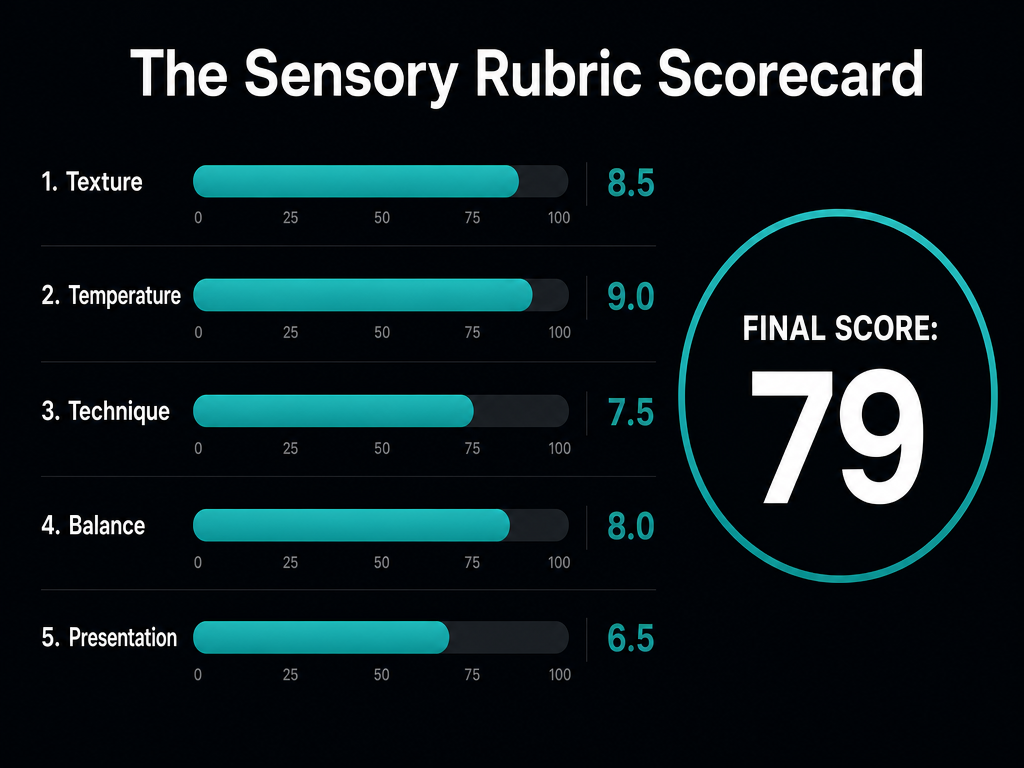 Using objective anchors like technique and temperature allows for consistent scoring across different cuisines, shifting the focus from subjective 'likes' to culinary execution.
3. Technique
This is the "did they actually cook it well" category. It's about fundamental execution: Is the protein cooked to the right doneness? Is the sauce properly emulsified? Did they achieve the Maillard reaction, or is this just steamed meat?
Technique reveals itself in details. The way a knife cut affects the texture of vegetables. The difference between a stock that's been carefully skimmed and one that tastes muddy. Whether a batter is light and crisp or heavy and greasy.
You don't need culinary school to recognize good technique. You just need to know what the dish is supposed to deliver, then assess whether it got there.
Key questions:
- Are the core techniques (searing, braising, emulsifying, etc.) executed correctly?
- Does the dish show evidence of skill, or could a home cook replicate this?
- Are there technical flaws that undermine the dish (broken sauce, overcooked protein, burnt aromatics)?
4. Balance
Balance is the interplay of salt, fat, acid, heat, and sugar. It's why some dishes feel complete while others leave you reaching for the salt shaker.
A balanced dish doesn't mean everything is in equal measure. It means the flavors support each other. A rich carbonara needs acid to cut through the cream. A spicy Thai curry needs sweetness and fat to temper the heat. A simple margherita pizza needs salt to make the sweetness of the tomato shine.
When evaluating balance, consider:
- Are the flavors in harmony, or does one element dominate?
- If the dish is intentionally unbalanced (like a very spicy dish), is that imbalance purposeful and successful?
- Would a small adjustment (more acid, more salt) make this significantly better?
5. Presentation
Presentation is the most misunderstood category. It's not about Instagram-worthiness. It's about whether the visual composition serves the dish functionally.
A well-plated dish makes eating easier and more intuitive. The components are arranged so you can get a bit of everything in one bite. The sauce is placed where it will coat the protein, not pooled uselessly at the edge of the plate. The garnish adds flavor or texture, not just visual noise.
Score presentation based on:
- Does the plating make the dish easier or harder to eat?
- Are the visual elements functional (adding flavor, texture, or temperature contrast)?
- Is this presentation purposeful, or is it just following trends?
The 80/20 Weighted Scoring System
Not all evaluation criteria carry equal weight. A dish can have beautiful presentation but taste mediocre. Conversely, a visually simple dish can be transcendent if the flavor and technique are perfect.
This 80/20 system prioritizes what actually matters: how the dish tastes and whether it was executed well.
The Fundamentals (80 Points)
This is where 80% of your score comes from. If a dish fails here, nothing else can save it.
- Flavor & Texture (60 points): This is the combined evaluation of the five objective anchors above. Did the dish deliver on taste, mouthfeel, and sensory experience?
- Quality of Ingredients (10 points): Were the ingredients fresh, appropriate, and well-sourced? You can't make great food from mediocre ingredients.
- Value (10 points): Is this dish priced appropriately for what it delivers? A $15 burger that tastes like a $40 burger scores high on value. A $40 burger that tastes like a $15 burger does not.
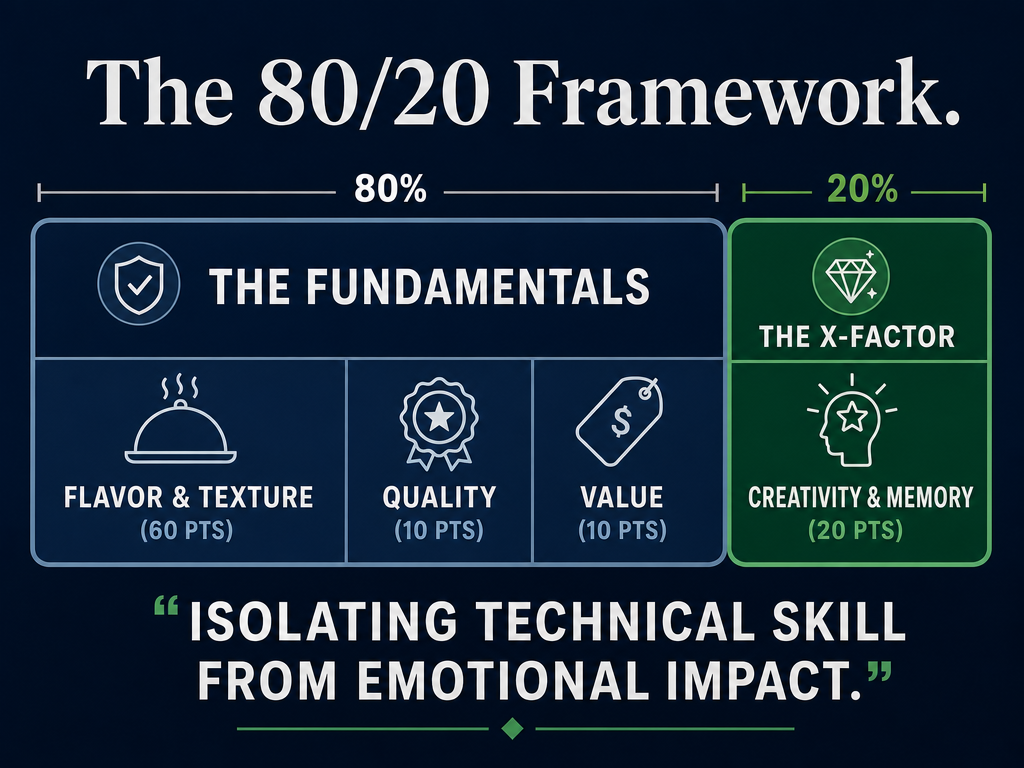 By weighting fundamentals at 80%, you ensure that a dish's technical success is the primary driver of the score, while leaving room for creative brilliance.
The X-Factor (20 Points)
This is where exceptional dishes separate themselves from merely good ones.
- Creativity (10 points): Is this dish doing something new, or executing a familiar idea in an unexpected way? Creativity doesn't mean molecular gastronomy - it can be as simple as an unexpected flavor pairing or a traditional technique applied in a new context.
- Legitimacy & "Core Memory" Potential (10 points): Will you remember this dish in six months? Does it have the kind of impact that makes you want to tell someone about it? Some dishes are technically perfect but forgettable. Others haunt you.
This weighting system ensures that a technically flawless but uninspired dish might score 80/100, while a dish that's both perfect and memorable can hit 95+.
Choosing Your Scale: 10-Point vs. 100-Point
The scale you choose shapes how precisely you can evaluate dishes. There's no single "correct" choice - it depends on how you think and what you're trying to accomplish.
The 10-Point Scale
A 10-point scale (or 1-10 scoring) is intuitive and fast. It works well if you're scoring dishes in real-time at the table and don't want to overthink it.
Pros:
- Quick to assign
- Easy to remember and compare
- Sufficient precision for most casual tracking
Cons:
- Limited granularity - the difference between a 7 and an 8 can feel arbitrary
- Harder to capture subtle differences between very good dishes
- Prone to "grade inflation" where everything good becomes an 8 or 9
If you choose this scale, define what each number means before you start scoring. For example:
- 10: Platonic ideal of this dish
- 9: Exceptional, memorable
- 8: Very good, would order again
- 7: Good, solid execution
- 6: Fine, but flawed
- 5 or below: Something went wrong
The 100-Point Scale
A 100-point scale gives you far more precision, which matters when you're comparing dishes across years or trying to rank your top experiences.
Pros:
- Granular enough to capture subtle differences
- Allows for weighted scoring (like the 80/20 system above)
- Creates meaningful separation between "very good" and "exceptional"
Cons:
- Slower to assign in the moment
- Requires more thought and calibration
- Can feel overly precise for casual meals
The 100-point scale is particularly useful if you're building a long-term personal database. It lets you rank dishes with confidence, even months or years later.
If you're serious about tracking dishes across cuisines and cities, this is the better choice. For a deep dive into how to implement it, see our guide on how to track and rate meals like a food critic.
Building Your Personal Rubric
A rubric is just a scoring framework that's written down. It removes ambiguity and ensures you're evaluating every dish against the same criteria.
Start with the five objective anchors (texture, temperature, technique, balance, presentation) and assign point values. For a 100-point system, you might allocate:
- Flavor & Texture: 40 points
- Technique: 20 points
- Quality of Ingredients: 10 points
- Value: 10 points
- Creativity: 10 points
- "Core Memory" Factor: 10 points
Then define what each point range means. For example:
- 90-100: Exceptional. The platonic ideal of this dish. Will remember it for years.
- 80-89: Excellent. Would actively seek this dish out again. Minor flaws, if any.
- 70-79: Good. Solid execution, would order again but not obsess over it.
- 60-69: Acceptable. Fine, but unremarkable. Wouldn't go out of my way.
- Below 60: Flawed. Something went wrong.
The key is consistency. Once you've defined your rubric, use it for every dish. Don't adjust the criteria mid-meal or give bonus points because you're in a good mood.
If you're looking for tools to help you organize and standardize your scoring system, check out the best food review apps that support custom rubrics.
Managing Subjectivity Bias
Even with a rigorous framework, your scores will be influenced by factors that have nothing to do with the food: your mood, who you're with, how hungry you are, what you ate yesterday.
You can't eliminate subjectivity entirely - and you shouldn't try. Personal preference is part of what makes your rating system yours. But you can manage the biggest sources of bias.
The Mood Variable
If you're stressed, exhausted, or distracted, everything tastes worse. Conversely, a meal eaten after a great day feels transcendent even if the food is merely good.
The fix: Never rate a dish in the moment if you're in an extreme emotional state. Take the photo, make a note, and assign the score later when you've had time to reflect.
The Company Effect
Food tastes better when you're with people you love. It tastes worse when you're dining with someone difficult. This is well-documented psychology, and it will skew your scores.
The fix: When you review a dish, mentally separate the sensory experience from the social one. Ask yourself: "If I ate this alone, would it still be exceptional?"
The Novelty Bias
The first time you try something unfamiliar, it often seems more impressive than it actually is. Conversely, familiar dishes can seem boring even when they're perfectly executed.
The fix: Give yourself permission to revise scores after the second or third visit. Your initial assessment is a hypothesis. Repeated experiences are data.
The Hunger Heuristic
Everything tastes better when you're starving. If you rate a dish immediately after arriving at a restaurant famished, you'll inflate the score.
The fix: If possible, don't score the first dish you eat when you're very hungry. Or make a note of your hunger level and factor it in when you review later.
The "Don't Rate Until the Bill Is Paid" Rule
This is the golden rule of consistent scoring: Never finalize a dish rating until after the meal is complete and you've paid. Adrenaline from the experience, the rush of service during peak dining, and the social energy of a great meal can all skew your perception.
Wait until you're outside the restaurant. Then ask yourself: "How do I actually feel about that dish now that the moment has passed?"
Digital Tools That Actually Work
Your scoring system is only as good as your ability to store, search, and compare your ratings. That means you need a tool that's designed for dish-level tracking, not just restaurant reviews.
For Casual Tracking: Beli
Beli uses an Elo-style ranking system (similar to chess ratings) where you compare two dishes head-to-head instead of assigning arbitrary numbers. Over time, this creates a ranked list of everything you've eaten.
Pros:
- Eliminates the "what's an 8 vs. a 9" problem
- Social features let you see friends' recommendations
- Simple, fast interface for quick logging
Cons:
- Focused on ranking, not detailed notes
- Limited ability to search by specific criteria (like "best ramen" or "top pasta dishes")
- Ratings are relative, not absolute
Beli works well if you want a lightweight system that ranks your experiences without requiring a lot of manual input. For more on how this works, see our review of the best food review apps.
For Serious Archiving: Notion or Airtable
If you want to build a true culinary database - with ingredient notes, flavor profiles, and custom tags - use a database tool like Notion or Airtable.
Pros:
- Fully customizable fields (location, cuisine type, date, price, flavor notes, etc.)
- Powerful search and filter capabilities
- Can link related entries (e.g., all ramen dishes, all Tokyo meals)
Cons:
- Requires setup and maintenance
- Not designed specifically for food, so you'll need to build your own templates
- Steeper learning curve than dedicated food apps
This approach is best for serious foodies who want to treat their dining history like a research project. For a detailed workflow, see our guide on how to build a personal restaurant library.
The Camera Roll Hack
Your iPhone or Android camera roll can be searchable if you set it up correctly. Here's the 30-second workflow:
- Take a photo of the dish
- Immediately add a caption with: Dish name, restaurant name, city, and a quick score
- Use a consistent tagging system (e.g., #ramen #tokyo #95)
- Create a "Dining Out" album and auto-sort food photos into it
This won't replace a proper database, but it makes your photos searchable by keyword, which is vastly better than a chaotic, untagged camera roll. For more on organizing food photos, see the best apps to organize food photos by restaurant.
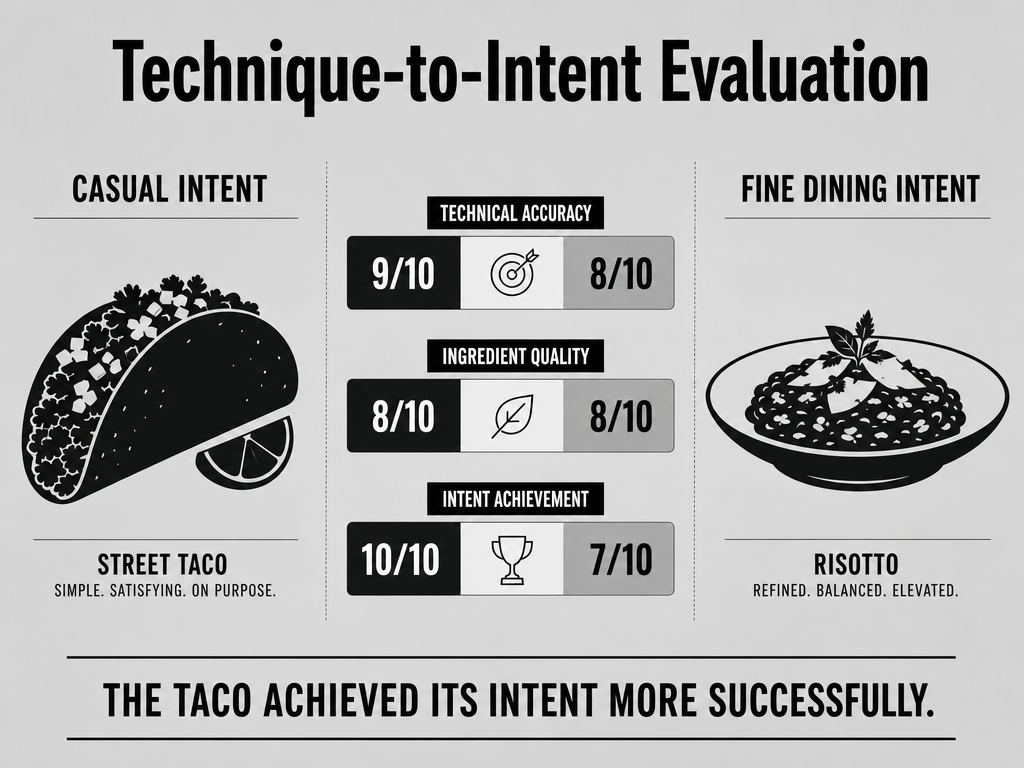 The 'Technique-to-Intent' framework allows you to objectively compare a street taco to fine dining by measuring how well a dish achieves its specific goals.
The 30-Second Post-Meal Workflow
A scoring system only works if you actually use it. The key is to make logging fast enough that you'll do it every time, even when you're tired or distracted.
Here's the workflow I use:
Take the photo (5 seconds): Before you start eating, get one clear shot of the dish.
Tag the location (5 seconds): Use your phone's built-in geotagging, or manually add the restaurant name in your app of choice.
Quick score or note (15 seconds): If you're using a 10-point scale, assign the number. If you're using 100-point, just make a rough note (e.g., "85-90 range, revisit"). If you're using Beli, just add it to your list - you'll rank it later.
One-sentence flavor note (5 seconds): Capture the one thing that defined the dish. "Perfectly funky miso. " "Undersalted. " "Best pork belly texture I've had. " This is your future self's reminder.
That's it. Thirty seconds, maximum. You'll refine the score later when you're reviewing your week, but the critical details - location, photo, rough assessment - are locked in.
If you want to go deeper with your note-taking and scoring workflow, check out how to track restaurant meals.
Frequently Asked Questions
What are the key criteria used in food competition judging?
Professional food competitions typically evaluate based on five core criteria: taste, presentation, creativity, technique, and adherence to the challenge parameters. Judges assign point values to each category, then total them for a final score. These criteria translate well to personal dish scoring - the main difference is that professional judges add "adherence to brief" (did you follow the rules of the competition?), which isn't relevant when you're evaluating a meal you've ordered.
How does Beli ranking work?
Beli uses an Elo rating system, originally developed for chess. Instead of assigning a fixed score to each dish, you compare two dishes head-to-head and choose which one is better. Based on your choice, both dishes' ratings adjust: the winner's rating goes up, the loser's goes down. Over time, this creates a ranked list of everything you've eaten. The advantage is that you never have to decide "is this an 8 or a 9?" - you just decide which dish you prefer. The disadvantage is that ratings are relative, not absolute, so you can't directly compare your scores to someone else's.
How do I add a rating on Beli?
Open the Beli app, tap "Add Dish," then enter the dish name and restaurant. The app will prompt you to upload a photo and add optional notes. Your rating happens through the comparison system - later, when you're browsing your feed, Beli will show you two random dishes you've saved and ask "which is better?" Your choice updates both ratings. You can also manually compare dishes by searching for them.
How to organize photos with tags?
On iPhone, use the built-in Photos app: open a photo, tap "Edit," then "Add Caption. " Write your tags in the caption field (e.g., "pasta carbonara Rome #pasta #italy"). Later, use the search bar in Photos to find all images with that tag. On Android, use Google Photos: open a photo, tap the three dots, select "Edit," then add your tags in the description field. For more advanced tagging, use a third-party app like Notion or Airtable where you can create custom tag fields and filter by multiple criteria at once.
How to categorize photos on iPhone?
Create custom albums in the Photos app by tapping "Albums" > "+" > "New Album. " Name it something specific (e.g., "Ramen, " "Tokyo 2025, " or "95+ Dishes"). Then manually add photos to that album by selecting them and tapping "Add To > [Album Name]. " You can also use the "Search" function to find photos by location, date, or keyword (if you've been captioning them), then batch-add them to an album. For a deeper system, see our guide on how to organize restaurant photos by dish.
What is the 30/30/30 rule for restaurants?
Some hospitality professionals use a proportional weighting approach that balances food quality, service, and atmosphere roughly equally when evaluating dining venues. This type of framework is commonly cited in hospitality training, but it's fundamentally a venue-rating system, not a dish-rating system. For serious foodies focused on individual dishes, this approach is too broad - you want to isolate the dish itself from the surrounding experience.
What are the criteria for a good food review?
A good food review evaluates both objective and subjective elements. Objectively, it should assess technique, ingredient quality, balance, and execution. Subjectively, it should capture the reviewer's personal experience: flavor, memorability, and whether the dish delivered on its promise. The best reviews are specific (naming techniques, ingredients, and textures) rather than vague ("it was amazing"). They also provide context: price, location, and how this dish compares to similar versions elsewhere.
What is the 2 2 2 rule for food?
The 2-2-2 rule refers to food safety guidelines for refrigerator storage: food should be consumed within 2 hours of being left out, stored in the fridge for no more than 2 days, or frozen for no more than 2 months for optimal quality. It's a health and safety guideline, not a culinary evaluation framework, so it's not relevant to dish scoring or rating systems.
Continue Reading
Start Tracking Your Dishes Today
Transform your food photos into a searchable, ratable culinary memory bank.
Download Savor App