
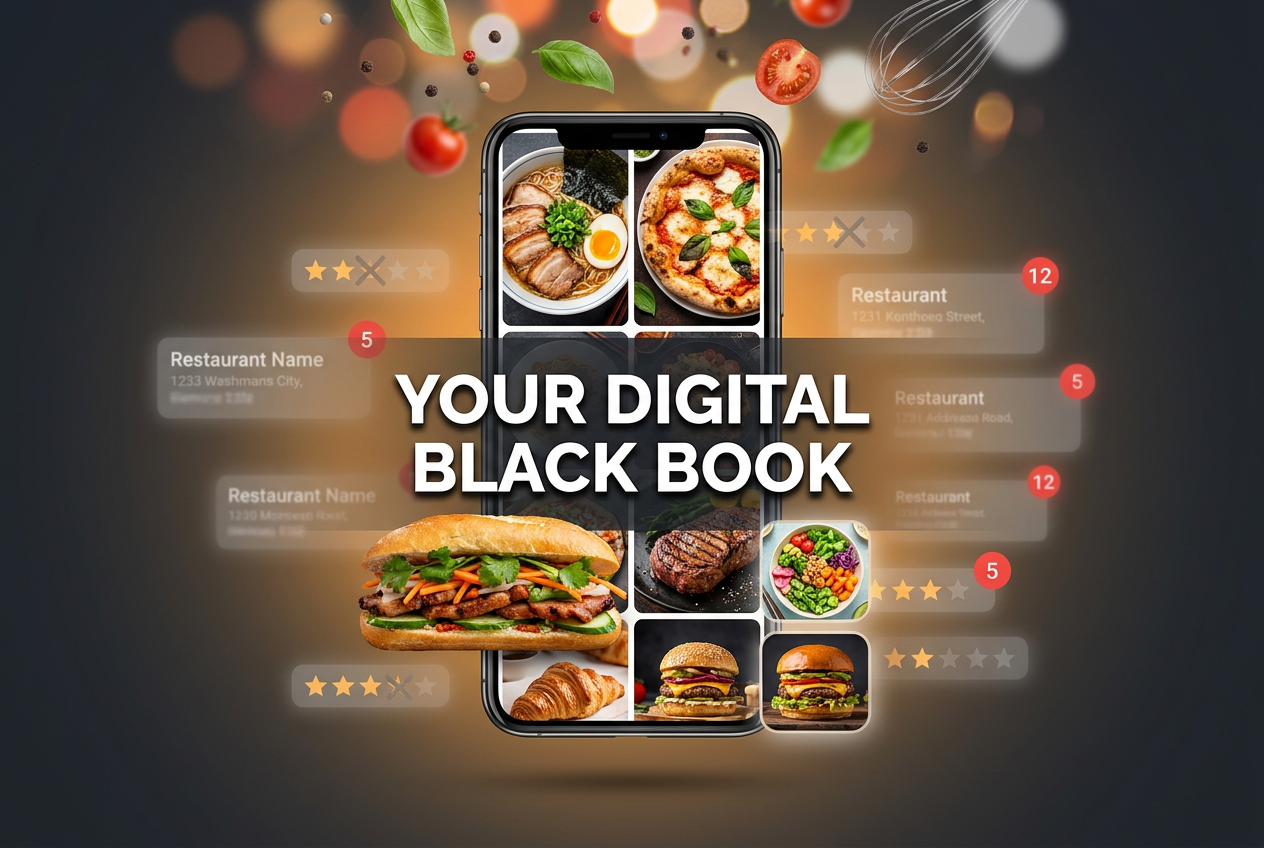
Beyond the Notes App: The 5 Best Restaurant Apps for Serious Foodies in 2026
Alex the juice queen
Alex hunts for the best juice bars and presses. She rates every sip and saves her favorites in Savor.
Beyond the Notes App: The 5 Best Restaurant Apps for Serious Foodies in 2026 You're staring at your iPhone Notes app again. Somewhere in that jumbled list...
Beyond the Notes App: The 5 Best Restaurant Apps for Serious Foodies in 2026
You're staring at your iPhone Notes app again. Somewhere in that jumbled list between "dentist appointment" and "gift ideas for Mom" is the name of that Vietnamese place your friend mentioned three months ago. You know the one - the spot with the banh mi that supposedly changed her life. But which Vietnamese place? And what did she actually recommend?
Meanwhile, your camera roll holds 2,400 food photos you'll never look at again. That transcendent carbonara in Rome? Buried under 147 screenshots. The ramen spot that made you reconsider everything you thought you knew about noodle soup? Lost somewhere between your dog's birthday party and a parking garage selfie.
The painful truth is that generic apps weren't built for the way serious foodies actually think about food. Yelp gives you a 4.2-star average from people who think Olive Garden is authentic Italian. Google Maps shows you what's nearby, not what's worth your time. Instagram Saves is where great meal memories go to die in an unsearchable graveyard.
Here's what you need instead: a proper digital black book. A system that works the way your brain works - organized by dish, searchable by craving, and built around the people whose taste you actually trust.
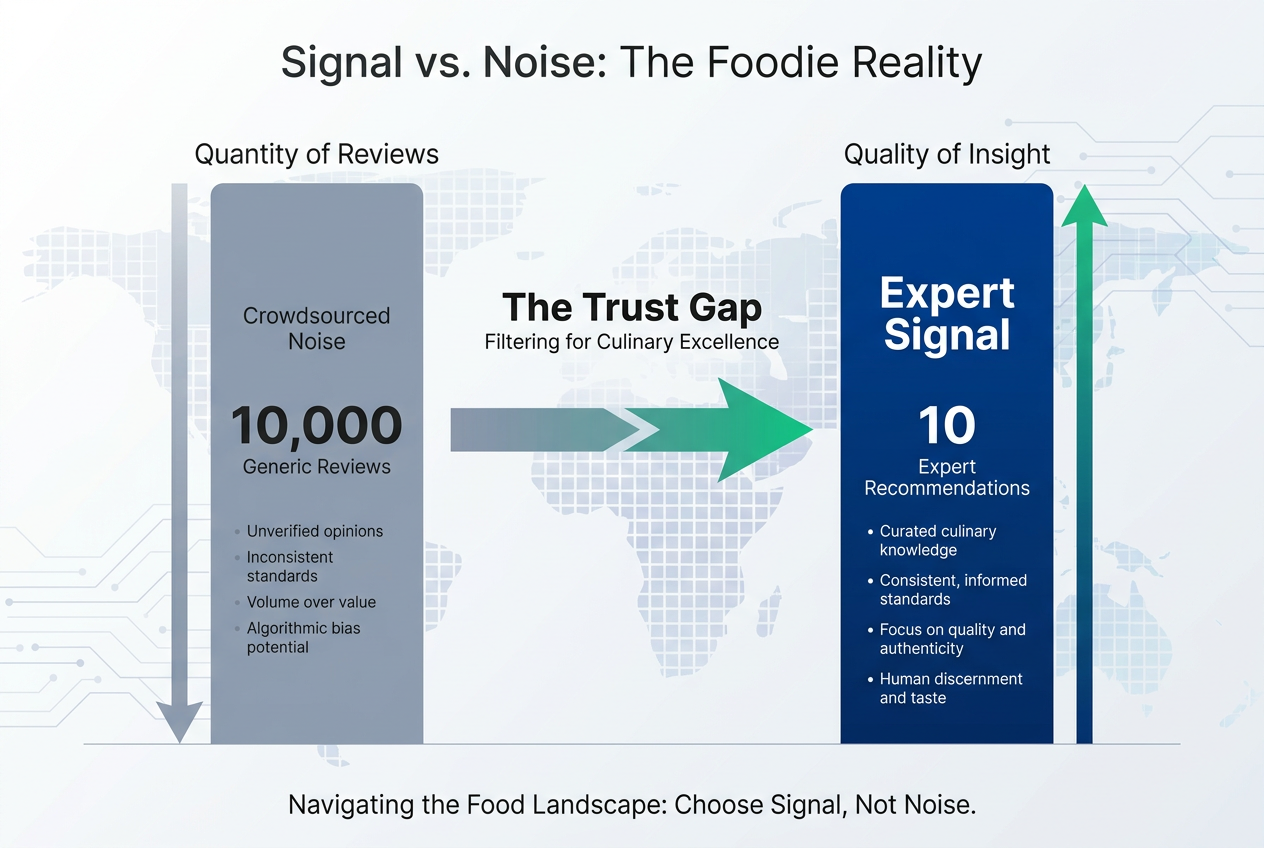 Traditional rating systems often prioritize volume over validity. For serious foodies, a single expert recommendation outweighs thousands of generic crowdsourced four-star reviews.
Table of Contents
- The Death of the 4.2-Star Rating
- The Digital Black Book Checklist
- The Heavy Hitters: Deep Dive Comparison
- Advanced Workflow: How to Transition
- The At-a-Glance Matrix
- Frequently Asked Questions
The Death of the 4.2-Star Rating
The crowdsourced review is dying, and you're probably one of the people who killed it.
Not because you did anything wrong. You just stopped trusting it. And you're right to - the entire model is collapsing under its own weight. When a restaurant has 3,847 reviews averaging 4.2 stars, what does that number actually tell you? That it's marginally better than average? That it's popular enough to attract thousands of opinions from people you've never met and whose taste you don't trust?
The noise-to-signal problem has become terminal. AI-generated reviews now pollute every major platform. Business owners game the system with incentivized five-stars. Review bombing happens when someone's political opinions clash with a restaurant's social media post. The entire apparatus has become a performance of consensus that tells you almost nothing about whether you'll actually enjoy the meal.
Professional food critics understand this intuitively. When Ruth Reichl reviewed restaurants for The New York Times, she didn't poll 3,000 strangers. She went multiple times, often in disguise, and paid meticulous attention to specific dishes, specific moments, specific details that revealed a kitchen's true character. The serious foodie needs the same approach - not crowdsourced averages, but curated, trusted, specific intelligence.
The shift is already happening. When you ask a friend for a restaurant recommendation, you don't want their star rating. You want to know: What did you order? What was extraordinary? What should I skip? You want dish-level intelligence from someone whose palate you understand.
The apps that win in 2026 are the ones that understand this fundamental truth: the best food review apps aren't the ones with the most reviews. They're the ones that help you build and maintain your own personal taste network.
The Digital Black Book Checklist
Before we get into specific apps, let's establish what you actually need. A proper restaurant recommendation app for serious foodies must accomplish five core functions:
Personal List-Building & Intelligent Tagging
You need more than a wishlist. You need a system that lets you tag restaurants by cuisine, neighborhood, occasion, price point, and - most critically - specific dishes. "Italian" isn't helpful. "Bucatini all'amatriciana that rivals Rome" is helpful. The app should let you create as many custom categories as your brain demands: "Natural wine bars," "Solo dining spots," "Places that do proper Neapolitan pizza," "Late-night Korean BBQ."
Interactive Map Views
Your memory is spatial. When you're in Brooklyn wondering where to eat, you don't want a list - you want a map showing every great meal you've logged in that neighborhood. The map should be fast, intuitive, and filterable by all those tags you've been meticulously adding.
Social Feeds from Trusted Circles
This is where most apps fail. You don't need a feed from 50,000 random food bloggers. You need to see what the 10 people whose taste you trust are eating right now. When your friend who lived in Bangkok for three years logs a Thai spot, that matters. When a stranger with a verified badge rates something, that's just noise.
Vetted Expert Content vs. Random Reviews
The best apps maintain a firewall between professional curation and user-generated chaos. Editorial content from critics who eat anonymously and pay for their meals carries different weight than a review from someone who got a free appetizer for checking in. Both can coexist, but the app needs to make the distinction clear.
Dish-First Architecture
Here's the critical insight: restaurants are vessels for dishes. You don't bookmark "Momofuku Noodle Bar" - you bookmark "the ginger scallion noodles at Momofuku Noodle Bar." The app needs to let you track and rate individual dishes, not just entire restaurants. This is the difference between a generic recommendation app and a serious foodie's tool.
Most people cobble together a system from multiple apps: Google Maps for starred locations, Instagram for saved posts, Notes for jotted-down names, screenshots for menus. It's a disaster. The right app consolidates all of this into a single, searchable, shareable database that grows more valuable with every meal you log.
The Heavy Hitters: Deep Dive Comparison
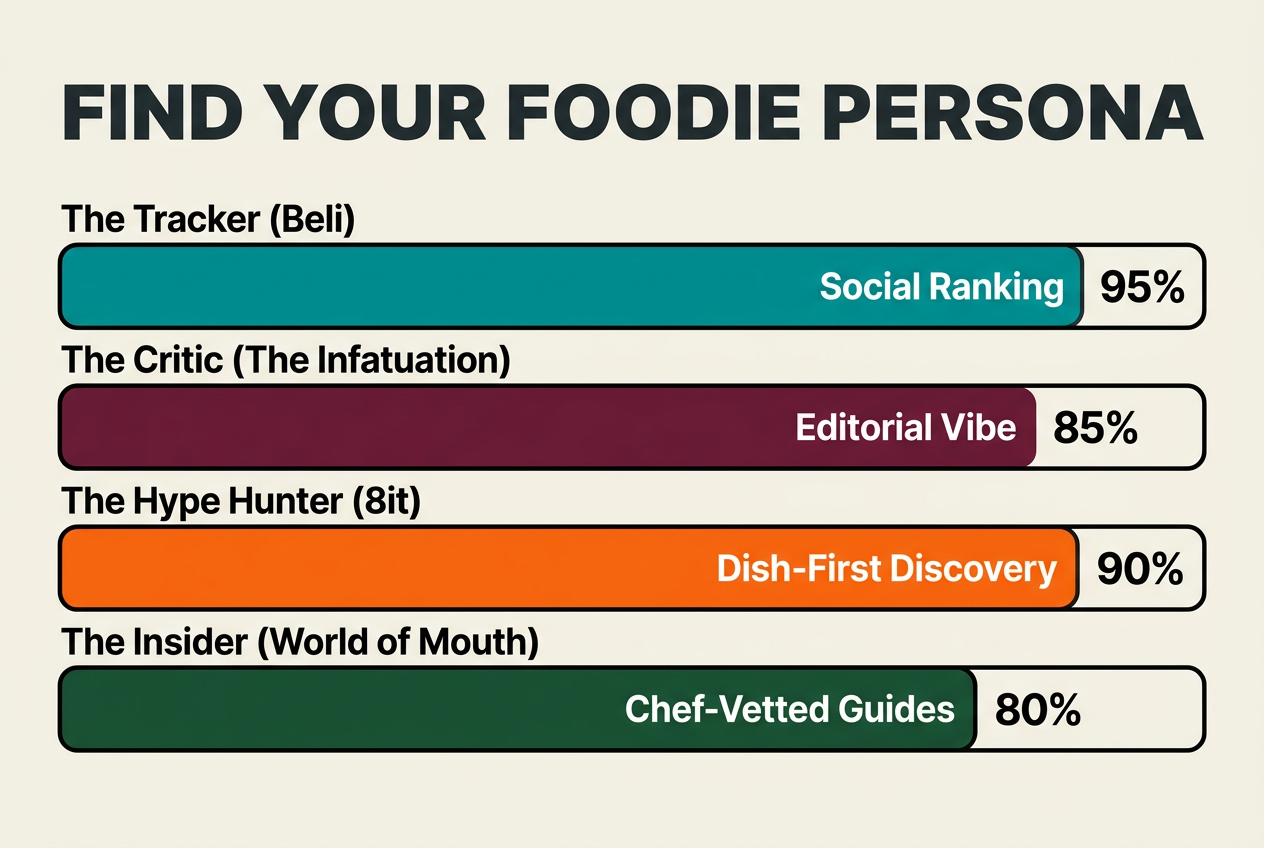 Not all recommendation apps are created equal. Use this persona matrix to identify which platform aligns with your specific dining and discovery style.
Beli: Best for the Competitive Tracker
Beli describes itself as "Strava for food," and that's exactly right. If you're the kind of person who needs to quantify everything - who ranks, rates, and obsessively compares - Beli is your app.
The genius of Beli is its forced-choice ranking system. Instead of asking you to assign an arbitrary number to a dish, it shows you two restaurants you've been to and asks: which was better? Over time, this creates a hyper-accurate personal leaderboard. Your top 10 isn't based on star ratings you assigned six months apart in wildly different moods. It's based on direct head-to-head comparisons that force you to make real decisions about what you actually prefer.
The social integration is strong. You follow friends, see what they're eating in real-time, and - critically - you can see how your rankings compare to theirs. When your friend visits that ramen spot you ranked #3 in the city and they rank it #12, that's useful information. It tells you something about how your palates differ.
Where Beli stumbles is in its focus on restaurants rather than dishes. You can note what you ordered, but the architecture is venue-centric. If you want to track that a specific restaurant has one transcendent dish and three mediocre ones, Beli isn't built for that level of granularity.
Best for: Data-driven diners who love quantification and competitive ranking with friends
Price: Free with premium features
Key limitation: Restaurant-first architecture doesn't capture dish-level excellence
The Infatuation: Best for Reliable Editorial and Vibe-Based Discovery
The Infatuation isn't trying to be crowdsourced. It's trying to be the opposite - a return to trusted editorial voices in an era of algorithmic chaos.
Every review is written by a critic who paid for their meal. That simple principle changes everything. There's no "I got this for free" disclosure, no incentivized content, no brand partnerships polluting the recommendations. The writers are eating anonymously, multiple times, and they're not afraid to be opinionated. A two-star review from The Infatuation tells you exactly what went wrong, in specific, useful detail.
The real genius is the situation-based filtering. You don't search by cuisine or neighborhood - you search by scenario: "Dinner with Parents Who Visit Once a Year." "Third Date When You're Trying to Impress." "Solo Lunch Spot Where Nobody Will Bother You." This is how humans actually think about restaurant decisions.
The weakness is coverage. The Infatuation operates in major cities, but if you're in Portland, Maine, or Albuquerque, you're largely on your own. It's also not great for logging your own meals or building a personal database. It's a recommendation engine, not a personal restaurant library tool.
Best for: People who want professional curation and scenario-based recommendations
Price: Free
Key limitation: Limited geographic coverage and no personal logging features
8it: Best for the Hype Hunter
If The Infatuation is about trusted editorial, 8it is about speed and cultural relevance. It's built for the diner who needs to know about the pop-up, the collaboration, the limited drop, the dish that's only available this week.
The interface is fast and visual - closer to TikTok than Yelp. Everything is "proof-based," meaning you see actual photos and videos of dishes before you decide to go. The emphasis is on specific dishes rather than entire restaurants, which is correct thinking. Nobody needs another review of Nobu. But a video of the exact hamachi crudo that makes Nobu worth visiting? That's useful.
8it's community skews young and trend-focused. If you're chasing the new natural wine bar that just opened in a converted warehouse, 8it will tell you about it before anyone else. If you want a classic French bistro that's been perfect for 40 years, 8it probably isn't tracking it.
The other limitation: 8it is focused on major food cities - New York, Los Angeles, San Francisco, Miami. Outside those markets, coverage drops significantly.
Best for: Urban diners chasing trends, pop-ups, and culturally relevant food moments
Price: Free
Key limitation: Limited to major cities and trend-focused rather than comprehensive
World of Mouth: Best for Global Travel and Chef-Vetted Recommendations
World of Mouth takes a different approach entirely. Instead of trying to aggregate every opinion from every diner, it sources recommendations exclusively from 800+ professional chefs and food critics around the world.
The value proposition is simple: when you're traveling to Copenhagen, you don't want to know what 10,000 tourists thought. You want to know where René Redzepi eats when he's not at Noma. World of Mouth gives you that.
The "hit rate" promise is what sets it apart. Because every recommendation comes from a professional whose reputation is on the line, there's an implicit quality floor. You might not love every restaurant, but you probably won't waste a meal on something genuinely bad.
The weakness is obvious: this is for globetrotting food travelers, not for everyday local dining. If you live in Nashville and need a Tuesday lunch spot, World of Mouth isn't designed for that. It's also read-only - you can't log your own meals or build a personal archive.
Best for: Serious food travelers who prioritize chef recommendations over crowdsourced reviews
Price: Free with premium subscription ($8/month)
Key limitation: Travel-focused, not useful for local everyday dining
Seated: Best for Subsidizing Your Dining Habit
Seated is different from every other app on this list because it's not about discovery or logging - it's about economics. The pitch is simple: book through Seated, and you'll get up to 30% back in rewards on your bill at high-end restaurants.
For the serious foodie who dines out frequently, this changes the math of how often you can afford to eat well. That $200 tasting menu becomes effectively $140. Over the course of a year, if you're eating out twice a week, this can save you thousands of dollars.
The catch: not every restaurant participates, and the reward percentages vary. But Seated has built solid partnerships with enough quality establishments that it's worth checking before any reservation. The app integrates with your calendar and can sync with corporate expense systems, which is useful if you're in a job that involves client dinners.
Seated isn't trying to replace your food diary or recommendation engine. It's purely transactional: a way to make dining out more financially sustainable when you're committed to eating well frequently.
Best for: Frequent diners who want to reduce costs at participating restaurants
Price: Free (makes money through restaurant partnerships)
Key limitation: Only works at participating venues, reward amounts vary
Advanced Workflow: How to Transition
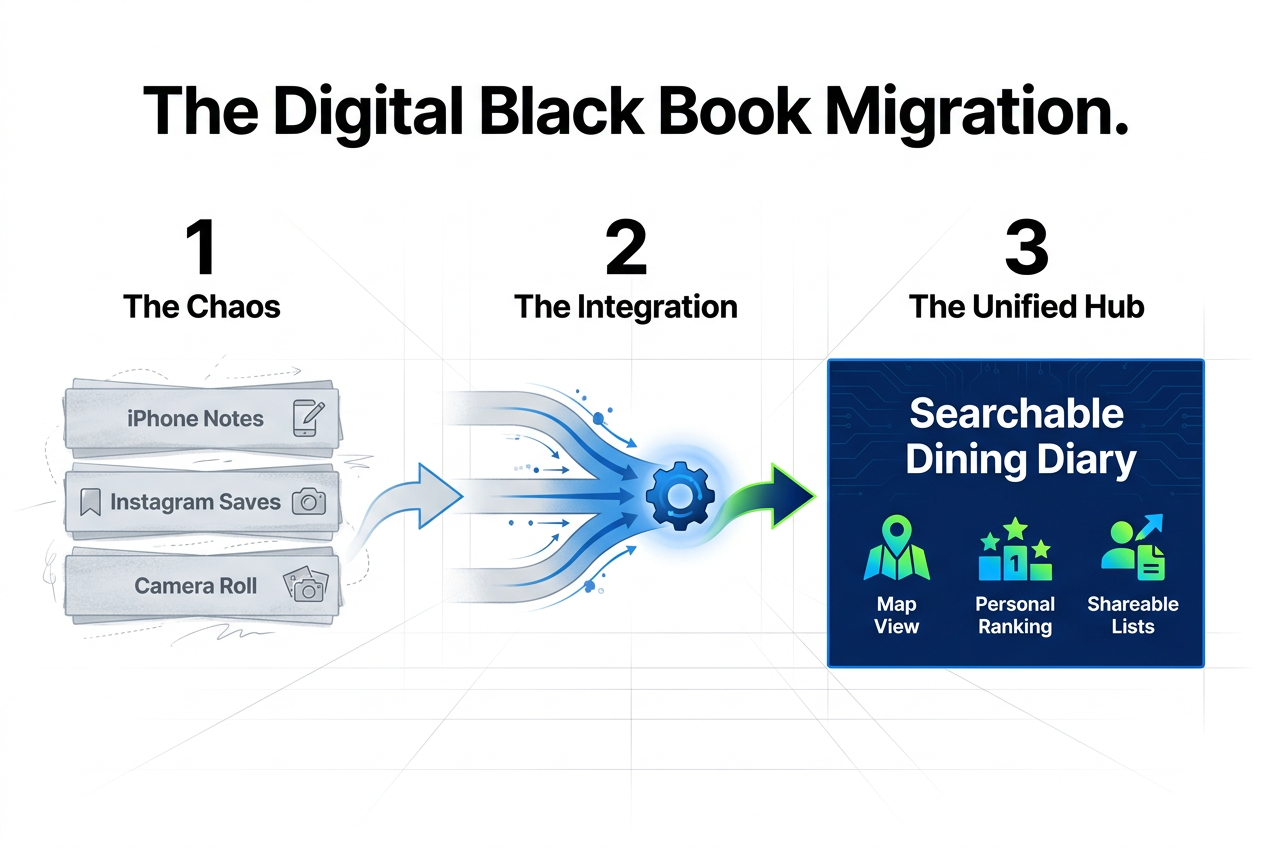 Stop losing restaurant names in your camera roll. Moving your fragmented notes into a dedicated dining app creates a searchable, professional-grade digital black book.
Moving from your current system - or lack thereof - to a proper dining workflow requires a one-time migration effort. But once it's done, you'll never lose track of a great meal again.
Step 1: Export Your Google Maps "Starred Places"
If you've been using Google Maps to save restaurants, your first job is extraction. Open Google Maps on desktop, go to "Your Places," select "Saved," and you'll see every location you've ever starred. This is the foundation of your dining history.
Go through this list with ruthless curation. Delete places you starred five years ago and barely remember. Focus on spots you've actually been to and loved, or places recommended by people whose taste you trust. Export the remaining locations - either manually or using Google Takeout - so you have a clean list to work from.
Step 2: Migrate Your Instagram Saves
Your Instagram Saved posts are a goldmine of unstructured data. Go through every food-related save and ask yourself: why did I save this? Was it a specific dish? A restaurant recommendation? A technique I wanted to try?
For each save that's actually a restaurant recommendation, create an entry in your new app. Tag it appropriately: "Brooklyn," "Ramen," "Recommended by Sarah." This is tedious work, but it transforms a pile of saved posts into actionable intelligence. Consider using apps specifically designed to organize food photos to streamline this process.
Step 3: Mine Your Notes App
Your Notes app is probably a disaster. Random restaurant names, half-remembered conversations, cryptic phrases like "the place near the park with the good dumplings." Go through it all. For each entry that represents a real lead, either: (a) visit the place and log your actual experience, or (b) create a "wishlist" entry tagged with who recommended it and why.
Delete everything else. Your Notes app wasn't designed to be a restaurant database. Stop trying to make it one.
Step 4: Process Your Camera Roll
This is the big one. You have thousands of food photos, and most of them are worthless without context. But buried in there are records of genuinely great meals.
Set aside two hours. Make coffee. Open your camera roll and scroll back chronologically. When you hit a food photo from a meal you remember being excellent, stop. Create an entry: restaurant name, dish name, date, and - critically - why it was good. "Spicy, perfectly balanced, best version I've had." That's the kind of note that will be useful in six months.
You can't process every photo. Focus on the meals that made you think: "I need to remember this."
Step 5: Establish Your Review Protocol
Going forward, you need a system. Here's the one that works:
The moment you order something special, take one good photo. Not 17 photos from different angles - one photo that captures what the dish actually looks like. Write a three-sentence review while you're still eating: what worked, what didn't, whether you'd order it again.
This takes 90 seconds. If you can't spare 90 seconds to document a meal you care about, you don't actually care about it. Learning how to review dishes like a professional doesn't require formal training - just consistency and a clear framework.
The serious foodie advantage isn't that you have a perfect memory. It's that you have a perfect system.
Step 6: Build Your Trust Network
The final step is identifying the 5-10 people whose taste you actually trust and following them in your app of choice. This isn't about amassing followers - it's about curating signal.
When your friend who lived in Tokyo for three years logs a Japanese spot, that's intel you can act on. When someone you've never met posts about their "amazing" brunch, that's noise. The goal is a feed that's actually useful rather than performative.
The At-a-Glance Matrix
| App | Best Use Case | Key Feature | Price | Primary Weakness |
|---|---|---|---|---|
| Beli | Competitive ranking and friend comparisons | Forced-choice comparison system creates accurate personal leaderboards | Free (premium features available) | Restaurant-focused, not dish-focused |
| The Infatuation | Scenario-based discovery and trusted editorial | Situation filters like "Third Date" or "Dinner with Parents" | Free | Limited geographic coverage |
| 8it | Trend-chasing and pop-up discovery | Fast, visual, proof-based dish recommendations | Free | Major cities only, trend-focused |
| World of Mouth | Global travel and chef recommendations | 800+ professional chefs and critics as sources | Free (premium $8/month) | Travel-focused, not for local everyday dining |
| Seated | Reducing dining costs | Up to 30% back in rewards at participating restaurants | Free | Limited to participating venues |
Frequently Asked Questions
What makes a restaurant app better than just using Google Maps?
Google Maps shows you where restaurants are and what their average rating is. A proper food app shows you what specific dishes are worth ordering, who recommended them, and how they compare to other versions you've tried. The difference is between a directory and a personal taste database.
Can I use multiple apps together, or should I pick one?
Most serious foodies use a combination: one app for personal logging and memory (like Savor or Beli), one for discovery in specific contexts (The Infatuation for editorials, 8it for trends), and Seated for booking when applicable. The key is having one central app where everything eventually gets logged so you're building a comprehensive personal restaurant library.
How do I decide which dish to order when visiting a new restaurant?
Check multiple sources before you go. Look at what professional critics highlight, what friends have logged, and what appears repeatedly in photo feeds. The dish that shows up across multiple trusted sources is usually the move. Once you're there, don't be afraid to ask your server what regulars order - that question often reveals the real signature dish.
What's the best way to organize my restaurant wishlist?
Tag aggressively. A wishlist entry should include: who recommended it, what they recommended ordering, why you added it, and any time constraints (limited pop-up, seasonal menu item). Your future self needs this context. A generic "try this place" entry is worthless three months later when you can't remember why you cared.
Should I rate dishes immediately or wait until later?
Rate while you're still eating or within an hour of finishing. Memory degrades fast. The details that make a dish memorable - the specific balance of flavors, the texture, the temperature - fade quickly. A review written three days later becomes generic. A review written while the taste is still in your mouth captures what actually matters.
How many restaurants should I follow on a food app?
Quality over quantity. You want to follow 5-10 people whose taste aligns with yours, not 500 random accounts. The goal is signal, not noise. Similarly, your personal database should focus on places you've actually been and dishes you actually remember, not every spot you've vaguely considered visiting someday.
What's the difference between a dish-tracking app and a meal-tracking app?
Meal-tracking apps focus on nutrition, calories, and health metrics. Dish-tracking apps focus on taste memory, recommendation building, and culinary discovery. They're solving completely different problems for completely different users. If you care about macros, use MyFitnessPal. If you care about never forgetting a transcendent bowl of ramen, use a proper food memory app.
How do I convince my food-loving friends to use the same app?
Lead by example. Start logging your meals consistently and sharing specific, useful recommendations. When someone asks "where should I eat in your neighborhood?" and you can instantly pull up a filtered map with notes on every dish you've loved, they'll ask what you're using. The app doesn't matter as much as demonstrating the value of the system - learn more about sharing food discoveries effectively.