
Why Your Best Meals Are Lost and How the 2016 Gastronome Method Saves Them
John the smoothie monster
John lives for smoothie bowls and cold-pressed juices. He uses Savor to remember his best blends.
The Gastronome Dines 2016: Why Your Best Meals Are Lost (and How to Find Them) You're scrolling through your phone at 11 PM, trying to remember the name of...
The Gastronome Dines 2016: Why Your Best Meals Are Lost (and How to Find Them)
You're scrolling through your phone at 11 PM, trying to remember the name of that restaurant. The one with the wine pairing that changed everything. You know you took a photo - somewhere between 2,400 other food shots - but that meal from 2016 might as well be in another universe now.
That's the paradox. We photograph more food than any generation in history, yet we remember less of it. By 2016, Instagram had logged over 177 million photos tagged #food, and younger millennials were capturing an average of 439 photos every six months. But volume isn't memory. That extraordinary biodynamic Zweigelt you had at a hidden bistro? The specific dish that made you rethink what "good" actually means? Gone. Lost in the camera roll graveyard.
What separates a casual diner from someone who actually builds culinary knowledge isn't just eating well - it's capturing what matters and making it searchable. The 2016 gastronomic landscape marked a turning point: the moment food documentation peaked culturally but failed functionally. Now, a decade later, we're finally asking the right question. Not "How do I take better food photos?" but "How do I turn ten years of dining history into actual, usable memory?"
Key Takeaways
- The Gastronome Dines 2016 reviews represent the gold standard of independent food criticism, emphasizing specificity like exact wine vintages and dish provenance over generic star ratings.
- 69% of millennials photograph their food before eating, yet most cannot retrieve or search those images effectively years later, creating a "camera roll graveyard" of lost culinary memories.
- Stuart Clarke's methodology for professional dining reviews focuses on four pillars: Context, Dish Specifics, Wine Pairing, and Atmosphere - a framework serious foodies can adopt to document meals like a critic.
- The restaurant industry is projected to reach $1.55 trillion in 2026, yet most food tracking tools still focus on calorie counting rather than the culinary archive serious eaters actually need.
- Modern gastronomes require specialized tools like OCR scanning for menus, metadata extraction for food photos, and dish-level tracking systems to rescue their dining history from digital oblivion.
Table of Contents
- The 2016 Gastronomic Time Capsule: Why We're Searching a Decade Later
- The Stuart Clarke Methodology: How a Professional Dines
- The Camera Roll Crisis: 10 Years of Unsearchable Food Memories
- Case Study: Iconic 2016 Reviews Revisited
- What Is the Best Restaurant Review Site in 2026?
- The Modern Gastronome's Toolkit: Rescuing Your 2016 Meals
- How to Create a Searchable Food Archive From Your Camera Roll
- Frequently Asked Questions
The 2016 Gastronomic Time Capsule: Why We're Searching a Decade Later
2016 represents the "Golden Age of the Digital Gastronome" - the year Instagrammable food culture peaked and professional-grade food blogging met mainstream accessibility. Independent reviewers like Stuart Clarke of TheGastronome.net were documenting meals with forensic precision: naming the exact vintage of a Zweigelt, cataloging the provenance of local produce, recording the specific texture of a sourdough crust. Meanwhile, the average diner was taking 439 photos every six months without any system to organize, search, or actually remember what they'd eaten.
The nostalgia for 2016 dining content stems from a cultural shift. That was the year before "influencer culture" dominated food media. Reviews were still written by people who cared more about the meal than the engagement rate. Selden Standard won Detroit's Restaurant of the Year. Per Se was navigating a rare stumble in its otherwise legendary trajectory. The food world still had stakes, standards, and critics whose opinions were earned through years of disciplined eating.
But here's the disconnect: we're searching for "The Gastronome Dines 2016 review" in 2026 not because we want to read about restaurants that might not even exist anymore. We're searching because we're trying to solve a personal problem. We want to know how someone like Stuart Clarke captured a meal so completely that a decade later, the review still transports you there. We're looking for a system. A method. A way to stop losing our own best meals to the void of an unsorted camera roll.
The Stuart Clarke Methodology: How a Professional Dines
Stuart Clarke's reviews from TheGastronome.net operate on a four-pillar framework that transforms casual dining into professional documentation. Every review follows the same structural discipline: Context, Dish Specifics, Wine Pairing, and Atmosphere. This isn't arbitrary - it's a replicable system that ensures each meal can be recalled with precision years later.
Context establishes the "why" of the meal. Clarke names the occasion (a Tuesday lunch, a celebration dinner), the company, and the restaurant's place in the broader culinary landscape. This isn't filler - it's the framework that makes memory stick. You don't just remember the dish; you remember the moment.
Dish Specifics go deep. Not "the steak was good," but "the 28-day dry-aged ribeye, sourced from a Herefordshire farm, served medium-rare with a crust that cracked audibly under the knife." Clarke lists ingredients, preparation methods, and specific textures. The 2016 Zero-G Zweigelt pairing at a Waterloo St. establishment wasn't just "a nice wine" - it was a specific vintage, a named producer, and a documented flavor profile that complemented the earthy richness of the main course.
Wine Pairing receives equal weight to the food. Clarke documents the vintage, the producer, the specific flavor notes, and how the pairing elevated or detracted from the dish. This level of specificity is what separates a professional review from a casual Instagram caption. Years later, you can replicate the experience - or at least understand what made it work.
Atmosphere closes the loop. Lighting, service style, noise level, even the specific table location. These details seem minor until you're trying to recreate a memory or recommend a restaurant to someone else. Atmosphere isn't just mood - it's data.
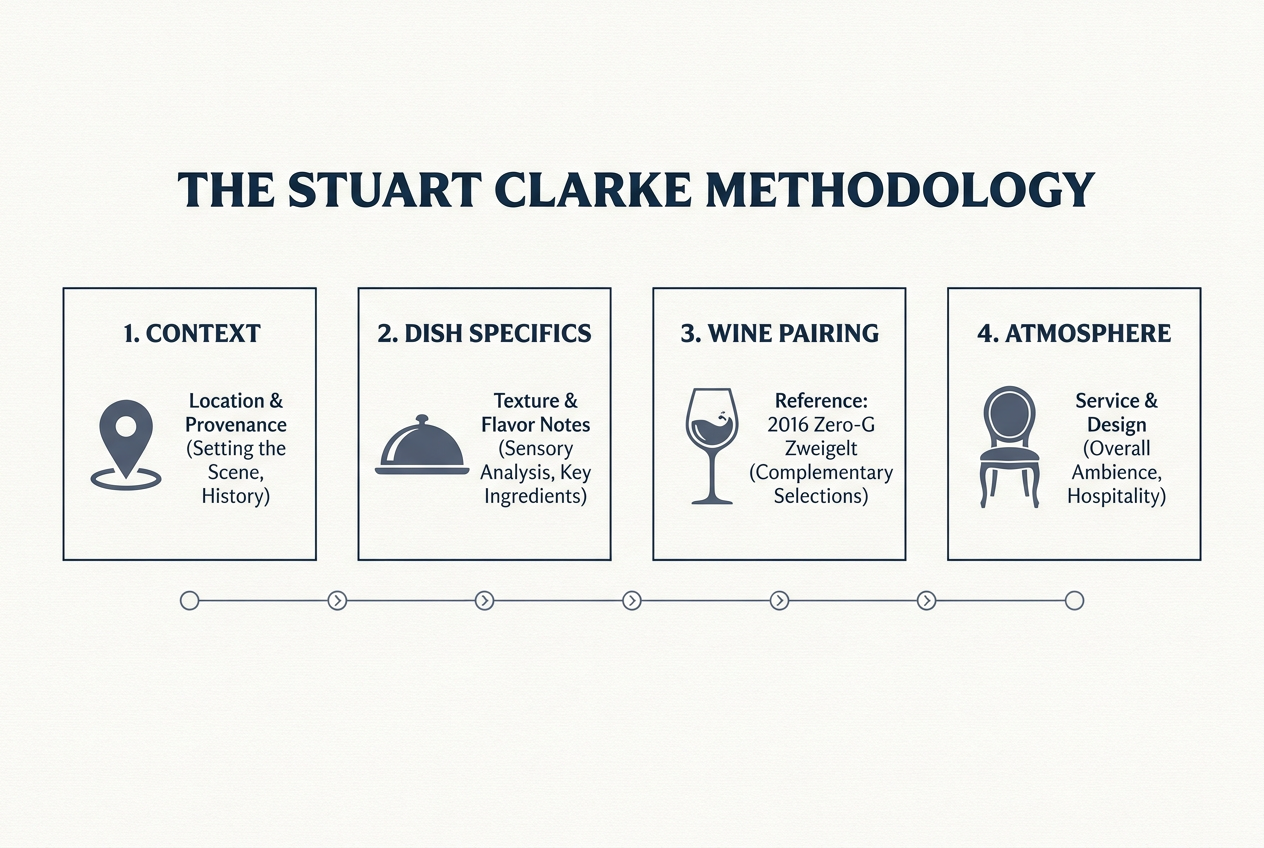 Master the Stuart Clarke methodology to transform casual food photography into professional-grade gastronomic documentation with this structured four-pillar framework for independent reviewers.
The genius of Clarke's method is its transferability. You don't need to be a professional critic to adopt this framework. Every meal you document using these four pillars becomes a permanent, searchable memory instead of another forgotten photo. The difference between "I had great pasta in Rome" and "I had the cacio e pepe at Flavio al Velavevodetto on Via di Monte Testaccio, paired with a 2014 Frascati Superiore, on a Tuesday afternoon in October - texture was silky, pecorino was sharp without being aggressive, pepper had visible bite" is the difference between a vague feeling and a replicable experience.
The Camera Roll Crisis: 10 Years of Unsearchable Food Memories
The statistics are brutal. 69% of millennials photograph their food before eating, according to a 2020 ScienceDirect study. The Consumer Technology Association reported that younger millennials take an average of 439 photos every six months. By 2016, Instagram had already logged over 177 million photos tagged with #food. But here's the problem: volume is not memory, and photos without metadata are just digital clutter.
Think about your own camera roll. Somewhere between photo 1,200 and 1,800, there's a shot of the best ramen you've ever eaten. You remember the moment - the steam rising, the broth so rich it coated your spoon, the pork belly that dissolved on contact. But you don't remember the restaurant's name. You don't remember the neighborhood. You vaguely recall it was "somewhere in the East Village" or "maybe Brooklyn?" and the search ends there.
This is the Camera Roll Crisis. We've documented a decade of extraordinary meals with zero retrieval system. Your iPhone Photos app can identify your dog, your car, and your living room, but it can't tell you where you had that life-changing carbonara in 2016. The AI doesn't know the difference between a $4 bodega sandwich and a $40 omakase course. Every photo gets the same treatment: a timestamp, a geotag if you're lucky, and a machine-learning label that says "food."
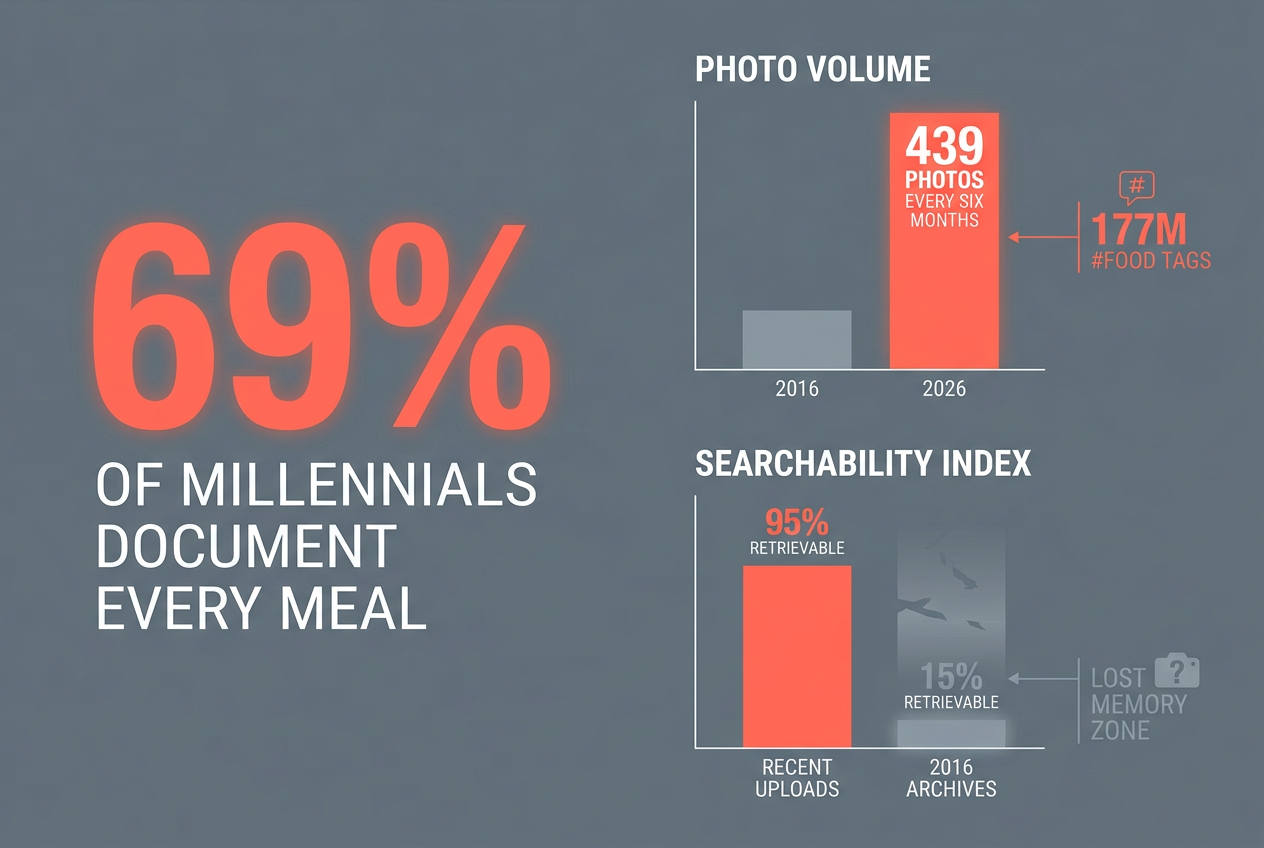 Statistics show that while food photography volume has exploded since 2016 searchability remains low for older archives making professional documentation tools essential for modern gastronomes.
The psychology behind this failure is straightforward. We photograph food as a form of social proof or aesthetic expression, not as an act of documentation. We're creating content, not archives. The photo exists to be posted, liked, and forgotten - not to serve as a functional memory aid ten years later. By the time we realize we actually need that information, it's buried under 2,000 subsequent meals, and the window of recollection has closed.
The restaurant industry is projected to hit $1.55 trillion in 2026, according to the National Restaurant Association. We're eating out more than ever, spending more than ever, and remembering less than ever. The average urban professional dines out 200+ times per year. That's 200 decisions, 200 experiences, and maybe five that get properly documented in a way that survives beyond the next phone upgrade.
Case Study: Iconic 2016 Reviews Revisited
The 2016 culinary landscape produced several landmark moments that independent reviewers like Stuart Clarke documented with precision. Selden Standard in Detroit was named the 2016 Restaurant of the Year by Hour Detroit, a recognition that validated the city's broader culinary renaissance. Clarke's review of similar establishments that year emphasized the shift toward hyper-local sourcing and chef-driven menus that prioritized ingredient provenance over European technique mimicry.
Per Se, Thomas Keller's New York temple of haute cuisine, experienced a rare stumble in 2016 - a critical moment when even three-Michelin-star institutions weren't immune to scrutiny. Reviews from that period provide a case study in how professional critics handle decline without resorting to sensationalism. Clarke's approach: document the specifics (which dishes failed, which service elements broke down), compare to the restaurant's established baseline, and let the reader draw conclusions. No clickbait, no hyperbole, just detailed observation.
Adams Restaurant at Gravetye Manor, another frequent subject of 2016 reviews, represented the opposite trajectory - a centuries-old property that successfully modernized its culinary program without sacrificing its historic identity. The 2016 reviews highlighted specific dishes (like the estate-grown vegetables prepared with Japanese precision) and documented how a restaurant could honor tradition while evolving technique. A decade later, these reviews serve as a historical record of a specific moment in a restaurant's evolution.
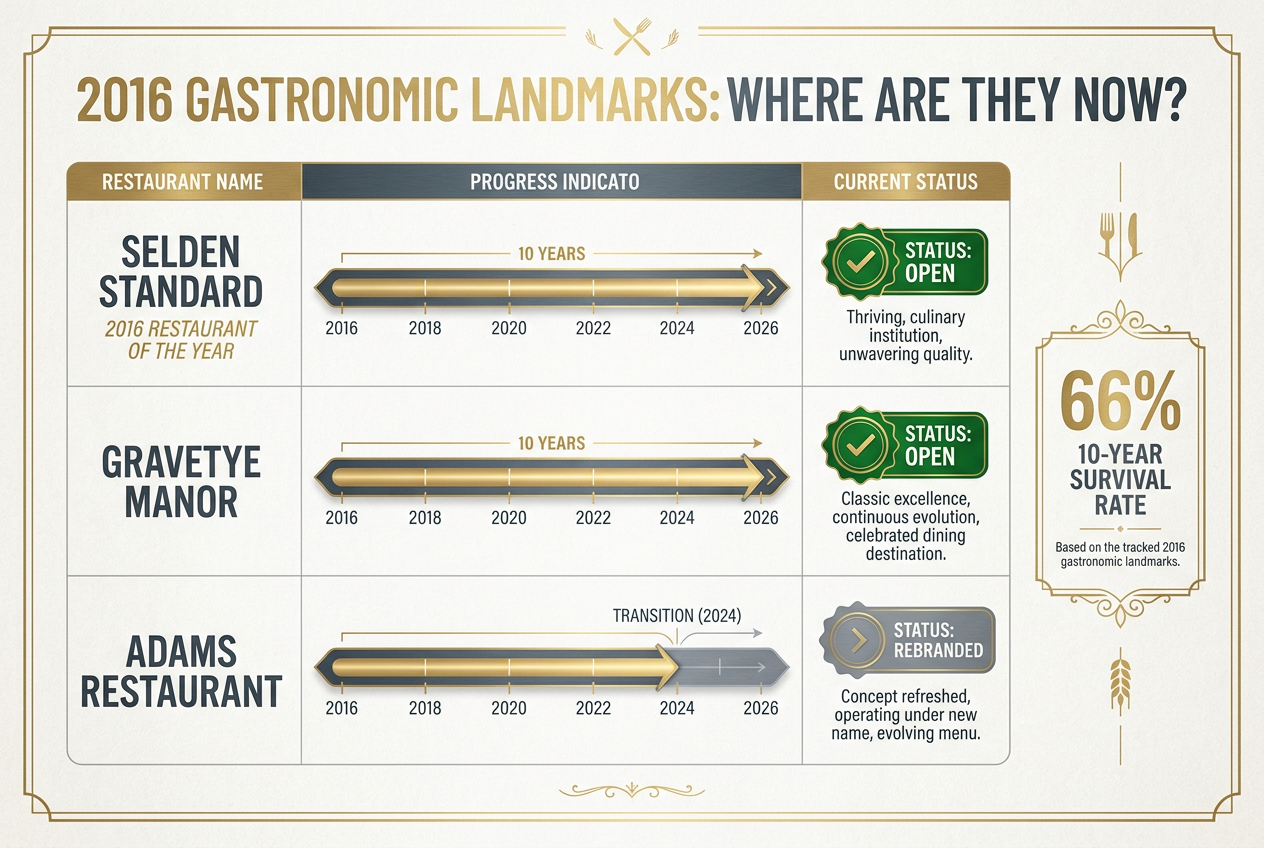 Tracking the legacy of the 2016 culinary landscape reveals which landmark establishments have maintained their gastronomic standards a decade later according to modern review archives.
What makes these 2016 reviews valuable in 2026 isn't nostalgia - it's the documentation standard. Clarke and his contemporaries created a reference library that allows modern diners to trace a restaurant's arc over ten years. Did Selden Standard maintain the standards that earned it Restaurant of the Year? Did Per Se recover from its 2016 misstep? These aren't abstract questions - they're answerable because someone took the time to document the specifics with professional rigor.
The lesson for the modern gastronome: your 2016 meals deserve the same treatment. Not for publication, but for personal memory. When you build a personal restaurant library, you're creating a reference document that compounds in value over time. The carbonara you had in Rome in 2016 becomes a benchmark for every carbonara you eat for the next decade.
What Is the Best Restaurant Review Site in 2026?
The "best restaurant review site" in 2026 depends entirely on what you're trying to accomplish. If you're looking for crowd-sourced opinions on whether a restaurant is "good," Yelp and Google Reviews still dominate - 74% of diners use social media content to decide which restaurant to visit, according to GourmetPix data from 2026. But if you're a serious foodie trying to find dish-level analysis, regional specialty guides, or critic-caliber reviews, the landscape fragments quickly.
For Independent, Professional Reviews: Sites like TheGastronome.net represent the gold standard - high specificity, no sponsored content, and a consistent methodology that allows you to calibrate the reviewer's taste against your own. The downside: limited scale. One critic can only cover so many restaurants, and if your city isn't on their radar, you're out of luck.
For Crowd Intelligence on Specific Dishes: Generic review platforms fall apart at the dish level. A restaurant might have a 4.5-star average, but that tells you nothing about whether the carbonara is worth ordering or if the dessert menu is a waste of time. Apps that focus on rating individual dishes solve this problem by surfacing what specific items are worth your time and money.
For Regional or Niche Cuisines: If you're searching for the best sushi in Paris or street food in Rome, specialized guides and food blogs outperform generic aggregators every time. The "best" site is the one written by someone who actually understands the cuisine and the city's dining culture.
For Personal Memory and Archiving: This is where traditional review sites fail entirely. They're designed for discovery, not memory. If you want to remember your own 2016 meals, you need a tool built for organizing food reviews at the dish level - something that functions as a private culinary database rather than a public recommendation engine.
The shift happening in 2026 is away from "Where should I eat?" and toward "What did I eat, and why did it matter?" The latter question requires a fundamentally different kind of tool - one that prioritizes searchability, specificity, and personal curation over viral lists and sponsored placements.
The Modern Gastronome's Toolkit: Rescuing Your 2016 Meals
If you're serious about rescuing your food photography from the camera roll graveyard, you need more than good intentions - you need a system. The modern gastronome's toolkit combines technology, methodology, and a small upfront time investment to turn ten years of dining chaos into a searchable, usable archive.
OCR (Optical Character Recognition) for Menus
Your camera roll contains dozens of menu photos. Most of them are unreadable at thumbnail size and completely unsearchable. OCR tools extract the text from those images and make it indexable. On iOS, the native Photos app now includes OCR functionality - long-press on text in any photo, and you can copy, search, or translate it. On Android, Google Lens offers similar capabilities.
The professional-grade approach: use a dedicated OCR app like Adobe Scan or Microsoft Lens to photograph menus before ordering. These apps automatically straighten, enhance, and extract text, creating a permanent, searchable record. Ten years later, you won't be staring at a blurry photo of a menu trying to remember what you ordered - you'll have the actual text, tagged and sortable.
Metadata Extraction and Geotags
Your phone already captures GPS coordinates for every photo. The problem: those coordinates are buried in the image metadata and completely invisible unless you use a tool that surfaces them. Apps like photo organization tools can extract this data and display it on a map, turning your camera roll into a visual dining history.
For manual documentation, add location data at the moment of capture. iOS allows you to add captions and location tags directly in the Photos app. Android offers similar functionality through Google Photos. The key is doing it immediately - waiting until you get home means you've already forgotten half the context.
Dedicated Food Tracking Systems
This is where generic photo apps break down. You need a tool designed specifically for tracking restaurant meals at the dish level - something that allows you to tag by restaurant, dish name, price, rating, and specific notes. Generic notes apps don't scale. Spreadsheets don't travel well. You need a mobile-first solution that lives where you actually use it: on your phone, in the moment, at the table.
The best systems allow you to rate dishes independently of the restaurant, create custom tags for flavor profiles or dietary restrictions, and export your entire history for long-term archiving. Think of it as building a personal food database rather than just taking prettier photos.
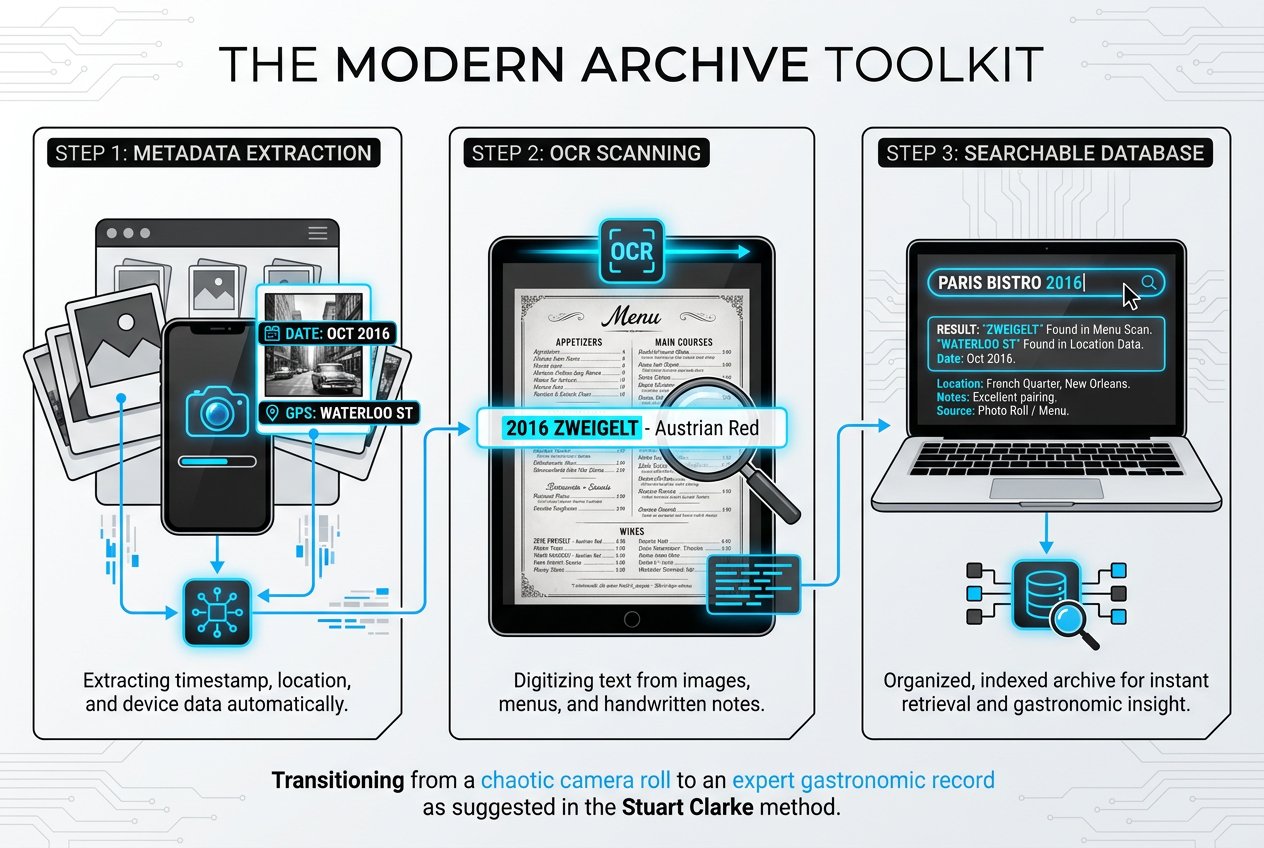 Utilize modern tools like OCR scanning and metadata extraction to rescue your 2016 dining memories and build a searchable professional gastronomic archive on your device.
The Stuart Clarke Method, Digitized
Adopting Clarke's four-pillar framework (Context, Dish Specifics, Wine Pairing, Atmosphere) requires discipline, but the payoff is enormous. The difference between "good pasta" and "the cacio e pepe at Flavio al Velavevodetto, October 2016, paired with a 2014 Frascati Superiore - silky texture, sharp pecorino, visible black pepper" is the difference between a vague memory and a replicable experience.
Modern food review apps make this easier by providing structured fields: restaurant name, dish name, date, price, rating, pairing notes, and open-text descriptions. You're not writing a blog post - you're filling out a form that will make sense to you ten years later.
How to Create a Searchable Food Archive From Your Camera Roll
Building a searchable food archive from a decade of unsorted photos is a weekend project, not a career. Here's the step-by-step process that actually works, tested by people who've rescued 2,000+ food photos from digital oblivion.
Step 1: Export and Centralize Pull all your food photos into a single location. If you've switched phones multiple times since 2016, this means consolidating photos from old iCloud backups, Google Photos archives, and any external hard drives where you dumped files "for safekeeping." The goal is one master folder containing every food photo you've ever taken.
Step 2: Use AI-Powered Photo Tagging Modern AI tools can identify dishes, ingredients, and even cuisines with reasonable accuracy. Google Photos, Apple Photos, and dedicated food apps all offer automatic tagging. Let the AI do the first pass - it will correctly identify 70-80% of images as "pasta," "sushi," "steak," etc. This creates a baseline taxonomy you can refine manually.
Step 3: Manual Curation of High-Value Meals You don't need to annotate every photo. Focus on the meals that actually mattered - the ones where you can still recall specific details. For those 50-100 high-value meals from 2016-2026, apply the Stuart Clarke method: add the restaurant name, dish specifics, date, and any memorable context. This is where keeping a food journal transitions from busywork to genuine memory preservation.
Step 4: Create a Custom Tagging System Generic categories (Italian, Asian, Dessert) don't scale. You need a tagging system that reflects how you actually search. "Worth Ordering Again," "Skip the Appetizers," "Best Carbonara," "Go Before 7 PM for No Wait" - these are the kinds of tags that make your archive useful five years later.
Step 5: Export to Multiple Formats Don't trust any single platform to exist forever. Export your data annually to CSV, PDF, or another portable format. The best food tracking apps allow full data export so you're never locked in. Think of this as insurance against platform shutdowns or subscription lapses.
Step 6: Link Photos to External Notes For critical meals, create a linked note document with full prose descriptions. Your photo archive captures the image; your notes capture the story. When you're trying to remember the exact wine pairing from that 2016 bistro meal, you'll thank yourself for spending five minutes writing it down.
The entire process takes 4-6 hours spread over a weekend. The payoff: a decade of dining history transformed from a chaotic camera roll into a searchable, sortable, genuinely useful archive that gets more valuable every year you maintain it.
Frequently Asked Questions
What is a gastronomic restaurant?
A gastronomic restaurant is an establishment that emphasizes culinary artistry, ingredient quality, and a refined dining experience over convenience or volume. These restaurants typically feature chef-driven menus, seasonal ingredients, sophisticated wine pairings, and intentional presentation. The term "gastronomic" signals a focus on the craft of cooking as an art form, not just a service. In practice, gastronomic restaurants range from Michelin-starred fine dining establishments to innovative neighborhood bistros where the chef's expertise and the quality of ingredients define the experience. What separates a gastronomic restaurant from a standard eatery is the intention behind every element - the sourcing, the technique, the plating, and the atmosphere all serve the goal of creating a memorable, elevated meal.
What is the best app for food journaling?
The best app for food journaling depends on whether you're tracking nutrition or tracking memory. If you're focused on macros and calories, apps like MyFitnessPal or Cronometer are industry standards. But if you're a serious foodie trying to remember where you had the best carbonara of your life, you need something designed for culinary archiving, not diet tracking. Look for apps that allow dish-level ratings, custom tagging by restaurant or cuisine type, and full-text search across your notes. The key feature is exportability - you want to own your data, not rent it. A strong food journal app should function as your private database of every meal that mattered, with photos, location data, pricing, and detailed notes all searchable from your phone. Generic notes apps fall apart after 100 entries; specialized tools scale to thousands.
What restaurants are no longer around from 2016?
Many restaurants reviewed in 2016 have closed due to standard industry turnover, which typically sees 60% of new restaurants fail within their first three years. Some high-profile closures from that era include Noma's original Copenhagen location (it reopened in a new space with a different concept), several New York establishments that couldn't survive rent increases, and independent bistros that were casualties of COVID-19 shutdowns between 2020-2021. For specific restaurants mentioned in 2016 Gastronome reviews, tracking their current status requires checking recent review sites, Google Maps updates, or the restaurant's own social channels. The broader lesson: documenting your own dining history matters precisely because restaurants are ephemeral. That extraordinary meal you had in 2016 might not be replicable in 2026, which makes your personal archive the only record that a specific moment in culinary history ever existed.
What is the best restaurant review site?
The best restaurant review site in 2026 is whichever one matches your specific use case. For crowd-sourced opinions on whether a restaurant is "good," Yelp and Google Reviews still dominate, with 74% of diners using social media to inform restaurant choices according to GourmetPix. For independent, professional criticism with consistent methodology, niche sites like TheGastronome.net or city-specific publications (Eater, Infatuation) offer higher editorial standards. For dish-level intelligence - knowing which specific items are worth ordering rather than just whether the restaurant is "4 stars" - you need platforms that focus on individual dishes rather than venue averages. The critical gap: most review sites are designed for discovery, not memory. If you want to remember your own meals, you need a personal tracking system rather than relying on public platforms that optimize for engagement over utility.
How expensive was a meal at Noma?
At its peak before closing the original location in 2016, a meal at Noma in Copenhagen cost approximately 2,000-3,000 Danish Kroner (roughly $300-$450 USD) per person for the tasting menu, not including wine pairings. Wine pairings typically added another $150-$250 per person, and the full experience with premium beverages could easily exceed $700-$800 per guest. When Noma reopened in its new location with a seasonal concept model, pricing remained in a similar range, though the structure changed to reflect different seasonal menus (vegetable season, seafood season, game season). The cost reflected not just the meal itself but the entire R&D operation behind Noma's foraging program, test kitchen, and staff training. For perspective, that price point was on par with other top-tier destinations like Eleven Madison Park or The French Laundry during the same period. The investment wasn't just in the food - it was in experiencing the leading edge of New Nordic cuisine at its creative peak.
What is the best app to keep track of restaurants?
The best app to keep track of restaurants is one that lets you document dishes, not just venues. Most people make the mistake of using Yelp or Google Maps to "save" restaurants, but that only tells you where to go - it doesn't capture what to order or why a specific meal mattered. Look for apps that allow you to rate individual dishes, add photos tied to specific menu items, tag by cuisine or neighborhood, and write detailed notes that are fully searchable later. Key features include offline access (so you can review your own history while traveling), export functionality (so you own your data), and a tagging system flexible enough to reflect how you actually think about food. Generic list apps don't scale past 50 entries; specialized restaurant tracking tools handle thousands of meals without breaking. The goal isn't just to remember where you ate - it's to build a personal culinary database that gets more valuable every year you use it.
What is the 30/30/30 rule for restaurants?
The 30/30/30 rule for restaurants is an operational guideline used by restaurateurs to manage costs and maximize profitability. It states that roughly 30% of revenue should go to cost of goods sold (food and beverage), 30% to labor, and 30% to overhead (rent, utilities, insurance, marketing), leaving approximately 10% as net profit. In practice, these percentages vary significantly by restaurant type - fine dining establishments often run higher food costs due to premium ingredients, while fast-casual spots might achieve lower labor percentages through efficient systems. The rule serves as a baseline for financial health, not a rigid formula. For diners, understanding this breakdown explains why restaurant prices are what they are: that $40 entree reflects not just the $12 worth of ingredients on the plate but the entire ecosystem required to deliver it - the chef's expertise, the rent on prime real estate, the server's wage, and the thin margin that keeps the doors open.
Is there an app to keep track of restaurants?
Yes, multiple apps exist specifically to keep track of restaurants, but most fall into two categories: generic discovery tools (Yelp, Google Maps) that let you "save" venues, and specialized food tracking apps designed for serious documentation. The former works if you just want a list of places to try; the latter is essential if you're building a personal culinary archive. The best restaurant tracking apps allow you to organize by dish, not just venue - because knowing you loved "that Italian place" is useless if you can't remember which specific pasta made the meal memorable. Look for apps that support custom tagging (by cuisine, neighborhood, price range, "date night spots," "business lunch approved"), photo organization tied to specific dishes, and full-text search across all your notes. The killer feature: exportability. Your data should be yours to keep, independent of the app's long-term viability. A strong tracking app turns your dining history into a searchable database that compounds in value over time.
Your camera roll from 2016 is a time capsule. Somewhere in those 2,400 photos is the meal that made you realize food could be more than fuel - it could be art, memory, and identity all at once. The difference between remembering that moment and losing it forever comes down to one decision: will you build a system to capture what matters, or will you keep scrolling past your own history hoping muscle memory kicks in?
The Gastronome's 2016 reviews survive because Stuart Clarke built a methodology. Your own dining history deserves the same rigor. Not for publication. Not for social proof. For you, ten years from now, when you're trying to remember why that specific meal changed everything.