
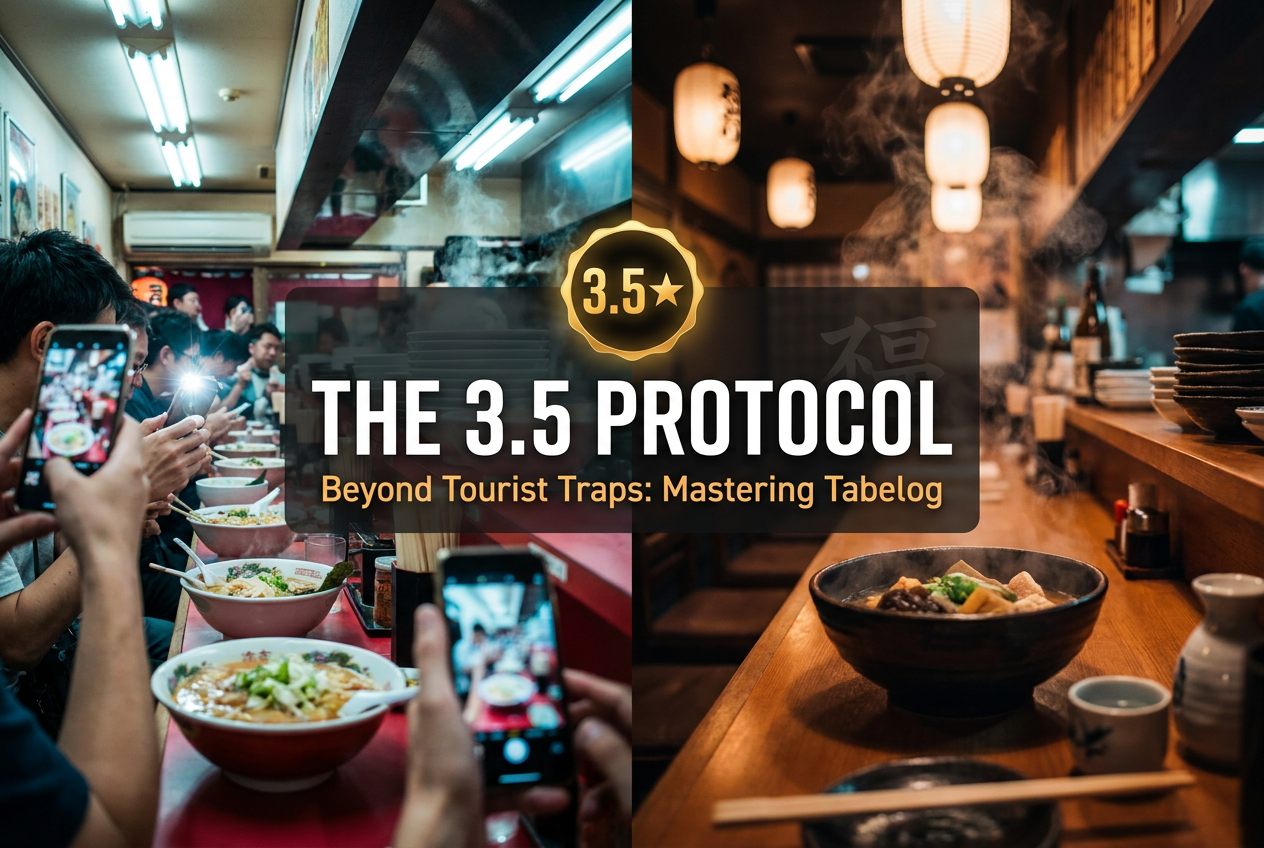
Beyond Tourist Traps: The Serious Foodie’s Guide to the Japanese Yelp
John the smoothie monster
John lives for smoothie bowls and cold-pressed juices. He uses Savor to remember his best blends.
Beyond the Tourist Traps: The Serious Foodie’s Guide to the "Japanese Yelp" (and the 3.5 Protocol) Picture this: You’re three days into Tokyo, armed with a...
Beyond the Tourist Traps: The Serious Foodie’s Guide to the "Japanese Yelp" (and the 3.5 Protocol)
Picture this: You’re three days into Tokyo, armed with a Google Maps screenshot and a 4.8-star ramen spot. You walk in. English menu. Tourists everywhere. The tonkotsu broth tastes like dishwater with soy sauce. You’ve been had.
Most travelers use Google Maps and eat at 4.5-star tourist traps. Serious foodies use the 3.5 Protocol. This guide decodes Tabelog, provides the workflow for booking the unbookable, and explains how to turn your Japanese food journey into a searchable archive instead of a cluttered camera roll.
Table of Contents
- Why Yelp is Irrelevant in Japan
- Mastering Tabelog: The True "Japanese Yelp"
- The Serious Foodie Workflow
- The Unsearchable Camera Roll Cure
- Frequently Asked Questions
Why Yelp is Irrelevant in Japan
Here’s what nobody tells you about Western review platforms in Japan: they’re optimized for tourists, not food quality.
The cultural divide runs deeper than language. In the United States, a 4.0-star rating means "pretty good." In Japan, a 3.0 means the same thing. This isn’t semantics - it’s a fundamental difference in how quality gets measured and rewarded.
Western Grade Inflation vs. Japanese Conservative Rating
American review culture operates on what I call "default generosity." Unless something goes catastrophically wrong, most diners start at four stars and work backward. The result? Rating compression. A 3.8 is considered mediocre. A 4.5 is merely acceptable. Anything below 4.0 might as well be toxic.
Japanese reviewers don’t work this way. A 3.0 on Tabelog signals a solid, well-executed meal. A 3.5 indicates excellence worth seeking out. A 4.0? You’ve found something legendary - a place where every element of execution, ingredient quality, and technique has reached near-perfection.
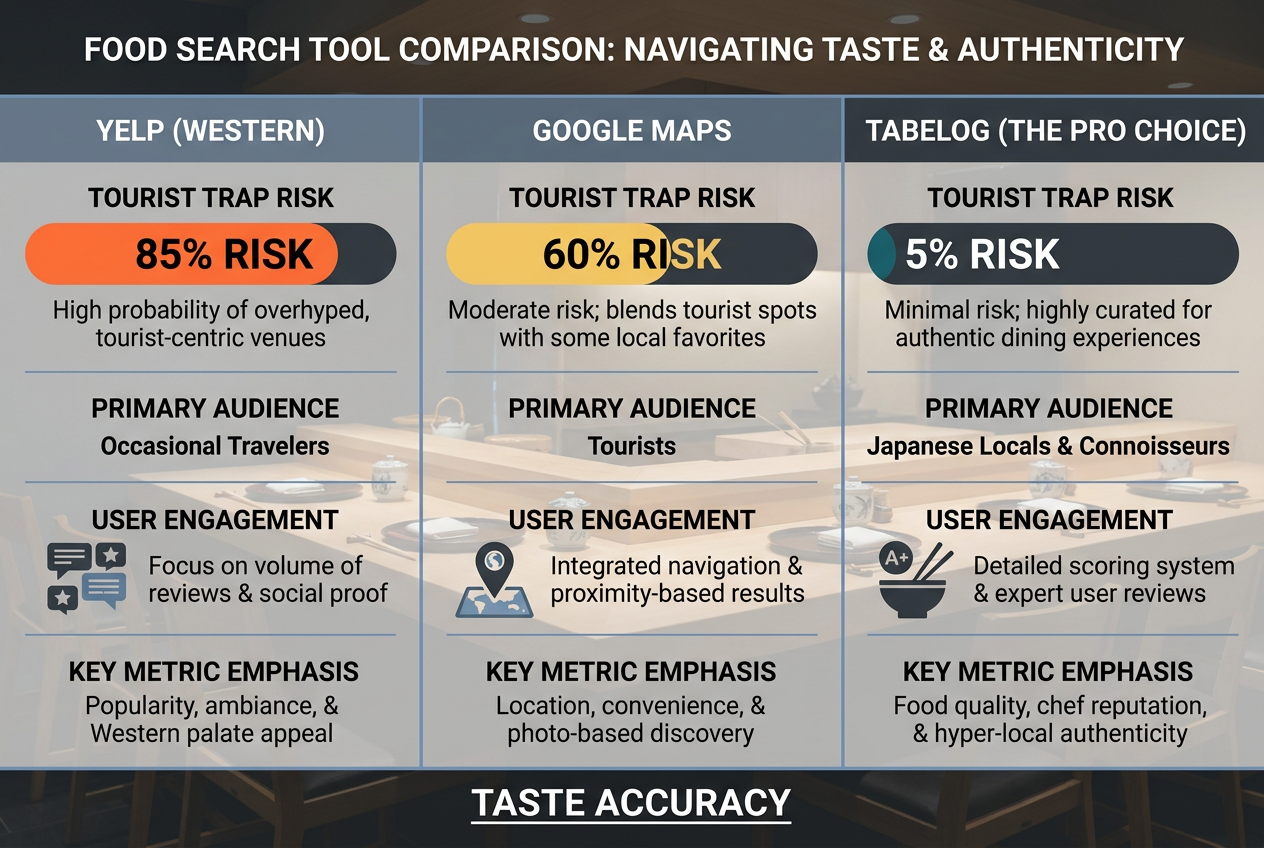 While Google and Yelp often surface tourist-heavy spots, Tabelog provides a data-driven look at where Japanese culinary experts actually dine, significantly reducing the risk of a mediocre meal.
The Google Maps Problem
Search "ramen near Shinjuku Station" on Google Maps right now. The top results cluster around 4.6 to 4.8 stars. Scroll through the photos. Notice anything? English signage. International tourists holding up peace signs. Generic bowls that look identical to what you’d find in Los Angeles or London.
These aren’t bad restaurants. They’re optimized restaurants - designed to appeal to Western palates, streamlined for efficiency, marketed for Instagram. The problem isn’t that the food is terrible. It’s that you flew 13 hours to eat something you could have found at home.
Real Tokyo locals aren’t using Google Maps to find ramen. They’re using station-based discovery on Tabelog, filtering by the Hyakumeiten badge, and looking for that 3.5 threshold. The mechanics matter less than the mindset: they’re searching for craft, not convenience.
If you’re serious about eating well in Japan, you need to stop relying on generic star ratings and start thinking like a Japanese diner.
Mastering Tabelog: The True "Japanese Yelp"
Let’s settle this immediately: Tabelog isn’t "Japanese Yelp." Yelp is American Tabelog - and a poor approximation at that.
Launched in 2005, Tabelog has become the definitive restaurant discovery platform in Japan, with over 100 million monthly users and more than 800,000 listed establishments. The site’s influence is so profound that a 0.1-point increase in rating can translate to measurable revenue gains for restaurants.
The 3.5 Rule: Why Elite Starts Here
The single most important number in Japanese dining is 3.5. Memorize it.
On Tabelog’s 5-point scale:
- 3.0 = Solid - A well-executed meal with no major flaws
- 3.5 = Outstanding - A destination-worthy experience showcasing exceptional technique or ingredients
- 4.0 = Legendary - Reserved for the absolute pinnacle of a cuisine category
Only 3-4% of restaurants on Tabelog achieve a 3.5 rating or higher. The filtering effect is brutal and efficient. You’re not just avoiding bad meals - you’re automatically eliminating 96% of mediocre ones.
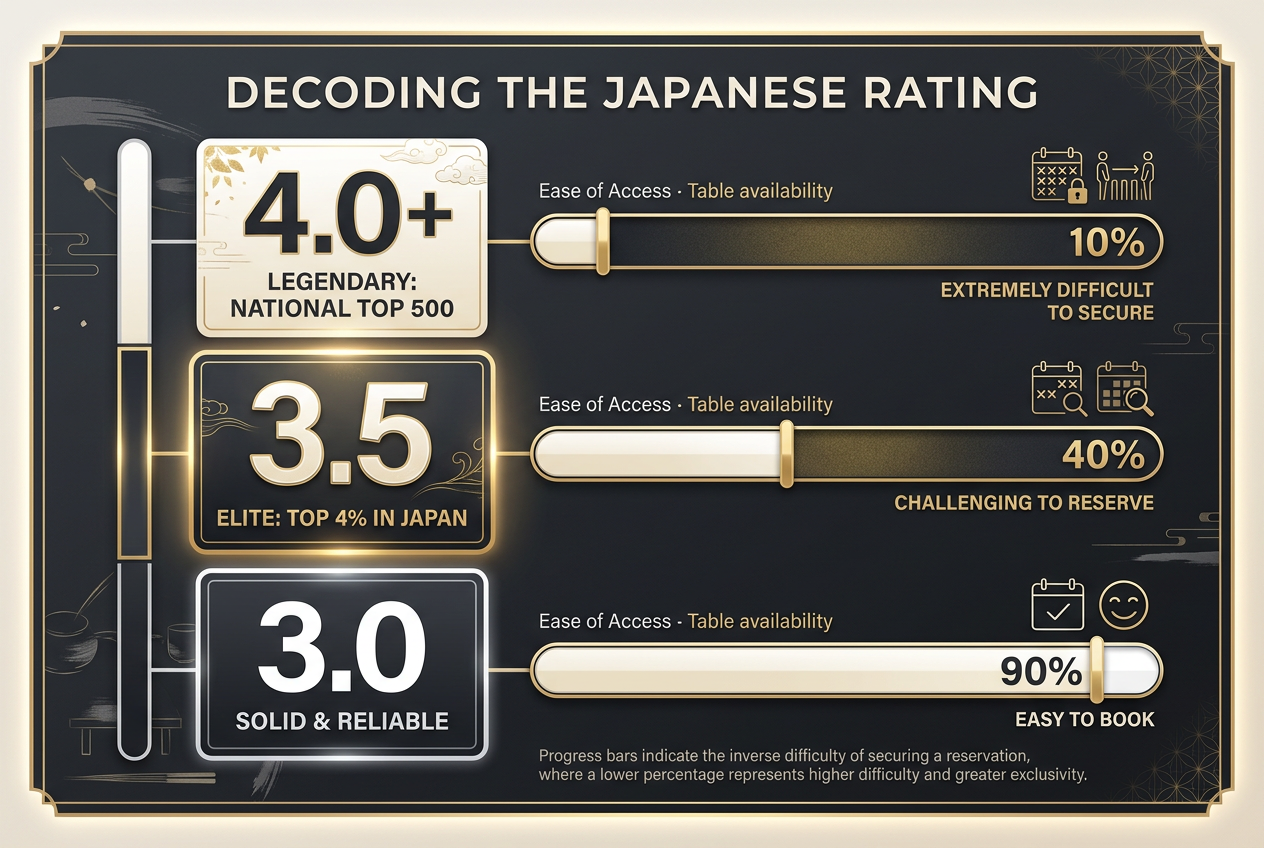 In Japan, a 3.5 rating is the threshold for excellence. Understanding this conservative scale is the first step to unlocking the country’s most prestigious and authentic dining experiences.
Compare this to Yelp, where roughly 70% of restaurants maintain a 3.5-star average or higher. The signal-to-noise ratio is incomparable.
The 2025 Update: Multilingual Interface, Local Soul
In a major shift for international travelers, Tabelog launched comprehensive multilingual support in late 2024. The interface now supports English, Chinese, and Korean, with machine-translated reviews appearing alongside Japanese originals.
Critical limitation: The translation layer is functional but not flawless. You’ll encounter awkward phrasing and occasional mistranslations. More importantly, the depth of review content remains heavily weighted toward Japanese-language posts. The most valuable insights - specific dish recommendations, insider tips about timing and reservations - often live in untranslated text.
My recommendation: Use the English interface for navigation and basic research. When you identify a serious contender, run the top Japanese reviews through Google Translate or DeepL. The extra two minutes matter.
Decoding "Hyakumeiten" (百名店): The 100 Famous Stores
Every year, Tabelog releases Hyakumeiten lists - curated compilations of the top 100 restaurants in specific categories. These aren’t algorithm-generated popularity contests. They’re editorially-curated lists that consider rating, review volume, consistency, and cultural significance.
Categories include:
- Ramen (ラーメン)
- Curry (カレー)
- Tonkatsu (とんかつ)
- Sushi (寿司)
- Yakitori (焼き鳥)
- Izakaya (居酒屋)
A Hyakumeiten badge is immediate validation. It signals that a restaurant isn’t just highly rated - it’s culturally significant within its category. For travelers with limited time, this badge provides instant triage. If a 3.5-rated restaurant also carries the Hyakumeiten designation, you’ve found something special.
To search for Hyakumeiten restaurants: Use Tabelog’s advanced filters, select your cuisine category, and toggle the "百名店" option. The list refreshes annually, ensuring the selections remain current.
For more on how to systematically track and rate the dishes you discover, check out how to build a personal restaurant library that goes beyond random phone photos.
The Serious Foodie Workflow
Discovering great restaurants in Japan isn’t difficult. It’s methodical. Here’s the exact process I use - and the one that eliminates 90% of dining disappointments.
 Master the logistics of the Japanese food scene by moving from station-based discovery to automated booking and digital archiving, ensuring every meal is both legendary and memorable.
Step 1: Identify Using Station-Based Search
Japanese people don’t search by neighborhood. They search by train station and exit.
This matters more than you’d think. Tokyo Station has over 200 exits. Shinjuku Station handles 3.6 million passengers daily across multiple train lines and a labyrinth of underground passages. "Near Shibuya" is functionally meaningless. "Shibuya Station, Hachiko Exit, 5-minute walk" is precision.
Open Tabelog. Instead of searching by cuisine type first, search by your exact location: the station name plus exit designation. Example: "新宿駅東口" (Shinjuku Station East Exit).
This approach mirrors local behavior. You’re not just filtering by proximity - you’re filtering by the mental map Japanese diners actually use. The restaurants that appear aren’t optimized for tourists searching "best ramen Tokyo." They’re optimized for locals searching "weekday lunch near my office exit."
The difference is everything.
Step 2: Filter by Rating and Hyakumeiten Badge
Once you’ve identified your station zone, apply two filters:
- Minimum rating: 3.5
- Hyakumeiten badge: Yes
Don’t worry about review volume or recency at this stage. Tabelog’s rating algorithm already factors in review frequency and time decay. A restaurant maintaining a 3.5 over 500+ reviews is statistically more reliable than one with a 3.8 over 20 reviews.
The Hyakumeiten filter is optional but powerful. It reduces decision paralysis. Instead of choosing between 40 well-rated ramen shops, you’re choosing between the 8 that made the annual Top 100 list.
Step 3: Book Using AutoReserve or TableCheck
Here’s where most international travelers hit a wall: reservation systems.
Many top-tier Japanese restaurants don’t accept walk-ins. They require advance reservations - and their booking systems often demand a Japanese phone number or reject foreign credit cards. Even if you speak Japanese, the friction is real.
Two services have solved this problem:
AutoReserve - A concierge-style service where you submit a reservation request (restaurant name, date, time, party size), and a human agent books it on your behalf. Fee: approximately ¥440 ($3) per reservation. The charge functions as a no-show deterrent and quality filter. Restaurants know AutoReserve users are serious diners, not casual tourists.
TableCheck - A more automated platform that integrates directly with participating restaurants. Many high-end establishments in Tokyo, Kyoto, and Osaka use TableCheck as their primary reservation system. Interface is fully bilingual. Payment is processed upfront in many cases, eliminating the credit card compatibility issue.
Both platforms are legitimate. AutoReserve offers broader coverage (they can book almost anywhere), while TableCheck provides a more seamless digital experience for participating restaurants.
The ¥440 booking fee isn’t a scam - it’s a signal. In Japan’s dining culture, no-shows are considered deeply disrespectful. The fee creates accountability. For context, many Michelin-starred kaiseki restaurants require deposits of ¥10,000-¥30,000 per person. A $3 concierge fee is negligible.
If you’re building a comprehensive food strategy for Japan, you’ll want a system for organizing restaurant photos and memories after the meal - because that 12-course kaiseki tasting won’t archive itself.
Step 4: Log Every Meal in a Searchable System
You just finished an extraordinary meal. Seventeen courses. Perfect rice. Uni that tasted like the ocean. You took 40 photos.
Now what?
Most travelers dump those photos into their camera roll, where they’ll vanish into a graveyard of 12,000 unsorted images. Six months later, you’ll remember the feeling but not the name. You’ll remember the location vaguely - "somewhere near that station" - but not the specific restaurant.
This is where serious food tracking separates amateurs from professionals.
Create a Personal Food Map
A searchable food archive requires three elements:
- Geolocation - Exact restaurant address, cross-referenced with the station/exit
- Dish-Level Detail - Individual photos and notes for each course or dish
- Personal Rating Context - Your own scoring system that accounts for price, setting, and specific taste preferences
Generic note-taking apps won’t cut it. You need structured fields for cuisine type, price range, formality level, and - most importantly - specific dishes. The goal isn’t to remember that you ate at "some sushi place in Ginza." It’s to remember that the chu-toro at Sushi Saito was transcendent while the tamago was surprisingly forgettable.
For travelers who take this seriously, tools designed specifically for food memory capture become essential. Instead of relying on random screenshots and vague recollections, apps that let you rate individual dishes transform your camera roll into an actual culinary database.
The Unsearchable Camera Roll Cure
Let’s address the elephant in the room: your phone’s photo library.
You’ve taken 2,000 food photos this year. You can name maybe 50 of the restaurants. You can recall the exact dish in about 20 of them. The rest? A beautiful, useless graveyard of expensive meals you can’t reconstruct.
This isn’t a memory problem. It’s an architecture problem.
The "I Had the Best Sushi of My Life" Problem
Every food traveler has this story. You stumbled into an incredible restaurant - maybe because a local friend recommended it, maybe because you got lost and hungry. The meal changed your understanding of a cuisine. You took photos. You meant to write down the name.
You didn’t.
Now it’s six months later. You’re trying to recommend the place to a friend visiting Tokyo. You remember it was "in Ginza, I think, maybe near the subway, definitely basement level." You remember the chef was older, maybe 60s. You remember the fish was extraordinary.
This description is useless.
Building a Personal Food Map
Here’s the systematic solution:
Immediate Capture (During or Right After the Meal):
- Photograph the restaurant exterior or signage
- Screenshot the Google Maps pin with the exact address
- Capture the menu or receipt showing the restaurant name in Japanese
- Take individual photos of each significant dish
- Record a 30-second voice memo with your immediate impressions
Post-Meal Archiving (Same Evening):
- Create a structured entry with: restaurant name (English + Japanese), full address, station/exit reference
- List each dish photographed with your personal rating
- Note price point, formality level, and reservation requirements
- Tag by cuisine type, neighborhood, and any special characteristics
Quarterly Review (Every 3 Months):
- Revisit your entries and add reflective notes
- Identify patterns in your preferences
- Create curated lists: "Tokyo sushi ranked," "Best yakitori in Kyoto," "Ramen deep cuts"
This system transforms your food photos from a chaotic archive into a living reference library. You’re not just documenting meals - you’re building a permanent, searchable record of your culinary education.
For serious foodies who’ve accumulated hundreds of restaurant visits across multiple countries, the difference between a camera roll and an actual database is profound. Tools designed to track restaurant meals systematically turn fleeting memories into permanent reference material.
The goal isn’t nostalgia. It’s utility. When you return to Tokyo in two years, you shouldn’t be starting from zero. You should be consulting your own curated archive of 40+ meals, ranked by category, with notes on what to order and what to skip.
Stop Losing Your Best Meals
Your food memories deserve better than the camera roll graveyard. Every extraordinary meal you’ve eaten - that perfect bowl of tsukemen in Shinjuku, the omakase that redefined your understanding of sushi, the yakitori stand where the chef remembered your face - all of it can disappear if you don’t have a system.
The Japanese have mastered the art of culinary excellence. They’ve also mastered the art of culinary documentation. Tabelog isn’t just a review platform - it’s a cultural institution where millions of diners contribute to a collective knowledge base about where to eat and what to order.
You deserve the same level of precision for your own dining history. Not because you’re trying to become a food critic, but because great meals are worth remembering in detail.
If you’re ready to stop losing your best meals to the void of your camera roll, start building a searchable food diary that actually works. Your future self - trying to remember that incredible unagi place "somewhere in Tokyo" - will thank you.
Frequently Asked Questions
What is the Japanese equivalent of Yelp?
Tabelog is the dominant restaurant review platform in Japan, functioning as the de facto "Japanese Yelp." Launched in 2005, it hosts over 800,000 restaurant listings and uses a conservative 5-point rating scale where 3.5+ indicates exceptional quality. Unlike Yelp’s tourist-friendly interface, Tabelog reflects local dining culture and maintains much stricter rating standards - only 3-4% of restaurants achieve 3.5 or higher. The platform added English language support in 2024, though the most detailed reviews remain in Japanese.
Why is a 3.5 rating on Tabelog considered excellent?
Japanese rating culture operates on fundamentally different standards than Western platforms. A 3.5 on Tabelog represents the top 3-4% of all restaurants - places demonstrating exceptional technique, ingredient quality, or cultural significance. This contrasts sharply with American review inflation, where 3.5 would be considered mediocre. The conservative scale means a 3.0 indicates a solid, well-executed meal, 3.5 marks destination-worthy excellence, and 4.0 is reserved for legendary establishments at the absolute pinnacle of their category.
How do I make restaurant reservations in Japan without a Japanese phone number?
Use AutoReserve or TableCheck. AutoReserve functions as a concierge service where human agents book on your behalf for approximately ¥440 ($3) per reservation - the fee acts as a no-show deterrent. TableCheck integrates directly with participating restaurants and offers a fully bilingual interface with upfront payment processing. Both services solve the common barriers international travelers face: Japanese-only booking systems, foreign credit card rejections, and phone number requirements. Many high-end establishments now prefer these platforms over traditional phone bookings.
What does the Hyakumeiten badge mean on Tabelog?
Hyakumeiten (百名店) translates to "100 Famous Stores" and represents Tabelog’s annual curated lists of top restaurants in specific cuisine categories like ramen, sushi, curry, and tonkatsu. These aren’t algorithm-generated rankings - they’re editorially selected based on rating, review volume, consistency, and cultural significance. A Hyakumeiten badge signals that a restaurant isn’t just highly rated but culturally important within its category. For time-limited travelers, this badge provides immediate validation and eliminates decision paralysis when choosing between dozens of well-rated options.
How should I search for restaurants on Tabelog like a local?
Search by train station and exit, not by neighborhood. Japanese diners navigate by precise station geography - "Shibuya Station, Hachiko Exit" rather than "near Shibuya." Enter the station name in Japanese (新宿駅東口 for Shinjuku Station East Exit) and apply filters for minimum 3.5 rating and Hyakumeiten badge status. This station-based approach surfaces restaurants optimized for local discovery rather than tourist searches, dramatically improving result quality and reflecting how Japanese people actually find places to eat.
Can I use Tabelog effectively without speaking Japanese?
Yes, though with limitations. Tabelog’s 2024 multilingual update provides English interface navigation and machine-translated reviews. However, the deepest insights - specific dish recommendations, timing tips, insider reservation strategies - often remain in untranslated Japanese reviews. Use the English interface for basic research and filtering, then run top Japanese reviews through Google Translate or DeepL when you’ve identified serious contenders. The extra effort matters: those untranslated reviews frequently contain the information that separates a good meal from an extraordinary one.
Why do some Japanese restaurants charge booking fees?
The ¥440 ($3) booking fee charged by services like AutoReserve functions as both a no-show deterrent and a quality signal. In Japanese dining culture, no-shows are considered deeply disrespectful - they represent wasted ingredients, lost revenue, and broken trust. The fee creates accountability and signals to restaurants that you’re a serious diner, not a casual tourist. Many Michelin-starred kaiseki restaurants require deposits of ¥10,000-¥30,000 per person. By comparison, a $3 concierge fee is nominal and ensures access to restaurants that would otherwise be unavailable to international visitors.
How do I avoid tourist trap restaurants in Tokyo?
Avoid Google Maps’ top results near major tourist areas - those 4.8-star ratings typically indicate tourist optimization, not food quality. Use Tabelog’s station-based search, filter for 3.5+ ratings and Hyakumeiten badges, and look for restaurants where reviews are predominantly in Japanese. Tourist traps reveal themselves through English signage, picture menus, and international customer photos. Elite local spots often lack English menus, require reservations, and maintain lower visibility on Western platforms. The 3.5 Protocol - combining Tabelog’s conservative ratings with station-based discovery - systematically eliminates mediocre options and surfaces restaurants Japanese diners actually frequent.