
Why You Should Track Your Favorite Restaurants by Signature Dish
Alex the juice queen
Alex hunts for the best juice bars and presses. She rates every sip and saves her favorites in Savor.
How to Track Your Favorite Restaurants by Signature Dish (Not by Stars) Your camera roll is a graveyard. Somewhere between photos 847 and 2,103, there's a...
How to Track Your Favorite Restaurants by Signature Dish (Not by Stars)
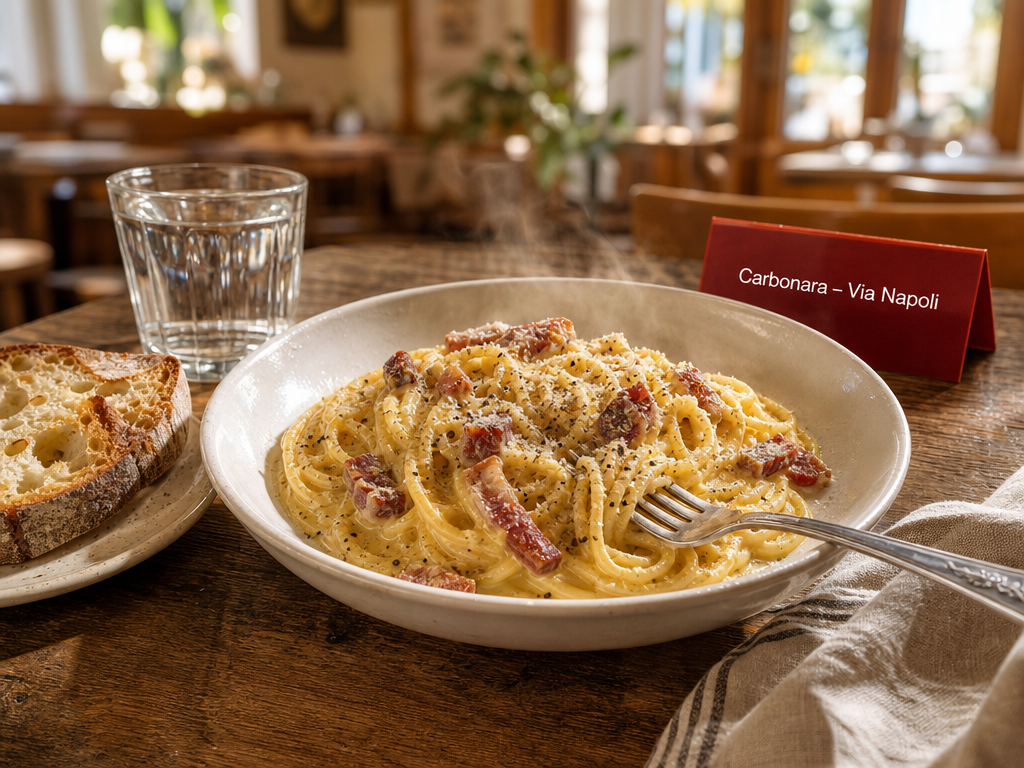
Your camera roll is a graveyard. Somewhere between photos 847 and 2,103, there's a picture of the best carbonara you've ever had. You remember the moment - the silky sauce, the pepper bite, the way the guanciale fat glistened - but you have no idea which restaurant it came from or even which city you were in.
This isn't a memory problem. It's an architecture problem.
Most restaurant tracking systems are built around the wrong unit of measurement. Yelp, Google Reviews, and even newer social platforms like Beli ask you to rate venues, not dishes. But serious food lovers don't form memories around restaurants - they form memories around specific plates. That perfect bite of tonkotsu ramen. The duck confit that made you reconsider everything you knew about French cooking. The margherita pizza that justified your entire trip to Naples.
The camera roll approach is where most dining memories go to die. The average user spends 3 minutes searching their camera roll for a specific food photo from 6 months ago, and that's assuming they remember enough details to even start the search. It's a system designed for scrolling, not for retrieval. Not for curation. And certainly not for answering the question that actually matters: "What should I order next time I'm here?"
This guide is about building something better. A searchable culinary legacy. A private database where you track not just where you ate, but what you ate, and - critically - whether it's worth ordering again.
Table of Contents
- The Restaurant vs. Dish Tracking Problem
- Why Dish-Level Metadata Matters More Than Star Ratings
- The Best Apps for Tracking Dishes (Not Just Restaurants)
- The Power User Alternative: Building a Notion or Airtable System
- The Bill-Time Habit: How to Log Accurately Without Killing the Vibe
- App Comparison: Features That Actually Matter
- Frequently Asked Questions
The Restaurant vs. Dish Tracking Problem
Here's the fundamental issue with traditional restaurant reviews: a 4.5-star rating tells you almost nothing about what you should actually order.
Consider a neighborhood Italian spot. The cacio e pepe might be transcendent - a 9.8 out of 10, the kind of dish that makes you understand why people write sonnets about Roman cuisine. But the tiramisu is a 5.2 at best, a forgettable afterthought assembled from grocery-store ladyfingers. On Yelp, both experiences average out to a middling venue score that communicates nothing useful.
Restaurant-level tracking collapses essential information. It treats a meal as a monolithic experience when the reality is far more granular. You don't return to a restaurant because it was "good" - you return because the braised short rib was extraordinary, even if the appetizers were forgettable and the service was merely adequate.
Dish-level tracking changes the entire framework. Instead of asking "Is this restaurant worth visiting?" you're asking more precise, more actionable questions:
- Which specific dishes justify the trip?
- What should I skip on my second visit?
- When I recommend this place to a friend, which plate should I insist they order?
This isn't about being pedantic. It's about building a system that reflects how serious food lovers actually experience restaurants. You remember dishes, not venues. Your taste memory is organized around flavor profiles, textures, and specific culinary moments - not business names and aggregate star ratings.
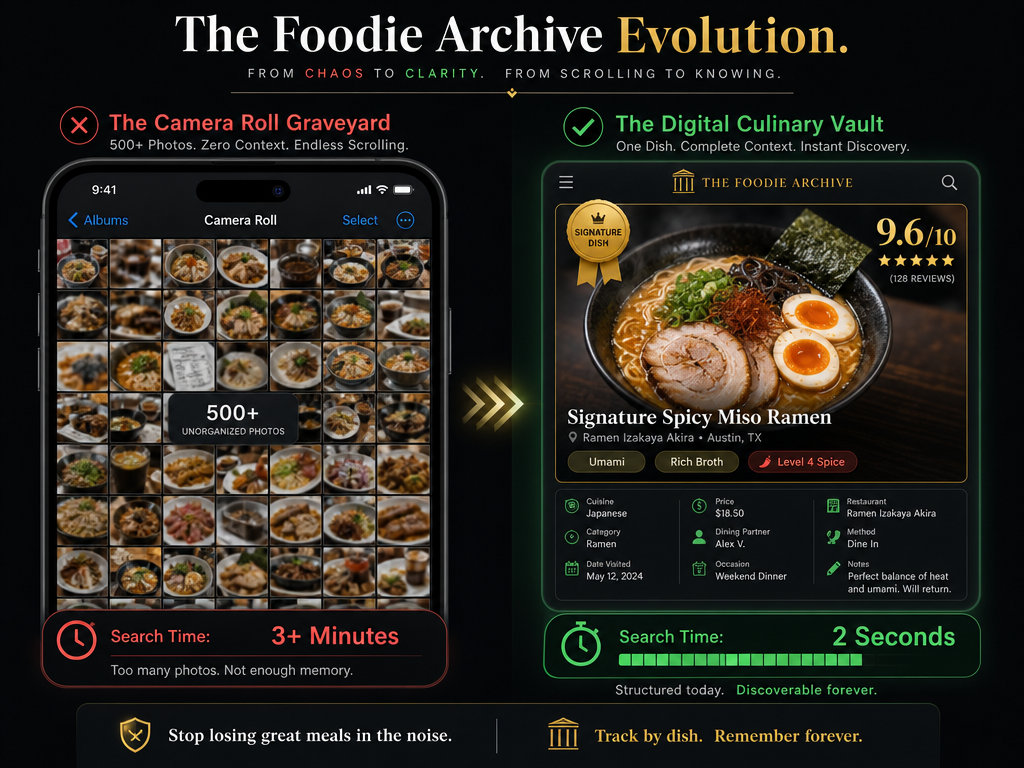 Transform your dining history from a chaotic camera roll into a searchable culinary legacy by prioritizing dish-level metadata over simple photo storage.
The shift from restaurant-level to dish-level tracking represents the professionalization of personal food curation. It's the difference between keeping a journal and maintaining an archive. Between remembering vaguely and knowing precisely. Between scrolling your camera roll and querying a database.
Why Dish-Level Metadata Matters More Than Star Ratings
A star rating is a summary statistic. It's useful for quickly sorting a list of options, but it's a lossy compression of a much richer experience. When you reduce a dish to a number between 1 and 5, you're discarding the very information that makes a meal memorable.
Dish-level metadata captures the details that star ratings erase:
Texture notes. Was the pork belly crispy or tender? Was the pasta al dente or overcooked? A 4-star rating doesn't tell you that the duck skin shattered like glass or that the risotto had an unpleasant gumminess.
Intensity markers. How spicy was it, really? Was the sweetness subtle or overwhelming? A dish you rate as an 8 might be someone else's 4 if they can't handle heat, and vice versa. Metadata allows you to calibrate recommendations for different palates.
Re-order status. This is the most valuable field in your entire database. Not "Would I recommend this restaurant?" but "Would I order this exact dish again?" It's a binary decision that cuts through all ambiguity. If the answer is yes, you've identified a signature dish worth returning for.
Occasion context. Some dishes are extraordinary in the moment but impossible to recreate under different circumstances. That 9.5-rated uni pasta you had in Hokkaido was perfect at a specific time, in a specific place, with ingredients harvested that morning. Metadata lets you distinguish between a dish that's reliably excellent and one that required perfect conditions.
Price-to-value calibration. A $45 bowl of ramen hits differently than a $4 bowl, even if they're technically the same quality level. Tracking cost alongside ratings helps you build a more honest assessment of what's actually worth the money.
Traditional food apps ignore these dimensions because they're designed for discovery, not for memory. They want to answer "Where should I eat tonight?" not "What did I eat six months ago, and why did it matter?"
The most sophisticated food lovers build systems to track dishes they've tried precisely because they understand this limitation. They know that a 10-point scale without context is just noise. They're building taste libraries, not restaurant lists.
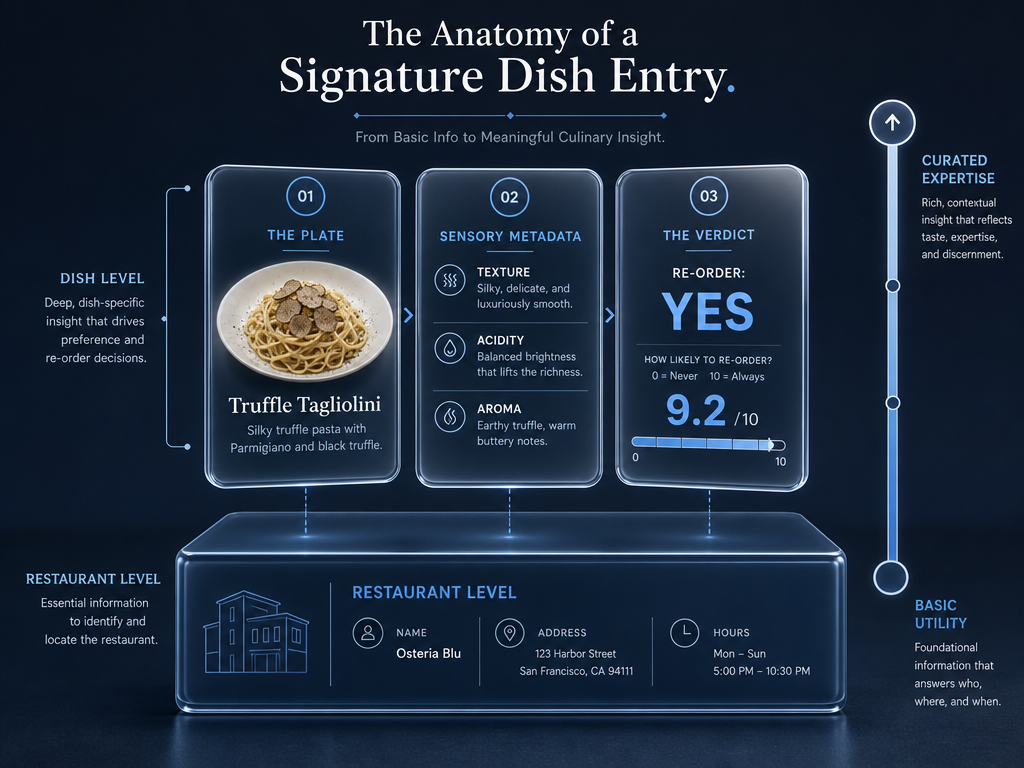 Beyond just 'where' you ate, tracking 'what' you ate allows you to build a sophisticated database of sensory notes and re-order recommendations.
If you're serious about remembering exceptional food, you need more than a camera roll full of pretty pictures and a vague sense that "this place was good." You need structure. You need searchability. You need metadata.
The Best Apps for Tracking Dishes (Not Just Restaurants)
The landscape of dish-tracking apps has matured significantly. These aren't calorie counters or meal-prep planners - they're purpose-built tools for serious food lovers who want to archive their dining history with the same rigor they'd apply to a wine collection or a music library.
Beli: Social Ranking with ELO Logic
Beli positions itself as "Letterboxd for food," and the comparison is apt. It's a social platform first, a tracking tool second. The core mechanic is ELO-based ranking: instead of assigning an absolute score, you compare dishes head-to-head. Carbonara vs. cacio e pepe. Tonkotsu ramen vs. shoyu ramen. The app builds your personal hierarchy through repeated comparisons.
The upside: ELO ranking forces you to clarify your preferences. You can't hide behind vague 4-star ratings - you have to commit to a position. Over time, this builds a surprisingly accurate portrait of your palate. Beli also includes friend maps, showing you where your trusted circle has eaten and what they've rated highly.
The limitation: Comparing dramatically different dining experiences always feels absurd. ELO works brilliantly within a single cuisine or category, but ranking across wildly different contexts produces results that are technically accurate but practically meaningless. The system also requires significant social engagement to unlock its full value - if your friends aren't on Beli, half the features become irrelevant.
Best for: Socially oriented food lovers who want their dining history to be a public portfolio, and who enjoy the gamification of head-to-head dish comparisons.
Savor: AI-Powered Private Archiving
Savor takes the opposite approach: it's a private vault, not a social network. The emphasis is on archival completeness and AI-assisted metadata. You photograph a dish, and Savor's recognition system attempts to identify it - "Looks like Margherita Pizza" - then prompts you for dish-level details: texture, spice level, re-order status.
The upside: The privacy model is refreshing in an era where every app wants to be a social platform. Your dining history is yours alone, searchable by dish type, location, cuisine, or date. The AI recognition isn't perfect, but it's useful enough to eliminate much of the manual data entry. You can organize your restaurant photos by dish without spending 20 minutes tagging each entry.
The limitation: There's no discovery layer. Savor doesn't suggest restaurants, doesn't show you what friends are eating, and doesn't aggregate user reviews. It's a personal database, nothing more. If you want recommendations, you'll need to supplement with another tool.
Best for: Archivists. People who dine out frequently enough to produce overwhelming camera roll clutter, and who value personal memory over social discovery. It's the anti-Yelp.
Crumble: Minimalist Friend-Circle Tracking
Crumble occupies a middle ground. It's built for small friend groups - not public social networks - and uses a Progressive Web App model that requires no install and two taps to add to the home screen.
The upside: The interface is stripped down to essentials. You rate dishes on a 0.1-precision scale (8.3, not just 8), add optional notes, and share lists with a curated circle of friends. No algorithmic feed. No influencer culture. Just a shared database of trusted opinions. The per-dish rating system is what makes it work - you're not evaluating a restaurant, you're evaluating a specific plate.
The limitation: It's designed for a specific user profile - someone with a tight-knit group of food-obsessed friends who are willing to adopt a new platform together. If you're a solo diner or if your social circle isn't into food logging, much of Crumble's value disappears.
Best for: Small dining crews who want a shared, private reference system without the noise of public review platforms. Think of it as a collaborative personal food database.
Yummi: Calendar-Based Food Diary
Yummi frames itself as a food diary rather than a review platform. The core UI is a calendar: each day shows thumbnails of what you ate, tagged with location and basic notes. The app has helped millions of foodies worldwide journal their food experiences, emphasizing memory over curation.
The upside: The visual calendar layout is intuitive for people who think chronologically. "What did I eat during my trip to Tokyo in March?" becomes an easy query. The geotagging features - "Foodprints" - create a map-based archive of your dining history.
The limitation: It's less structured for "what to order next" utility. Yummi is optimized for capturing a moment, not for building a searchable database of signature dishes. If you're trying to remember which ramen shop had the best broth, you'll need to scroll through calendar entries manually.
Best for: Travelers and visual thinkers who want a photo-first diary of their food life, organized by time and place rather than by cuisine or rating.
Truffle: Low-Effort Automated Sync
Truffle's pitch is radical simplicity: it auto-syncs with your credit card and Instagram stories. Order a meal, pay with your linked card, and Truffle logs the restaurant automatically. Post a story, and it captures that too. The goal is to reduce friction to near-zero.
The upside: It works passively. You don't have to remember to open an app and log your meal - Truffle does it for you. For people who find manual tracking tedious, it's an elegant solution.
The limitation: There's no granular dish-level rating structure. Truffle knows you ate at a restaurant, but not what you ordered or whether it was worth returning for. It's a venue tracker with some automation magic, not a dish-centric archive.
Best for: People who want a low-maintenance record of where they've dined, without the commitment of detailed metadata entry. It's a good supplement to a more structured system, but not a replacement.
If you're looking for more options beyond these five, explore other food tracking apps designed for serious food lovers who refuse to let great meals disappear into their camera rolls.
The Power User Alternative: Building a Notion or Airtable System
Some food lovers find even the best apps too restrictive. They want full control over the data schema, the ability to export everything as CSV, and the flexibility to build custom views that no consumer app would ever prioritize. For them, the answer is a custom database - usually Notion or Airtable.
Here's a minimal schema that works:
Core Fields:
- Restaurant Name (Text)
- Dish Name (Text)
- Category (Select: Appetizer, Main, Dessert, Beverage)
- Cuisine Type (Select: Italian, Japanese, French, etc.)
- Rating (Number, 0-10 scale with decimals)
- Re-Order? (Checkbox)
- Date Visited (Date)
- Location (Text or Dropdown by city)
- Price (Number)
- Tasting Notes (Long Text)
- Photo (File or URL)
Optional Advanced Fields:
- Texture (Multi-select: Crispy, Tender, Creamy, Al Dente, etc.)
- Spice Level (Number, 1-5)
- Acidity (Low, Medium, High)
- Occasion (Business Meal, Date Night, Solo Exploration, Group Dinner)
- Chef/Restaurant Group (Text, useful for tracking consistency across venues)
The power of a custom database is in the views. In Notion or Airtable, you can create:
- A "9.0+ Dishes" filtered view, sorted by most recent
- A "Tokyo 2024" timeline view
- A "Ramen Ranked" list, sorted by rating
- A "Worth Returning" checklist, filtered by Re-Order status
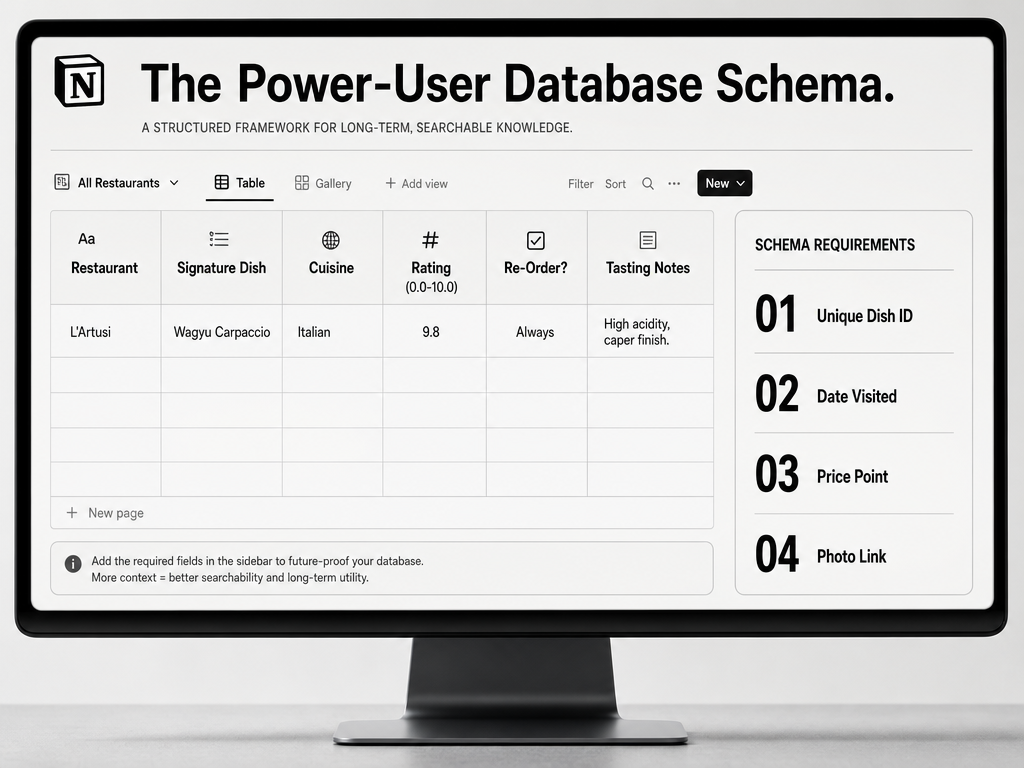 For those who find apps restrictive, a custom database schema in Notion or Airtable provides the ultimate control over your culinary portfolio.
The downside is obvious: you're now doing manual data entry, with no AI assist, no social layer, and no mobile-optimized UI. But for a certain kind of food lover - the kind who already maintains spreadsheets for wine cellars or travel itineraries - this level of control is worth the overhead. You're building a system that organizes food reviews exactly the way your brain works, not the way an app designer decided it should work.
If this approach appeals to you, start simple. Create a basic table with the five core fields (Restaurant, Dish, Rating, Re-Order, Date) and expand the schema only when you hit a real limitation. Overengineering the structure upfront is the fastest way to abandon the project.
The Bill-Time Habit: How to Log Accurately Without Killing the Vibe
The biggest obstacle to maintaining a dish-tracking system isn't technical - it's behavioral. You need to log the meal while the details are still fresh, but without letting the act of logging ruin the experience. Nobody wants to be the person frantically typing notes while their dining companions finish dessert.
The solution is the bill-time habit. Here's the protocol:
Step 1: Photograph the dish when it arrives. This is already standard behavior for most food lovers. You're not adding work - you're just being intentional about the framing. Capture the plate clearly enough that you'll recognize it six months from now.
Step 2: When the check arrives, pull out your phone. This is dead time anyway. You're waiting for the server to process payment. Use that 90 seconds to open your tracking app and log the essentials: dish name, rating, re-order status.
Step 3: Add tasting notes later that night, if needed. The critical data - what you ordered and whether it was worth it - gets captured immediately. The optional metadata (texture, acidity, detailed observations) can wait until you're home, when you have the photo to jog your memory.
The key is separating the mandatory minimum (dish name + rating) from the optional enrichment (detailed notes). The former takes 30 seconds and can be done discreetly. The latter can happen whenever you have time to reflect.
This habit is what separates people who maintain a useful food database from people who start with good intentions and abandon the project after three weeks. Consistency beats completeness. It's better to log 100 dishes with minimal metadata than to log 10 dishes with exhaustive detail and then give up.
Some practical tips for making this work:
Use voice notes if typing feels intrusive. Most tracking apps support audio recordings. You can verbally capture your impressions ("incredible depth of flavor, maybe a little undersalted") and transcribe later.
Don't log bad meals in detail. If a dish is a 4 or below, just mark it as "skip" and move on. You're building a curated archive of excellence, not a comprehensive record of mediocrity.
Create templates for recurring situations. If you eat at the same ramen shop every week, you don't need to log every visit - just update your notes when you try a new menu item or notice a quality change.
The bill-time habit works because it aligns the logging task with an existing pause in the meal. You're not interrupting conversation. You're not letting food get cold. You're using idle time productively, building a system that will pay compound interest for years.
App Comparison: Features That Actually Matter
Here's what separates a useful dish-tracking app from one you'll abandon after a week:
| Feature | Beli | Savor | Crumble | Yummi | Truffle |
|---|---|---|---|---|---|
| Dish-Level Ratings | Yes (ELO) | Yes (10-point) | Yes (0.1 precision) | Basic | No |
| Privacy Model | Public Social | Private Archive | Friend Circles | Private Diary | Private |
| AI Dish Recognition | No | Yes | No | No | No |
| Photo Storage | Yes | Yes | Yes | Yes | Yes |
| Searchability | Good | Excellent | Good | Limited | Limited |
| Tasting Notes | Yes | Yes | Yes | Yes | No |
| Export/Backup | Limited | Yes (CSV) | Unknown | Limited | Limited |
| Platform | iOS/Android | iOS/Android | PWA | iOS/Android | iOS |
| Social Features | Strong | None | Friend-Only | Minimal | Story Sync |
| Free Tier | Limited | Generous | Yes | Yes | Yes |
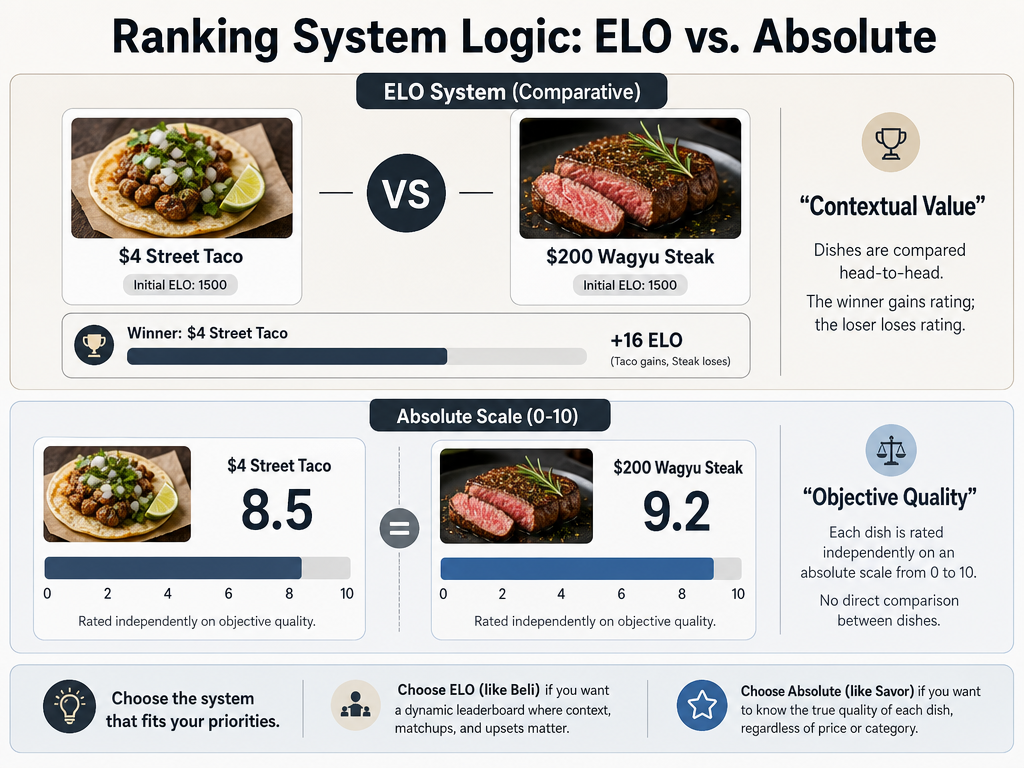 Choosing the right ranking logic - whether comparative ELO or absolute scoring - is essential for accurately reflecting your personal palate and dining preferences.
Picking the right tool depends on your archetype:
If you're a social curator who wants your food opinions to be part of your public identity, Beli is the obvious choice. The ELO system is engaging, the friend maps are genuinely useful, and the platform has momentum among serious food communities.
If you're a private archivist who values completeness and searchability over social features, Savor is purpose-built for you. The AI recognition speeds up data entry, and the privacy model means you're not performing for an audience - you're building a personal reference library.
If you're part of a tight-knit dining crew, Crumble offers the best of both worlds: collaboration without the noise of a public platform. The per-dish precision rating (8.3 vs. 8.0) appeals to people who take scoring seriously.
If you're a visual thinker who wants a timeline of food experiences organized by date and location, Yummi's calendar-based interface will feel intuitive. It's less useful for querying "best ramen in Tokyo" but excellent for remembering "what I ate during my March trip."
If you want zero-effort logging and don't care about detailed metadata, Truffle's automated sync is clever. Just know that you're trading granularity for convenience.
Most serious food lovers eventually use a combination - a primary tracking app supplemented by a custom Notion database for edge cases, or a social platform for discovery paired with a private archive for memory. The goal isn't to find one perfect tool. It's to build a system that matches how you actually think about food.
For a deeper dive into the broader ecosystem, see our guide on best apps to track restaurant meals.
Frequently Asked Questions
What is the best app for tracking restaurants?
The "best" app depends on whether you want to track restaurants (venues) or dishes (specific menu items). For venue-level tracking, Google Maps and Yelp remain dominant. But if you're serious about remembering which specific dishes were exceptional - not just which restaurants were "good" - you need a dish-first tool like Savor, Beli, or Crumble. The latter approach gives you actionable memory: not just "Trattoria X was great" but "the cacio e pepe at Trattoria X was a 9.6, order it every time."
Is there an app that can track Michelin-starred restaurants?
Any general restaurant-tracking app can handle Michelin-starred venues, but most dedicated foodies find that Michelin ratings are an incomplete proxy for personal taste. A three-star rating tells you a restaurant achieved technical excellence, but it doesn't tell you whether their signature dish matches your palate. Apps like Beli and Savor let you build your own hierarchy, independent of external accolades. You might discover that a neighborhood ramen shop's tonkotsu broth is more memorable than a Michelin-starred kaiseki course - and your database will reflect that.
What is the best app for tracking meals?
If "meals" means individual dishes with granular metadata (texture, spice level, re-order status), Savor is the strongest option for private archiving. If you want a social dimension with ELO-based rankings, Beli is better. If you prefer a low-friction visual diary organized by calendar date, Yummi fits that use case. The critical distinction is between calorie-tracking apps (MyFitnessPal, Cronometer) and memory-tracking apps (Savor, Beli, Crumble). The former are built for nutrition; the latter are built for curation.
Is there an app for foodies?
"Foodie" covers a wide range of behaviors. Beli is explicitly designed for food enthusiasts who want a public-facing portfolio of their dining history. Savor is for foodies who value private archiving over social sharing. Crumble is for small friend groups who want a trusted reference system without the noise of public platforms. If you're looking for discovery tools rather than tracking, explore apps designed specifically for serious foodies in major food cities.
What are the best apps for foodies?
The best apps combine discovery, memory, and curation without forcing you into a one-size-fits-all model. For dish-level tracking: Savor (private), Beli (social), Crumble (friend circles). For reservation management: Resy, OpenTable. For finding specific cuisines in unfamiliar cities: Google Maps with careful query formulation. For recipe organization: apps that organize recipes like Paprika or Notion. The sophisticated food lover uses a stack of tools, not a single app, because no one platform solves every problem.
What does Gen Z use instead of Yelp?
Gen Z has largely abandoned Yelp in favor of TikTok, Instagram, and Google Maps. TikTok's search function has become the de facto discovery engine for restaurants, with users searching "[city] food" to find viral dishes rather than reading text reviews. Instagram is used similarly - scrolling tagged locations to see what dishes look appealing. Google Maps is trusted for operational data (hours, address, phone) and for its integrated photo feed. For tracking personal dining history, younger users are adopting Beli and similar social-first platforms that feel more like Letterboxd than Yelp.
Is Beli still invite only?
As of 2026, Beli has moved past its initial invite-only phase and is now publicly available for download. The invite system was used during beta to control growth and maintain community quality, but the app is now open to anyone. That said, the platform's value still scales with network effects - the more of your friends who use Beli, the more useful the friend maps and recommendation features become.
Who are Beli's main competitors?
Beli's direct competitors in the dish-tracking space include Savor (focused on private archiving with AI assist), Crumble (friend-circle tracking with Progressive Web App simplicity), and to a lesser extent, traditional platforms like Yelp and Google Reviews (though those remain venue-focused rather than dish-focused). Outside the dedicated tracking category, Beli also competes with Instagram and TikTok for "where should I eat" mindshare, though those platforms lack structured rating systems. The competitive landscape is less about displacing Yelp and more about capturing a new behavior: dish-level memory archiving rather than venue discovery.