
The 5 Best Food Radar Apps for Serious Foodies
John the smoothie monster
John lives for smoothie bowls and cold-pressed juices. He uses Savor to remember his best blends.
Beyond the Camera Roll: The 5 Best "Food Radar" Apps for Serious Foodies (2026 Edition) You’re scrolling through 2,400 photos of pasta. Somewhere in this...
Beyond the Camera Roll: The 5 Best "Food Radar" Apps for Serious Foodies (2026 Edition)
You’re scrolling through 2,400 photos of pasta. Somewhere in this digital graveyard is that transcendent cacio e pepe from the West Village spot with the unmarked door, but you can’t remember the name of the place, the cross street, or even what month you went. All you have is a poorly lit iPhone shot and a vague memory of crying a little because the texture was that perfect.
Most dining apps won’t help you here. Yelp is designed for tourists making safe choices. Google Maps is a navigation tool. Neither was built for the serious foodie’s actual problem: organizing a chaotic visual history of taste into something searchable, referenceable, and genuinely useful. What you need isn’t another discovery platform - it’s a personal radar system for your culinary life.
Table of Contents
- The Foodie Organizational Crisis
- Defining the "Food Radar" Category
- The Heavy Hitters: Comparative Analysis
- Feature Comparison Matrix
- How to Choose Your Radar
- Frequently Asked Questions
The Foodie Organizational Crisis
The problem isn’t that you don’t take notes. You do. You photograph every dish. You screenshot menus. You save articles. You text yourself reminders. The problem is that this system - if you can call scattered digital debris a system - fails the moment you actually need it.
Ask yourself: can you name the three best versions of carbonara you’ve ever eaten, in order, with specific details about what made each one distinct? Can you pull up a map of every exceptional pasta dish you’ve had in the last two years? Can you remember which of your friends recommended that spot in Williamsburg versus the one in Bushwick?
For most food lovers, the answer is no. Not because the experiences weren’t memorable, but because memory is a terrible database. Generic review platforms like Yelp aren’t designed to organize your personal taste history - they’re designed to aggregate crowd opinions into a single, often misleading number.
This is where the "food radar" concept enters. Not radar as in "find me something nearby," but radar as in "show me the landscape of everything I actually care about, organized by dish, by geography, by the specific qualities that matter to my palate."
Defining the "Food Radar" Category
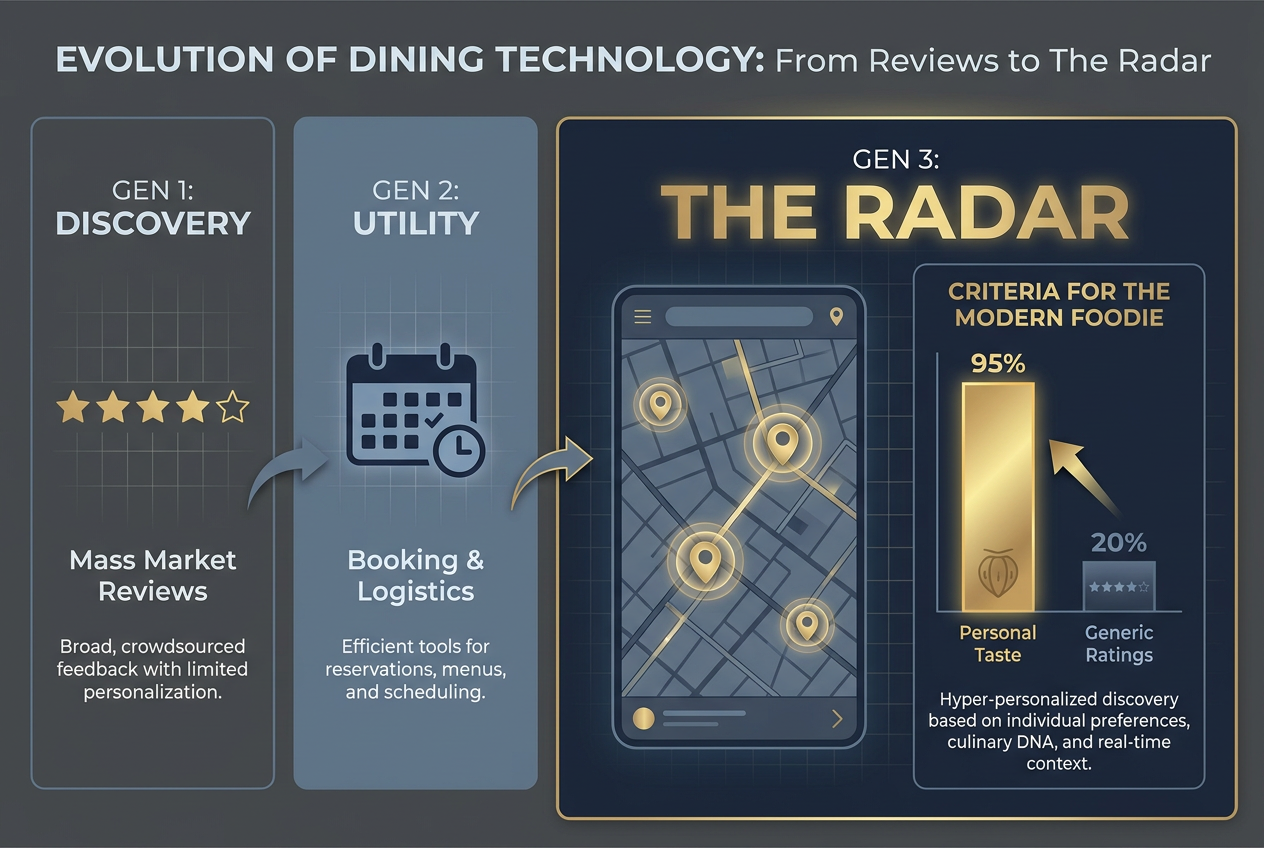 The evolution of dining technology has moved from generic star ratings to sophisticated ’Food Radar’ apps that prioritize personal taste and dish-level data.
The dining app landscape has evolved through three distinct generations:
Gen 1: Discovery (Yelp, early Google Reviews) - These platforms democratized restaurant criticism by letting anyone with an opinion contribute a rating. The trade-off? A 4.3-star average tells you almost nothing about whether the duck confit will change your life.
Gen 2: Utility (OpenTable, Resy) - These apps solved the friction problem: getting a table. They’re brilliant at what they do, but they stop at the reservation confirmation. Once you’re seated, you’re back to your camera roll and hope.
Gen 3: The Radar (Beli, Savor, Reserviaa, World of Mouth) - These platforms recognize that serious food lovers don’t need help finding "highly rated restaurants." They need help tracking, comparing, and rediscovering the specific dishes they’ve loved, organized in a way that reflects how taste actually works - personal, subjective, and detail-oriented.
The shift is philosophical. Gen 3 apps start from the premise that your experience is the only review that matters. A stranger’s five-star rating of a restaurant is nearly useless if they don’t share your palate, your priorities, or your definition of what makes a dish worth remembering.
The Heavy Hitters: Comparative Analysis
Beli: The Gamified Social Foodie
Beli rebuilt restaurant tracking around a core insight: your friends’ recommendations are exponentially more valuable than crowd-sourced ratings from strangers. The app’s signature "Match Score" feature analyzes taste overlap between you and your network, surfacing recommendations from people who actually share your palate.
The interface feels like a private social network for food. You rank restaurants on a 10-point scale, write quick notes, and the app builds a living map of your dining history. When a friend adds a spot, Beli notifies you if it aligns with places you’ve already loved.
Best for: The competitive foodie who wants social validation and enjoys the game of building ranked lists. If you like discussing where things rank and comparing notes with your circle, Beli’s leaderboard-style format will feel natural.
Limitation: If you care more about individual dishes than overall restaurant ratings, Beli’s venue-level focus can feel frustratingly broad. A restaurant with one transcendent dish and six mediocre ones will get a middling score, obscuring what you actually want to remember.
Savor: The Private Critic’s Time Machine
Savor inverts the social model entirely. It’s designed for the foodie who doesn’t need external validation - they need a private, searchable archive of their own taste history. The app’s "Time Machine" feature lets you search your entire dining past by dish name, ingredient, location, or date, turning a chaotic camera roll into a queryable database.
The interface is built around dish-level logging. You don’t rate the restaurant; you rate the specific plate. The braised short rib. The flourless chocolate torte. The miso-glazed black cod. Each entry can include photos, notes, scores across multiple dimensions (taste, presentation, value), and geographic pins. Over time, you build a map that reflects your actual eating history, not your social signaling.
Best for: The meticulous chronicler who wants to remember every bite without broadcasting their opinions. If you’ve ever wished you could search your brain for "that duck dish with the cherry reduction from spring 2024," Savor’s query system will feel like a revelation.
Why it wins the "Food Radar" category: Savor’s approach to organizing restaurant photos and meals creates a genuinely searchable archive. You can filter by dish type, score range, neighborhood, or even specific flavor profiles you’ve logged. It’s the only app that treats your taste history like a research project worth preserving.
Reserviaa: The Dish-Level Search Engine
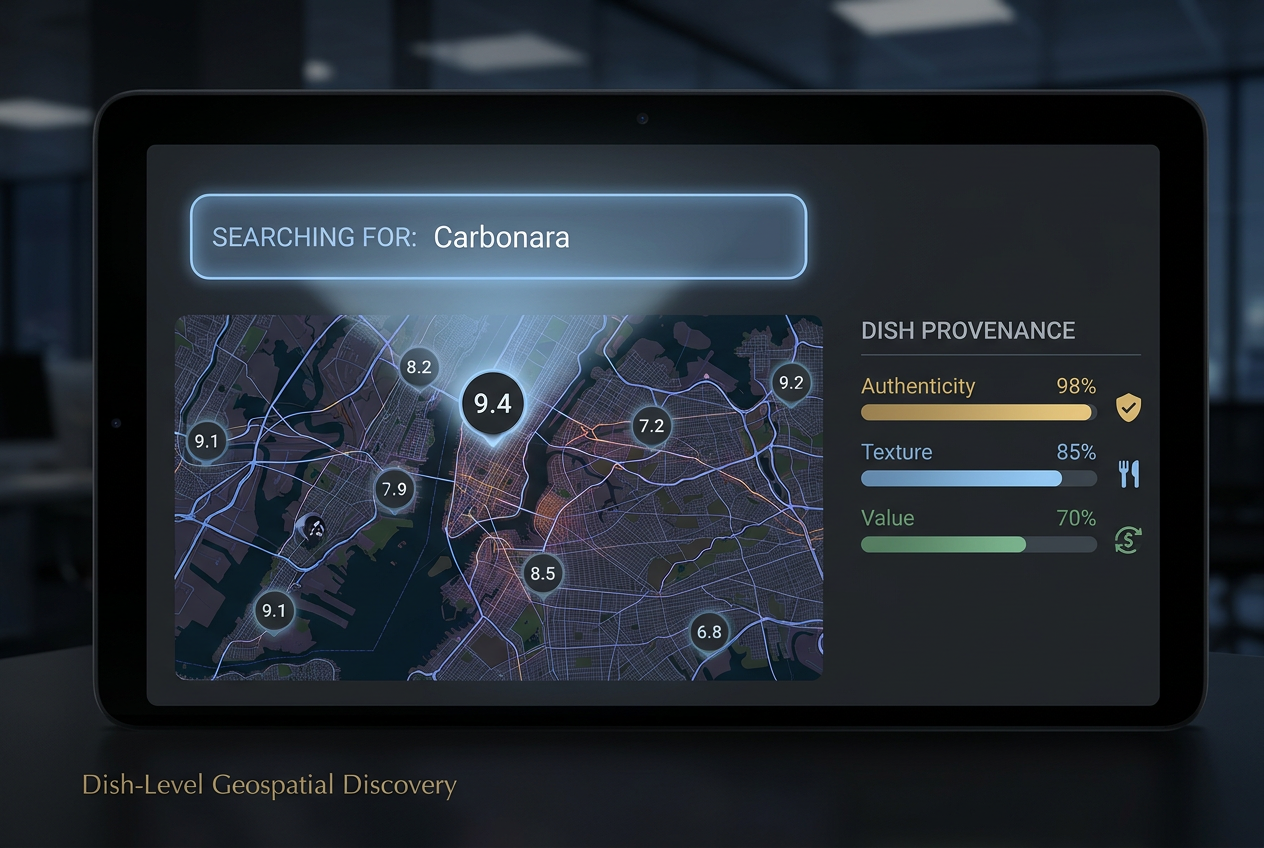 Modern food radar apps like Reserviaa allow users to scan entire cities for specific dishes, providing granular data that goes beyond restaurant-level ratings.
Reserviaa takes the food radar metaphor literally. Its standout feature is a dish-specific search: type "carbonara" and the map populates with every reviewed version in your city, each tagged with ratings for that specific preparation. No more scrolling through restaurant pages hoping someone mentioned the dish you care about.
The platform crowdsources dish-level data, letting users rate and photograph individual menu items. The interface is elegant - tap a neighborhood, see a constellation of dishes, drill down to read tasting notes from people who ordered the same thing you’re considering.
Best for: The intentional eater who knows exactly what they want and refuses to settle for "pretty good Italian." If you’re the type to research the best version of a specific dish before committing to a restaurant, Reserviaa’s surgical precision will save you hours.
Limitation: Success depends on critical mass. In well-documented food cities like New York, San Francisco, or Los Angeles, the dish database is robust. In smaller markets, you might find yourself contributing more data than you’re consuming.
World of Mouth: The Expert-Curated Luxury Atlas
World of Mouth positions itself as the anti-algorithm. Instead of crowd ratings or friend networks, the platform relies on 800+ culinary experts - chefs, food writers, sommeliers - who curate the map. Each recommendation comes with provenance: you’re not trusting a stranger, you’re trusting a specific expert whose taste you’ve vetted.
The interface is clean and minimalist. Restaurants appear as pins, each marked with a fork icon if an expert has endorsed it. Tap in, and you see who recommended it and why. The app also organizes spots into thematic lists ("Best Natural Wine Bars," "Hidden Omakase Gems") curated by specific authorities in their field.
Best for: The luxury traveler or aspirational diner who wants vetted, high-end recommendations without wading through amateur opinions. If you’re planning a food-focused trip and want a curated shortlist of must-try spots, World of Mouth delivers credible intel fast.
Limitation: The expert-only model excludes the kind of neighborhood gems that don’t attract professional food media. If you want to track your own discoveries alongside expert picks, you’ll need a second app for your personal archive.
Feature Comparison Matrix
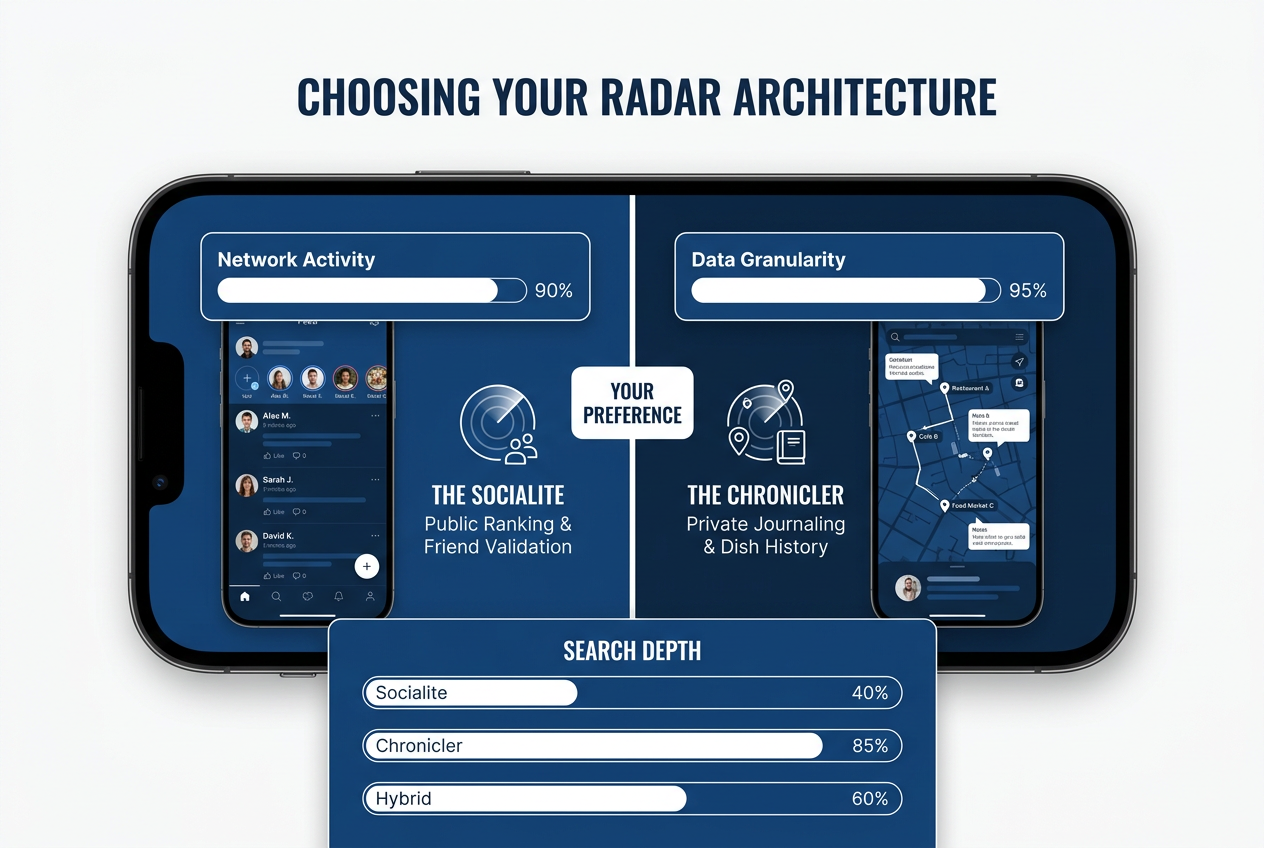 Deciding between social ranking and private chronicling is the first step in selecting the right food radar app for your culinary lifestyle.
| Feature | Beli | Savor | Reserviaa | World of Mouth |
|---|---|---|---|---|
| Primary Focus | Social ranking | Private journaling | Dish-level search | Expert curation |
| Rating Granularity | Restaurant-level | Dish-level | Dish-level | Restaurant-level |
| Privacy Model | Social feed (friends only) | Completely private | Public dish reviews | Public expert lists |
| Search Capability | Friend recommendations | Full-text dish archive | City-wide dish search | Expert-curated filters |
| Photo Organization | Venue galleries | Dish-specific albums | Dish-specific albums | Venue galleries |
| Best Use Case | Comparing tastes with friends | Building personal taste archive | Finding best version of specific dish | Discovering vetted high-end spots |
| Cost | Free with premium tiers | Free with premium features | Free | Subscription required |
| Ideal User | Social foodie | Critical chronicler | Dish obsessive | Luxury traveler |
When choosing between these options, the deciding factor isn’t features - it’s workflow. Do you want your dining life to be a private reference library or a shared conversation? Do you think in terms of restaurants or dishes? Are you more interested in documenting your own taste or discovering what experts recommend?
How to Choose Your Radar
The wrong app won’t ruin your food life, but it will create friction - and friction is the enemy of sustained use. If logging a meal feels like work instead of a quick ritual, you’ll stop doing it, and your taste history vanishes back into the camera roll void.
Choose Beli if:
- You trust your friends’ taste more than algorithms or critics
- You enjoy the social aspect of sharing recommendations
- You think in terms of "great restaurants" more than "great dishes"
- You want notifications when friends discover spots that match your taste profile
Choose Savor if:
- You care deeply about preserving specific dish memories, not just venue check-ins
- You want a private archive that’s searchable by ingredient, flavor, date, or location
- You’re tired of losing track of individual dishes in generic restaurant reviews
- You think of your eating history as a form of personal research worth documenting
Choose Reserviaa if:
- You often search for "best [specific dish] in [city]"
- You prefer targeted research over broad discovery
- You’re willing to contribute dish reviews to build a better database
- You care more about finding the perfect version of something than discovering random new spots
Choose World of Mouth if:
- You’re planning a food-focused trip and want expert-vetted options fast
- You primarily eat at high-end or critically acclaimed restaurants
- You trust professional curation over crowd opinions
- You’re willing to pay for access to curated knowledge
Most serious food lovers will eventually use two apps: one for personal documentation (Savor) and one for either social sharing (Beli) or expert discovery (World of Mouth or Reserviaa, depending on your research style). The key is recognizing that no single platform solves every problem - the food radar category is still young, and different tools serve different parts of the workflow.
What matters most is that you choose something and use it consistently. An imperfect system you actually maintain beats a perfect system you abandon after three weeks. The goal isn’t to document every meal - it’s to preserve the ones worth remembering before they dissolve into the digital noise of your camera roll.
Frequently Asked Questions
What is a food radar app?
A food radar app is a specialized tool that helps serious food lovers organize, track, and search their dining history by individual dishes rather than just restaurant ratings. Unlike generic review platforms that focus on venue-level scores, food radar apps treat your taste history as a queryable database, letting you search for specific dishes, compare versions across restaurants, or rediscover meals by location, date, or ingredient. The term "radar" refers to the map-based interface most of these apps use, displaying your eating history as a geographic constellation of data points rather than a linear list.
Why can’t I just use Yelp or Google Maps to track restaurants?
Yelp and Google Maps are designed for discovery and navigation - they excel at helping you find a highly rated restaurant nearby or get directions. But they fail at the chronicler’s task: preserving the granular details of your own taste history. You can’t easily search your Yelp bookmarks for "that duck dish with the fig reduction from spring 2024." You can’t filter by the dishes you scored 9 or higher. You can’t compare three versions of carbonara across different neighborhoods. Generic platforms aggregate crowd opinions; food radar apps preserve your personal perspective.
Do I need a separate app just for tracking dishes?
If you’re serious about food - if you plan trips around meals, if you have strong opinions about technique and ingredients, if you’ve ever felt frustrated trying to remember where you had that perfect bowl of ramen - then yes, a dedicated dish tracking app will change how you eat. The alternative is letting your taste history evaporate into your camera roll, relying on fragile human memory to recall details that fade with time. A dish tracking app isn’t about being obsessive; it’s about respecting the effort you already put into seeking out great food by preserving what you discover.
How is Savor different from Beli?
Beli is a social app built around sharing restaurant recommendations with friends and seeing how your taste aligns with your network. Savor is a private journaling tool focused on preserving individual dish memories for your own reference. Beli encourages you to think in terms of "best restaurants" and uses ranking systems and social feeds. Savor encourages you to think in terms of "best versions of specific dishes" and builds a searchable archive of your entire eating history. If you want your dining life to be a conversation with friends, choose Beli. If you want it to be a personal research project, choose Savor.
Can I use multiple food radar apps at the same time?
Absolutely, and many serious food lovers do. A common setup is using Savor for private, detailed dish logging and either Beli for social recommendations or World of Mouth for expert-curated discovery. The apps serve different functions: one is your memory vault, the others are filtering tools for new experiences. The key is choosing a primary archive system and sticking with it consistently, then layering in supplementary apps as needed for discovery or sharing.
Are food radar apps free?
Most food radar apps offer free versions with basic functionality, then charge for premium features. Beli and Reserviaa are free with optional upgrades. Savor offers robust free features with premium tiers for advanced search and unlimited photo storage. World of Mouth requires a subscription for full access. The paid tiers typically unlock features like advanced filtering, export capabilities, or ad-free experiences. If you’re committed to building a long-term taste archive, premium features are usually worth the cost - think of it as paying for the infrastructure to preserve years of culinary memories.
How much time does it take to log dishes in a food radar app?
Logging a dish in Savor or similar apps takes 30-90 seconds: snap a photo, add a quick score, maybe write a sentence or two about what stood out. You don’t need to write essays - just enough detail for future-you to remember why this dish mattered. The goal isn’t exhaustive documentation of every meal; it’s capturing the highlights. Over time, even minimal logging creates a valuable archive. The alternative - losing track of great meals entirely - costs far more in terms of regret and wasted discovery than two minutes of data entry.
What’s the difference between rating a restaurant and rating a dish?
Rating a restaurant forces you to average your experience across everything - service, ambiance, the dishes you tried, the dishes you didn’t. A single venue score obscures the details that matter most: which specific plates were transcendent, which were forgettable, and why. Rating individual dishes preserves granularity. It lets you remember that the duck confit at X was a 9 while the dessert was a 6, or that the carbonara at Y is better than the version at Z even though Z has higher overall Yelp ratings. Dish-level tracking creates a more accurate and useful taste archive than venue averages ever could.