
How to Organize Restaurant Dishes by Country: A Serious Foodie’s Guide
Harry the matcha king
Harry is our resident matcha obsessive. He’s tasted hundreds of bowls and tracks every cup in Savor.
How to Organize Restaurant Dishes by Country: A Serious Foodie's Guide You spent a significant amount on a life-changing meal in Rome three months ago. Now...
How to Organize Restaurant Dishes by Country: A Serious Foodie's Guide
You spent a significant amount on a life-changing meal in Rome three months ago. Now you're staring at your camera roll, scrolling through thousands of unsorted food photos, trying to remember which trattoria served that otherworldly cacio e pepe. The name is gone. The address is a mystery. All that's left is a blurry photo and the fading memory of salty pecorino and cracked black pepper.
This is the camera roll graveyard every serious foodie knows too well.
The problem isn't that you don't take enough photos. It's that you lack a system to preserve what actually matters: the dishes themselves, their cultural context, and the sensory details that made them unforgettable.
Organizing restaurant dishes by country isn't about creating a travel scrapbook. It's about building a searchable culinary archive that treats dining as a collection of cultural artifacts - one that lets you surface "that incredible Vietnamese bánh xèo" six months later without scrolling through thousands of photos.
This guide is your blueprint for creating that system.
Table of Contents
- Why Country-Based Organization Matters (And When It Doesn't)
- The Three-Tier Taxonomy: From Macro-Region to Regional Cuisine
- Platform Selection: Low Friction vs. High Detail
- The Live-Logged Workflow: What to Do at the Table
- Solving the Fusion Problem
- Building Your Smartphone Archive Without Manual Hell
- When to Abandon Country Labels Entirely
- Frequently Asked Questions
Why Country-Based Organization Matters (And When It Doesn't)
At its core, organizing dishes by country serves one fundamental purpose: cultural context preservation. When you tag a dish as "Japanese," you're not just filing it under an arbitrary label. You're anchoring it to a specific culinary tradition, ingredient philosophy, and flavor grammar.
Consider two seemingly identical bowls of soup noodles. One is Vietnamese phở - bright, herbaceous, built on star anise and fish sauce. The other is Japanese ramen - umami-forward, layered with dashi and soy. Without cultural tagging, both become "Asian noodle soup" in your chaotic photo library, and the specificity that made each meal memorable vanishes.
Country-based organization works exceptionally well when:
- You travel frequently and need geographic memory triggers
- You're tracking regional cuisines like Sichuan, Provençal, or Oaxacan
- You want to compare how different cultures handle similar ingredients (grilled meat, fermented vegetables, rice-based dishes)
- You're building a "Food Atlas" for cities you visit repeatedly
It breaks down when:
- The dish is modern fusion with no clear cultural lineage
- You care more about technique than geography (sous vide, wood-fired, fermented)
- You're tracking dietary restrictions or macros rather than cultural origin
- The restaurant itself defies categorization (a Korean chef cooking French food in Peru)
The best food review apps that serious foodies use today allow multi-layered tagging, letting you organize by country and technique and dietary preference simultaneously. You don't have to choose one taxonomic system - you build a flexible framework that adapts to how you actually think about food.
The Three-Tier Taxonomy: From Macro-Region to Regional Cuisine
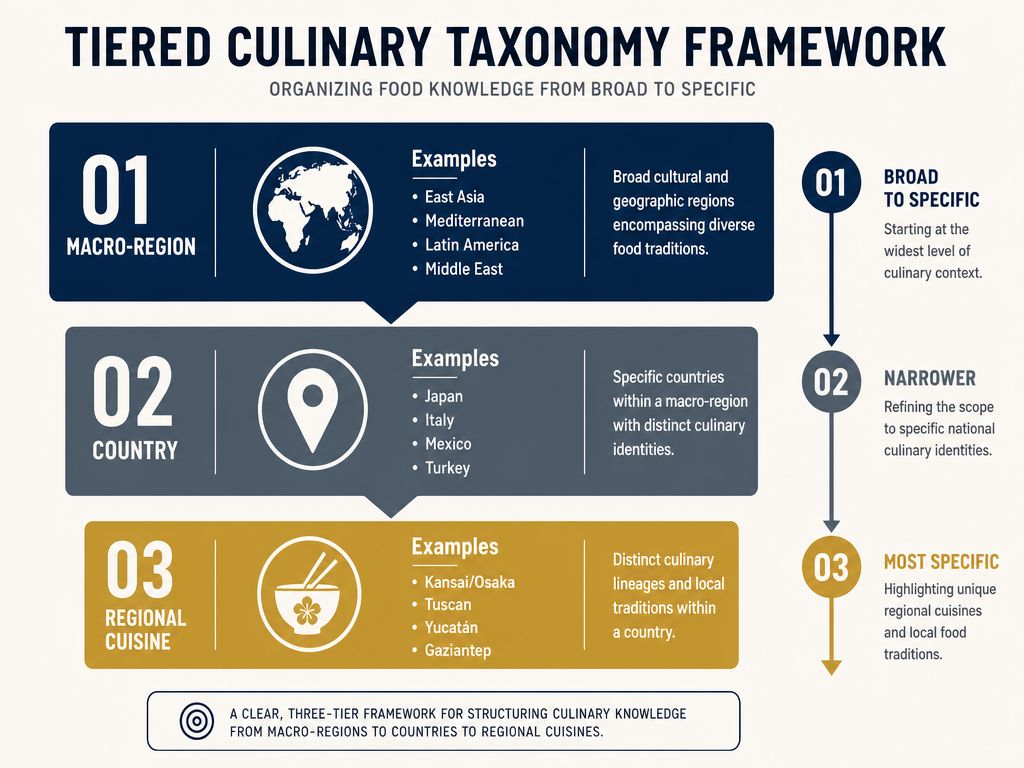
Most people stop at "Country" when organizing dishes, but that's often too broad to be useful. If you've eaten at 50 Italian restaurants, a single "Italy" tag becomes meaningless noise. The solution is a three-tier hierarchy that mirrors how culinary traditions actually work.
Tier 1: Macro-Region
This is your broadest filter - useful for scanning your archive when you remember where in the world you ate something, but not the specifics.
- Mediterranean (Southern Europe, North Africa, parts of the Middle East)
- East Asia (China, Japan, Korea, Taiwan)
- Southeast Asia (Thailand, Vietnam, Malaysia, Singapore, Indonesia)
- South Asia (India, Pakistan, Bangladesh, Sri Lanka, Nepal)
- Latin America (Mexico, Central America, South America)
- Middle East (Levant, Gulf states, Persia)
- Sub-Saharan Africa (West Africa, East Africa, Southern Africa)
- Nordic Europe (Scandinavia, Baltic states)
Regional ethnic cuisines rank as the top trend in international food, followed by fusion and Southeast Asian cuisines like Thai, Vietnamese, Burmese, and Malaysian ("Ethnic Food Trends in American Restaurants"), which means organizing by macro-region helps you spot patterns in your own dining habits that mirror larger culinary movements.
Tier 2: Country
This is where most foodies naturally land. It's specific enough to narrow your search dramatically, but flexible enough to handle most dining situations.
When you tag a dish as "French," you're creating a baseline association with butter, wine-based sauces, technique-driven cooking, and a particular flavor balance. When you tag something as "Chinese," you're signaling soy sauce, wok cooking, five-spice, and a completely different flavor grammar.
Country-level tagging works especially well for:
- International travel dining
- Ethnic restaurants in major cities
- Cuisine-focused food halls or neighborhoods
- Building a "greatest hits" list per country
Tier 3: Regional Cuisine
This is where the magic happens for serious foodies. Within each country, regional cooking traditions can be so distinct they deserve their own subcategories.
France:
- Provence → Mediterranean, olive oil, herbs
- Burgundy → Beef, wine, mustard
- Alsace → German influence, charcuterie, beer
- Normandy → Cream, butter, seafood
China:
- Sichuan → Numbing heat, chili oil, fermentation
- Cantonese → Seafood, dim sum, subtle flavors
- Hunan → Dry heat, smoked meats, pickled vegetables
- Shanghainese → Sweet-savory, braised dishes, soup dumplings
Italy:
- Emilia-Romagna → Egg pasta, Parmigiano, prosciutto
- Campania → Tomato, mozzarella, wood-fired pizza
- Piedmont → Truffles, butter, Barolo
- Sicily → Arab-influenced, seafood, citrus
Japan:
- Tokyo (Kanto) → Soy-forward, edomae sushi
- Osaka (Kansai) → Street food, okonomiyaki, takoyaki
- Kyoto → Kaiseki, tofu, subtle refinement
- Hokkaido → Seafood, dairy, miso ramen
This regional layer transforms your archive from a static list into a living culinary map. When someone asks, "What's the best ramen you've had?" you can answer with specificity: "The tonkotsu in Hakata" or "The shoyu in Tokyo" - not just "ramen in Japan."
If you're using apps like Beli, which has over 17,000 ratings and a 4.8-star score on the App Store ("Beli App Store Page"), you can create custom tags for these regional subcategories. If you're building a manual system in Notion or Google Sheets, you'll want columns for Macro-Region, Country, and Regional Cuisine to enable multi-level filtering.
Platform Selection: Low Friction vs. High Detail
The right organizational tool depends entirely on how much friction you're willing to tolerate in exchange for depth of information. There's no single "best" app - only the best fit for your specific workflow.
Low Friction: Social Food Apps
Best for: People who want automatic organization with minimal manual input. The tradeoff is rigid categorization and less control over data structure.
Yummi automatically organizes "Foodprints" (geotagged food photos) on a chronological calendar ("Yummi Official Site"). If you enable location services when you photograph your food, Yummi places each dish on a map and timeline without manual entry. The app's strength is its visual, zero-friction approach - you take a photo, it handles the rest. The weakness is that its search and filtering capabilities are limited compared to manual databases.
Beli excels at ranking and wish-list building. You can create country-specific lists (e.g., "Japanese Restaurants to Try"), but the app is fundamentally restaurant-focused rather than dish-focused. If you want to track that incredible negitoro don you had at a standing sushi bar, you'll need to add it as a restaurant note rather than a standalone entry.
Eaten allows dish-level tracking within restaurants, meaning you can rate specific plates instead of entire venues. This makes it easier to organize by cuisine type or country, since you're not forced to categorize an entire restaurant under one label. The app's performance can be slow, particularly in cities with smaller user bases.
For more guidance on choosing between these platforms, see the best apps to track favorite dishes.
Medium Friction: Hybrid Tools
Best for: Foodies who want more control than social apps offer, but don't need the infinite flexibility of a custom database.
Mapstr uses custom hashtags for deep organizational control. You can create country tags (#Japan), regional tags (#Sichuan), and even dish-specific tags (#Ramen) to build a multi-dimensional filing system. The limitation is that Mapstr isn't food-specific, so you'll need to manually tag every entry rather than relying on auto-categorization.
Google Maps with custom lists is a surprisingly powerful middle ground. Create separate lists for "Japanese Restaurants," "Italian Restaurants," "Dishes to Recreate," etc. The advantage is that Google Maps is platform-agnostic and already integrated into your phone. The disadvantage is that it's not designed for dish-level detail, so you'll be tracking locations rather than specific plates.
High Detail: Custom Databases
Best for: Power users who want complete control over data structure and are willing to invest time in manual entry. The payoff is a system that perfectly matches how you think about food.
A Notion database gives you infinite flexibility to create fields for Country, Region, Dish Name, Star Ingredient, Flavor Profile, Memory/Context, and Photo. You can filter by any combination of these criteria, meaning you can surface "all Sichuan dishes I rated 9+ that featured fermentation" in seconds.
The workflow looks like this:
- Create a database titled "Dishes I've Eaten"
- Add properties: Country (Select), Region (Select), Dish Name (Text), Restaurant (Text), City (Text), Date (Date), Rating (Number), Photo (File), Notes (Text)
- Create views: Group by Country, Filter by Rating, Sort by Date
- Tag dishes as you eat them, either immediately or during a weekly review session
The Notion approach requires the highest input friction - you're manually entering every field - but delivers the most powerful output. You're building a personal culinary encyclopedia that functions exactly how you want it to.
For a comparison of different organizational approaches, see how to organize restaurant photos by dish.
The Live-Logged Workflow: What to Do at the Table
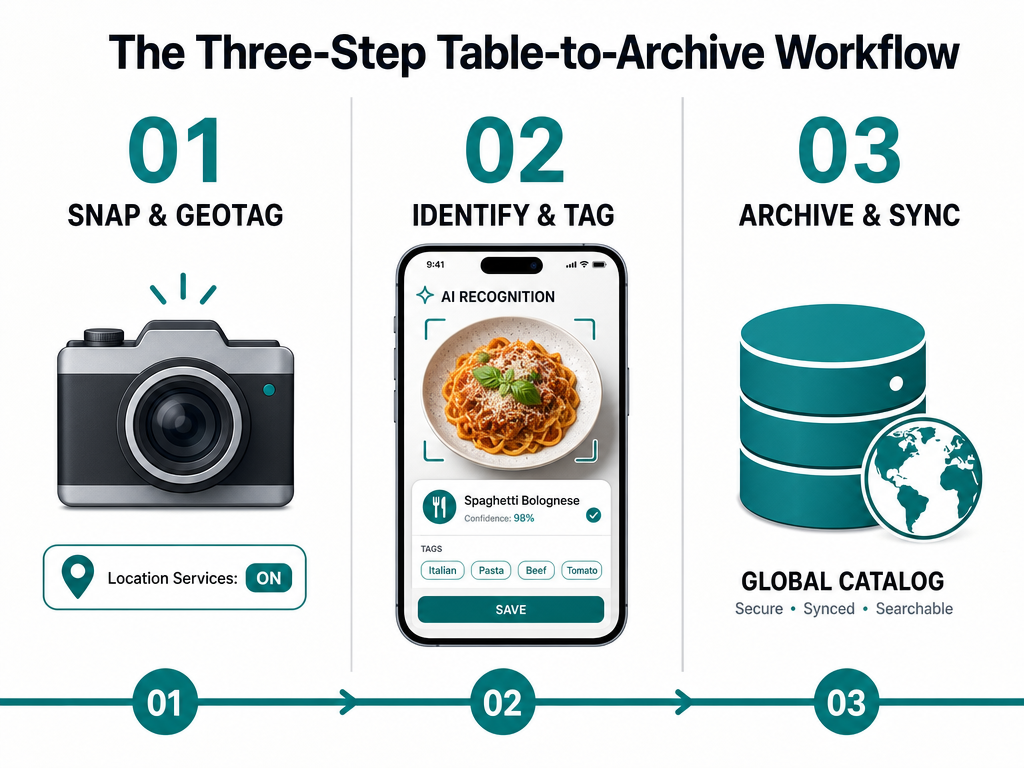
The difference between a useful food archive and a cluttered photo library comes down to workflow discipline. The best time to capture context is at the table, when the details are still fresh. The worst time is three weeks later, when you're scrolling through hundreds of photos trying to remember which restaurant served what.
Phase 1: At the Table (60 seconds per dish)
Step 1: Photograph with intention
Turn on location services. Frame the dish with context - the table setting, the restaurant interior, anything that triggers spatial memory later. Take one good photo, not ten mediocre ones.
Step 2: Voice note the specifics
Open your phone's voice memo app and record: "Tonkotsu ramen at Ichiran, Shibuya. Creamy pork bone broth, springy noodles, ridiculous umami. Ordered extra spice. Nine out of ten."
This 15-second voice note captures everything a photo can't: taste, texture, intensity, and your immediate reaction. Most serious foodies who lose their best meals skip this step, relying on the photo alone.
Step 3: Screenshot the menu or receipt
This solves the "what was it actually called?" problem. A photo of the menu entry preserves the dish name in the original language, which makes future searching dramatically easier.
Phase 2: The Next Day (5 minutes per meal)
Step 1: Identify the dish using AI
iOS now includes a "Look Up Food" feature that uses computer vision to identify dishes. Open your photo, tap the dish, and select "Look Up." This often surfaces the correct name, even in other languages, which you can copy into your database.
Step 2: Organize into your chosen system
If you're using Yummi, the work is already done - it auto-organizes by location and date. If you're using Notion, manually input the data from your voice note and screenshots. If you're using Mapstr, add the restaurant to your map and tag it with relevant hashtags.
Step 3: Add one memory anchor
Write a single sentence that captures why this dish mattered. "Reminded me of the ramen I had in Tokyo in 2019, but with more funk" or "The best cacio e pepe I've had outside Rome - finally got the cheese-to-pasta ratio right."
This memory anchor is what makes your archive searchable six months later. You won't remember the restaurant name, but you'll remember "that Roman-style cacio e pepe that nailed the ratio," and you can search your database for those keywords.
For a deeper look at building effective food memory workflows, see how to build a personal restaurant library.
Solving the Fusion Problem
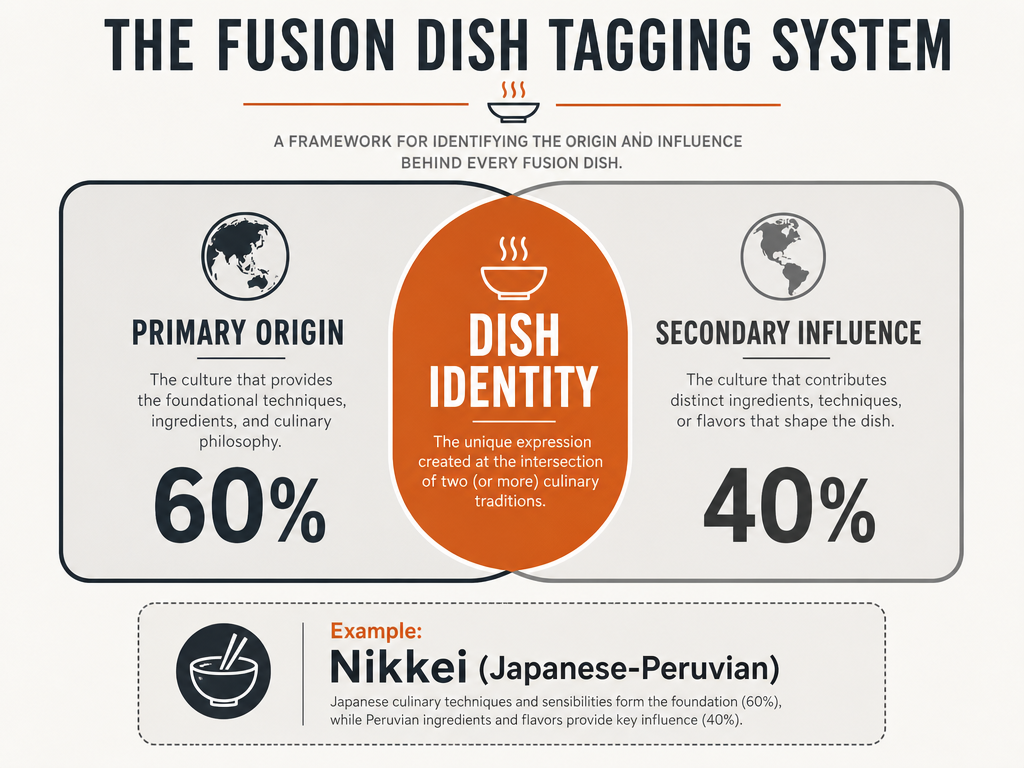
Fusion cuisine is where country-based organization breaks down. When a Japanese chef cooks French food in Peru using local ingredients, which country tag do you use? The answer is to implement a Primary/Secondary Influence tagging system.
The Framework
Every dish gets two tags:
- Primary Origin: The dominant culinary tradition
- Secondary Influence: The modifying tradition
Nikkei Cuisine (Japanese-Peruvian)
- Primary: Japanese (technique, presentation, umami)
- Secondary: Peruvian (aji amarillo, cilantro, lime)
- Example: Yellowtail tiradito with aji amarillo and yuzu
Tex-Mex Cuisine (Mexican-American)
- Primary: Mexican (tortillas, beans, salsa)
- Secondary: American (cheese sauce, ground beef, wheat flour)
- Example: Beef and cheese enchiladas with chili con queso
Indo-Chinese Cuisine (Indian-Chinese)
- Primary: Chinese (wok cooking, stir-frying, noodles)
- Secondary: Indian (spices, curry leaves, green chili)
- Example: Hakka noodles with curry leaves and Sichuan peppercorns
Korean-Mexican Fusion (Korean-Mexican)
- Primary: Korean (gochujang, sesame, kimchi)
- Secondary: Mexican (tortillas, lime, cilantro)
- Example: Bulgogi tacos with kimchi slaw
This dual-tagging system lets you search your archive from either direction. If you're craving Japanese food, you'll surface that Nikkei tiradito. If you're craving Peruvian food, it'll appear there too. The dish exists in both taxonomic categories without forcing you to choose one.
In a Notion database, you'd implement this with two "Select" fields: Primary Origin and Secondary Influence. In Beli or Mapstr, you'd use two separate tags per dish. In a manual spreadsheet, you'd have two columns.
For apps that support multi-dimensional tagging, see the best food software guide.
Building Your Smartphone Archive Without Manual Hell
The biggest objection to organized food documentation is time. Who wants to spend considerable time every night filing food photos? The answer is no one, which is why the best systems minimize friction through automation and strategic laziness.
The Smart Album Strategy (iOS)
iOS lets you create "Smart Albums" that automatically organize photos based on metadata. Here's the setup:
- Create a "Foodie" album: Settings → Photos → create new album titled "Foodie"
- Enable location-based auto-sorting: Any photo taken at a restaurant (based on GPS) automatically gets added to this album
- Use the "Look Up Food" feature: iOS's AI identifies dishes and adds metadata tags, making them searchable without manual input
This solves the "thousands of unsorted photos" problem. Your food photos automatically separate from vacation snapshots, baby pictures, and screenshots, and they become searchable by dish type without manual tagging.
The Weekly Batch Workflow
Instead of filing every meal immediately, designate one focused session per week to process your recent dining:
- Sunday morning: Open your Foodie album, review the week's meals
- Batch process: Log all dishes into your chosen system (Notion, Yummi, Mapstr)
- Add context from memory: While the meals are still recent, add quick notes about standouts
This batch approach reduces friction by separating capture (at the table) from organization (during dedicated time). You're not interrupting meals with data entry, but you're not losing context by waiting months to file photos.
The Voice-to-Text Shortcut
Most smartphones support voice-to-text shortcuts. Create a custom Siri command like "Log food" that opens a pre-formatted template in your notes app:
Template:
Restaurant:
Dish:
Country/Region:
Rating (1-10):
Why it worked:
Speak your entries directly at the table, then copy-paste them into your database during your weekly batch session. This captures detail without breaking the flow of the meal.
For more on turning food photos into organized memory systems, see the best apps to organize food photos.
When to Abandon Country Labels Entirely
Country-based organization is powerful, but it's not the only - or always the best - framework for archiving dishes. Serious foodies often discover that after a few hundred logged meals, their needs evolve beyond geographic categories.
When Technique Matters More Than Origin
If you're tracking cooking methods rather than cultural traditions, ingredient-based or technique-based taxonomy becomes more useful:
- Fermentation-focused: Kimchi, sauerkraut, miso, preserved lemons (spans multiple countries)
- Wood-fired cooking: Neapolitan pizza, Argentine asado, Thai grilled fish (same technique, different cultures)
- Sous vide: French confit, Japanese chashu, American short ribs (modern technique, universal application)
A foodie obsessed with fermentation might organize their archive by fermentation type rather than country, because the cultural context matters less than the microbial process.
When You're Chasing Specific Ingredients
Some foodies build archives around hero ingredients that transcend borders:
- Wagyu beef: Track Japanese A5, Australian wagyu, American Wagyu
- Heirloom tomatoes: Compare Italian San Marzano, American heirlooms, Japanese momotaro
- Aged cheese: Organize by aging time rather than origin (Parmigiano-Reggiano, aged Gouda, Comté)
If this describes your obsession, ingredient-first taxonomy makes more sense than country-first.
When Dietary Needs Take Priority
For foodies with dietary restrictions, origin becomes secondary to safety and compatibility:
- Vegan travelers: HappyCow covers vegan and vegetarian food options in over 180 countries ("Seven Apps Every Foodie Traveler Needs"), making it a better organizational tool than country-based tagging
- Gluten-free diners: Tag by "safe" vs. "risky" rather than Italian vs. Japanese
- Kosher or halal restrictions: Certification level matters more than cuisine type
In these cases, country tags become metadata rather than primary organization, and dietary compatibility becomes the top-level filter.
For more on when to use alternative organizational systems, see how to organize food reviews.
Frequently Asked Questions
What is the best app to track restaurants by country?
No single app dominates country-based restaurant tracking, but the best fit depends on your priorities. Yummi excels at automatic geographic organization using GPS data and places dishes on a visual map without manual input. Beli is stronger for ranking and wish-list building, allowing you to create country-specific lists like "Japanese Restaurants to Try." For maximum control over data structure, a Notion database with custom Country and Region fields offers the most flexibility, though it requires more manual entry. See the best food spotting apps guide for a detailed comparison.
How do I organize dishes from restaurants that serve multiple cuisines?
Multi-cuisine restaurants require dish-level tagging rather than venue-level tagging. Instead of categorizing the restaurant as "Fusion" or "Pan-Asian," log each dish individually with its own country or regional tag. For example, at a restaurant serving both Thai and Vietnamese food, tag the pad thai as "Thai" and the pho as "Vietnamese." Apps like Eaten and Savor are built specifically for this dish-level approach, allowing you to rate and organize individual plates rather than entire restaurants.
Should I organize by country of origin or country where I ate the dish?
Both approaches work, but they serve different purposes. Organizing by cuisine origin (e.g., tagging cacio e pepe as "Italian" even if you ate it in New York) helps you compare how the same dish performs across different restaurants and cities. Organizing by dining location (e.g., tagging the same cacio e pepe as "United States - New York") is better for travel documentation and geographic memory triggers. The most robust systems use both tags - "Cuisine Origin: Italian" and "Dining Location: New York" - allowing you to filter by either dimension.
How do I handle regional cuisines that span multiple countries?
For cuisines that cross borders - like Kurdish food (Iraq, Turkey, Syria, Iran) or Basque cuisine (Spain, France) - use the Primary/Secondary tagging framework described in the Fusion Problem section. Tag the dish with its cultural identity first ("Kurdish" or "Basque"), then add a secondary geographic tag for the specific country where you ate it. This preserves cultural context while maintaining geographic searchability. In Notion or spreadsheet systems, create a "Cultural Cuisine" field separate from your "Country" field.
What's the fastest way to add country tags to existing food photos?
The fastest method is to use iOS's "Look Up Food" feature, which uses computer vision to identify dishes and often suggests cuisine type. Open each photo, tap the dish, select "Look Up," and note the suggested category. For bulk processing, create a weekend batch session where you review all recent photos at once rather than filing them individually. If you're using Yummi, the app automatically organizes photos by location and date without manual tagging. For manual systems like Notion, use voice-to-text to dictate entries rather than typing each field.
Is organizing by country worth the effort if I mostly eat locally?
Yes, but the value shifts from geographic memory to cultural education. Even if you're eating at local restaurants in your hometown, organizing by country helps you track your exposure to different culinary traditions, identify gaps in your dining experience, and build a more intentional eating practice. You might discover you've eaten at many Italian restaurants but only a few Ethiopian spots, prompting you to explore underrepresented cuisines. The organizational framework creates visibility into your own dining patterns that you wouldn't otherwise notice.
Your camera roll doesn't have to be a graveyard of forgotten meals. With a structured approach to organizing dishes by country - or any other taxonomy that matches how you think about food - you transform random photos into a searchable culinary archive. The extraordinary meal you had three months ago no longer vanishes into digital chaos. It becomes a permanent reference point, a data point in your personal food history, and a memory you can surface instantly whenever you need it.
The system you build today becomes the archive you treasure ten years from now.