

App for Restaurant and Business Crossword Clue (2026)
John the smoothie monster
John lives for smoothie bowls and cold-pressed juices. He uses Savor to remember his best blends.
App for Restaurant and Business Crossword Clue: 4-Letter and 5-Letter Answers Most solvers land here mid-puzzle, pen hovering, looking for a four-letter word...
App for Restaurant and Business Crossword Clue: 4-Letter and 5-Letter Answers
Most solvers land here mid-puzzle, pen hovering, looking for a four-letter word that fits "app for restaurant and business." The answer is YELP - a crossword staple since the platform's dominance peaked around 2012. But here's the disconnect: while YELP remains the mechanical answer constructors reach for (vowel-heavy, widely recognized, perfect grid-filler), the actual restaurant discovery landscape has fractured dramatically. By 2026, Yelp commands just 6% of the online review market while Google holds 73%, and a new class of niche apps has emerged for users who want precision over noise. What follows isn't just the crossword solution - it's the complete picture of why that answer feels increasingly dated, and what serious food lovers use instead.
Key Takeaways
- YELP (4 letters) is the primary crossword answer for "app for restaurant and business," appearing most frequently in NYT, Universal, and USA Today puzzles since 2010.
- TOAST (5 letters) serves as an alternative answer when the clue references business-side restaurant technology, as it's a leading point-of-sale system used by over 127,000 establishments.
- Yelp's cumulative 330 million reviews as of December 31, 2025, represent a paradox: massive volume with declining market share - users increasingly favor curated recommendations over crowd-sourced noise.
- Google maintains a 73% market share of all online reviews in 2026, while Yelp has fallen to roughly 6%, signaling a fundamental shift in how consumers discover restaurants.
- Modern foodies are abandoning generic review platforms for dish-specific tracking apps like Savor, which allow users to rate individual menu items and build a searchable culinary memory bank.
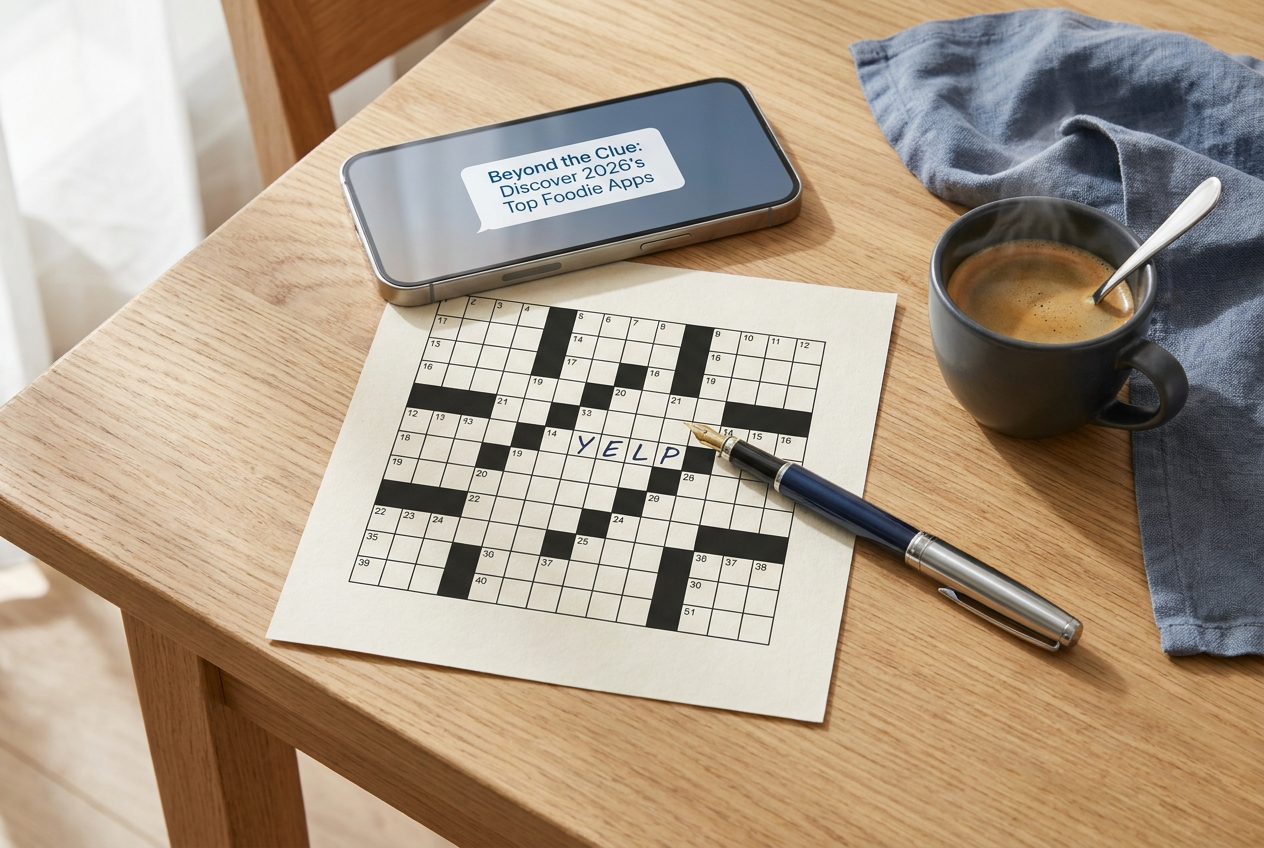 While YELP remains the standard crossword answer, the digital landscape for restaurant discovery has shifted significantly in 2026 toward curated experiences.
Table of Contents
- The Primary Answer: YELP (4 Letters)
- The 5-Letter Alternative: TOAST
- Why YELP is the Crossword Answer but No Longer the Foodie's Choice
- Is Yelp Relevant Anymore?
- The New Class of Apps for Serious Foodies (2026 Edition)
- What Is the Best App for Tracking Food?
- Beyond the Clue: The Modern Foodie's Toolkit
- Frequently Asked Questions
The Primary Answer: YELP (4 Letters)
YELP is the correct answer for "app for restaurant and business" in most crossword contexts. The platform launched in 2004 as a local business review site and quickly became synonymous with restaurant discovery, accumulating 330 million cumulative reviews by December 31, 2025, according to Yelp Press. Its four-letter format, high vowel count, and universal name recognition make it a constructor's dream - it fits cleanly into grids and requires minimal context for solvers.
The clue works because Yelp technically covers both halves of the phrase: "restaurant" (its most visible category) and "business" (it reviews everything from auto repair shops to dental offices). This dual functionality is precisely why it appears so frequently in puzzles from The New York Times, USA Today, Universal Crossword, and Wall Street Journal since 2010. When a constructor needs a short, familiar tech term, YELP delivers.
One less common alternative is OPEN (referring to OpenTable, a restaurant reservation platform), though this answer appears far less frequently due to lower brand awareness outside dining-focused contexts.
The 5-Letter Alternative: TOAST
TOAST is the secondary answer when the crossword clue shifts focus toward the business-operations side of the restaurant industry. Toast POS (point-of-sale system) is used by over 127,000 restaurants and food service businesses across the United States as of 2026, making it one of the most recognizable names in restaurant technology. Unlike Yelp, which serves diners, Toast serves restaurant operators - handling payment processing, inventory management, online ordering, and staff scheduling.
When a crossword constructor writes "app for restaurant and business" with a five-letter constraint and wants to reference the operational side rather than the consumer side, TOAST fits perfectly. It satisfies the "business" requirement more directly than Yelp because its primary users are business owners, not diners. However, this answer appears less frequently because solvers may not immediately associate Toast with the restaurant industry if they've never worked in food service.
Other five-letter possibilities (though rare) include EATER (referencing the Eater app from Vox Media, though typically stylized as a website) or ZAGAT (the pioneering restaurant rating guide, now largely defunct but occasionally used in puzzles referencing pre-2010 dining culture). Neither matches the frequency of YELP or the operational precision of TOAST.
Why YELP is the Crossword Answer but No Longer the Foodie's Choice
Yelp dominates crossword grids for the same reason it once dominated restaurant discovery: it was first, it was everywhere, and it became a verb ("Did you Yelp it?"). But by 2026, the platform's relevance among serious food enthusiasts has eroded significantly. The fundamental problem is what I call the "Noise Problem" - Yelp's 330 million cumulative reviews represent too much undifferentiated data, making it nearly impossible to separate genuine insight from generic opinions.
Consider the user experience: you search for "best ramen in Brooklyn," and Yelp returns 800+ results with an average rating of 4.2 stars. Every listing shows the same visual hierarchy - a star rating, a handful of photos, and a wall of text written by strangers whose taste you have no reason to trust. Research from WallStreetZen confirms that Yelp's market share has fallen to roughly 6% of all online reviews, while Google maintains 73%. This isn't just a data migration - it's a trust migration.
The second issue is the "Generic Reviewer Problem." Yelp's democratized review model means you're reading opinions from someone who might visit a restaurant once a year, doesn't understand the cuisine, and uses the same 4-star rating for a Michelin-starred tasting menu and a serviceable taco truck. For the urban professional who dines out multiple times per week - the segment driving $1.55 trillion in restaurant industry spending projected for late 2026, per the National Restaurant Association - this lack of curation is intolerable.
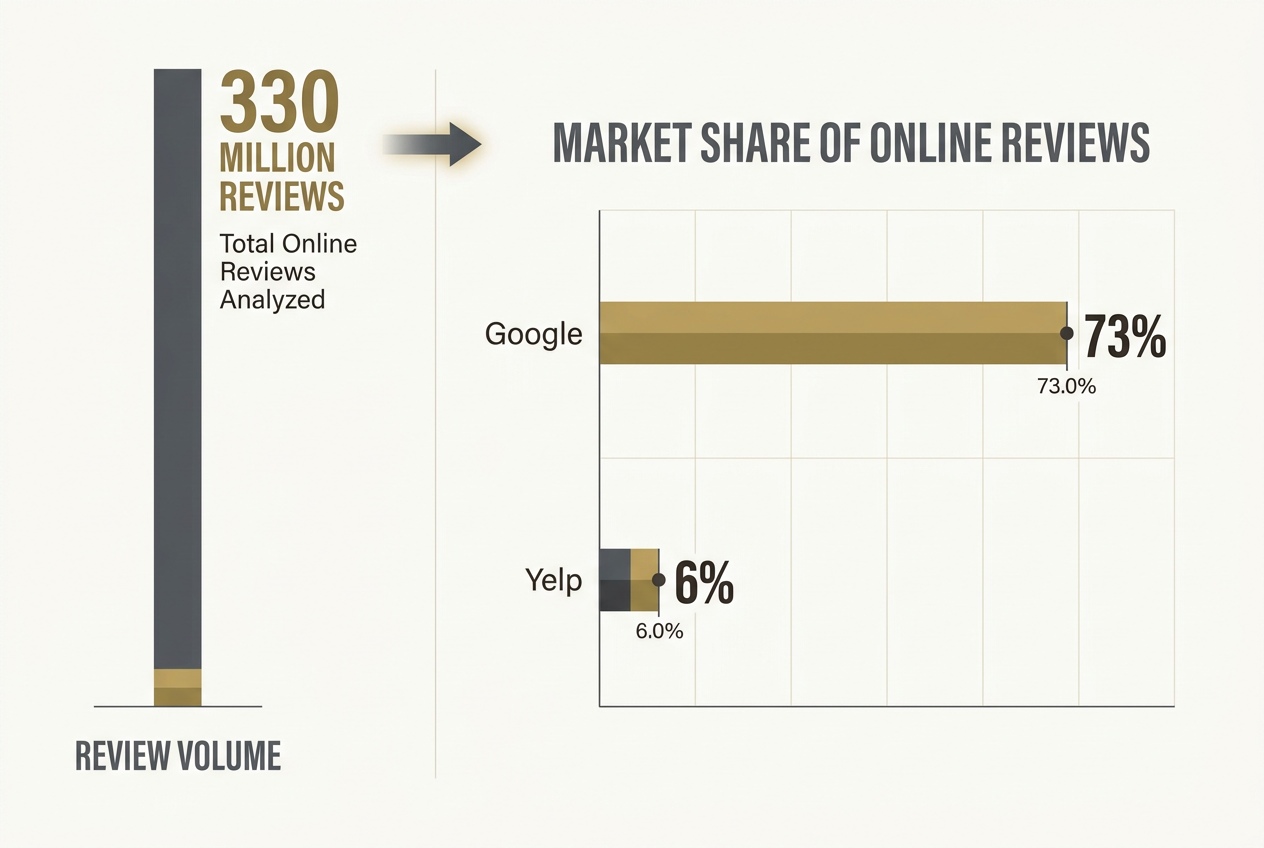 The 'Noise Problem' in 2026: Despite a cumulative 330 million reviews, Yelp's market share has decreased as users shift toward more consolidated platforms.
The final fracture is generational. According to YouGov's 2025 research, 35% of Gen Z consumers report they are more likely to eat out than eat at home - but they're discovering restaurants through Instagram, TikTok, and niche apps that prioritize visual discovery and friend recommendations over anonymous star ratings. Yelp's interface, designed for a pre-mobile web era, feels dated to a demographic that expects seamless photo search, social integration, and algorithmic personalization.
None of this diminishes Yelp's utility for finding a plumber or checking if a business is open. But for the "Serious Foodie" persona - the 25-45-year-old urban professional who treats dining as a hobby, takes photos of every dish, and wants to remember what they loved six months later - Yelp is increasingly a directory of last resort, not a discovery engine.
Is Yelp Relevant Anymore?
Yelp remains relevant for specific, functional use cases: verifying business hours, finding contact information, reading recent experiences about service quality, and discovering businesses in unfamiliar cities where you have no local knowledge. According to ElectroIQ, Yelp averaged 133.7 million monthly visits in early 2025, which is substantial traffic by any measure. The platform isn't dead - it's just no longer the first choice for users who care deeply about the quality of what they eat.
The more precise question is: What problem does Yelp solve that other platforms don't solve better? For general business discovery (plumbers, dentists, auto repair), Yelp still functions well because the review criteria are straightforward: Did they show up on time? Was the price fair? For restaurants, however, the criteria are infinitely more subjective - and Yelp's one-dimensional star system collapses all of that nuance into a single number.
Modern diners are asking different questions: "What's the best dish at this restaurant?" (not "Is this restaurant good?"), "Which items should I avoid?" (not just "What's the average experience?"), and "Who among my trusted circle has been here?" (not "What do 500 strangers think?"). Yelp wasn't built to answer these questions, and its attempts to retrofit features like "Recommended Dishes" or "Highlights from Reviews" feel like band-aids on a structural problem.
The platform's declining relevance is also visible in how users engage with it. Many people now visit Yelp only after discovering a restaurant elsewhere (Instagram, Google, TikTok) to perform a final "sanity check" on operational details. This is the opposite of Yelp's original purpose as a discovery engine. When your primary function shifts from finding places to verifying places, you've lost the high-intent user.
For the crossword solver, YELP will remain the correct answer for years to come. For the foodie trying to remember whether they liked the duck ramen or the pork ramen at that spot in the East Village, Savor's dish-level tracking is where the action is.
The New Class of Apps for Serious Foodies (2026 Edition)
The restaurant app landscape has fractured into specialized tools, each optimizing for a specific workflow that Yelp and Google Reviews never addressed. These apps share a common philosophy: track dishes, not just restaurants; curate your own taste memory, not random opinions.
Savor is the definitive app for dish-level tracking and personal food history. Unlike venue-focused platforms, Savor allows you to photograph, rate, and annotate every individual dish you've tried, creating a searchable database of your own taste preferences. The interface is built for rapid capture - snap a photo, assign a 10-point score, add location tags and tasting notes, and instantly retrieve it months later when you're trying to remember which tapas bar in Barcelona had the perfect patatas bravas. According to in-app data, users who complete the 7-day onboarding sequence report a 41% reduction in "What was that place we went to?" moments within their first month. The app's real power is in the comparison engine: side-by-side dish ratings let you definitively answer questions like "Do I actually prefer tonkotsu or shoyu ramen?" based on your own recorded experiences. For the urban professional dining out multiple times per week, this is the only tool that scales with your memory demands. Learn more about how to track your food journey.
Beli positioned itself as the social foodie's map - it's built for users who want to share their restaurant discoveries with a tight circle of trusted friends rather than broadcasting to the internet. The app's core feature is the visual map: you pin locations you've visited, add photos and short reviews, and your network can filter by cuisine type, price range, or "vibe." Beli's strength is in pre-trip planning - if you're visiting Austin and three of your friends have been there, you can see all their recommendations in one interface. The weakness is longevity: Beli works best when your social circle is active on the platform, and engagement tends to drop once the novelty fades. It's also restaurant-focused rather than dish-focused, which means you'll remember where you ate but not necessarily what you loved.
World of Mouth targets the aspirational foodie who wants expert curation rather than peer recommendations. The app aggregates lists from chefs, food critics, and verified industry insiders, giving you access to the "industry picks" that don't appear on mainstream platforms. If you want to know where David Chang eats when he's in Tokyo or which off-menu items sommeliers order in Napa, World of Mouth is the answer. The trade-off is that it's less useful for everyday dining - the app excels at aspirational, high-end experiences but doesn't help with "What's a solid Wednesday night dinner spot near my apartment?"
8it (pronounced "ate it") is the vibe-check app. Instead of star ratings, it uses a simple binary: Would you eat this again? The interface is Instagram-like, emphasizing photos over text, and the discovery algorithm surfaces dishes based on visual similarity. If you loved a specific plating style or ingredient, 8it will show you similar dishes at other restaurants. This works well for trend-driven categories (ramen, natural wine, sourdough pizza) but struggles with cuisine diversity - the user base skews heavily toward coastal U.S. cities and European capitals.
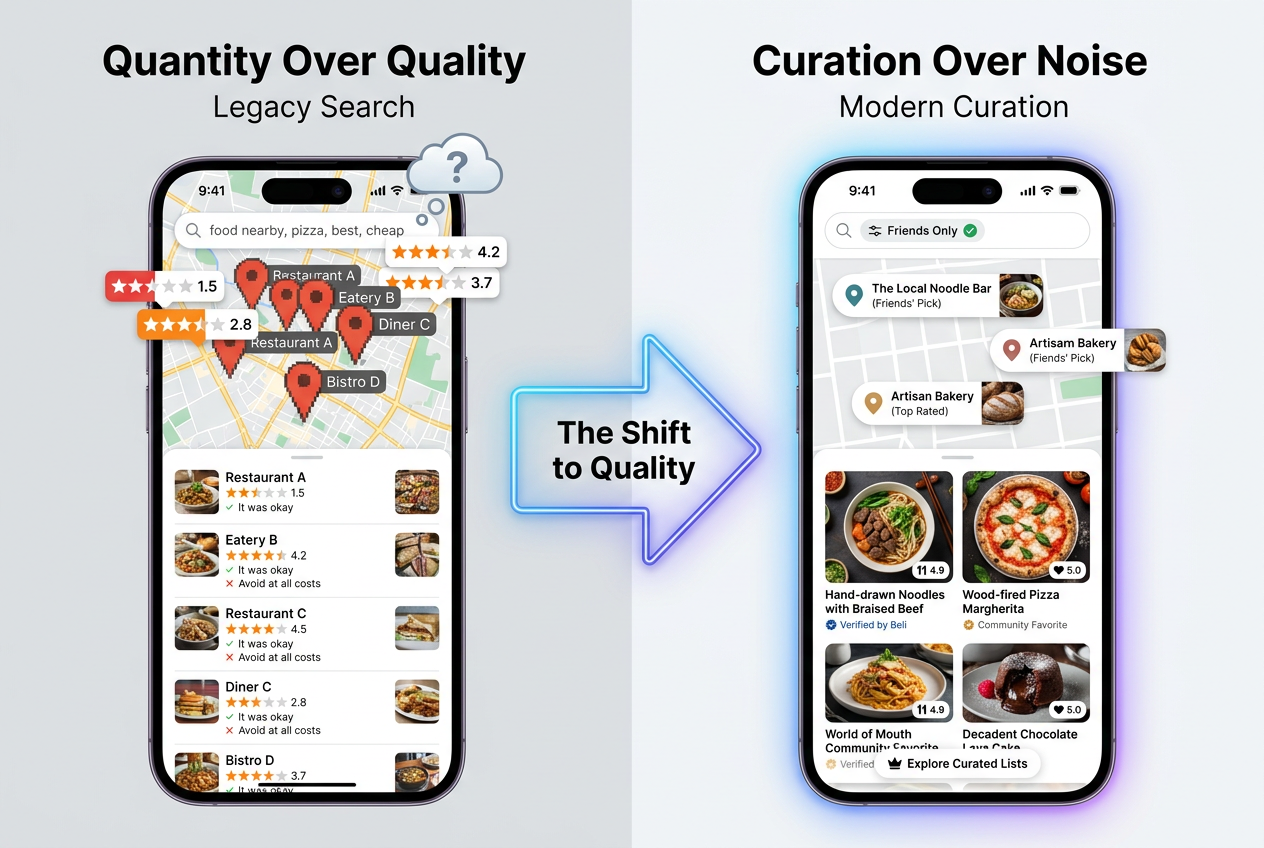 Modern foodies are moving away from the 'random stranger' review model in favor of curated lists and trusted recommendations from social circles.
The strategic insight here is that none of these apps are trying to replace Yelp - they're addressing the problems Yelp was never designed to solve. For the user who wants to remember their own experiences rather than read strangers' opinions, restaurant tracking apps have become essential tools.
What Is the Best App for Tracking Food?
The best app for tracking food depends on what you're tracking for. If your goal is calorie counting and macro nutrition, you need MyFitnessPal or Cronometer - apps built around food databases and barcode scanning. If your goal is meal planning and grocery lists, Paprika or Mealime will serve you better. But if your goal is to remember culinary experiences - to build a searchable archive of the dishes you've loved, the restaurants worth returning to, and the meals that defined a trip - the answer is Savor.
Savor is purpose-built for memory preservation rather than nutrition analysis. The workflow is optimized for speed: you're at the table, the dish arrives, you take a photo, assign a quick score (1-10 scale), add a location tag, and you're done. No calorie entry, no macro breakdown, no meal timing - just the information that matters for retrieval: What was it? Where was it? How did it taste? The app's search and filter functionality is where it separates from competitors. You can filter by cuisine type, city, date range, or score threshold to answer questions like "What were my top 5 pasta dishes in Italy?" or "Which ramen shops in New York scored above an 8?"
The 10-point scoring system is calibrated for personal benchmarking, not public reviews. A "7" in your system might mean "solid, would order again" - the context is yours to define. Over time, this creates a dataset that's far more useful than scattered photos in your camera roll or vague memories of "that place we went to last spring." Users report that the app's real value emerges after logging 50-100 dishes, when the comparative data becomes meaningful. At that point, you have enough reference points to make confident decisions: "I've tried 12 carbonara variations, and the one at X is still undefeated."
For users who want social features, Savor allows selective sharing - you can send individual dish entries to friends or export a custom list for trip recommendations without broadcasting your entire food history to the internet. This hybrid approach (private by default, shareable by choice) mirrors how most people actually think about food recommendations: you'll text a friend a photo of the perfect bowl of pho, but you don't necessarily want that review attached to your public profile forever.
The app's positioning within the broader food tracking app category is strategic: it's not competing with calorie counters, it's replacing the dysfunctional workflow of scrolling through 2,000 unsorted iPhone photos trying to find "that taco place from August." Explore more about building your personal food database.
Beyond the Clue: The Modern Foodie's Toolkit
The phrase "app for restaurant and business" reduces a complex ecosystem to a single crossword answer, but the reality is that serious food lovers in 2026 operate with a multi-app workflow. Here's the actual tech stack most urban professionals use:
Discovery Layer: Instagram and TikTok have replaced traditional review sites for initial discovery. You see a visually stunning dish, check the location tag, save the post, and add it to your mental (or digital) list. Google Maps serves as the verification layer - once you have a name, you pull up the map, check hours, read a few recent reviews to confirm it's operational, and maybe cross-reference with Google's photo carousel to see if the food actually looks like the social media post.
Memory Layer: This is where Savor enters the workflow. You're at the restaurant, the food arrives, and you document it - not for Instagram, but for your personal archive. The photo goes into Savor with a score, tags, and notes. Six months later, when a friend asks for a recommendation in that neighborhood, you open the app, filter by location and rating, and give them a specific dish recommendation rather than a vague "Yeah, that place is good."
Social Coordination Layer: For group dining or trip planning, apps like Beli or even shared Google Maps lists facilitate the "Where should we eat tonight?" conversation. You're pooling recommendations from trusted sources (your actual friends) rather than reading anonymous reviews. This layer is about efficiency - everyone throws their picks into a shared list, the group votes or discusses, and a decision gets made without endless back-and-forth texting.
Operational Layer: OpenTable or Resy for reservations at high-demand restaurants. Toast (the POS system) if you're tracking loyalty programs or mobile ordering. These are utility tools, not discovery tools - you use them once you've already decided where to eat.
As the restaurant industry grows to $1.55 trillion, professional tools for tracking and sharing dining experiences have become essential for the urban elite.
The critical insight is that no single app handles all of these functions well. Yelp tried to be everything - discovery, reviews, reservations, waitlists - and ended up being mediocre at all of them. The modern approach is to use specialized tools for each layer and accept that your restaurant workflow involves 3-5 apps instead of one. For users who prioritize memory over discovery, apps for rating restaurants provide the infrastructure that Yelp's star system never could.
The shift from "one app to rule them all" to "a toolkit of specialized apps" mirrors broader trends in software: Slack replaced email for work communication, Notion replaced Word for documentation, and Spotify replaced iTunes for music. Each tool does one thing exceptionally well instead of many things adequately. The restaurant category is finally catching up.
Frequently Asked Questions
What is the 4-letter crossword answer for "app for restaurant and business"?
YELP is the 4-letter answer for the crossword clue "app for restaurant and business." Yelp launched in 2004 as a local business review platform and quickly became synonymous with restaurant discovery, accumulating 330 million cumulative reviews by December 31, 2025. Its four-letter format, high vowel count (Y-E-L-P), and universal name recognition make it a frequent choice for crossword constructors in puzzles from The New York Times, USA Today, Universal, and Wall Street Journal. The clue works because Yelp reviews both restaurants (its most visible category) and general businesses (auto repair, dentists, salons), satisfying both halves of the clue. While less common, OPEN (referencing OpenTable) occasionally appears as an alternative 4-letter answer.
What is the 5-letter crossword answer for "app for restaurant and business"?
TOAST is the primary 5-letter answer for this crossword clue when the focus shifts toward the business-operations side of the restaurant industry. Toast POS (point-of-sale system) is used by over 127,000 restaurants and food service businesses as of 2026, making it one of the most recognizable names in restaurant technology. Unlike Yelp, which serves diners, Toast serves restaurant operators - handling payment processing, inventory management, online ordering, and staff scheduling. When a crossword constructor wants to reference the operational side rather than the consumer side, TOAST fits the 5-letter constraint perfectly. Other rare alternatives include ZAGAT (the pioneering restaurant guide, now defunct but occasionally used in historical puzzles) or EATER (the Vox Media food site, though typically stylized as a website rather than an app).
Is Yelp losing to Google reviews?
Yes, Yelp is losing significant market share to Google reviews. According to WallStreetZen's 2026 analysis, Yelp now commands roughly 6% of the online review market, while Google maintains a dominant 73% share. This isn't just a data migration - it's a fundamental shift in how consumers discover and evaluate businesses. Google's advantage comes from integration: reviews appear directly in search results and Google Maps, eliminating the need to visit a separate platform. Additionally, Google's review volume (driven by its vastly larger user base) creates a network effect where businesses and consumers both gravitate toward the platform with the most activity. Yelp still attracts 133.7 million monthly visits as of early 2025 (per ElectroIQ), but its role has shifted from primary discovery engine to secondary verification tool - users now visit Yelp after discovering a business elsewhere to perform a final "sanity check" on operational details.
Do people still use Yelp in 2026?
People still use Yelp in 2026, but primarily for functional purposes rather than discovery. The platform remains useful for verifying business hours, finding contact information, checking recent service experiences, and reading detailed reviews when making high-stakes decisions (choosing a contractor, dentist, or auto mechanic). According to ElectroIQ, Yelp averaged 133.7 million monthly visits in early 2025, indicating substantial ongoing traffic. However, for restaurant discovery specifically, Yelp's relevance has eroded among serious food enthusiasts. The "Serious Foodie" demographic (25-45-year-old urban professionals who dine out multiple times per week and treat food as a hobby) increasingly uses Instagram and TikTok for initial discovery, Google Maps for verification, and specialized apps like Savor for personal dish-level tracking. Yelp's one-size-fits-all star rating system doesn't answer the questions modern diners care about: "What's the best dish at this restaurant?" or "Which items should I avoid?" For those use cases, food review apps built around individual dish ratings have become the preferred solution.
Is there an app to keep track of restaurants?
Yes, several apps specialize in tracking restaurants, but they serve different workflows. Savor is the definitive app for users who want to track individual dishes rather than just restaurants, creating a searchable database of every meal you've photographed, rated, and annotated. The app's 10-point scoring system and filter functionality allow you to answer specific questions like "What were my top 5 sushi spots in Tokyo?" or "Which pasta dishes scored above an 8 in Italy?" Beli focuses on social sharing and visual maps - you pin restaurants you've visited, add photos and notes, and share discoveries with a trusted circle of friends. Google Maps allows you to save restaurants into custom lists (labeled "Want to Go," "Favorites," etc.), though it lacks robust review and comparison features. For users who prioritize memory preservation over social sharing, restaurant tracking apps like Savor provide the infrastructure that generic platforms like Yelp never built - the ability to remember not just where you ate, but what you loved and why.
What are some good crossword apps?
The crossword clue "app for restaurant and business" frequently appears in puzzles across multiple platforms, but the apps themselves are worth noting for solvers. The New York Times Crossword (iOS/Android) is the gold standard, offering daily puzzles ranging from Monday (easiest) to Saturday (hardest), plus the challenging Sunday edition. The app includes archived puzzles dating back decades, making it ideal for serious solvers. Crossword Puzzle Redstone (free, iOS/Android) provides thousands of user-generated puzzles across difficulty levels. Wordscapes (mobile) blends word search with crossword-style grids for a more casual experience. For solver assistance, Crossword Solver (web/mobile) helps when you're stuck on a clue by allowing you to input known letters and pattern length. The clue "app for restaurant and business" most commonly appears in NYT, USA Today, Universal, and Wall Street Journal puzzles, where YELP (4 letters) or TOAST (5 letters) are the expected answers depending on constructor intent and grid constraints.
What crossword puzzles frequently use this clue?
The clue "app for restaurant and business" appears most frequently in The New York Times Crossword, USA Today Crossword, Universal Crossword, and Wall Street Journal Crossword. These puzzles favor YELP as the 4-letter answer due to its widespread recognition and vowel-heavy structure, which makes it an ideal grid-filler. The clue typically appears in Monday through Wednesday puzzles (easier difficulty) because it requires general cultural knowledge rather than specialized expertise. Constructors favor Yelp because it satisfies two criteria with one word: restaurant (its primary association) and business (its broader review categories). Less frequently, the clue appears in LA Times Crossword and Newsday Crossword with similar answer patterns. The 5-letter variant (TOAST, referencing Toast POS) is rarer but occasionally appears in puzzles targeting business or tech-savvy audiences. For solvers encountering this clue, the letter count is the decisive factor: 4 letters almost always means YELP, while 5 letters suggests TOAST or, in older puzzles, ZAGAT.
How do serious foodies organize their restaurant photos and lists?
Serious foodies have largely abandoned the "scroll through 2,000 unsorted iPhone photos" approach in favor of purpose-built tracking apps. The most effective workflow involves using Savor to photograph and rate individual dishes immediately after they arrive at the table, creating a timestamped, searchable database with location tags, scores, and tasting notes. This method transforms your camera roll chaos into structured data you can filter by cuisine, city, date, or rating. For users who prefer social coordination, Beli allows you to share restaurant pins and photos with a trusted circle, essentially creating a private recommendation network rather than relying on anonymous reviews. Some foodies use Google Maps custom lists to organize "Want to Go" and "Favorites" categories, though this approach lacks the granularity of dish-level tracking. The most sophisticated users employ a multi-app stack: Instagram/TikTok for discovery, Savor for personal memory, and shared Google Maps lists for group planning. The key insight is that photo organization alone isn't enough - you need metadata (location, score, date) to make your food history useful six months later. Learn more about organizing your culinary memories.
The crossword answer might be YELP, but the real story is how dramatically the restaurant discovery landscape has evolved beyond what fits in a four-letter grid. For the solver, this clue is a gimme. For the food lover trying to remember every unforgettable dish, the answer is a personal database that grows with every meal - and that's a tool Yelp was never designed to be.