
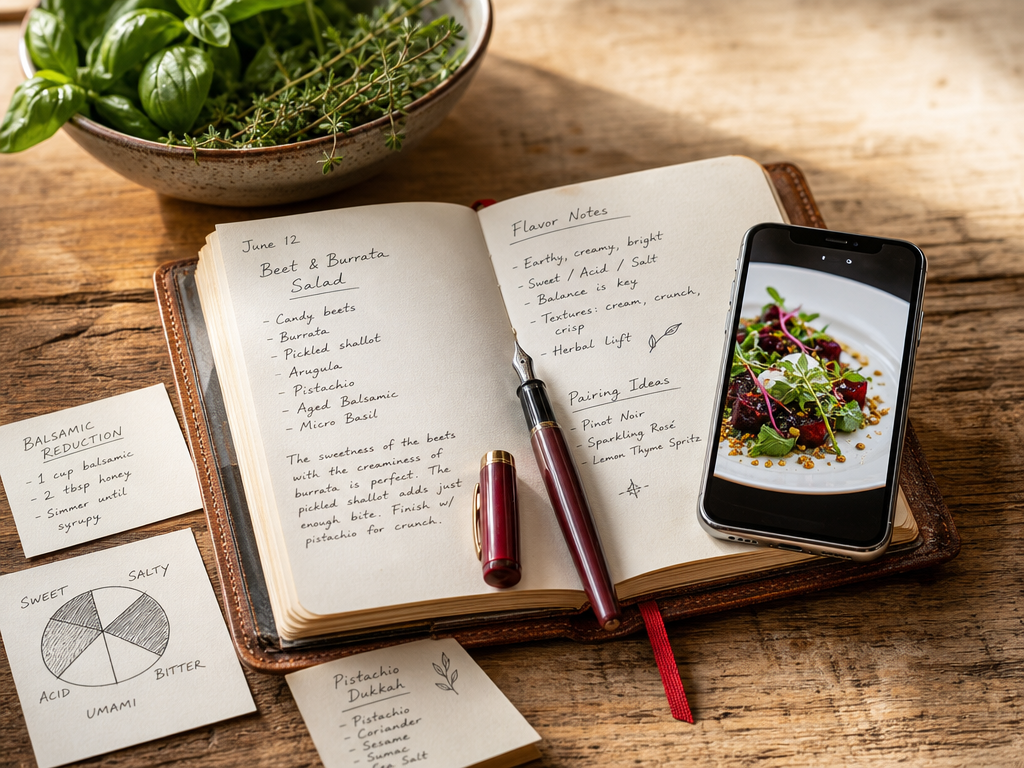
How to Keep Private Food Tasting Notes: A Complete System for Serious Foodies
Harry the matcha king
Harry is our resident matcha obsessive. He’s tasted hundreds of bowls and tracks every cup in Savor.
How to Keep Private Food Tasting Notes: A Complete System for Serious Foodies You had an extraordinary meal three months ago. The duck confit was perfect -...
How to Keep Private Food Tasting Notes: A Complete System for Serious Foodies
You had an extraordinary meal three months ago. The duck confit was perfect - crispy skin, tender meat, that lingering hint of star anise. You took a photo. You remember the feeling. But can you recall the restaurant's name? The specific dish? Whether it was the Tuesday special or a permanent menu item?
Your camera roll holds hundreds, maybe thousands of food photos. But without a system to capture what made each dish memorable, those images become a graveyard of forgotten flavors.
Private food tasting notes solve this problem. They're your personal culinary database - a searchable archive of every dish you've loved, organized by flavor, location, chef, or any other criteria that matters to you. Unlike public reviews on Yelp or Instagram, private notes let you track dishes honestly, build genuine taste memories, and actually retrieve them when it matters.
This guide explains how to build a tasting note system that works, from professional frameworks adapted for personal use to the specific platforms that make retrieval effortless.
Table of Contents
- What Are Private Food Tasting Notes?
- Why Traditional Methods Fail
- The Professional Tasting Framework (Adapted)
- The Dish-Centric Framework
- The Frictionless Workflow
- Platform Comparison Guide (2026)
- Advanced Tactic: The Chef Map
- Frequently Asked Questions
What Are Private Food Tasting Notes?
Private food tasting notes are structured observations about specific dishes, recorded for your eyes only. Unlike restaurant reviews that evaluate an entire venue, tasting notes focus on individual culinary moments: the exact preparation of a cacio e pepe, the specific wine pairing that elevated a ribeye, the texture of a perfect croissant.
The core elements include:
- Dish identification: Name, chef, venue, date
- Sensory observations: Texture, acidity, umami, dominant flavors
- Technical execution: Cooking method, ingredient quality, plating
- Personal context: Who you were with, what made it memorable
- Retrieval tags: Cuisine type, key ingredients, cooking techniques
The goal is simple: turn fleeting taste experiences into searchable, lasting memories.
Why Traditional Methods Fail
Most people try one of three approaches, and all three break down at scale.
The camera roll strategy captures the visual but nothing else. You have 2,000 food photos with zero context. Was that ramen in Tokyo or Vancouver? Which bowl was the one with the 48-hour tonkotsu broth?
The Instagram/Yelp approach optimizes for public performance, not private memory. You write for an audience, not for yourself. The incentive is to sound clever or generous with stars, not to capture the specific technical details that made a dish exceptional.
The notes app scribble starts strong but becomes unsearchable chaos. Your entry from March reads "amazing pasta" with no venue name, no dish name, no way to find it again when you're craving that exact flavor profile six months later.
The problem isn't that you don't care. It's that none of these systems are built for retrieval. Private tasting notes flip the script: you design your database first, then capture just enough information to make every entry searchable.
The Professional Tasting Framework (Adapted)
Professional food critics and sommeliers use structured tasting protocols because memory is unreliable. The WSET Systematic Approach to Tasting (SAT) for wine, for example, breaks sensory evaluation into discrete, repeatable categories. You can adapt this for food.
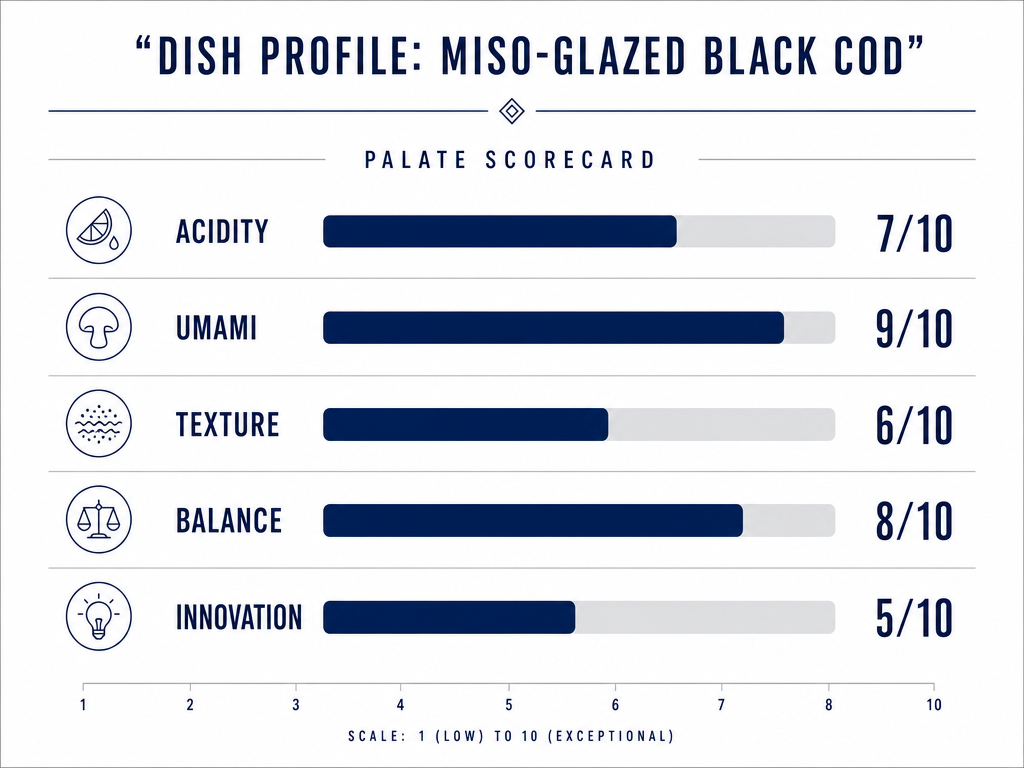
Using a standardized taxonomy like this flavor profile scorecard allows you to compare dishes across different cuisines and track your palate's evolution over time.
Core Evaluation Categories
Texture: Rate on a spectrum from crispy/crunchy to silky/creamy. A perfect katsu has an audible shatter. A French omelet should flow like lava. Precision here makes dishes searchable by mouthfeel.
Balance: Assess how acidity, umami, salt, sweet, and bitter interact. A great ceviche balances acid and salt without overwhelming the fish. A mole should integrate 20+ ingredients into a coherent whole. Track this on a 1-10 scale for each element.
Execution: Distinguish between creative ambition and technical precision. A molecular gastronomy dish might score high on innovation but low on execution if the foam collapses. A perfect roast chicken might be technically flawless but conceptually simple.
This framework doesn't require culinary school. It just requires consistency. Rate 10 dishes using the same criteria, and you'll start noticing patterns in your own taste.
For food lovers who want to go deeper, adapting professional methods like those used in restaurant feedback software can provide additional structure for your private notes.
The Dish-Centric Framework
Most restaurant apps organize by venue. You save a restaurant, maybe tag it with a cuisine type, and move on. This fails because what you actually remember is the dish.
A dish-centric database inverts the hierarchy:
Primary record: The dish
- Name: "Cacio e Pepe"
- Chef: Lucio Sforza
- Venue: Flavio al Velavevodetto (current)
- Date: March 2026
- Rating: 9.2/10
- Flavor notes: "Black pepper dominant, pecorino creamy without being heavy, pasta exactly al dente"
Secondary record: The chef
- Track career moves across venues
- Link to multiple dishes prepared over time
- Note signature techniques or ingredient sourcing
Tertiary record: The venue
- Current location (may change)
- Operational details (reservations required, cash only)
- Connection to multiple chefs and dishes
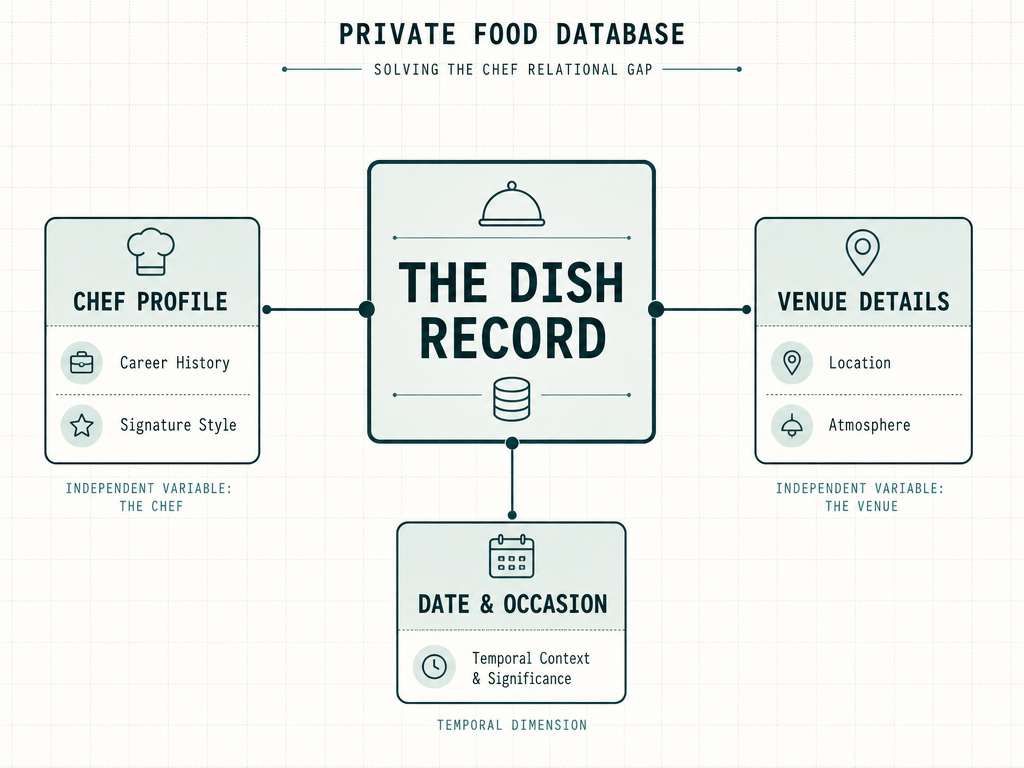
By tracking chefs as independent entities from restaurants, you can follow culinary talent as they move across venues, creating a personal 'Chef Map.'
This structure matters because restaurants close. Fine dining restaurants have a higher failure rate (4.9%) than other segments, highlighting the ephemeral nature of these venues. Chefs move. The specific carbonara you loved at a now-defunct trattoria becomes findable only if you tagged the dish and chef separately from the venue.
Want to track your favorite dishes more systematically? The best apps to track your favorite dishes offer frameworks you can adapt for your private notes.
The Frictionless Workflow
The biggest barrier to maintaining tasting notes is friction. Typing detailed observations while your dinner companion waits is socially awkward and cognitively exhausting.
The solution: separate capture from organization.
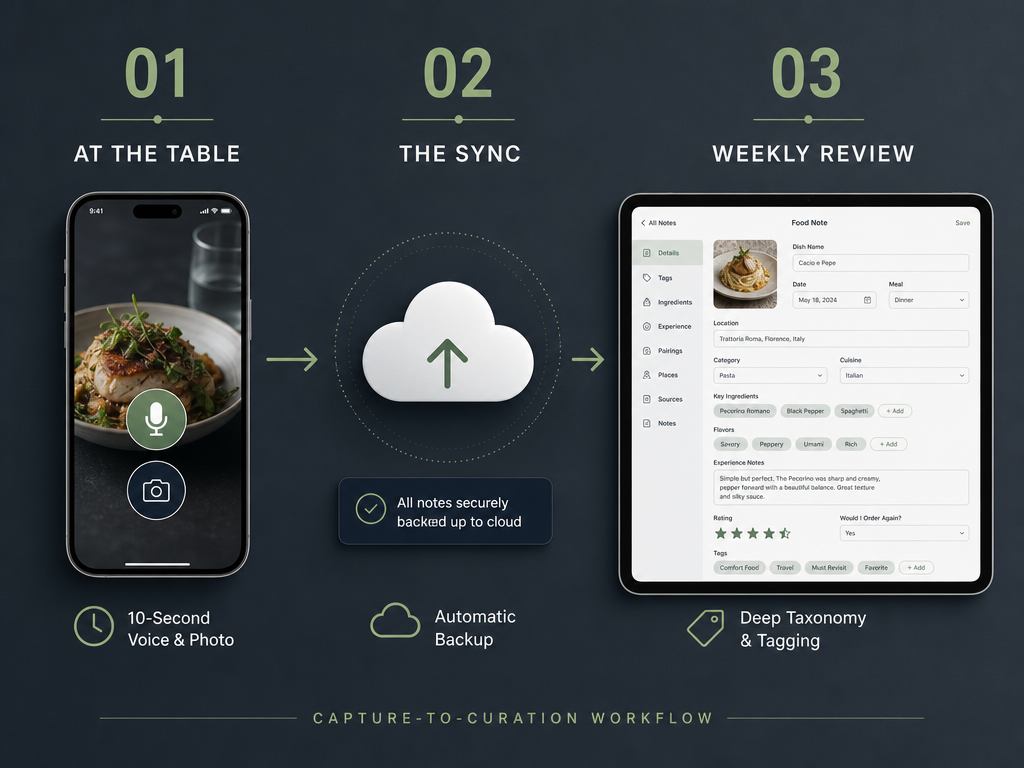
Mastering the 'Capture-First, Organize-Later' method ensures you enjoy your meal socially while preserving technical culinary details for your private database later.
At the Table: Instant Capture
One photo: Get a clear shot of the plated dish. Natural light is ideal, but don't stress. The photo is a memory trigger, not portfolio material.
10-second voice memo or three-word vibe check: "Umami bomb, perfectly balanced" or "Too salty, creative plating" captures the essence without disrupting conversation. Your phone's native voice memo app works fine.
Optional quick tag: If your dining companion is also taking photos, use the moment to add a single-word tag in your notes app: "Ceviche" or "Omakase #3."
This takes 15 seconds. You stay present. You enjoy the meal.
Weekly Review: The Sunday Admin Session
Set aside 30 minutes once a week to process your captured notes. This is when you add structure.
For each dish:
- Transfer the voice memo notes into your chosen platform
- Add the complete dish name, chef, venue, and date
- Rate using your flavor profile framework (texture, balance, execution)
- Add 2-3 searchable tags: cuisine type, key ingredients, cooking techniques
This batch processing is efficient. You'll remember the context from photos and brief notes. The cognitive load is manageable because you're not doing it at the table.
Photographers already use this workflow. They shoot hundreds of images on vacation, then cull and edit at home. The same logic applies to taste memories. For more details on organizing your food photography workflow, see how to organize restaurant photos.
Platform Comparison Guide (2026)
Your choice of platform depends on your commitment level and technical comfort.
Analog: Pre-Printed Templates
Best for: Tactile thinkers who process better with pen and paper.
Tools: Moleskine Passion Journal (Food) or custom-designed tasting sheets.
Strengths: Zero digital distraction, highly personal, satisfying to write.
Limitations: Not searchable. Photos must be printed or stored separately. Difficult to share specific lists.
Verdict: Works well for low-volume tasters (1-2 meals per week) or as a supplementary emotional record alongside a digital system.
Low-Friction: Apple Notes with Smart Folders
Best for: iPhone users who want simplicity and native OS integration.
Setup: Create notes titled by dish name. Use hashtags for cuisine (#Italian), key ingredients (#Truffle), or techniques (#Fermentation). Apple Notes' search function indexes hashtags.
Strengths: Already on your device. Syncs across iPhone, iPad, Mac. Photos embed directly. Free.
Limitations: No relational database features. Can't easily generate "all pasta dishes rated 9+" or "all dishes by Chef Massimo."
Verdict: Excellent starting point. Migrate to a structured platform when you hit 50+ entries and retrieval becomes difficult.
For those looking to optimize their existing note-taking habits, how to build a personal restaurant library offers additional strategies.
Power User: Notion or Airtable
Best for: Data-oriented foodies comfortable with spreadsheets and databases.
Setup: Build three interconnected tables: Dishes (primary), Chefs (secondary), Venues (tertiary). Use relational fields to link a dish to its chef and venue. Add filter views: "Pasta dishes in Rome," "All dishes by Chef Enrique," "9+ rated umami-forward entries."
Strengths: Infinitely customizable. Powerful search and filtering. Can generate lists, export data, track trends over time.
Limitations: Steep learning curve. Requires initial setup time (2-3 hours). Overkill for casual tasters.
Verdict: The gold standard for serious foodies tracking 100+ dishes annually. The investment pays off in retrieval power.
If you're ready to commit to a database approach, check out best food software for serious foodies for detailed platform comparisons.
Dedicated: Savor (Dish-Centric) vs. Memolli (Privacy-Centric)
Savor: Built specifically for dish-level tracking. Automatically links dishes to chefs and venues. Includes a professional rating framework adapted for personal use. Designed for retrieval: "Show me all 9+ rated pasta dishes" or "What did I eat in Tokyo last year?"
Memolli: Focuses on completely private, unshared food journaling. No social features, no public profiles. Your notes stay yours.
Beli: Previously a strong contender but shifted focus toward social discovery and public sharing, making it less ideal for purely private note-taking.
Strengths (Dedicated Apps): Purpose-built workflows. No need to design your own database structure. Often include photo integration and geolocation tagging.
Limitations: Requires buying into a specific platform. Risk of shutdown or feature changes.
Verdict: Worth trying if you value turnkey solutions over customization. Many offer free tiers to test fit.
Curious about alternatives? Best food spotting apps provides additional options for organizing your culinary memories.
Advanced Tactic: The Chef Map
Restaurants are locations. Chefs are careers. The best dishes often follow the talent, not the address.
A Chef Map tracks culinary professionals across their career arc:
Example: Chef Daniela Soto-Innes
- 2016-2018: Cosme (NYC) - Sous Chef - Signature: Duck carnitas
- 2018-2019: Atla (NYC) - Executive Chef - Signature: Chilaquiles verdes
- 2020-present: Independent projects - Watch for pop-ups
By maintaining a separate "Chefs" table in your database, you can:
- Receive alerts when a chef opens a new venue
- Compare signature dishes across different kitchens
- Understand how a chef's style evolves over time
This approach transforms passive documentation into active curation. You're not just remembering meals - you're tracking the artists who create them.
For foodies interested in following specific culinary talent, best apps to share lists can help coordinate dining plans with fellow enthusiasts.
Frequently Asked Questions
What is a tasting note?
A tasting note is a structured sensory evaluation of a specific dish or beverage, typically including observations about aroma, taste, texture, and balance. In wine, it might describe tannin levels and fruit notes. In food, it captures flavor profiles, cooking techniques, and ingredient quality. The key difference between a tasting note and a casual review is consistency and specificity.
How do I set up a food journal?
Start with three components: a capture method (phone camera + voice memos), a storage platform (Apple Notes, Notion, or a dedicated app), and a weekly processing routine. At meals, take one photo and record a 10-second verbal impression. Once a week, transfer those impressions into your chosen platform, adding dish names, ratings, and searchable tags. Begin simple - dish name, location, date, and a 1-10 rating - then add complexity as the habit solidifies.
What is the best app for keeping a food diary?
It depends on your goals. For general health tracking with calorie counts, MyFitnessPal or Cronometer excel. For culinary memory focused on dish-level details and flavor profiles, apps designed for dish tracking like Savor or custom Notion databases work better. The "best" app is the one you'll actually use consistently.
Is there a good app for tracking restaurants?
Yes, but most restaurant-tracking apps optimize for venue-level information rather than dish-level detail. Google Maps allows custom lists and notes. Beli offers social features for sharing recommendations. For serious foodies who want to track specific dishes across multiple restaurants, a dish-centric app or database provides better long-term value than traditional restaurant trackers.
What not to do when journaling?
Don't wait until the end of the meal to capture everything - you'll forget details. Don't try to write full paragraphs at the table - it kills the social experience. Don't use vague descriptors like "good" or "delicious" without supporting observations. Don't track restaurants instead of dishes - you'll lose the specificity that makes notes useful. And don't skip the weekly review session - unprocessed photos become as useless as no notes at all.
How do professional food critics take notes during a meal?
Most professionals use a hybrid approach: discrete shorthand notes during service (often on their phone or a small notepad), followed by detailed longhand expansion immediately after the meal. They focus on specific technical observations - exact cooking temperatures, sauce consistency, ingredient sourcing - rather than subjective impressions. Many use a standardized evaluation framework adapted from culinary school training. The key is capturing objective data points that trigger memory reconstruction later.
Should I track the chef's career or just the restaurant location?
Track both, but prioritize the chef. Restaurants close, rebrand, or change ownership. A talented chef's signature dishes often reappear across multiple venues throughout their career. By maintaining a separate "Chefs" table linked to your dish entries, you can follow culinary talent as it moves, discovering new restaurants when your favorite chefs relocate. This approach is particularly valuable in the fine dining world, where restaurant failure rates are notably high.
How can I link my food photos to my private notes automatically?
Use a platform that supports photo metadata or allows manual tagging during your weekly review. Google Photos can recognize locations if geotagging is enabled on your camera. Notion and Airtable allow you to drag photos directly into database entries. Dedicated dish-tracking apps often auto-import camera roll photos based on timestamps. The most reliable method is to take the photo, immediately create a basic note entry on your phone, then expand that entry during your Sunday admin session when you're at a computer with a full keyboard.
What is a "flavor profile taxonomy" and why do I need one?
A flavor profile taxonomy is a consistent vocabulary for describing taste experiences. Instead of vague terms like "good" or "interesting," you use specific sensory markers: high acidity, low umami, crispy texture, balanced fat content. This consistency allows you to search your database meaningfully. If you rate acidity on a 1-10 scale across 50 pasta dishes, you can eventually query "show me all high-acid pasta dishes rated 8+" and discover your personal preferences. Without this structured language, your notes remain unsearchable anecdotes.
Your camera roll doesn't have to be a graveyard. With a structured approach to private food tasting notes - combining professional evaluation frameworks, a dish-centric database, and a frictionless capture workflow - every exceptional meal becomes a searchable, lasting memory.
Start simple. Take a photo, record a 10-second voice note, and commit to one weekly review session. Build from there. The goal isn't to document every meal, just the ones worth remembering. Your future self, searching for "that perfect duck confit with star anise from 2026," will thank you.