
How to Track the Best Dishes You’ve Tried in Every City
Harry the matcha king
Harry is our resident matcha obsessive. He’s tasted hundreds of bowls and tracks every cup in Savor.
How to Track the Best Dishes You've Tried in Every City: The Complete System for Serious Foodies Your camera roll is a graveyard. Somewhere between photo 847...
How to Track the Best Dishes You've Tried in Every City: The Complete System for Serious Foodies
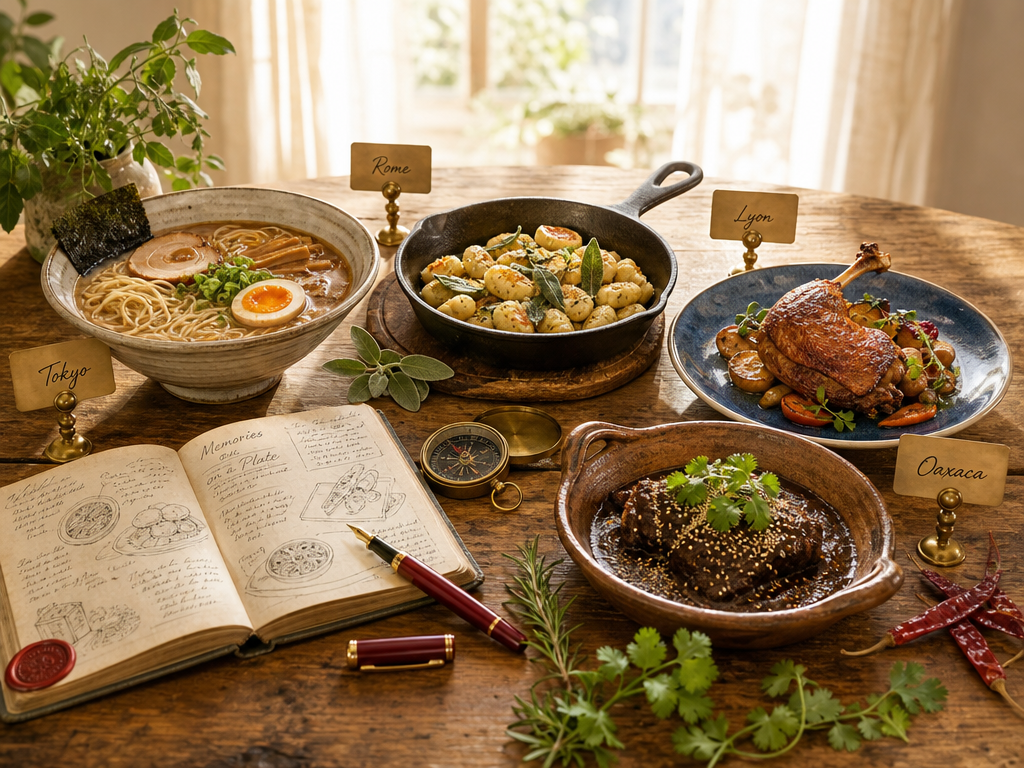
Your camera roll is a graveyard. Somewhere between photo 847 and photo 2,341, there's an image of the best bowl of ramen you've ever had. It was in Tokyo. Or was it Osaka? You remember the broth was cloudy, rich, almost gelatinous. You remember the waiter spoke no English but smiled when you ordered. You remember leaving that meal thinking, "I need to come back here."
But you can't. Because you have no idea what the restaurant was called.
This is the modern foodie's curse. We live in an era of unprecedented culinary access - 81% of travelers across generations now prioritize food when planning trips - yet we've never been worse at remembering what we ate. Your phone holds thousands of food photos, but they're functionally useless. No tags. No notes. No way to answer the question that matters most: "Where was that incredible dish I had in Chicago three months ago?"
This guide isn't about finding restaurants. It's about building a system to archive, search, and recall every exceptional dish you've ever eaten across multiple cities. Think of it as your personal culinary knowledge management system - a way to turn fleeting taste memories into a permanent, searchable record.
Table of Contents
- Why Restaurant Ratings Fail Serious Foodies
- The Atomic Unit: Why You Must Track Dishes, Not Venues
- The Culinary Schema: 8 Essential Data Points
- The Stealth Log Workflow: Capture Without Killing the Moment
- The Tech Stack: Three Tiers of Tools
- Advanced Search: How to Query Your Food Life
- Cross-City Comparison: Finding Your Best Carbonara
- Frequently Asked Questions
Why Restaurant Ratings Fail Serious Foodies
A restaurant isn't a monolithic entity. It's a collection of individual dishes, each with its own success rate. That five-star Italian spot? The cacio e pepe is transcendent. The osso buco is aggressively mediocre. But all you'll see on Google Maps is a single 4.6-star rating that tells you nothing about which dishes are worth ordering.
The problem compounds across cities. You've eaten at 150 restaurants this year. You can't recall which ones had the best duck confit, the most balanced mole, or the lightest gnocchi. All you have is a vague sense of "good" or "not good" attached to venue names you've already forgotten.
This is why serious foodies are abandoning venue-level ratings entirely. The unit of measurement is wrong. You don't remember restaurants. You remember dishes.
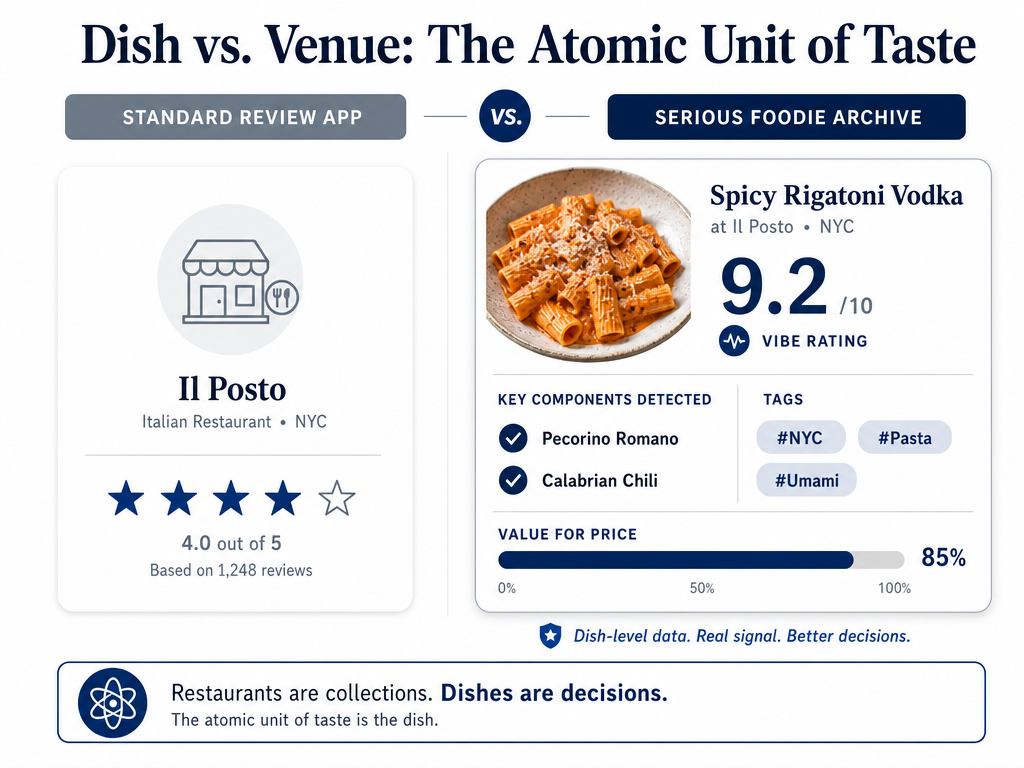
Why restaurant ratings fail serious foodies: by shifting the focus to the 'Atomic Unit' - the dish - you capture the granular data needed for a truly useful culinary archive.
The Atomic Unit: Why You Must Track Dishes, Not Venues
Here's the framework: The dish is the atomic unit of taste memory.
Not the restaurant. Not the meal. The specific plate of food in front of you. That margherita pizza at L'Antica Pizzeria da Michele in Naples. That duck confit at Le Comptoir in Paris. That tonkotsu ramen at Ichiran in Fukuoka.
When you track at the dish level, you unlock something venue ratings can never provide: the ability to compare a specific culinary technique across cities, countries, and years. You can answer questions like:
- Which city had the best version of a specific dish (e.g., "best carbonara: Rome, New York, or London?")
- How does the Neapolitan pizza in Naples compare to the Neapolitan-style pizza in Brooklyn?
- What are the common threads in every 10-point pasta dish you've ever eaten?
This is the shift from passive consumption to active curation. You're not just eating. You're building a database of your own taste.
The Culinary Schema: 8 Essential Data Points
A food photo without metadata is just a picture. To make your archive searchable, you need structure. Here's the eight-field system used by professional food critics and serious archivists:
1. Dish Name (Specific, Not Generic)
Not "pasta." Write "Cacio e Pepe with Pecorino Romano and hand-crushed black pepper."
Not "sushi." Write "Chu-toro nigiri, medium fatty tuna belly."
Specificity is what makes the entry findable three years later. Generic labels are useless.
2. Restaurant & City
Include the full venue name and the exact city. "Osteria Francescana, Modena" is actionable. "That Italian place" is not.
3. Date/Occasion
When did you eat this? "October 12, 2025" is better than "Fall 2025." "Sister's birthday dinner" is even better. Context anchors memory.
4. Hero Ingredient
What was the star of the dish? The ingredient that defined the flavor? "San Marzano tomatoes." "Jamón Ibérico de Bellota." "Hokkaido uni."
This field is what allows you to track ingredient quality across cuisines.
5. Flavor Profile Tags
Use hashtags or keywords: #umami, #smoke, #citrus, #funk, #spicy, #sweet-savory. These are your cross-reference keys. Want to find every dish you've rated highly that had a smoky element? Search #smoke.
6. Subjective "Vibe" Rating (1-10)
This is your personal score. Not what you think the critic would say. What you felt. A 10 means "I would fly back to this city just to eat this dish again." A 6 means "decent, but forgettable."
Professional food critics often use a 100-point scale, but a 10-point system is more practical for personal archives.
7. Price/Value
Note the cost. It helps you identify the best value dishes when planning future trips, and provides useful context for comparing experiences across different cities and markets.
8. The Visual Anchor (Photo)
The photo isn't decoration. It's your sensory trigger. One well-lit shot of the dish is enough. You're not shooting for Instagram. You're shooting for memory retrieval.
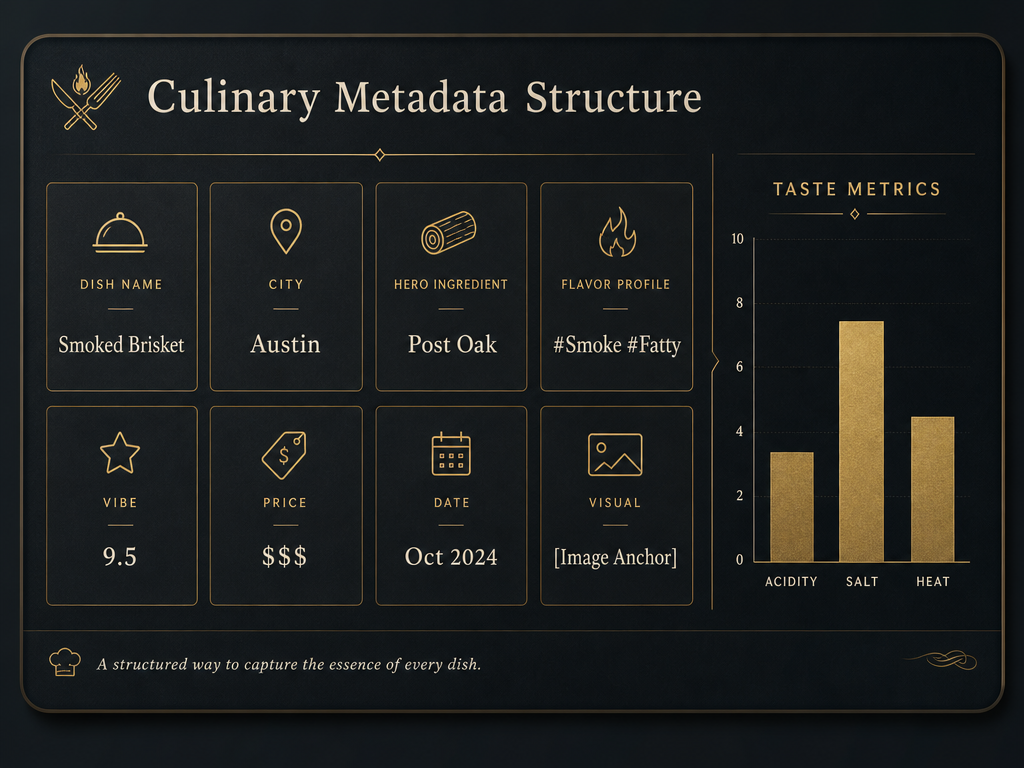
Standardizing your culinary data with an 8-field schema transforms a simple photo gallery into a powerful, searchable database of your lifelong gastronomic journey.
The Stealth Log Workflow: Capture Without Killing the Moment
The social contract of dining is sacred. Nobody wants to sit across from someone who's furiously typing notes into their phone while the food gets cold. Here's how you log without being that person:
Step 1: The 30-Second Capture (At the Table)
When the dish arrives:
- Take one photo. Natural light if possible. Don't rearrange the plate.
- Open your tracking app
- Type the dish name and restaurant name
- Close your phone
That's it. 30 seconds, maximum. Then put the phone away and eat.
The key insight: you're not trying to capture everything in the moment. You're creating a skeleton entry you'll flesh out later.
Step 2: The 5-Minute Reflection (In Transit)
On the Uber ride home. On the train back to your hotel. In the airport lounge. This is when you fill in the rest:
- The hero ingredient
- The flavor tags
- Your rating
- Any tasting notes that stuck with you
Why does this work? Because the sensory memory is still sharp. You can still taste the dish. You can still recall the texture, the aroma, the way the flavors developed. Wait until tomorrow, and it's gone.
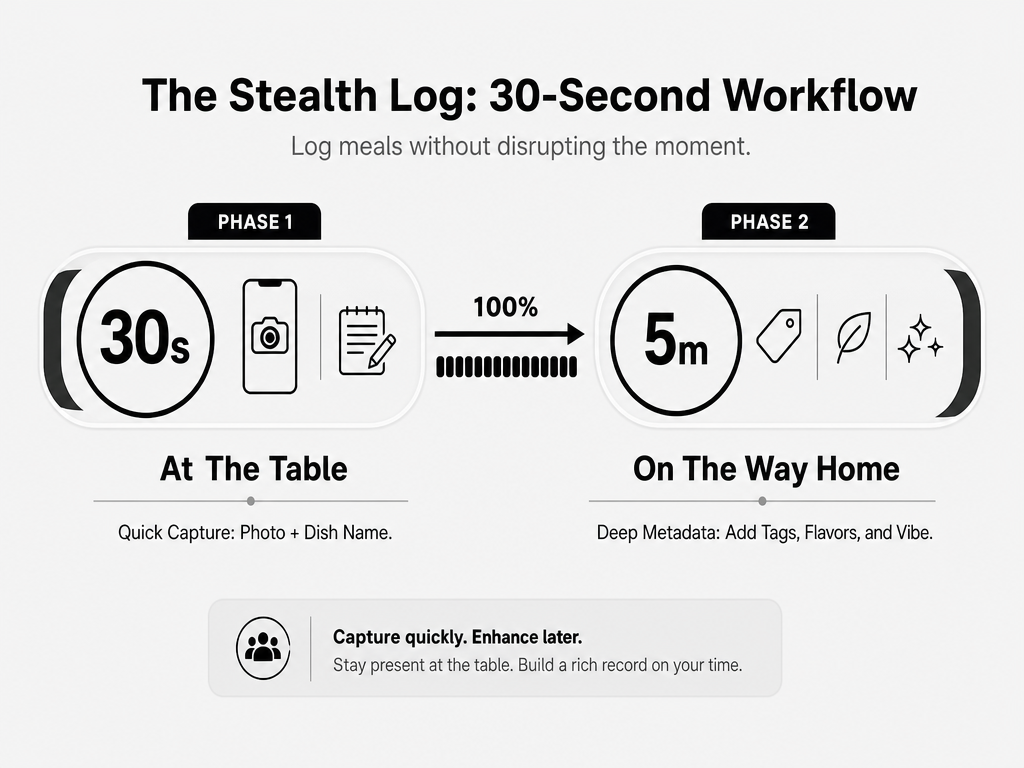
The Stealth Log workflow balances social presence with data integrity, ensuring you capture high-quality memories without letting technology interrupt the dining experience.
The Tech Stack: Three Tiers of Tools
The right tool depends on your technical comfort level and how much control you want over your data. Here are three tiers, from simplest to most powerful:
Tier 1: The Minimalist (For the Non-Technical Foodie)
Tool: Apple Notes, Bear, or Google Keep with a structured hashtag system
How it works: Create one note per dish. Use a consistent format:
Dish: Margherita Pizza
Restaurant: L'Antica Pizzeria da Michele
City: Naples
Date: 2025-10-12
Rating: 9/10
Tags: #pizza #Naples #simplicity #buffalo-mozzarella
Notes: The crust had that perfect char. Barely any toppings - just sauce, mozzarella, basil. This is the standard.
Search by hashtag. When you want to find every pizza you've rated 9+, search #pizza AND 9.
Pros: Zero learning curve. Built-in backup. Free.
Cons: No structured database. No automatic city grouping. Searching gets clunky after 500+ entries.
Tier 2: The Collector (For the Dedicated Foodie)
Tool: Savor, Memolli, or a dedicated dish-tracking app
How it works: These apps are purpose-built for dish-level archiving. They understand that you're tracking individual plates, not restaurants. They often include:
- City-based organization
- Ingredient tagging
- Rating scales
- Photo galleries
- Search by flavor profile
Savor, for example, treats the dish as the primary data object. You can see all your pasta dishes across all cities on a single page. You can filter by rating, by ingredient, by date.
Pros: Purpose-built for this exact problem. Visual. Shareable lists for friends. Often includes map views.
Cons: Proprietary database. If the app shuts down, your data could be at risk. Check for export capabilities before committing.
Read more about the best apps to track your favorite dishes.
Tier 3: The Architect (For the Power User)
Tool: Notion or Obsidian with a custom database template
How it works: You build your own culinary knowledge management system. Create a database with custom fields:
- Dish Name (text)
- Restaurant (linked database)
- City (dropdown)
- Date (date)
- Rating (number)
- Hero Ingredient (text)
- Flavor Tags (multi-select)
- Photo (file upload)
- Tasting Notes (rich text)
Then create filtered views: "All dishes rated 9+ in Tokyo," "Every pasta dish, sorted by rating," "All uses of white truffles."
Pros: Total control. Infinite customization. Your data lives in Markdown files you own forever. Data portability is guaranteed.
Cons: Steep learning curve. High friction at the dinner table. Requires discipline to maintain.
For most serious foodies, Tier 2 (a dedicated app) is the sweet spot. You get structure without complexity. But if you're already deep in the Notion ecosystem, Tier 3 lets you integrate your food archive with travel planning, recipe collections, and wine logs.
Advanced Search: How to Query Your Food Life
Once you've logged 200+ dishes, the real power reveals itself. You can now treat your food history like a database. Here are the queries that change how you travel and eat:
Query 1: "Show me every spicy dish I've rated 8+ in Asia"
Filter by:
- Flavor tag:
#spicy - Rating: 8-10
- Location: Any city in Asia
Result: A ranked list of your favorite spicy dishes across Tokyo, Bangkok, Seoul, and Singapore. You now have your personal spice tour.
Query 2: "What's the best pasta dish I've ever eaten?"
Sort by:
- Dish category: Pasta
- Rating: Descending
Result: Your top-ranked pasta, with notes on what made it exceptional. When someone asks for a restaurant recommendation in that city, you can point them to the exact dish, not just the venue.
Query 3: "Compare all my duck confit entries"
Filter by:
- Ingredient: Duck confit
Result: A side-by-side view of every duck confit you've logged. You can see patterns. Maybe the best ones all used duck fat for the potatoes. Maybe the ones you liked least were all too salty.
This is the ROI of the system. You're not just remembering. You're learning your own taste.
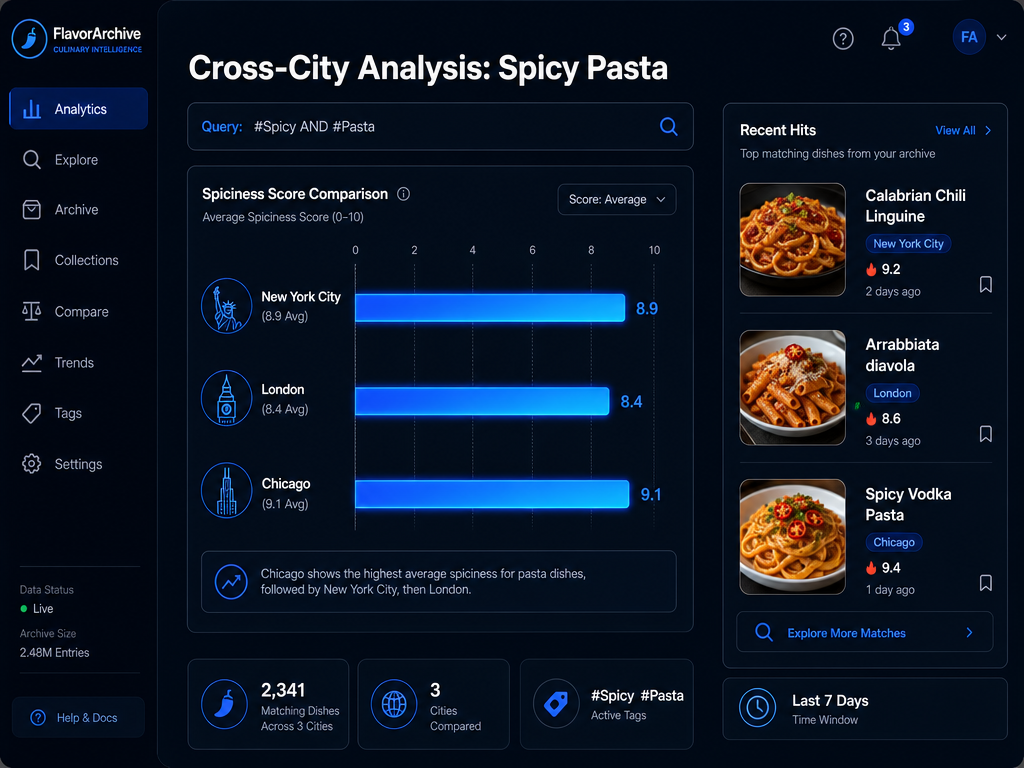
The ultimate payoff of a personal archive: instantly querying your history to compare specific dishes like 'Spicy Pasta' across multiple cities and years.
Cross-City Comparison: Finding Your Best Carbonara
Here's where the system proves its worth. You've eaten carbonara in Rome, New York, London, and Los Angeles. Which city does it best?
Without a dish-level archive, you're relying on vague memory. "I think the one in Rome was better, but I'm not sure."
With a dish-level archive, you can pull up every carbonara entry, see your ratings, read your notes, and make an informed judgment:
- Rome, Ristorante Flavio al Velavevodetto, 9/10: "Creamy without cream. Guanciale had perfect char. Pecorino was sharp, salty. This is the standard."
- New York, Torrisi Bar & Restaurant, 8/10: "Excellent, but the guanciale was a bit too crispy. Sauce was spot-on."
- London, Padella, 7/10: "Good for London, but the egg was overcooked. Sauce broke."
- Los Angeles, Osteria Mozza, 6/10: "Too heavy. They added cream. Not traditional."
The data tells a story. Rome sets the standard. New York comes close. London and LA don't understand the dish.
This is how you build taste intelligence. You're not just eating. You're refining your palate across geographies.
Learn more about tracking dishes across cities.
Data Portability: Why You Need an Exit Strategy
Let's talk about risk. You're going to invest hundreds of hours building this archive. What happens if the app you're using shuts down? What if the company pivots? What if they start charging substantially more than you're comfortable paying?
This is why data portability matters. Before you commit to any tool, check if it supports:
- CSV export: A simple spreadsheet with all your entries
- JSON export: Structured data that can be imported into other systems
- Markdown export: Plain text files you can read in any text editor
Apps that lock your data behind proprietary formats are a non-starter. You're not building a temporary log. You're building a lifelong archive. Treat it like a valuable asset, because it is.
The Long Game: Why This Matters in Five Years
Right now, you're thinking, "This sounds like a lot of work."
You're right. It is.
But here's what happens when you commit to the system:
Year 1: You log 150 dishes. It feels tedious. You question whether it's worth it.
Year 2: You log 300 more dishes. You start to see patterns. You realize you rate Japanese food higher than Italian. You discover you prefer simple, ingredient-focused dishes over complex, technique-heavy ones.
Year 3: You log 400 more dishes. You've now eaten in 35 cities. When a friend asks, "Where should I eat in Tokyo?", you pull up your archive, filter by city and rating, and send them a ranked list of your top 10 dishes. It takes 60 seconds.
Year 5: You've logged 1,200 dishes. Your archive is now your most valuable travel asset. You can plan an entire trip around the specific dishes you want to try. You can avoid the bad versions of a dish because you know what the good versions taste like. You've built a personal Michelin guide, calibrated to your taste, covering the entire world.
This is the compounding effect of a personal food archive. The effort is front-loaded. The value accrues forever.
Explore how to build your personal restaurant library.
Frequently Asked Questions
What are the best apps for foodies who want to track dishes?
The best apps for tracking dishes (not restaurants) are those that treat the dish as the primary unit. Savor is purpose-built for dish-level archiving, with features like ingredient tagging, city-based organization, and flavor profile filters. Memolli focuses on private journaling with map-centric views. For those who want total control, Notion or Obsidian allow you to build custom databases with infinite flexibility. Avoid apps that only let you rate restaurants - they're solving the wrong problem.
How do I organize my food photos so I can actually find them later?
Organizing food photos requires metadata, not just folders. The most effective system is to use a dedicated food tracking app that links each photo to structured data (dish name, restaurant, city, date, rating, tags). If you're using Apple Photos or Google Photos, create albums by city or cuisine type, then add descriptive captions to each photo. But the real solution is to move beyond the camera roll entirely and treat your photos as part of a searchable database, not a chronological gallery.
Is Beli still invite-only in 2026?
Beli's invite-only status changes frequently, and current information suggests it has opened up access in many markets. However, Beli is primarily a social ranking platform focused on comparing your restaurant ratings with friends, not a private dish archive. If you're looking for a personal memory system rather than a social competition, consider apps like Savor or Memolli instead. Beli works best for users who want the social validation layer on top of their tracking.
Can I add tags to my Google Maps lists to organize restaurants?
Google Maps allows you to create custom lists and add notes to saved places, but it doesn't support a formal tagging system for organizing by cuisine, dish type, or flavor profile. You can work around this by creating multiple lists (e.g., "Best Pizza NYC," "Spicy Dishes Tokyo"), but this approach breaks down quickly when you have hundreds of entries across dozens of cities. For serious foodies, Google Maps is better used for navigation and discovery, not for building a searchable culinary archive. Dedicated dish-tracking apps solve this problem properly.
What's the difference between tracking restaurants and tracking dishes?
Tracking restaurants gives you a venue-level rating - useful for answering "should I go here?" Tracking dishes gives you item-level intelligence - useful for answering "what should I order if I go here?" and "where can I find the best version of this dish?" A restaurant can have a 4-star rating but serve both 9-point and 5-point dishes. If you only track the restaurant, you lose the granular data that actually informs your next meal. Serious foodies track at the dish level because the dish is the atomic unit of taste memory, not the venue.
How do I take better food photos for my archive?
Better food photos for archiving (not social media) require three things: natural light, a clean angle, and focus on the dish itself. Shoot near a window if possible. Avoid using your phone's flash. Frame the dish from a 45-degree angle or straight overhead. Don't rearrange the plate - you're documenting, not styling. Take one well-lit shot, then put the phone away. The goal is a visual memory trigger, not an Instagram post. If the lighting is terrible, take the photo anyway - it's better than nothing. You're building an archive, not a portfolio.
What does Gen Z use instead of Yelp?
Gen Z leans heavily on TikTok, Instagram, and creator-driven recommendations rather than crowd-sourced review platforms like Yelp. They trust individuals with strong personal brands (food creators, local influencers) over anonymous aggregated ratings. For personal tracking, many younger foodies are adopting private dish-level tracking apps like Savor or using Instagram saved folders as informal archives. The shift reflects a broader trend: away from public reviews optimized for search engines, toward private memory systems and trusted personal networks.
Your camera roll holds thousands of food photos. Most of them are unsearchable, untagged, and destined to be forgotten. The system outlined here - treating the dish as the atomic unit, capturing structured metadata, building a searchable archive - turns those orphaned images into a permanent record of your culinary life.
The work is real. The payoff compounds. In five years, you'll have a personal Michelin guide covering every city you've visited, calibrated to your exact taste, accessible in seconds. That's worth the effort.
Start tonight. Log one dish. Just one. Then do it again tomorrow. The archive builds itself, one meal at a time.