
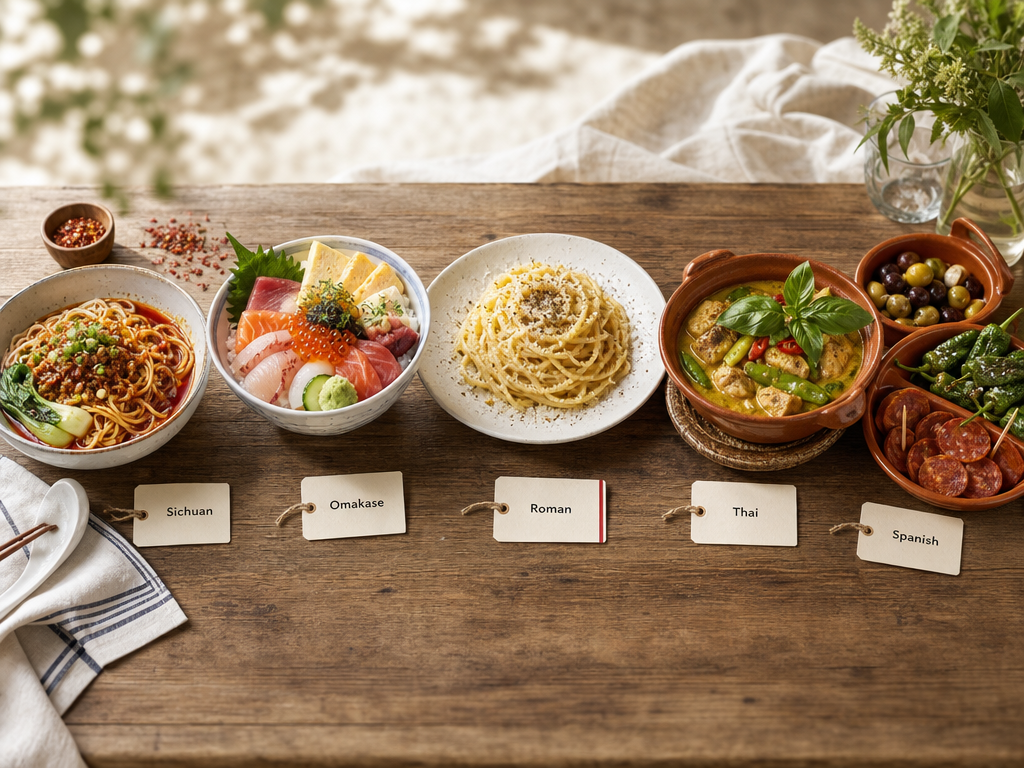
How to Track Dish Ratings by Cuisine Type: The Ultimate Foodie System
Harry the matcha king
Harry is our resident matcha obsessive. He’s tasted hundreds of bowls and tracks every cup in Savor.
How to Track Dish Ratings by Cuisine Type: The Complete System for Serious Foodies Your camera roll holds thousands of food photos, but when you try to...
How to Track Dish Ratings by Cuisine Type: The Complete System for Serious Foodies
Your camera roll holds thousands of food photos, but when you try to remember that exceptional ramen from six months ago, you're scrolling for minutes. Tracking dish ratings by cuisine type means building a searchable, personal food database that organizes meals by regional taxonomy - Italian, Sichuan, Northern Thai - so you can instantly recall the best version of any dish you've ever eaten.
This isn't about restaurant reviews or calorie counting. It's about solving "Digital Food Amnesia": the inability to find a specific dish among thousands of photos. According to research from Savor, the average user spends 3 minutes searching their camera roll for a specific food photo from 6 months ago; modern tracking apps reduce this to 3 seconds.
Table of Contents
- Why Most Food Tracking Systems Fail at Cuisine Organization
- Phase 1: The Camera Roll Clean-Up (Quick Wins)
- Phase 2: The Big Three App Ecosystems
- Phase 3: Building a Professional Taxonomy
- Phase 4: The Evaluation Protocol
- Choosing Your System: Decision Framework
- Frequently Asked Questions
Why Most Food Tracking Systems Fail at Cuisine Organization
Most restaurant apps track locations, not dishes. When you open Yelp or Google Maps, you're searching for "Italian restaurants" or "Thai food near me" - but what you actually want is to remember which specific Cacio e Pepe changed your life, or compare three versions of Pad Thai you've tried.
The taxonomy problem runs deeper than you'd think. A single "Chinese" category collapses Sichuan dry pot, Cantonese dim sum, and Taiwanese beef noodle soup into one meaningless bucket. Serious foodies take between 2,000 and 2,847 food photos per year, yet most can't find a specific dish weeks later because generic tags like "noodles" or "rice" don't capture regional nuance.
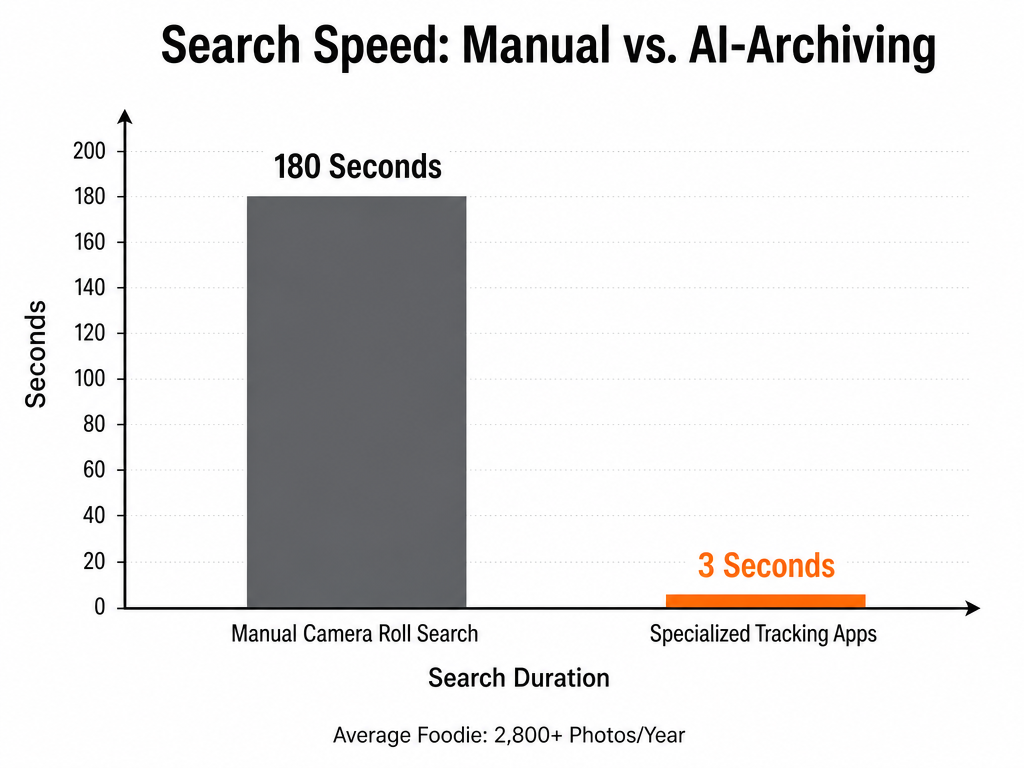 Specialized archiving tools eliminate digital food amnesia, reducing the time spent hunting through thousands of photos to just a few seconds.
Public review platforms create another distortion. When you post a photo to Instagram or leave a Yelp review, you're performing for an audience. That distorts your honesty. The truly useful system is private: a taste memoir where you can say "this was a 6/10" without social consequences.
The final problem is rating methodology. Star systems (1-5) lack granularity for serious comparison. Cultural context matters too: Japanese culture dictates a 3 out of 5 rating is "average," while American culture treats 4 out of 5 as "average." A 10-point scale provides the precision needed to sort hundreds of dishes effectively.
Phase 1: The Camera Roll Clean-Up (Quick Wins)
Before you build a permanent archive, extract value from the photos you've already taken. Modern AI search in Apple Photos and Google Photos has improved substantially, but you need to know how to use it.
Using Visual Intelligence and Ask Photos
Google Photos added a toggle for "Classic Search" alongside AI "Ask Photos" to improve identification accuracy. Instead of typing "ramen," try these specific prompts:
- "Show me ramen with soft-boiled eggs from Chicago"
- "Find all pasta dishes from August"
- "Show spicy red curry from Thai restaurants"
Apple's Visual Intelligence works similarly. Open a food photo, then tap the search icon. The AI will surface similar dishes, but its cuisine detection is often too broad. That's where the Caption Hack becomes essential.
The Caption Hack: Immediate Tagging
The moment you finish a meal, while the experience is fresh, add a caption with structured hashtags:
#Sichuan #MaPoTofu #Numbing8/10#NorthernThai #KhaoSoi #Coconut9/10#RomanPizza #Margherita #Leoparding7/10
This override defeats generic AI tags. Six months later, when you search #Sichuan, you'll surface every dish from that region you've documented. The third tag captures your immediate reaction - a provisional rating that prevents memory drift.
For a more comprehensive approach to organizing your restaurant photos, see our guide on how to master your personal restaurant library.
Phase 2: The Big Three App Ecosystems
Once you've extracted value from your camera roll, choose a specialized system. Three distinct philosophies dominate the space, each with material tradeoffs.
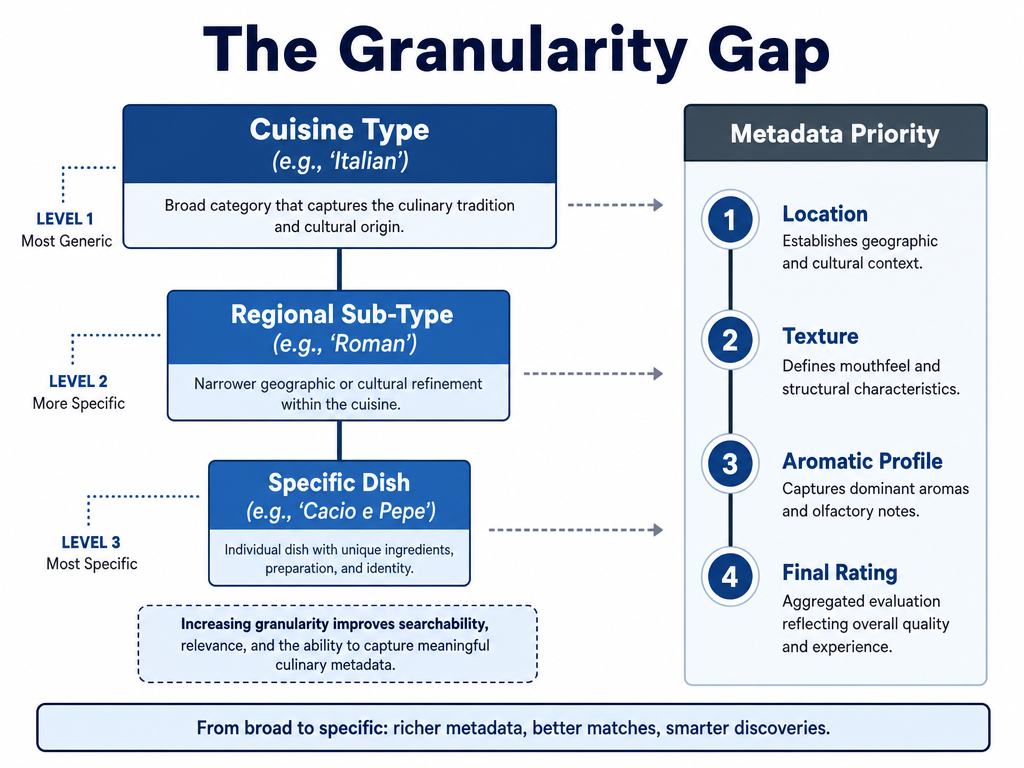 Choosing the right system depends on whether you value social ranking, private AI-driven archiving, or absolute control over your culinary database.
The Social Ranker: Beli
Beli uses ELO ranking - a chess-style comparative system where you pit dishes against each other: "Was the carbonara in Rome better than the one in New York?" It's restaurant-focused, meaning you compare venues rather than individual plates, though you can create dish-specific lists.
Best for: Competitive diners who enjoy social feeds and want to share curated lists with friends. The ranking approach works well when you have a manageable number of restaurants to compare within a single city.
Limitations: ELO ranking becomes exhausting at scale. When you've logged a substantial number of dishes, comparing each new entry against your entire archive is impractical. The social element also encourages "performative" ratings - you might inflate scores for trendy spots.
If you're exploring alternatives to Beli, our detailed comparison of the best apps to share lists for foodies covers additional options.
The Private Archivist: Savor
Savor operates at dish-level granularity. Its AI automatically detects cuisine type (Italian, Sichuan, Mexican) and suggests the dish name, which you can refine. You assign a 10-point rating immediately, then add optional tasting notes. The system is private by default - no social feed, no public performance.
Best for: Detail-oriented foodies who want absolute precision and searchability. If you need to compare multiple versions of Tonkotsu Ramen or track how a chef's signature dish has evolved across multiple visits, this architecture excels.
Limitations: Requires manual input immediately after eating. If you wait two days to log a meal, memory distortion has already begun. The 10-point scale also demands calibration - you need to decide what each rating level means consistently.
For more context on how Savor's approach differs from traditional restaurant tracking, read our analysis of the best apps to track restaurant meals.
The Total Control System: Notion or Airtable
Custom databases offer infinite flexibility. You define every field: Restaurant Name, City, Cuisine Type, Sub-Region, Dish Name, Rating (1-10), Price, Key Aromatics, Texture Notes, Would Order Again (Yes/No/Maybe).
Best for: Power users who want a permanent, exportable archive that will outlive any app. If you're documenting a lifetime of meals and need full control over your data structure, this is the only genuine solution.
Limitations: Steep learning curve and zero automation. You're manually entering every field for every dish. It's sustainable if you treat food documentation as a serious hobby; it's overwhelming if you want something quick.
For step-by-step instructions on building a custom system, see our guide to building a personal restaurant library.
Phase 3: Building a Professional Taxonomy
The difference between a casual food photo collection and a searchable archive is taxonomy: the hierarchical structure you use to categorize dishes.
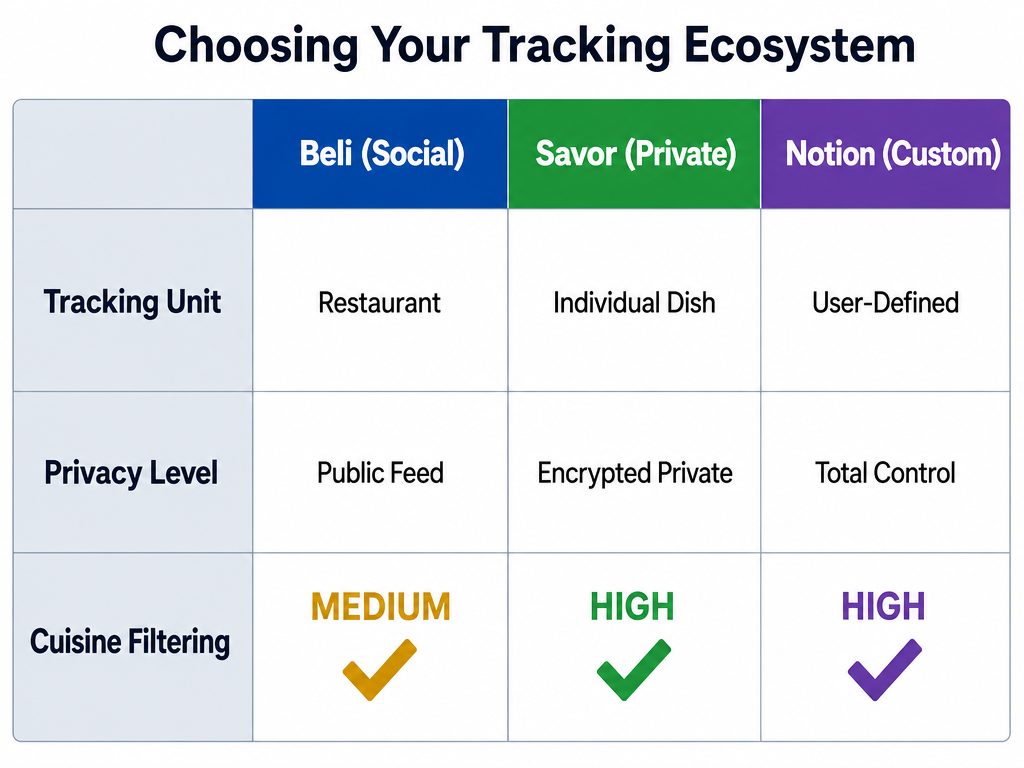 Mastering regional taxonomy ensures you can distinguish between sub-cuisines, like Roman versus Neapolitan pizza, for more accurate taste profiling.
The Serious Foodie Metadata Schema
Here's the five-level hierarchy that creates genuine searchability:
- Location (City/Country): Tokyo, Rome, Bangkok
- Cuisine (Broad Category): Japanese, Italian, Thai
- Region (Sub-Cuisine): Neapolitan, Sichuan, Northern Thai
- Dish (Specific Item): Margherita Pizza, Mapo Tofu, Khao Soi
- Rating (1-10) + Key Descriptors: 9/10 - Leoparding, Charred Crust, Buffalo Mozzarella
This structure lets you answer powerful queries six months later:
- "Show me all highly-rated Northern Thai dishes"
- "Compare every Margherita I've had in Italy"
- "What was that numbing Sichuan dish in Brooklyn?"
Why Sub-Cuisine Matters
Generic categories fail because they erase meaningful differences. "Italian" collapses Roman, Neapolitan, Tuscan, and Sicilian cuisines into one tag. Roman pizza has a thin, crispy base; Neapolitan pizza has a soft, puffy crust. Those aren't variations - they're different philosophies.
Apply this rigor everywhere:
- Not "Chinese" - specify Sichuan, Cantonese, Taiwanese, Hunanese
- Not "Mexican" - specify Oaxacan, Yucatecan, Northern, Mexico City
- Not "Indian" - specify Punjabi, Bengali, Kerala, Gujarati
If you're building this level of detail into a custom system, explore our best food software guide for platform recommendations.
Key Aromatics and Textures
Beyond region and dish name, capture the sensory details that make a meal memorable:
- Aromatics: Garlic, ginger, star anise, fish sauce, saffron
- Textures: Crispy, creamy, al dente, gelatinous, velvety
- Dominant Flavors: Umami-forward, bright acidity, numbing heat, caramelized sweetness
These descriptors turn a high rating into a usable memory. Six months later, "Excellent - Numbing heat, crispy pork, fermented black beans" helps you recall the exact dish.
Phase 4: The Evaluation Protocol
A rating system is only useful if it's consistent. Most people drift: a "great" meal in January becomes a different rating by December because standards have shifted. Here's how to prevent that.
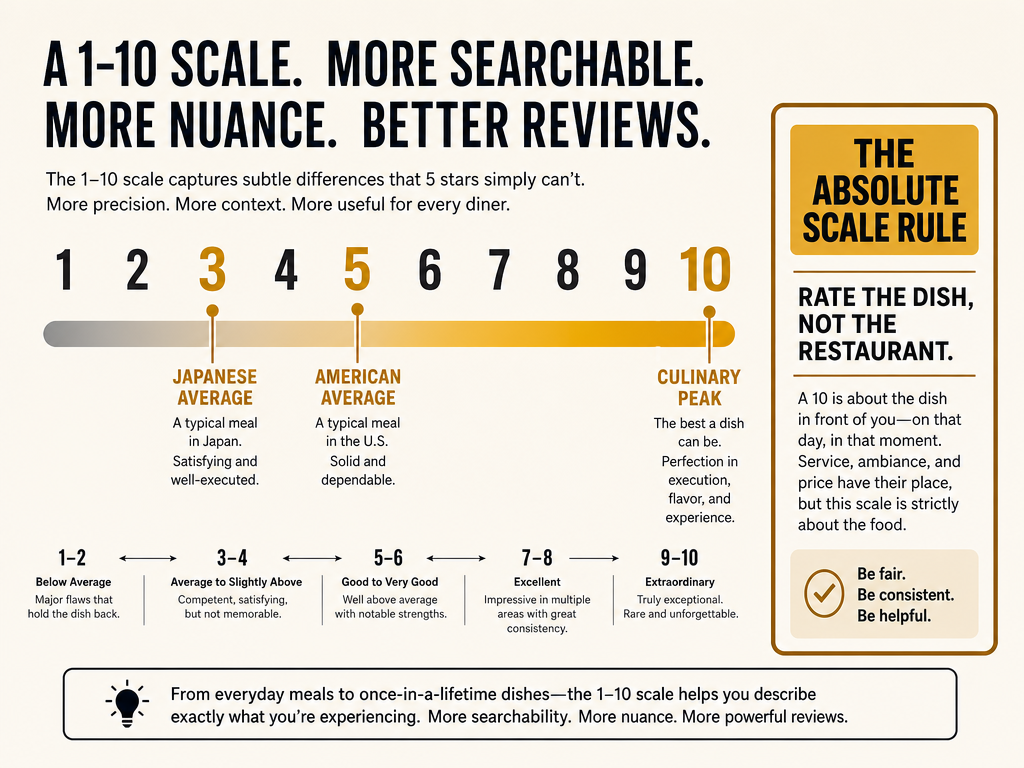 Adopting an absolute 1-10 scale provides the granularity needed to sort hundreds of dishes effectively, moving beyond the limitations of 5-star systems.
Rate the Dish, Not the Restaurant
This is the cardinal rule. An exceptional dessert doesn't make every dish at that restaurant highly rated. You're evaluating a single plate, not the entire menu. This discipline prevents halo effects and keeps your archive accurate.
The 10-Point Absolute Scale
Forget star ratings. Use a 10-point system where each number has a defined meaning. Establish clear criteria for yourself: what qualifies as life-changing versus merely excellent? What makes a dish forgettable versus poor?
Calibrate your scale by anchoring it to reference dishes. Decide: "This specific Margherita in Naples is my benchmark for exceptional pizza." Every subsequent pizza is measured against that standard.
For a deeper dive into creating consistent ratings, see our guide on how to review and track meals like a serious foodie.
Immediate vs. Delayed Ratings
Rate the dish immediately - within minutes of finishing the meal. Memory distortion begins the moment you leave the restaurant. That exceptional carbonara becomes a vague "it was good" by tomorrow.
If you're using a private system, you can also revisit ratings. After trying many bowls of ramen, you might downgrade early entries as your palate refines. That's not cheating; it's calibration.
Why Absolute Ratings Beat Relative Rankings
Some systems use relative comparison (Beli's ELO model): "Was Dish A better than Dish B?" This works for small datasets but collapses at scale. When you've logged hundreds of dishes, comparing a new bowl of ramen against your entire archive is exhausting.
Absolute ratings are searchable. You can instantly surface "all exceptional Thai dishes" or "every top-rated meal in Japan." Relative rankings don't support that query - they only tell you which dish ranks higher, not whether either is excellent.
Choosing Your System: Decision Framework
No single system is "best." The right choice depends on how you plan to use your archive.
Choose Beli if:
- You value social discovery and want to see what friends recommend
- You're comparing restaurants within a single city
- You enjoy the gamification of ranking and list-making
- You're comfortable with restaurant-level (not dish-level) tracking
Choose Savor if:
- You need dish-level precision and AI-assisted tagging
- Privacy matters - you want honest ratings without social performance
- You're willing to log meals immediately for maximum accuracy
- You plan to track many dishes over time
Explore our full comparison of the best apps to remember every dish you've eaten for additional context.
Choose Notion/Airtable if:
- You want total control over data structure and export options
- You're documenting a lifetime archive and need permanence
- You're comfortable with manual data entry for every field
- You want to track non-food metadata (wine pairings, dining companions, chef names)
Choose the Caption Hack if:
- You're not ready to commit to a specialized app
- You want immediate results with zero learning curve
- Your primary need is surfacing old photos by cuisine type
- You're okay with limited search functionality compared to a database
Frequently Asked Questions
What is the best food rating app?
There's no universal "best" - it depends on whether you prioritize social features (Beli), dish-level precision (Savor), or total control (Notion/Airtable). Beli excels for competitive social ranking of restaurants, Savor specializes in private dish archiving with AI tagging, and custom databases offer permanence. For most serious foodies tracking many dishes, a 10-point absolute rating system in a private app provides the most searchability over time.
Can I use Notion templates for free?
Yes, Notion offers a free personal plan with unlimited pages and blocks. Many food tracking templates are available for free from the Notion community, though you'll need to customize them to match your preferred taxonomy. The limitation isn't cost - it's the manual effort required to enter data for every dish.
How do I search Google Photos by description?
Open Google Photos and use the search bar at the top. Instead of generic terms like "food," try specific prompts: "ramen with soft-boiled eggs," "spicy Thai curry," or "pizza from August." Google's AI will surface relevant photos based on visual recognition and any captions you've added. For better results, immediately tag photos with structured hashtags like #Sichuan #MapoTofu right after the meal.
What is the best app for tracking restaurant food?
For dish-level tracking with cuisine filtering, Savor provides the most granular system with AI-assisted tagging and private 10-point ratings. For social discovery and restaurant-level ranking, Beli offers ELO comparison and list sharing. For absolute control and data permanence, a custom Notion or Airtable database lets you define every field. Choose based on whether you need social features, automation, or total flexibility.
Can ChatGPT make a Notion template?
Yes, ChatGPT can generate structured database schemas, including field names, data types, and relational links for a Notion food tracking system. However, you'll still need to manually build the database in Notion and enter your own data. The AI can provide a blueprint (Location, Cuisine, Dish Name, Rating, Tasting Notes), but it can't automate the documentation process itself.
The difference between a cluttered camera roll and a searchable culinary archive is structure. Track by cuisine type, rate with precision, and capture regional nuance. Your future self - scrolling through thousands of food photos - will thank you.