
How to Rate Dishes While Eating Out: A Memory-First Framework for Your Palate
Alex the juice queen
Alex hunts for the best juice bars and presses. She rates every sip and saves her favorites in Savor.
How to Rate Dishes While Eating Out: A Memory-First Framework for Building Your Personal Taste Archive You just finished an extraordinary meal. The duck confit...
How to Rate Dishes While Eating Out: A Memory-First Framework for Building Your Personal Taste Archive
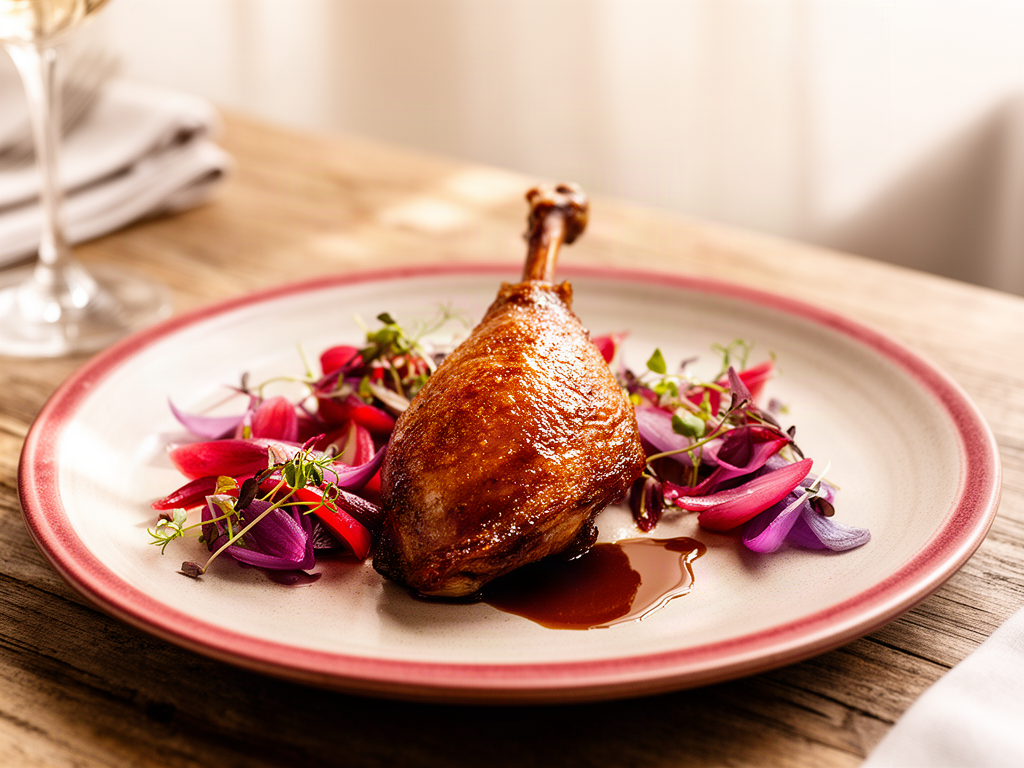
You just finished an extraordinary meal. The duck confit was perfectly rendered, the jus had this haunting depth you can't quite place, and the pickled shallots cut through the richness in a way that made you take a second bite immediately. But three months from now, you'll remember absolutely nothing about it except that you ate somewhere in that neighborhood and it was "really good."
Your camera roll holds thousands of food photos. Your brain holds vague memories. What you don't have is a system to actually remember why that dish worked, what made it special, or whether you'd order it again if you returned.
Rating dishes while eating out isn't about becoming a food critic. It's about building attention. When you know you have to rate the acidity, you taste for it more deeply. When you're tracking texture, you notice the contrast between the crispy skin and the tender meat underneath. The act of rating forces you to be present with your food in a way that Instagram stories and five-star Yelp reviews never will.
This guide presents a complete framework for rating individual dishes at restaurants, organizing those ratings into a searchable personal archive, and actually using that information to eat better meals for the rest of your life.
Table of Contents
- The Fundamental Problem: Restaurants vs. Dishes
- The Universal Dish Scorecard
- The Sensory Vocabulary Cheat Sheet
- Etiquette: The 30-Second Rule
- Digital Tool Stack for Dish Rating
- The Value Debate: Contextual vs. Absolute
- Professional Frameworks Worth Studying
- How to Give a Rating for Food
- Frequently Asked Questions
The Fundamental Problem: Restaurants vs. Dishes
Most rating systems focus on the wrong unit of measurement. Yelp wants you to rate the entire restaurant experience. Google Reviews asks for stars on everything from service to ambiance. Michelin evaluates the total package of a dining establishment.
But you don't eat restaurants. You eat dishes.
A restaurant can have an exceptional signature pasta, mediocre appetizers, and a forgettable dessert program. If you rate it 4 stars overall, you've lost all the nuance. You won't remember which specific plates were worth ordering again. You won't be able to tell a friend, "Skip the risotto, but the agnolotti is transcendent."
Dish-level rating solves this. It acknowledges that culinary memory lives in specific preparations, not vague impressions of an evening out. When you build a personal archive of rated dishes, you're creating a searchable database of your own palate evolution.
The Universal Dish Scorecard
The scoring framework below aggregates five categories into a 100-point "Master Score." You can adjust the weights based on what matters most to your palate, but this distribution represents a balanced starting point that prioritizes the fundamentals while acknowledging that presentation and value matter.
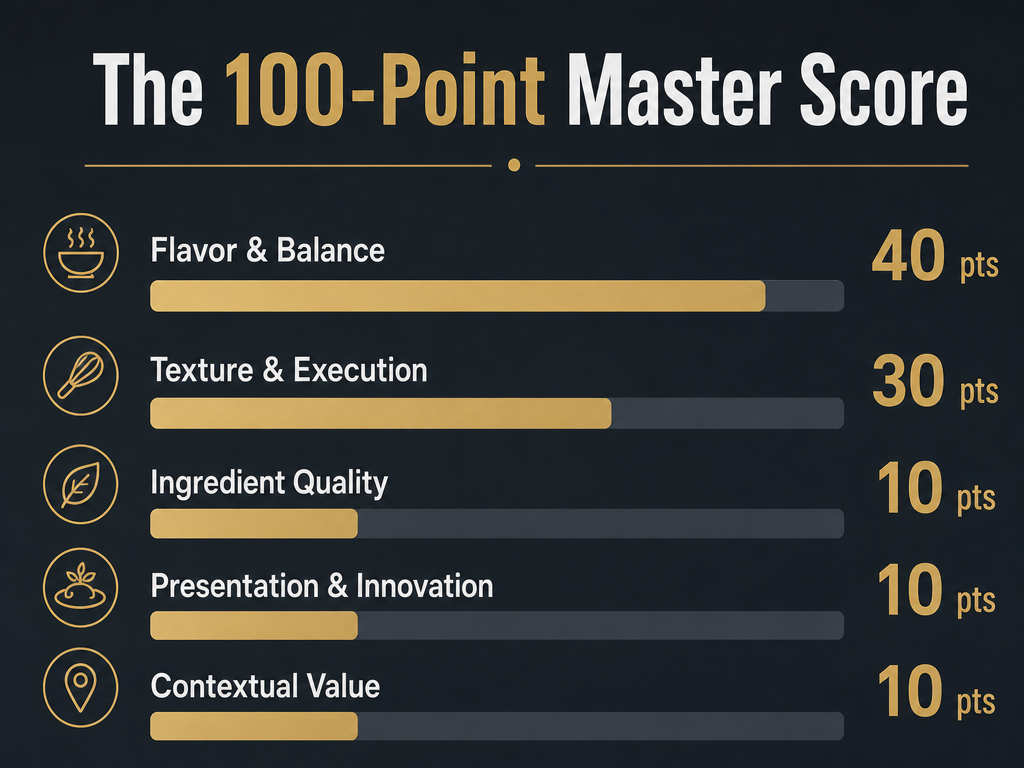 This 100-point framework prioritizes flavor and execution while acknowledging that presentation and value are essential components of a complete culinary evaluation.
Flavor & Balance (40 points)
This is the foundation. A dish can look beautiful and use expensive ingredients, but if the flavor profile is flat or unbalanced, nothing else matters.
Ask yourself:
- Is the salt level appropriate? Over-salted food is aggressive; under-salted food tastes incomplete.
- Does acid cut through richness appropriately? Fat needs brightness to avoid becoming cloying.
- Are the dominant flavors harmonious or competing? A dish can be complex without being chaotic.
- Is there a clear point of view? Great dishes have intention behind every element.
Deduct points for one-dimensional flavor (lacks depth), excessive sweetness that masks other notes, or a glaring absence of acid when the dish desperately needs it.
Texture & Execution (30 points)
Technical skill shows up in texture. A perfectly seared steak has a caramelized crust and a tender interior. Pasta should have toothsome bite, not mushiness. Vegetables retain structural integrity instead of collapsing into gray mush.
Ask yourself:
- Is there textural contrast? The best dishes often pair crispy with creamy, crunchy with soft.
- Does the cooking method suit the ingredient? Delicate fish shouldn't be bludgeoned with char.
- Are components cooked to the right degree? Overcooked protein is a technical failure regardless of how it's plated.
Professional critics use frameworks like a 20-point scale that separate technical execution from creativity, but for personal use, combining them into a "texture and execution" category captures both concerns without adding spreadsheet complexity.
Ingredient Quality (10 points)
This category acknowledges the raw materials. Is the produce seasonal and fresh? Is the protein high-quality? Can you taste the difference between mediocre tomatoes and heirloom varieties at peak ripeness?
In practice, ingredient quality often correlates with price, but not always. A neighborhood taqueria using fresh, hand-pressed tortillas and well-marbled beef can outscore a luxury steakhouse serving frozen sides and industrial produce.
Presentation & Innovation (10 points)
Yes, we eat with our eyes first. Presentation isn't about Instagram-worthy garnishes; it's about whether the plating enhances or detracts from the eating experience.
Ask yourself:
- Does the presentation telegraph what you're about to eat? Surprise is fine, but confusion is a failure.
- Is the plating practical or precious? Food that requires deconstruction at the table often loses heat and structure.
- Does the dish show creativity within its genre, or is it a rote execution of a standard template?
A perfectly composed dish earns full points here. A messy but delicious plate still deserves 5-6 points. Reserve low scores for truly dysfunctional plating or uninspired copies of other restaurants' signature dishes.
Contextual Value (10 points)
This is the most subjective category and the one that adjusts based on setting. A pasta in Midtown Manhattan exists in a different value context than a pasta in Bologna. Both can be worth it, but you're evaluating different questions.
Ask yourself:
- Would you order this dish again at this price?
- Does the quality justify the premium over comparable dishes elsewhere?
- Did the experience deliver something you couldn't easily replicate at home?
The concept of value shifts depending on the type of restaurant. Fine dining often ignores price as a scoring factor entirely, focusing purely on the plate. Casual dining makes value paramount. For your personal rating system, decide whether you're evaluating in absolute terms (is this dish worth the price to anyone?) or relative terms (is this dish worth the price to me?).
For a deeper exploration of different approaches to dish-level tracking, see our guide to the best apps to track your favorite dishes.
The Sensory Vocabulary Cheat Sheet
Generic adjectives kill culinary memory. Saying a dish was "good" or "delicious" tells you nothing three months later. Expanding your descriptive vocabulary allows you to capture the specific qualities that made a dish memorable.
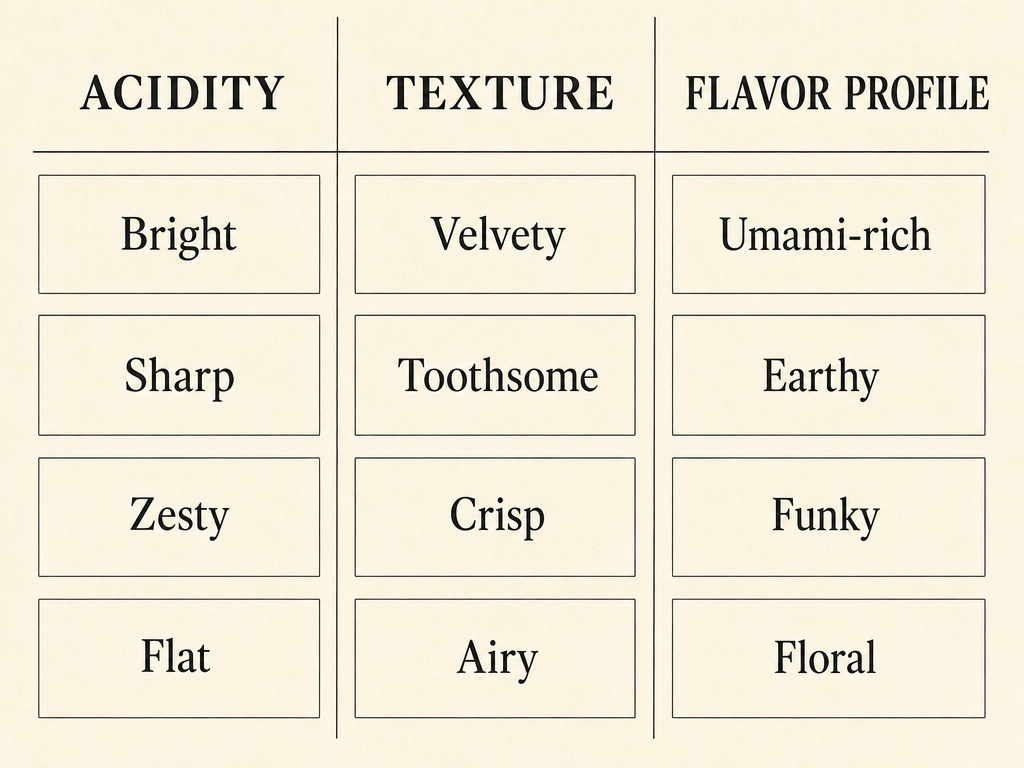 Expanding your culinary vocabulary allows you to move beyond generic descriptors and identify exactly why a dish succeeds or fails on the palate.
Acidity
- Bright: High acid that wakes up the palate (think lemon, vinegar, pickles)
- Sharp: Aggressive acidity that borders on overwhelming
- Zesty: Citrus-forward acid with aromatic oils
- Flat: Lacking acid entirely; the dish feels heavy and one-dimensional
Texture
- Velvety: Smooth, luxurious mouthfeel (think high-fat sauces, custards)
- Crisp: Snappy, clean break (properly fried foods, fresh vegetables)
- Toothsome: Pleasant resistance when bitten (al dente pasta, properly cooked grains)
- Gelatinous: Rich, sticky mouthfeel from collagen (braised meats, bone broths)
- Airy: Light, almost insubstantial (whipped mousses, properly made meringue)
- Crunchy: Audible texture with more aggressive bite than "crisp"
Flavor Profile
- Earthy: Soil-forward notes (mushrooms, root vegetables, certain cheeses)
- Funky: Fermented, pungent character (aged cheese, fish sauce, kimchi)
- Umami-rich: Savory depth that coats the palate (aged beef, Parmesan, tomatoes)
- Floral: Aromatic, perfume-like notes (saffron, rose, lavender)
- Herbaceous: Green, fresh herb-forward character (basil, cilantro, parsley)
- Smoky: Wood smoke or char notes (grilled meats, smoked paprika)
Use these terms in your rating notes. Instead of "the pork belly was amazing," write "fatty, gelatinous texture with sharp pickled mustard greens cutting through the richness." You'll thank yourself later.
Etiquette: The 30-Second Rule
Rating dishes shouldn't ruin the social experience of dining. Nobody wants to eat with someone who pulls out a notebook and starts scribbling technical analysis between courses. The 30-second rule keeps you present while capturing enough data to reconstruct the memory later.
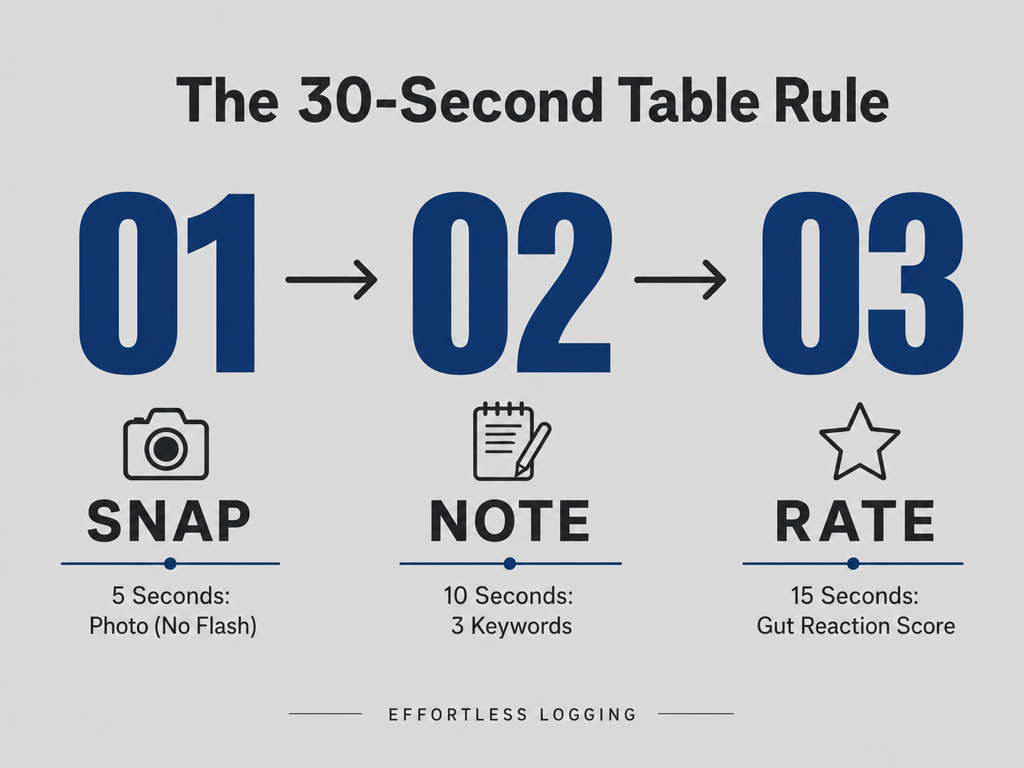 Mastering the 30-second rule ensures you capture essential data points for your personal food journal without disrupting the social flow of your meal.
Step 1: Snap (5 seconds)
Take one photo when the dish arrives. No flash. No standing up for overhead angles. No Instagram stories. A single shot that captures the plating and gives you a visual reference point.
Step 2: Note (10 seconds)
While you're tasting, mentally catalog three immediate reactions. Not complete sentences, just keywords that trigger the memory:
- Dominant flavor note (e.g., "smoke", "citrus", "funk")
- Textural standout (e.g., "crispy skin", "toothsome", "gelatinous")
- One critique or observation (e.g., "over-salted", "needs acid", "perfect temp")
Don't write these down yet. Just make a mental note and return to the conversation.
Step 3: Rate Later (Variable)
Do the full scoring framework when you're waiting for the check, in the Uber home, or in bed that night. Not at the table during the meal. The 30-second capture is enough to reconstruct the full evaluation later when you have a quiet moment to reflect.
This approach respects the social contract of dining while ensuring you don't lose the memory to vague recollection.
For additional strategies on organizing your restaurant photos and building a comprehensive dining archive, we've compiled practical frameworks that extend beyond the rating process itself.
Digital Tool Stack for Dish Rating
Your rating system only works if you can actually find the information later. Scattered notes across text messages, camera rolls, and vague memories won't cut it. You need a dedicated tool that makes dish-level tracking the default behavior.
Beli: Best for Social Foodies and Ranked Lists
Beli pioneered the dish-first approach to restaurant tracking, and the platform has reached over 100M ratings as of 2026. The app's core mechanic is simple: you photograph a dish, assign it a ranking relative to other dishes in the same category, and your personal rankings become searchable by restaurant, cuisine, or dish type.
Strengths: Network effect means you can see what your friends loved at restaurants you're considering. The ranked-list approach makes trade-offs explicit (is the carbonara at Restaurant A better than the one at Restaurant B?).
Limitations: Rankings are comparative, not absolute. You can't assign numerical scores. Privacy is limited; everything you post is visible to your network unless you adjust settings.
If you're interested in the best food review apps that prioritize dish-level tracking, we've compared the major platforms in depth.
Savor: Best for Private Dish-Level Archives
Full disclosure: this guide is published by Savor, but the tool solves the specific problem we're addressing here. Savor is designed around the premise that you want a private, searchable database of every dish you've ever eaten, organized by restaurant, cuisine type, city, and your personal rating.
Strengths: Completely private by default. Supports custom rating criteria, detailed tasting notes, and advanced filtering (show me every 9/10 pasta dish I've had in the last two years). Built specifically for the serious foodie who treats dining as a curatorial practice.
Limitations: No social features. No crowd-sourced recommendations. If you want to discover new restaurants based on what strangers think, this isn't the tool.
Learn more about how to build a personal restaurant library using tools like Savor and similar dish-tracking platforms.
Notion: Best for the Data Foodie
If you're comfortable building custom databases, Notion offers maximum flexibility. You can create a "Dishes" table with properties for cuisine type, restaurant name, city, rating, price, date visited, and freeform notes. You can then filter, sort, and view your data in infinite configurations.
Strengths: Total control over structure and display. Can integrate with other life databases (travel logs, recipe collections, wine notes). Supports rich media embedding and cross-linking.
Limitations: Requires significant upfront setup and ongoing discipline. No mobile app optimized specifically for quick dish capture at the table.
If you're exploring the best food software options for serious food curation, Notion sits at the high-complexity, high-flexibility end of the spectrum.
The Value Debate: Contextual vs. Absolute
The "Contextual Value" category in the scoring framework triggers an important philosophical question: Are you rating the dish in isolation, or are you evaluating it within its competitive and economic context?
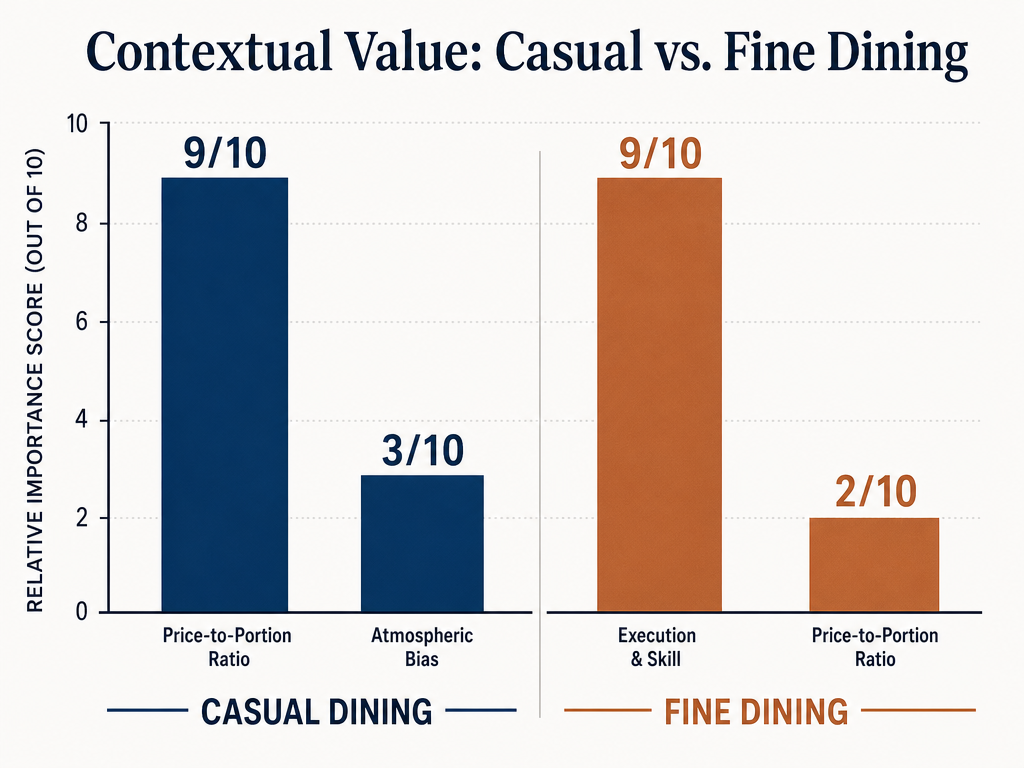 Value is subjective; this framework helps you distinguish between the raw quantity of a casual meal and the technical precision of high-end gastronomy.
The Michelin Approach: Ignore Price Entirely
Michelin inspectors famously focus only on what's on the plate. A dish is evaluated purely on ingredient quality, technical skill, and flavor harmony. Whether it costs a modest amount or commands a premium price is irrelevant to the score. This creates a "pure" evaluation of culinary merit, but it also means a perfect street taco and a perfect tasting-menu course receive identical treatment despite wildly different contexts.
The Yelp/Google Approach: Value is Paramount
Crowd-sourced reviews prioritize value because most diners are making pragmatic decisions about where to spend limited budgets. A 5-star rating on Yelp often signals "great food for the price," not "world-class cuisine regardless of cost." This makes sense for discovery and decision-making, but it compresses all dining into a single value-adjusted framework.
The Middle Ground: Contextual Value
For your personal rating system, consider evaluating dishes on both axes:
Absolute Quality (40 points for Flavor, 30 for Texture, 10 for Ingredients): How good is this dish in the context of all dishes you've ever eaten?
Contextual Value (10 points): Would you order this again at this price in this setting?
This allows you to maintain high standards for objective quality while acknowledging that an affordable bowl of ramen can deliver more personal satisfaction than a technically flawless premium tasting-menu course if the ramen hits exactly what you crave and the tasting menu feels like culinary performance art.
If you're building a comprehensive approach to how to review and track meals, understanding the value question helps you calibrate your system to match your actual dining priorities.
Professional Frameworks Worth Studying
Before you reinvent the wheel, it's worth understanding how professional critics approach dish evaluation. You don't need to adopt their systems wholesale, but they offer useful principles.
Andy Hayler's 20-Point Scale
Food critic Andy Hayler uses a detailed 20-point scoring system that separates technical execution from creativity and ingredient quality. His framework is rigorous and consistent, but it's optimized for professional restaurant criticism, not personal memory-building.
Key Principle to Steal: Separate technical skill (did they cook it properly?) from creative ambition (did they try something interesting?). A dish can be technically perfect but uninspired, or vice versa.
The "Four Pillars" Model
Borrowed from Samin Nosrat's Salt, Fat, Acid, Heat, this framework suggests that great cooking balances four fundamental elements:
- Salt: Proper seasoning enhances everything
- Fat: Carries flavor and creates mouthfeel
- Acid: Provides brightness and balance
- Heat: Transforms ingredients and builds texture
When you're evaluating a dish, ask whether these four elements are in harmony. If something tastes flat, it probably lacks salt or acid. If it feels heavy, there might be too much fat without enough brightness to cut through it.
For a more structured approach to scoring food like a critic, we've built out a complete framework based on professional methodologies adapted for personal use.
How to Give a Rating for Food
The mechanics of assigning a numerical rating can feel arbitrary at first. Here's a practical calibration guide to help you build internal consistency:
1-3 Points (Fundamentally Flawed)
Reserve these scores for dishes with glaring technical failures: burned proteins, over-salted vegetables, ingredients that are past their prime. These aren't just "not to your taste"; they're objectively broken preparations.
4-5 Points (Acceptable but Forgettable)
The dish is edible and reasonably well-executed, but there's no reason to remember it. This is the "fine, I guess" tier. Most mediocre chain restaurants live here.
6-7 Points (Good, Would Order Again)
Solid execution with no major flaws. The dish delivers on its promise and would satisfy you if you ordered it again. This is the backbone of your regular restaurant rotation.
8-9 Points (Memorable, Actively Recommend)
The dish is excellent. Technical skill is evident, flavors are harmonious, and you'll think about it days later. You'd actively recommend this to friends and return specifically to order it again. For a deeper exploration of the best dishes worth remembering, this tier represents the upper echelon of regular dining.
10 Points (Exceptional, Potentially Life-Changing)
Reserve perfect scores for dishes that genuinely expand your palate, demonstrate virtuosic technique, or deliver an emotional experience beyond the sum of their ingredients. If you're giving out 10s regularly, you're either eating at world-class restaurants exclusively or you need to recalibrate your scale.
Frequently Asked Questions
What is the 30/30/30 rule for restaurants?
Some people discuss customer response patterns in the service industry, suggesting that a portion of diners will have consistently positive reactions, another portion will have consistently negative reactions, and another group's responses are shaped by their specific experience. For dish rating purposes, this concept has limited application; your personal evaluation shouldn't assume crowd-sourced averages determine quality.
What does Gen Z use instead of Yelp?
Gen Z diners increasingly rely on visually driven platforms like Beli, TikTok, and Instagram for restaurant discovery, with Beli surpassing 100M ratings by prioritizing dish-level tracking over venue-level reviews. These platforms emphasize visual storytelling and personal curation over anonymous crowd-sourced aggregation. For more context on modern food review alternatives to Yelp, the shift is toward personal memory-building rather than public recommendation engines.
Is a 4.7 rating for a restaurant good?
A high rating on platforms like Google or Yelp generally indicates strong crowd approval, but it's a venue-level average that obscures dish-level variation. A restaurant can have a strong rating overall while serving a mix of exceptional signature dishes and mediocre sides. For your personal rating system, focus on individual plates rather than aggregated venue scores - you're building a memory archive, not validating popular opinion.
Is there a good app for rating restaurants?
Several apps excel at dish-level rating rather than venue-level reviews. Beli pioneered the ranked-list approach and has reached substantial adoption with over 100M ratings. Savor prioritizes private dish databases with advanced filtering. For a comprehensive comparison, see our guide to the best apps to track restaurant meals.
Should I rate dishes immediately after eating or wait?
Use the 30-second rule: capture basic data (photo, three-word gut reaction) within moments of tasting, then complete the full scoring framework later when you have a quiet moment to reflect. Immediate impressions capture sensory intensity, but delayed scoring allows you to evaluate whether the dish had staying power in your memory. If you can't remember any specific details an hour later, that's itself a signal about the dish's memorability.
How do I keep a food journal?
The most effective food journals prioritize consistency over perfection. Capture the essential data - dish name, restaurant, location, date, brief tasting notes, and a rating - immediately, then elaborate later if the meal warrants deeper reflection. Tools like Savor automate much of the structure, but even a simple spreadsheet works if you maintain the discipline. For more detailed guidance, see our complete resource on how to keep a food journal.
What's the best way to organize food photos?
Organize by dish rather than restaurant or date. Create a searchable system where you can filter by cuisine type, city, or personal rating. Dedicated apps like Savor handle this natively, but you can also build custom solutions using tools like Notion or Google Photos with disciplined tagging. The key is making your archive useful for answering questions like "What was that incredible pasta I had in Rome?" For more strategies, read our guide to organizing restaurant photos.
What are the five elements of flavor?
The five basic tastes your tongue perceives are sweet, salty, sour, bitter, and umami (savory). But flavor is more complex than just taste - it includes aroma, texture, temperature, and even the psychological context of eating. When rating a dish, evaluate the balance between these elements. Great dishes don't maximize every element equally; they create intentional tension and harmony based on the cuisine and preparation method.
How do I write better tasting notes?
Use specific sensory vocabulary instead of generic adjectives. Replace "delicious" with "bright acidity cutting through rich butter," or swap "amazing" for "gelatinous, yielding texture with deeply savory umami notes." The Sensory Vocabulary Cheat Sheet above provides a practical reference list. The goal is to capture enough detail that you can reconstruct the sensory experience months later when browsing your archive.
Your camera roll holds thousands of food photos. Your memory holds vague impressions. This framework bridges that gap. Start with one dish tonight. Take the photo, jot three keywords, and rate it later using the scorecard above. Do it again tomorrow. In six months, you'll have a personal database of culinary memory that transforms how you eat, travel, and experience food.
The goal isn't perfection. It's attention. When you force yourself to evaluate acid, salt, texture, and balance, you stop eating mindlessly and start building a relationship with your own palate. That relationship, more than any Michelin star or Yelp consensus, is what separates dining from simply consuming calories.
Continue Reading
Start Tracking Your Dishes Today
Transform your food photos into a searchable, ratable culinary memory bank.
Download Savor App